
Boise Kitchen Smart Tech: 6 Worth Installing (And 3 That Aren't) in a 2026 Remodel
Smart-home marketing has saturated the kitchen-appliance category. Some tech genuinely improves daily kitchen function; some is gimmick. Six categories worth installing in your Boise kitchen remodel and three to skip.
Quick answer
Maybe. Test by placing a magnet on the bottom of each pan — if the magnet sticks, the pan is induction-compatible (magnetic stainless steel or cast iron). If the magnet doesn't stick (aluminum, copper, glass, ceramic), the pan won't work on induction.
Walk through any 2026 kitchen showroom and most appliances have smart-home connectivity. Wi-Fi-enabled refrigerators, connected ranges, smartphone-controlled dishwashers, voice-activated faucets. The marketing positions all of it as essential. The reality: some smart kitchen tech delivers genuine daily-use value; some is marketing that underdelivers on actual function.
This guide is specific to Boise households. Some tech has Boise-specific advantages (Idaho Power's optional Time-of-Day rate plan, hard-water-mitigation tech) and some has Boise-specific drawbacks (rural-broadband-dependent features may not work reliably in foothills or Treasure Valley rural-edge homes). Six categories worth specifying in your remodel and three to skip — with the reasoning for each.
For broader smart-home integration across the whole house — security, HVAC, lighting, entertainment — see our smart home remodeling guide for Boise. This page focuses specifically on kitchen-appliance and kitchen-fixture smart tech with pragmatic recommendations rather than comprehensive coverage.
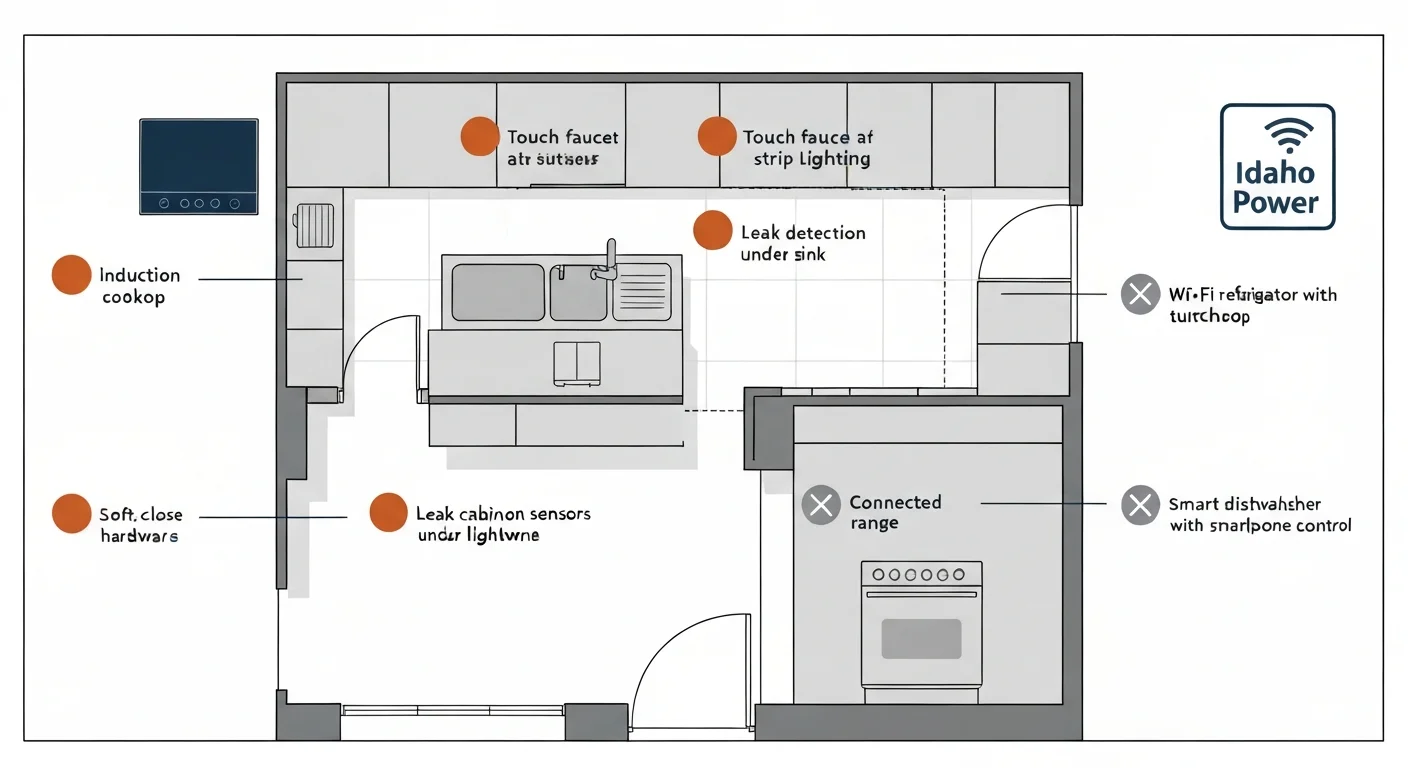
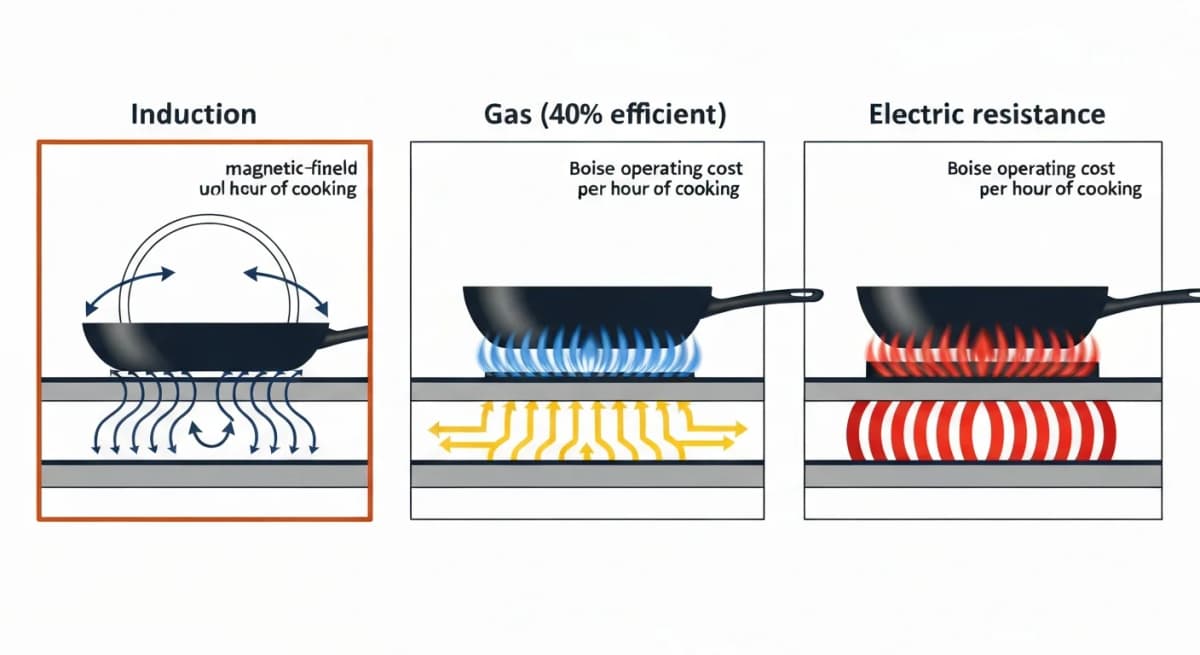
Induction cooking is the single highest-impact smart-tech upgrade in 2026 kitchen remodels. The technology uses electromagnetic induction to directly heat the pan rather than transferring heat through a flame or resistance coil.
Why induction is worth installing in Boise:
Efficiency: Induction puts a much larger share of its input energy into the pan than a gas burner does, because a gas flame heats the air and the pan bottom alike while induction excites the pan itself. Electric resistance sits between the two. We are not going to quote you efficiency percentages we can't source to a current test standard, and in any case the number that decides your bill is the price of gas against the price of electricity at your own address, which you can read off your Idaho Power and Intermountain Gas statements.
Speed: Induction brings a pot to a boil noticeably faster than either gas or electric resistance — it is the difference most people notice on day one. The actual margin depends on the cooktop's rated wattage and the pan, so compare the specific models you're considering rather than the categories.
Indoor air quality: No combustion gases in the kitchen. For Boise's air-quality-conscious households (wildfire smoke during August-September makes indoor air quality more salient), eliminating combustion is meaningful.
Safety: Cooktop surface stays cool except where directly in contact with the pan. Reduces burn risk significantly compared to gas or electric resistance. Particularly valuable for households with kids or aging residents.
Boise-specific consideration: Idaho Power's electricity rates are among the lower in the western US. The economic case for induction is stronger here than in higher-rate markets like California.
Cost: $1,800-$4,500 for a quality 30-inch induction cooktop. $3,500-$8,000 for premium 36-inch models. Compatible cookware required (magnetic stainless steel or cast iron; aluminum and copper don't work). Cookware upgrade: $300-$1,500 typical if existing cookware is non-magnetic.
The smart-tech component: most modern induction cooktops include smartphone connectivity for timer monitoring, recipe-based temperature ramping, and integration with smart-home systems. The connectivity is genuinely useful (monitor cooking time when you've stepped away from the kitchen, set timers from your phone) rather than gimmick.
Comparison to gas: many Boise homeowners specifically prefer gas cooking. For those users, induction is a meaningful behavior change rather than an upgrade. The decision rests on personal cooking style. For homeowners willing to make the transition, induction delivers genuine value. For homeowners committed to gas, smart features on gas ranges generally don't justify the premium.
All Boise kitchen remodels except those with strong personal preference for gas cooking.
Requires compatible cookware. Initial cost premium over standard electric resistance cooktops ($800-$2,000 difference).
Touch (Delta Touch2O) and touchless (Moen MotionSense, Kohler Sensate) kitchen faucets are practical smart-tech investments that meaningfully improve daily kitchen function.
Why smart faucets are worth installing in Boise:
Hands-free operation during cooking: The faucet activates by touch (any spot on the body, with hands wet or dirty) or motion (wave a hand near the sensor). Eliminates contamination of the faucet handle by raw meat, dough, or other materials during cooking.
Water conservation: Hands-free shutoff between rinses reduces water waste. For Boise's drought-conscious homeowners (see our WaterSense article), this is meaningful.
Faster cleanup: Touchless particularly speeds dishwashing — wash, rinse without touching the faucet, wash next item. Eliminates the wet-handle-to-touch-back cycle.
Lifespan: Modern touch and touchless faucets have 7-10 year operating lifespans with one or two minor service events (battery replacement, solenoid replacement). This is comparable to standard faucet lifespan, so the smart-tech doesn't shorten functional life.
Cost: $350-$700 for quality touch/touchless faucets vs. $150-$350 for comparable non-smart. The premium of $200-$350 is modest and the daily-use benefit is substantial.
Boise-specific consideration: Boise's moderately hard water (about 108 mg/L / 6 gpg on average, up to ~13 gpg in well-fed zones) affects all faucet types — see our kitchen faucet hard water article. Touch and touchless faucets are not significantly more vulnerable to hard-water issues than standard faucets. Specify Delta Touch-Clean aerator or equivalent quick-clean construction regardless of touch/touchless choice.
Battery vs hardwired: most smart faucets run on AA or AC battery packs (1-3 year battery life). Some support hardwired AC power via under-sink power supply. Hardwired eliminates battery replacement maintenance; battery operation simplifies install. For new construction, hardwired is the better choice. For retrofits, battery is more practical.
All Boise kitchen remodels. The cost-benefit is favorable across budget tiers.
Higher upfront cost than non-smart faucets. Requires occasional battery replacement (if battery-powered).
Under-cabinet LED lighting controlled by smart-home systems (Lutron Caseta, Philips Hue, smart-switch dimmers) delivers daily quality-of-life improvement that justifies the modest cost premium over standard under-cabinet lighting.
Why smart under-cabinet lighting is worth installing:
Task-appropriate brightness: Smart dimming allows bright task lighting during prep work and dimmed ambient lighting during evening relaxation. Single-fixture serves multiple needs.
Color-temperature tuning: Tunable-white LEDs (2700K-5000K range) match the lighting to the time of day or task. Cooler temperatures for detailed prep work, warmer for ambient evening use. For Boise's winter dim-daylight period, this matters more than in continuously-sunny climates.
Schedule-based automation: Lights can turn on automatically at sunset or based on motion. Convenient for households where multiple users access the kitchen at different times.
Integration with broader smart home: "Good morning" routines can include kitchen lighting; "Good night" routines can shut everything off. Genuine integration value rather than novelty.
Cost: $40-$120 per linear foot for premium LED strips ($25-$80 standard non-smart) plus $200-$500 for smart-control system. Total premium over standard under-cabinet LED: $200-$600 for a typical kitchen with 12-18 feet of under-cabinet lighting.
Specific products that work well:
Philips Hue: Mature smart-home ecosystem. Works with all major voice assistants. Good color accuracy and dimming. Premium price but solid product.
Lutron Caseta: Best-in-class smart dimmer switches that work with standard LED tape light. Pair with standard LED strips for the best of both worlds (mid-tier LED price plus premium smart control).
Wyze and similar budget options: Lower cost but less reliable. Works for casual use but expect periodic connectivity issues.
The Boise-specific angle: Boise's 9-hour winter daylight means kitchens rely heavily on artificial lighting during morning prep (before sunrise) and evening dinner (after sunset). Smart lighting that adapts to time-of-day and use-case adds meaningful daily value.
Boise kitchens with substantial under-cabinet lighting in the design, particularly homes where the kitchen is used heavily across multiple time periods.
Adds upfront cost. Some smart systems require ongoing app/firmware updates to maintain function.
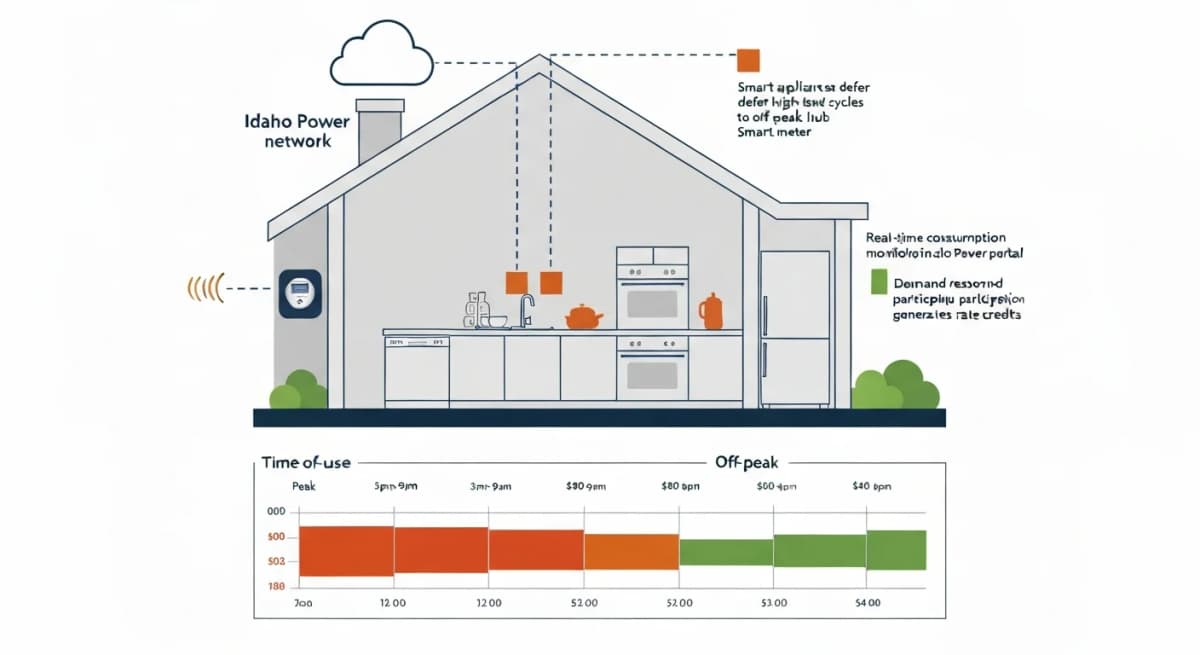
Boise homeowners have a specific opportunity through Idaho Power's smart meters and optional Time-of-Day rate plan that isn't available in all utility markets.
Idaho Power smart-meter capabilities (as of 2026):
Time-of-use rate plans (TOU): Idaho Power offers TOU rate plans where electricity costs more during peak demand periods (typically afternoon-evening summer) and less during off-peak (typically overnight). Smart kitchen appliances can defer high-load cycles to off-peak periods automatically.
Real-time consumption monitoring: Idaho Power's customer portal provides hourly consumption data via the smart meter. Smart-home integration consumes this data and helps homeowners identify cost-driving usage patterns.
Kitchen smart-tech that integrates with Idaho Power:
Smart dishwashers: Can defer wash cycles to off-peak periods; savings depend on usage and the rate differential.
Smart ovens: Can pre-heat during off-peak windows for evening cooking.
Smart refrigerators: Can shift defrost cycles to off-peak periods.
Heat pump water heaters (kitchen-adjacent): The highest-impact appliance integration and the largest load-shifting opportunity on a Time-of-Day plan. See our Idaho Power heat pump water heater article.
Cost: Smart meter is provided free by Idaho Power. Time-of-use rate enrollment is free. Smart appliances cost $200-$1,500 more than non-smart equivalents (depending on category). Smart-home integration hub costs $100-$500.
Savings depend on how much load you can shift and on the current Time-of-Day rate differential; check Idaho Power's rate pages before assuming a payback on the smart-appliance premium.
One caveat: TOU rate plans aren't always cheaper than standard residential rates for all households. Households that primarily use electricity during peak hours (typical for working-family households) may not save under TOU. Analyze your usage pattern before switching.
Boise households that can shift major electrical loads to off-peak periods (evening dishwasher cycles, overnight appliance cycles, etc.).
TOU rate plan requires behavior change to capture savings. Households unable to shift loads may not benefit.
Smart tech that earns its place in your kitchen
Pragmatic kitchen smart-tech integration is part of our standard remodel design. Schedule a consultation and we'll specify the technology that delivers daily value for your specific household — not the gimmicks that look impressive in showrooms.
Kitchen water leaks (dishwasher gasket failures, refrigerator water-line leaks, sink supply-line breaks) cause some of the most expensive residential water-damage claims. Smart leak detection plus smart shutoff valves prevent the multi-thousand-dollar damage from undetected leaks.
The technology:
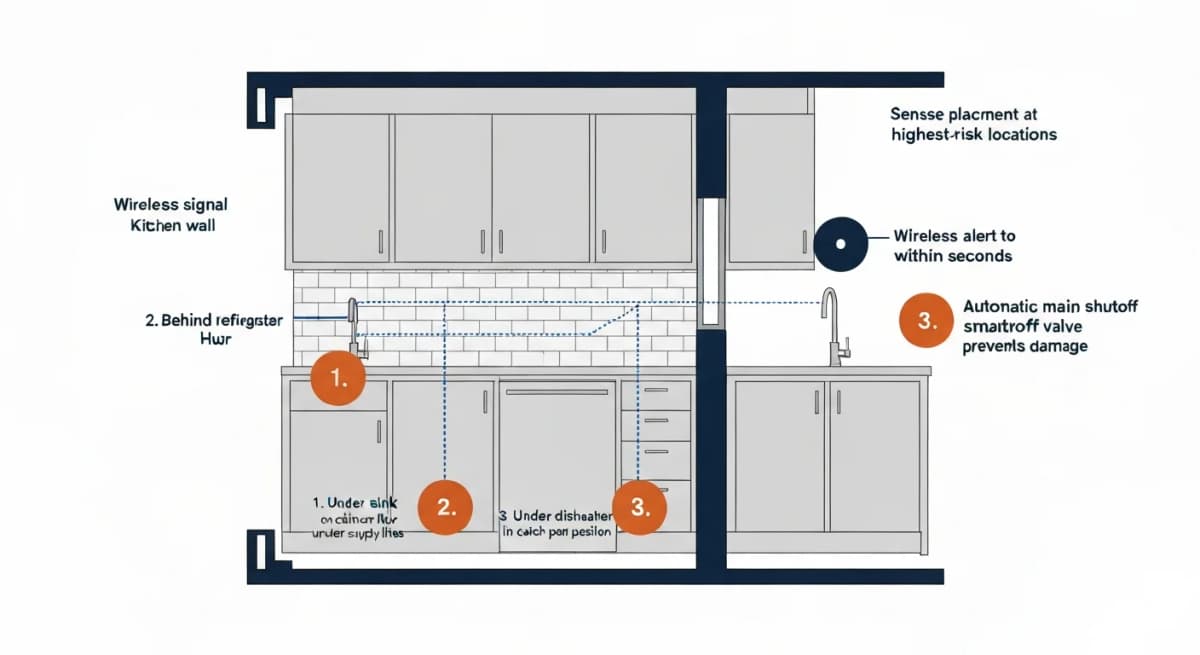
Leak detection sensors: Small battery-powered sensors placed in high-risk locations. When water contacts the sensor, it sends an alert to the smart-home hub. Cost: $25-$60 per sensor. Place 3-5 sensors in a typical kitchen (under sink, behind refrigerator, under dishwasher, near refrigerator water line).
Smart shutoff valve: Installed at the home's main water shutoff valve. When triggered (manually via smartphone or automatically via leak sensor detection), the valve closes within seconds, stopping water flow throughout the home. Cost: $400-$1,200 for the valve plus $200-$500 for plumber installation.
Integration: The leak sensors trigger the shutoff valve automatically. Homeowner gets a smartphone notification ("Leak detected under kitchen sink, water shutoff activated"). The leak source can be addressed without flooding the home.
Why it's worth the cost:
Insurance claims data: The average residential water-damage claim runs over $10,000 (Insurance Information Institute). Even partial detection (alerting the homeowner before automatic shutoff) catches many leaks in their early stages.
Boise-specific risk: Boise's hard water causes mineral deposits on supply lines and dishwasher gaskets, accelerating wear. Hard water creates more leak risk than soft-water markets. Leak detection has higher value here.
Long ownership horizons: Empty-nester and aging-in-place homeowners often live in the home for 15-30+ years. Cumulative leak risk over this period justifies the upfront investment.
Cost: $500-$1,500 total for sensors + smart shutoff valve + installation. The case for it is not a published return figure — it's that a supply line that lets go while nobody is home is one of the few failures in a house that can damage every floor beneath it, and an automatic shutoff is the only thing in the system that acts when you aren't there.
Recommended products:
Phyn Plus Smart Water Assistant: Premium tier. Includes shutoff valve and learns the home's water-usage patterns to detect anomalies.
Moen Flo: Mid-tier. Solid functionality, good app, reasonable price.
Wasserstein/Govee leak sensors: Budget tier. Just sensors, no shutoff. Better than nothing but doesn't prevent damage automatically.
Roost (smoke + leak combined sensors): Existing smoke alarm replacement that adds water leak detection. Convenient if you're replacing smoke alarms anyway.
All Boise kitchen remodels, particularly for long-term homeowners. Significant insurance-claim reduction value.
Upfront cost. Requires plumber installation for the shutoff valve component.
Soft-close cabinet hinges and drawer slides aren't traditional "smart tech" in the electronic sense — they're mechanical engineering. But they belong on this list because they deliver the same kind of daily-use upgrade as electronic smart tech, at lower cost and with higher reliability.
What soft-close hardware does:
Soft-close cabinet hinges: Hinges include a hydraulic damper that catches cabinet doors in the last few inches of closing, slowing the motion to a gentle stop. Eliminates door-slamming.
Soft-close drawer slides: Drawer slides include a damper mechanism that catches the drawer in the last 2-3 inches and pulls it gently closed.
Why it's worth installing:
Daily quality of life: Cabinets and drawers close quietly. The kitchen sounds calmer. Small but constant improvement in daily experience.
Reduces hardware wear: Slamming damages cabinet boxes and door frames over time. Soft-close eliminates this. Cabinets last longer with less repair.
Child and pet safety: Drawers and cabinet doors close gently rather than crushing fingers or paws. Particularly valuable for households with young children, grandchildren, or pets.
Modern expectation: Buyers (especially empty-nester buyers) increasingly expect soft-close hardware. Standard hardware feels dated.
Cost: $4-$15 per soft-close hinge (replacing standard hinges) and $20-$60 per drawer slide. For a typical kitchen with 15-25 cabinet doors and 8-12 drawers, total soft-close hardware cost: $300-$1,000. Already included in most semi-custom and custom cabinet brands as standard, so often $0 additional if specifying a quality cabinet line.
Why "smart" tech can't replace this: soft-close is mechanical excellence. Electronic alternatives (sensor-activated motorized cabinet doors) exist but are dramatically more expensive ($300-$1,000 per door), unreliable, and often unnecessary. Mechanical soft-close hardware is the right choice.
Every Boise kitchen remodel. There's essentially no scenario where soft-close hardware isn't worth the modest cost.
None significant. Failure mode (rare): the damper mechanism eventually wears out (15-20+ years typical) and the hinge or slide reverts to non-soft-close. Replacement is straightforward.
Three categories of smart kitchen tech consistently underdeliver on their marketing promise. Skip these in your Boise kitchen remodel and put the budget toward the items in items 1-6.
Skip: Wi-Fi enabled refrigerators with touchscreens:
Marketing promise: see what's in your fridge from your smartphone, manage shopping lists, family communication via the touchscreen, recipe display.
Reality: the connectivity features are gimmicky. Internal-camera systems work poorly (food blocks the cameras, requiring constant re-positioning). Touchscreens become outdated within 3-5 years while the fridge itself lasts 15-20 years. Manufacturer apps lose support for older models, leaving the smart features non-functional. Standard fridge functions don't need or benefit from connectivity.
Cost premium: $800-$2,500 above comparable non-smart refrigerators. Recommendation: spend the $800-$2,500 on a higher-quality non-smart refrigerator (better compressors, longer warranty, better build quality) and capture more daily-use value.
Skip: Wi-Fi connected ranges (gas or electric, but especially gas):
Marketing promise: pre-heat from your smartphone, monitor cooking remotely, receive notifications when oven temperature is reached, voice control.
Reality: pre-heating remotely saves 3-5 minutes per cooking event. Monitoring cooking remotely is a niche use case. Voice control of cooking is awkward at best. The connectivity features lose value quickly as user routines normalize.
Cost premium: $500-$1,500 above comparable non-smart ranges. Particularly questionable for gas ranges — fire-safety considerations make some smart features (remote ignition, remote pre-heat) inappropriate or restricted by code.
Recommendation: spend on cooktop quality (induction, premium gas burners, dual-fuel configurations) rather than connectivity.
Skip: Smart dishwashers with smartphone control:
Marketing promise: start the dishwasher from your smartphone, receive completion notifications, manage cycle settings remotely.
Reality: starting a dishwasher requires loading it first, which requires being in the kitchen. The remote-start feature doesn't add value. Completion notifications duplicate what the dishwasher's built-in chime already provides.
One nuance: smart dishwashers with TOU-rate-plan integration (deferring wash cycles to off-peak periods) do provide value as covered in item 4. But "smartphone control" alone, without TOU integration, doesn't justify cost premium.
Cost premium: $300-$800 above comparable non-smart dishwashers.
Recommendation: spend on dishwasher quality (better filtration, better drying systems, longer warranty, quieter operation) rather than connectivity. If TOU integration is genuinely useful for your usage pattern, spec accordingly — but most households don't actually benefit.
The underlying pattern: smart appliances often justify their premium pricing based on connectivity features that sound useful but don't deliver daily-use value. Buy quality appliances with the features you actually use, not the features that look impressive in the showroom.
Boise homeowners who want to allocate kitchen smart-tech budget toward genuinely-useful upgrades.
Forgoing some convenience features that some users may genuinely value. The recommendation is based on average-use patterns; specific households may have different priorities.
Iron Crest's kitchen smart-tech recommendations are explicitly pragmatic. We don't push connectivity features that underdeliver, and we do recommend the categories (induction, smart faucets, leak detection, Idaho Power integration) that produce daily-use value. The total smart-tech investment for a typical Boise kitchen runs $3,000-$8,000 spread across the worthwhile categories — modest relative to overall kitchen scope ($45–$70k typical) and delivering meaningful daily improvement.
For broader smart-home integration including security, HVAC, and entertainment, see our smart-home remodeling guide. For the kitchen scope itself, see our Boise kitchen remodeling page.
Will induction cooking work with my existing cookware?
Maybe. Test by placing a magnet on the bottom of each pan — if the magnet sticks, the pan is induction-compatible (magnetic stainless steel or cast iron). If the magnet doesn't stick (aluminum, copper, glass, ceramic), the pan won't work on induction. Expect to replace some of the cookware — how much depends entirely on what's in your cupboard, so run the magnet test across the whole set before you budget for it. Cost: $300-$1,500 for replacement cookware depending on how much fails the test and the quality tier you replace it with. Many homeowners use this as an opportunity to upgrade to higher-quality cookware. Some manufacturers (All-Clad, Demeyere, Made In) explicitly market induction-compatible cookware sets.
Are there Idaho Power rebates for smart appliances?
Not for appliances. Idaho Power's residential offers are the Heating and Cooling Efficiency Program, the A/C Cool Credit, and the Shade Tree Project — there is no ENERGY STAR refrigerator, dishwasher, or range rebate. Two kitchen-adjacent items do fall under the Heating and Cooling Efficiency Program: a smart thermostat and a hybrid heat pump water heater. Idaho Power does not publish the incentive amounts on that page, and the program is first-come first-served, one incentive per home, and not paid retroactively — so confirm the current offer during the design phase rather than after the equipment is bought.
What's the smart-tech upgrade I should NOT skip even if I'm budget-constrained?
Leak detection sensors. Cost: $75-$200 for 3-5 basic sensors (without the full smart shutoff valve). The downside protection (preventing $10,000+ water damage events) is dramatically higher than the upside required to justify. Even on the tightest budget, $75-$200 in basic leak sensors is the right call. Add the smart shutoff valve ($600-$1,500 additional) when budget allows.
How long do smart kitchen appliances last vs traditional appliances?
Hardware lifespan is comparable — 10-15 years for major appliances regardless of smart connectivity. The smart-tech component is where differences emerge. Manufacturer apps typically support specific appliance models for 5-8 years after the model is discontinued. After that, the smart features may stop working even though the appliance itself still functions. This is one of the strongest arguments against paying premium for smart features on appliances designed to last 15-20 years — the smart layer becomes orphaned hardware. Less of an issue for newer smart-tech categories (smart faucets, smart lighting) where the technology is more mature and standards-based.
Can I retrofit smart-tech to my existing kitchen without a remodel?
Most of the items in this guide retrofit without a full kitchen remodel: smart faucet ($350-$700 to replace existing faucet, half-day labor), under-cabinet smart lighting ($400-$1,200 for retrofit kits), leak detection sensors ($75-$500 depending on system, mostly DIY install), smart switches and dimmers ($30-$100 per location). Induction cooktop replacement requires electrical capacity assessment and possibly a panel upgrade. Smart shutoff valve requires plumber install. Total retrofit budget: $1,000-$3,500 for a comprehensive smart-kitchen upgrade without remodel scope, $300-$1,200 for the highest-value individual items (leak detection plus smart faucet).
Smart tech that earns its place in your kitchen
Pragmatic kitchen smart-tech integration is part of our standard remodel design. Schedule a consultation and we'll specify the technology that delivers daily value for your specific household — not the gimmicks that look impressive in showrooms.
These pages go deeper on the topics linked from this article. Read them before your consultation and you'll come in with sharper questions and a clearer scope.
The following government agencies, industry organizations, and official resources provide additional information relevant to your remodeling project.