
Kitchen Faucet Pull-Down Pressure in Boise: 6 Failure Patterns from Hard Water Plus the Brands That Survive
Pull-down kitchen faucets fail faster in Boise than in soft-water markets. Specific brands and constructions hold up; others don't. Six failure patterns commonly reported in hard-water markets, plus the specifications to look for when replacing a kitchen faucet.
Quick answer
For standard plastic-mesh aerators in Boise water, plan on cleaning every 3-6 months. For Touch-Clean rubber-nub aerators (Delta), cleaning every 6-12 months is usually sufficient. The cleaning process for standard aerators: unscrew the aerator, soak it in white vinegar for 30-60 minutes, scrub gently with an old toothbrush, rinse thoroughly, reinstall.
Boise's municipal water averages about 108 mg/L calcium carbonate hardness (~6 grains per gallon) and reaches ~13 gpg in well-fed zones — moderately hard on average, hard to very hard in the hardest zones. Pull-down kitchen faucets, with their flexible hose, articulated head, and multi-spray patterns, expose this hardness across many small flow channels. The result: faucet failures that can show up in 2-4 years in Boise's harder zones vs. 6-10 years in soft-water cities.
The failure modes aren't dramatic — faucets rarely just stop working. They degrade in patterns that homeowners notice gradually: spray intensity drops, the pull-down head develops a sticky retraction, one spray mode (typically the rinse spray) becomes weaker than the others, and aerators clog requiring more frequent cleaning. By the 4-5 year mark, many Boise homeowners are looking at faucet replacement that the manufacturer's "lifetime warranty" doesn't typically cover (warranties exclude mineral deposit damage).
This article maps the six most common failure patterns we see on Boise pull-down faucets and identifies the brand-specific construction features that resist these failures. Selecting the right faucet at remodel time saves $300-$800 in mid-cycle replacement costs and avoids the project-completion-feel disappointment of early faucet failure after a kitchen remodel.
For the broader Boise hard-water plumbing fixture context — including bathroom fixtures, hot water heaters, valves, and the full water-quality framework — see our Boise hard water plumbing fixtures guide. This page focuses specifically on pull-down kitchen faucet failure patterns and brand-specific construction features.
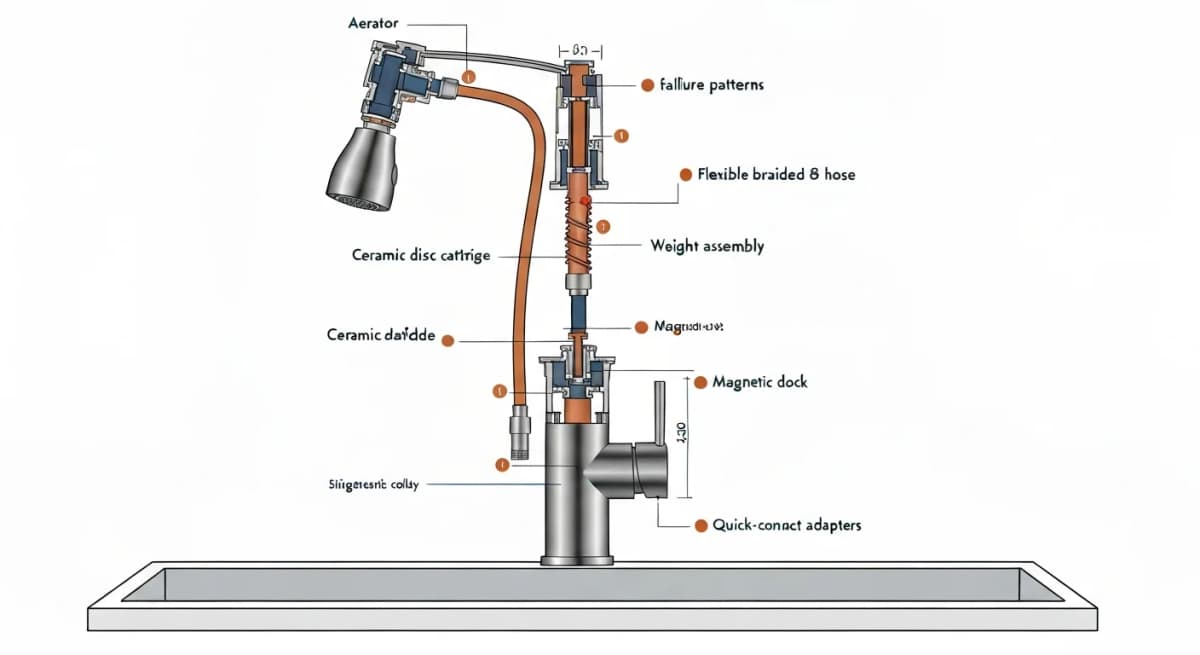
The most common pull-down faucet failure in Boise: aerator clogging. The aerator is the small mesh screen at the tip of the spray head that adds air to the water flow and shapes the stream pattern. Boise's hard water deposits calcium and magnesium scale on the aerator screen, gradually restricting flow.
Visible symptoms: weaker overall flow, uneven stream pattern, scale rings visible on aerator when the head is detached, sometimes water spraying sideways from clogged sections.
Timing: clogging becomes noticeable at 6-18 months in standard Boise installations, depending on water heater temperature (higher temps accelerate scale formation), use frequency, and aerator construction.
Standard aerator construction: Plastic mesh insert with fine holes. The holes clog easily; cleaning requires unscrewing the aerator, soaking in vinegar, and reinstalling. Lifespan in Boise water before replacement: typically 18-36 months.
Brass aerator construction: Brass mesh insert. More resistant to scale formation. Cleaning still required periodically but less frequently. Lifespan: 3-5 years.
Quick-clean rubber-nub aerator (e.g., Delta Touch-Clean): Replaces the mesh with flexible rubber nubs. Scale doesn't accumulate on rubber the way it does on mesh, and any minor accumulation can be wiped off the nubs by hand without disassembly. This is the right configuration for Boise water. Lifespan: 5-8 years before any noticeable degradation. Available on Delta and a few other brands.
Recommendation: specify Delta Touch-Clean aerators or equivalent quick-clean design for any Boise kitchen faucet selection.
All Boise kitchen faucet selections. Aerator construction is one of the easiest specifications to verify before purchase.
Limits brand selection somewhat — quick-clean aerators aren't available on every brand or line.
Pull-down faucets offer multiple spray modes — typically a stream mode (gentle, low-velocity flow), a spray mode (wide-pattern high-velocity rinse), and sometimes a pause mode (water off temporarily). The mode selector is a mechanical mechanism in the spray head that diverts water between flow channels.
Boise hard-water failure: the diversion mechanism uses small precision-machined channels that scale accumulates within. After 2-4 years of Boise installation, the spray mode selector becomes sticky, sometimes failing to switch modes reliably, and the spray pattern degrades as the diversion channels partially clog.
Visible symptoms: spray mode selector requires more force to switch, one mode no longer fully turns off when another is selected, spray pattern becomes uneven, water dribbles in unintended directions.
Standard plastic spray-mode mechanism: Most pull-down faucets in the $150-$350 range. Scale-vulnerable. Lifespan: 2-4 years before noticeable issues.
Brass internal mechanism (premium tiers): The diversion channels are brass rather than plastic. More tolerant of scale; cleanable in place.
Simpler 2-mode design (stream + spray only, no pause mode): Fewer flow channels in the diversion mechanism means less surface area for scale. Lifespan: 4-6 years.
Touch-controlled mode switching (Delta Touch2O, Moen MotionSense): The mode switching is electronic rather than mechanical. Scale doesn't affect electronic switching. Lifespan: 8-10+ years for the switching mechanism itself, though the spray channels still need normal cleaning.
Recommendation: for sustained Boise installations, prefer touch-controlled or brass-internal designs over standard plastic mechanisms. The cost premium ($75-$300) returns through extended faucet useful life.
Kitchens where the faucet is used heavily — meal prep, dish cleaning, vegetable washing. Spray mode failure becomes noticeable faster in heavy-use installations.
Touch-controlled and premium-brand options have higher upfront cost. Some homeowners prefer simpler mechanical designs even at the cost of shorter Boise-water lifespan.
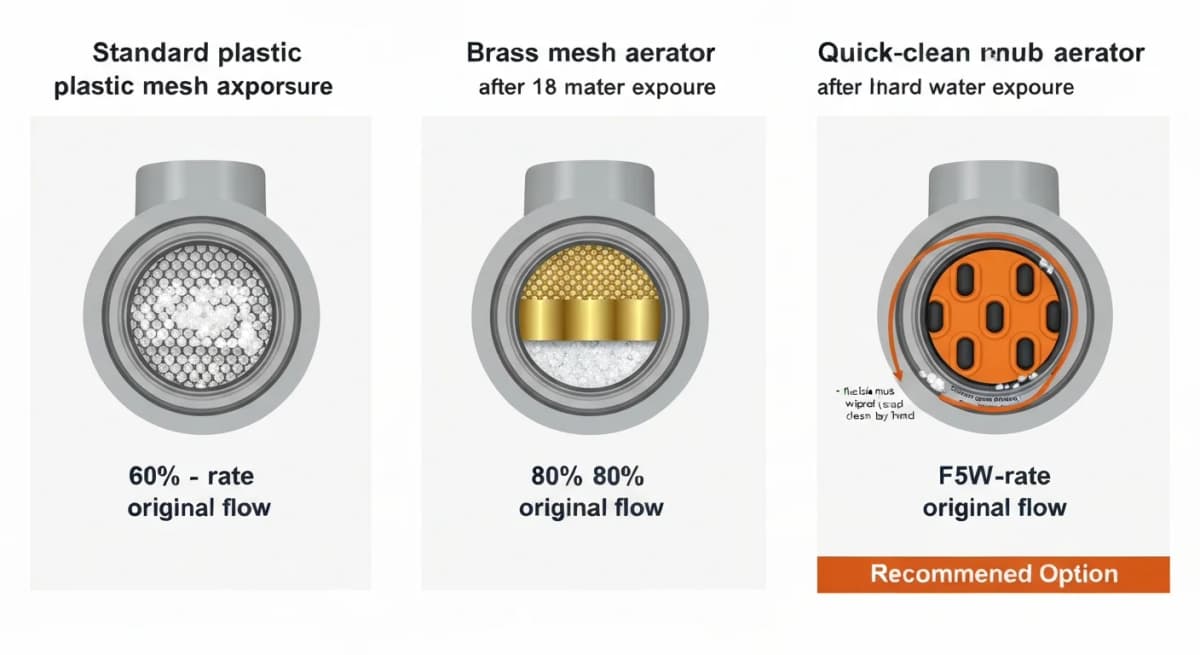
The pull-down hose retraction system uses a weight (gravity-style) or spring (mechanical-style) attached to the flexible hose under the sink. When the user releases the head, the weight or spring pulls the hose back into the faucet body.
Boise hard-water failure: the hose's flexible braided construction develops scale deposits in the inner liner over time. Scale stiffens the hose, making retraction sticky, and eventually causing the head to fail to fully retract into the dock.
Visible symptoms: head doesn't fully retract, hangs partway out of the dock, requires manual push to seat. Sometimes the hose squeaks during retraction as the stiffened liner drags through guides.
Timing: typically 3-6 years in Boise installations.
Standard plastic-braided hose (most pull-down faucets): Plastic-braided exterior with PEX or vinyl interior tube. Scale forms on the interior tube. Lifespan in Boise: 3-5 years.
PEX-A core hose: PEX-A's smoother interior surface reduces scale formation. Available on some Moen and Kohler premium lines. Lifespan: 5-7 years.
Replaceable hose assemblies: Some brands (Delta, Moen, Kohler) sell replacement hose assemblies as accessories. When a hose fails, replacing just the hose costs $25-$75 instead of replacing the entire faucet. Specify a faucet brand and line where this is supported.
Magnetic dock vs. mechanical dock: Magnetic docks (most modern pull-down faucets) hold the head in position by magnet rather than mechanical latch. Magnetic docks are more forgiving of slightly imperfect retraction — even if the hose is stiffening, the magnet still pulls the head into position. Mechanical-latch docks require more precise retraction; partial-retraction issues show up earlier.
Recommendation: specify a faucet with magnetic docking and PEX-A hose (or accept a slightly shorter hose lifespan for non-premium-tier brands and budget for replacement-hose service at 5-6 years).
Long-term kitchen installations where faucet replacement disruption is undesirable.
Premium-hose construction adds $50-$200 to faucet cost. Many budget faucets don't support replacement-hose service.
Pick a kitchen faucet that survives Boise water
Brand and construction selection at remodel time saves $300-$800 in mid-cycle faucet replacement and avoids the post-remodel disappointment of faucet failure. Schedule a consultation and we'll recommend the right faucet for your kitchen scope and budget.
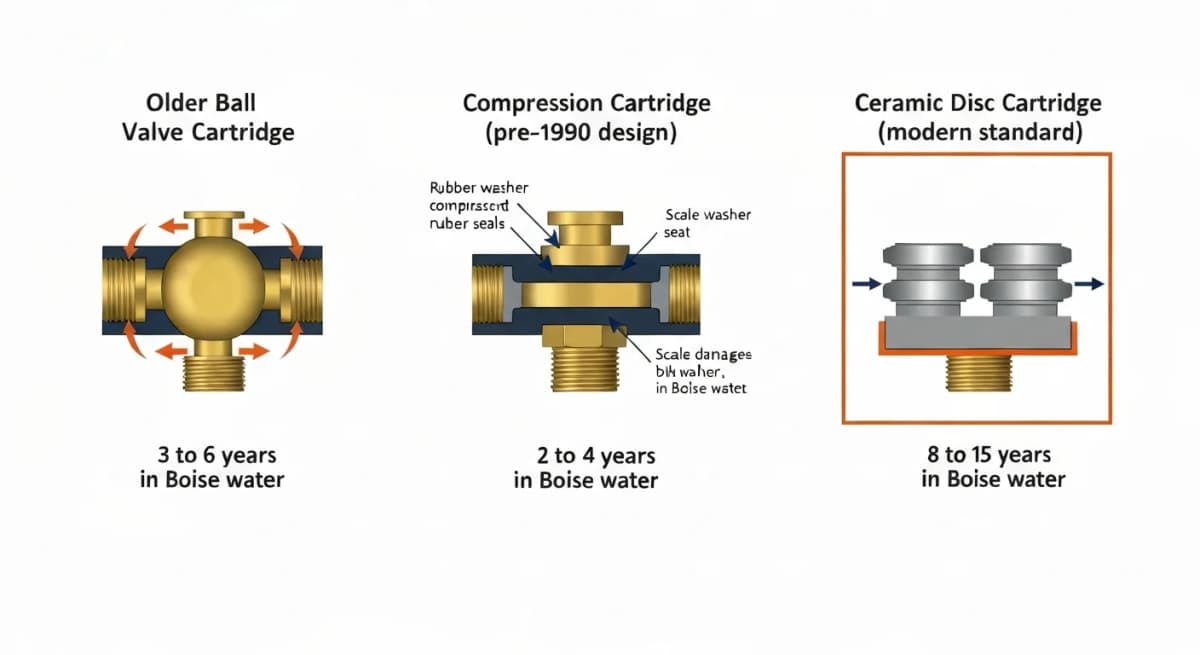
The faucet's main valve cartridge controls hot/cold mixing and on/off flow. Modern faucets almost all use ceramic disc cartridges — the industry standard for ~25 years. Older homes may have ball-valve or compression-style cartridges; both are more vulnerable to scale damage.
Boise hard-water failure: scale deposits on the cartridge's seal surfaces cause dripping (when the seals fail), stiff lever action (when scale binds the cartridge motion), or hot/cold mixing imbalance (when scale partially blocks the mixing channel).
Visible symptoms: faucet drips when fully closed, lever becomes stiff or notchy, water temperature shifts unexpectedly during use, audible hammering or whistling at certain flow rates.
Timing: ceramic disc cartridges typically last many years in Boise water with normal use; older ball-valve cartridges tend to wear out much sooner.
Ceramic disc cartridge (modern standard): Two polished ceramic discs that slide against each other to control flow. Scale-resistant; long-lived. Standard on essentially all faucets above $50. Look for Sedal or Kerox-brand ceramic cartridges (these are the OEM cartridge manufacturers; many faucet brands use them).
Ball-valve cartridge (older designs): A brass ball rotates within rubber O-ring seals. Scale damages the seals; lifespan in Boise is short. Avoid unless replacing in a faucet that's already this style.
Compression cartridge (oldest designs): Rubber washer compresses against a brass seat. Scale damages both. Typically only found on faucets installed pre-1990. Replace at first opportunity.
Modern faucet brands typically offer 5-year to lifetime warranty on the cartridge. Boise water doesn't void these warranties — but the warranty doesn't cover labor, only the cartridge replacement itself. Budget $75-$200 for plumber labor when a cartridge needs replacement (typically every 8-15 years for premium faucets, more frequently for budget options).
Any kitchen faucet selection. The cartridge spec is one of the most important quality differentiators.
Difficult to verify cartridge brand at point of purchase — usually requires reading reviews or technical specifications. Brand reputation is the practical signal.
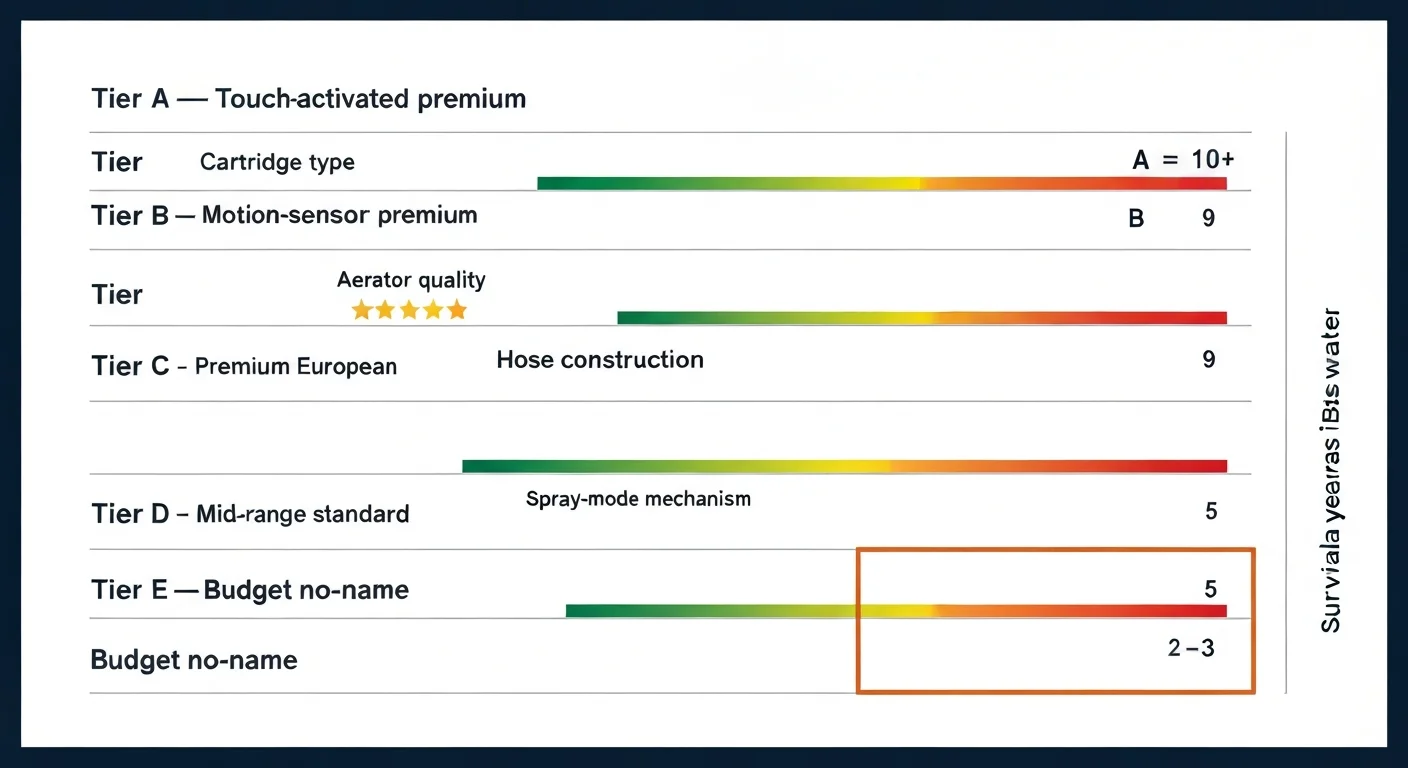
Touch (Delta Touch2O, Kohler Touchless) and motion-sensor (Moen MotionSense) faucets are increasingly popular in Boise kitchens. They eliminate the need to touch the faucet with dirty hands during cooking. Boise hard-water effect on these systems is mixed.
The touch/sensor mechanism itself is electronic and isn't directly affected by water hardness. But the solenoid valve that opens and closes the water flow IS affected — scale on the solenoid's internal channels can cause delayed response, partial-open conditions, or eventual valve failure.
Failure patterns:
Delta Touch2O (capacitive touch): The capacitive touch sensor itself is reliable. Solenoid valve has a typical lifespan of 7-12 years in Boise water. Replacement solenoid: $60-$150 plus plumber labor.
Moen MotionSense (infrared motion sensor): Infrared sensor reliability varies — some early-generation MotionSense had high failure rates, but current-generation (MotionSense Wave) is significantly improved. Lifespan: 6-10 years.
Kohler Sensate (infrared motion sensor): Comparable to current-generation MotionSense. Premium price point, comparable reliability.
Battery vs. hardwired power: Most touch and touchless faucets run on AA or AC battery packs that need replacement every 1-3 years. Some support hardwired AC power (with appropriate under-sink power supply). Battery operation simplifies install but creates ongoing maintenance — and battery failure is the most common service issue for these faucets.
Recommendation: if the household uses cooking heavily and values hands-free operation, current-generation touch and touchless faucets are reasonable choices. Specify battery-powered if undersink electrical isn't available; specify hardwired if it is. Expect 7-12 year operating life with one or two minor service events (battery replacement, solenoid replacement) over that span.
Households that cook frequently and value hands-free faucet operation.
Higher upfront cost ($350-$700 vs. $150-$350 for comparable non-touch). More service events over the faucet lifespan.
The faucet's exterior finish (chrome, brushed nickel, matte black, brushed brass, etc.) interacts with the cleaning products homeowners use to combat Boise hard-water spotting. The combination of mineral spotting on faucet surfaces plus aggressive cleaners produces faster finish degradation than either factor alone.
Common cleaning products that damage faucet finishes: vinegar (acidic, dissolves some finishes over time), Lime-A-Way and CLR (strong descaling products that strip some PVD coatings), abrasive scrubbing pads (scratch any finish).
Finish durability ranking for Boise installations:
PVD (Physical Vapor Deposition) finishes: Chrome, brushed nickel, brushed brass, matte black — all available as PVD coatings on premium faucets. PVD is essentially the most durable consumer-grade finish, very resistant to scratches, scaling, and cleaning-chemical damage. Spec PVD for any Boise installation. Available on Delta, Moen, Kohler, Hansgrohe, Brizo, and most premium brands. Cost premium over standard plating: $40-$120.
Standard electroplated finishes: The default on budget and mid-tier faucets. Reasonable durability but susceptible to chipping and scratching over time. In Boise's hard-water environment with aggressive cleaning routines, electroplated finishes show wear within 5-8 years.
Lacquered finishes: Some decorative finishes (especially polished brass and antique copper) are protected by a clear lacquer topcoat. The lacquer degrades over time (5-10 years), and the underlying finish then tarnishes. Avoid for daily-use kitchen faucets.
Matte black PVD specifically: Excellent for hiding hard-water spotting. The matte texture and dark color mask mineral deposits that would be visible on chrome or nickel. Increasingly popular in Boise kitchen remodels for this reason.
Recommendation: spec PVD finish in any color that fits the kitchen design. Matte black PVD is especially well-suited to Boise water if it fits the aesthetic. Avoid lacquered specialty finishes for daily-use applications.
Long-term kitchen installations where the faucet's appearance after 10+ years matters.
PVD premium adds $40-$120 to faucet cost. Some specialty finishes (polished copper, antiqued brass) aren't available as PVD.
Iron Crest's kitchen faucet recommendations for Boise installations are deliberately narrowed compared to the full retail catalog. For typical mid-budget kitchens ($45–$70k total scope), we recommend Delta Trinsic or Essa series with Touch2O technology, PVD finish, and Touch-Clean aerator — combined retail in the $400-$700 range. For higher-budget kitchens, we move to Hansgrohe Cento, Kohler Sensate, or Brizo. The selection reflects the construction features — ceramic-disc cartridges, PVD finishes, quick-clean aerators — that hold up best in hard water.
For homeowners with existing faucets that are within 2-3 years of installation, replacement isn't always the right call — many failure patterns are addressable through aerator replacement (cheap, simple), cartridge replacement (moderate cost, moderate complexity), or hose replacement (if the brand supports it). We can assess existing faucet condition during any kitchen consultation and recommend either repair or replacement based on the specific failure pattern. For the broader hard-water context across the whole house, see our Boise hard water plumbing fixtures guide; for full kitchen scope, see our kitchen remodeling page.
How often should I clean my Boise kitchen faucet aerator and spray head?
For standard plastic-mesh aerators in Boise water, plan on cleaning every 3-6 months. For Touch-Clean rubber-nub aerators (Delta), cleaning every 6-12 months is usually sufficient. The cleaning process for standard aerators: unscrew the aerator, soak it in white vinegar for 30-60 minutes, scrub gently with an old toothbrush, rinse thoroughly, reinstall. For spray heads with multi-mode mechanisms, similar process — disassemble where possible (most modern brands have user-serviceable spray heads), soak in vinegar, brush, rinse, reassemble. If buildup is severe, a 4-hour soak followed by gentle scrubbing usually clears even heavy deposits.
Is installing a whole-house water softener cost-effective specifically for kitchen faucet longevity?
Softener cost-effectiveness depends on multiple factors beyond just the kitchen faucet. Whole-house softeners run $1,500-$4,500 installed plus ongoing salt cost ($200-$500/year) and waste-water for regeneration. The pure kitchen-faucet benefit alone doesn't justify the softener investment — a $400 faucet replaced every 8-10 years costs less than the softener over the same period. But softeners deliver broader benefits: water heater longevity (significantly extended), dishwasher and washing machine performance, bathroom fixture lifespan, easier daily cleaning. For Boise homes with extensive plumbing fixture investments, a softener often pencils out over 10-15 years of operation. The faucet benefit is one part of a larger calculation. See our hard-water guide for the full economic analysis.
What's the difference between a kitchen faucet and a bar/prep faucet — should I have both in my kitchen?
A bar or prep faucet is a smaller secondary faucet typically installed at a secondary sink (island prep sink, bar sink, butler's pantry sink). For Boise kitchens, bar faucets follow the same hard-water failure patterns as main kitchen faucets but typically get less use, so they last longer. If you have a secondary sink in your kitchen design, a dedicated prep faucet is worth specifying for usability — but apply the same brand and construction criteria as the main faucet. Mismatched faucet quality between main and prep faucets is a common Boise kitchen issue: the main faucet gets the premium brand, the prep faucet gets a budget option, and the budget prep faucet fails first and visibly mismatches the working main faucet by year 3-4.
Why do some new Boise kitchen faucets develop sticky operation within 6 months?
Three common causes. (1) Manufacturing residue not fully flushed from the faucet at install — common in budget and mid-tier brands. Flushing the faucet for 60-90 seconds at high flow after install removes manufacturing residue and prevents this. (2) Hard-water deposit on a specific failure point that's particularly vulnerable in the specific faucet design — this is often a brand or model-specific issue best addressed by selecting different brand/model. (3) Inadequate aerator cleaning during the first cleaning event — homeowners often skip aerator cleaning until the problem is visible, by which point deposits have hardened. The fix is establishing the 3-6 month aerator cleaning routine from install rather than waiting for visible problems.
Should I buy my kitchen faucet through my contractor or buy it myself and have it installed?
Generally cheaper to have your contractor source it, especially for premium brands. Contractors generally buy fixtures at a trade price rather than retail, and often pass some or all of that through — ask your contractor what their pricing looks like on the specific brand instead of assuming a fixed discount. Plus the contractor takes warranty responsibility — if a faucet they sourced fails within warranty, they handle the replacement; if you sourced it, you handle it. The exception: very specific fixture preferences (specific finish, specific designer brand not normally stocked) where direct retail purchase makes sense. Iron Crest is happy to coordinate either approach — contractor-sourced or owner-sourced — but we recommend contractor-sourced for most projects because it simplifies the install and warranty experience.
Pick a kitchen faucet that survives Boise water
Brand and construction selection at remodel time saves $300-$800 in mid-cycle faucet replacement and avoids the post-remodel disappointment of faucet failure. Schedule a consultation and we'll recommend the right faucet for your kitchen scope and budget.
These pages go deeper on the topics linked from this article. Read them before your consultation and you'll come in with sharper questions and a clearer scope.
The following government agencies, industry organizations, and official resources provide additional information relevant to your remodeling project.