
Airbnb Kitchen Speed Layout for Boise STR Operators: 7 Design Decisions That Cut Cleaning Time Per Turnover
Boise's short-term rental market keeps cleaners running tight turnovers. Kitchen design that ignores cleaning velocity costs operators 30-60 minutes per guest cycle — at $35-$55 per hour for cleaning labor across a year of turnovers, that's roughly $900–$1,650 of avoidable cost per unit per year, or $9,000–$24,750 over the kitchen's 10–15 year life.
Quick answer
Boise STR kitchen remodels typically run $25,000-$55,000 for full-scope work — vs. $45,000–$70,000 for comparable owner-occupied work. The lower budget reflects mid-tier rather than premium material selections, simpler layouts (no custom millwork, no extensive specialty appliances), and the absence of luxury aesthetic upgrades that drive owner-occupied costs higher.
The economic model of a Boise short-term rental kitchen is fundamentally different from an owner-occupied kitchen. Owner-occupied kitchens optimize for daily cooking ergonomics, family flow, and aesthetic preference. STR kitchens optimize for one thing: turnover speed. Every minute the cleaner spends in the kitchen is a minute that compounds against operating margin and limits same-day check-in flexibility.
The Boise STR market specifically — operators in North End, Hyde Park, downtown corridor, Bench, and Boise River-adjacent areas — runs 4-7 day average stays with cleaners targeting 90-minute total turnover windows. The kitchen is routinely the slowest room in that window, because it is the one with the most surfaces, the most small items to reset, and the most places a previous guest can leave something. Twenty minutes off the kitchen is twenty minutes off the turnover — which is the difference between accepting a same-day check-in and refusing it. We have no sourced figure for what that is worth per unit per year, and it will depend on your nightly rate and how often the same-day booking actually appears.
This article covers seven design decisions specific to STR kitchen design that reduce per-turnover cleaning time. Each is a tradeoff against owner-occupied design priorities (aesthetic preference, cooking ergonomics) in favor of operational efficiency. For pure investor-owned rental properties, the tradeoff is almost always worth making.
For the broader rental-property remodel framework — distinguishing long-term rental from short-term rental design priorities, capital budget allocation, and material durability under high-turnover use — see our rental property remodel guide for Boise. This page focuses specifically on STR kitchen design and the turnover-velocity optimization that distinguishes it from long-term rental kitchen design.
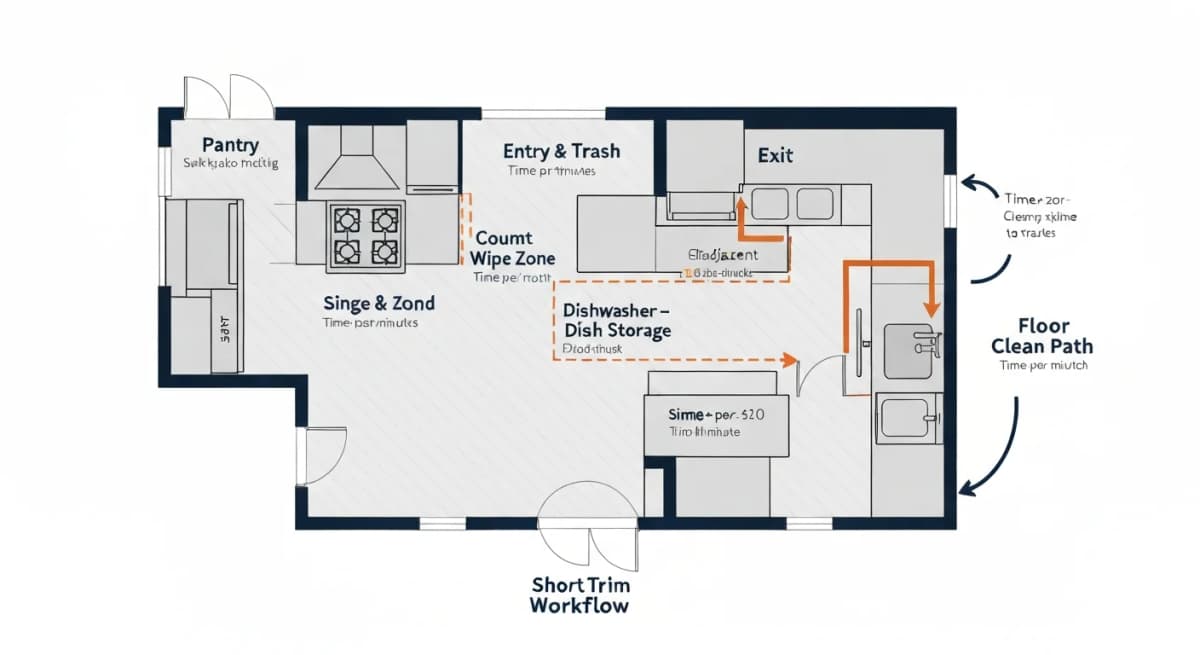
The economic case for STR-optimized kitchen design rests on a specific calculation. Walk through the math:
Average Boise STR cleaning rate: $35-$55 per hour for professional cleaners (2026 market rate). Most operators pay flat per-turnover rates ($75-$125 typical) that translate to roughly $45/hour at standard pace.
Average kitchen cleaning time in a typical Boise STR: 40-50 minutes per turnover. Includes counter sanitization, appliance cleaning (exterior plus inside microwave and visible interior of fridge), dishwasher loading/unloading or hand-wash cycle, floor cleaning, range stovetop and hood, sink scrubbing, trash and recycling.
Average annual turnovers per Boise STR unit: 60-110 turnovers (depending on occupancy and average stay length).
Annual kitchen cleaning cost per unit: 60-110 turnovers × 45 minutes × $45/hour ÷ 60 = $2,025-$3,712 per unit per year for kitchen cleaning labor alone.
STR-optimized kitchen reduction: The seven design decisions in this article collectively reduce kitchen cleaning time from 45 minutes to 25 minutes — a 20-minute reduction per turnover.
Annual savings: 60-110 turnovers × 20 minutes × $45/hour ÷ 60 = $900-$1,650 per unit per year. Over the kitchen's 10-15 year usable life: $9,000-$24,750 per unit.
Plus the indirect benefits: tighter turnover windows enable same-day check-in offerings, reduced cleaner burnout (Boise's STR cleaner labor pool is tight; well-designed kitchens retain cleaners better), and reduced damage from cleaner-rushed work.
The cost premium for STR-optimized design: $1,500-$4,500 above standard residential kitchen scope. Payback period: 18-36 months. After that, all savings are pure margin.
Investor-owned STR units where the economic optimization is clear and aesthetic preferences are secondary.
Some STR-optimized design choices look less custom or less premium to guests — visible in listing photos. The actual impact on bookings tends to be small but measurable.
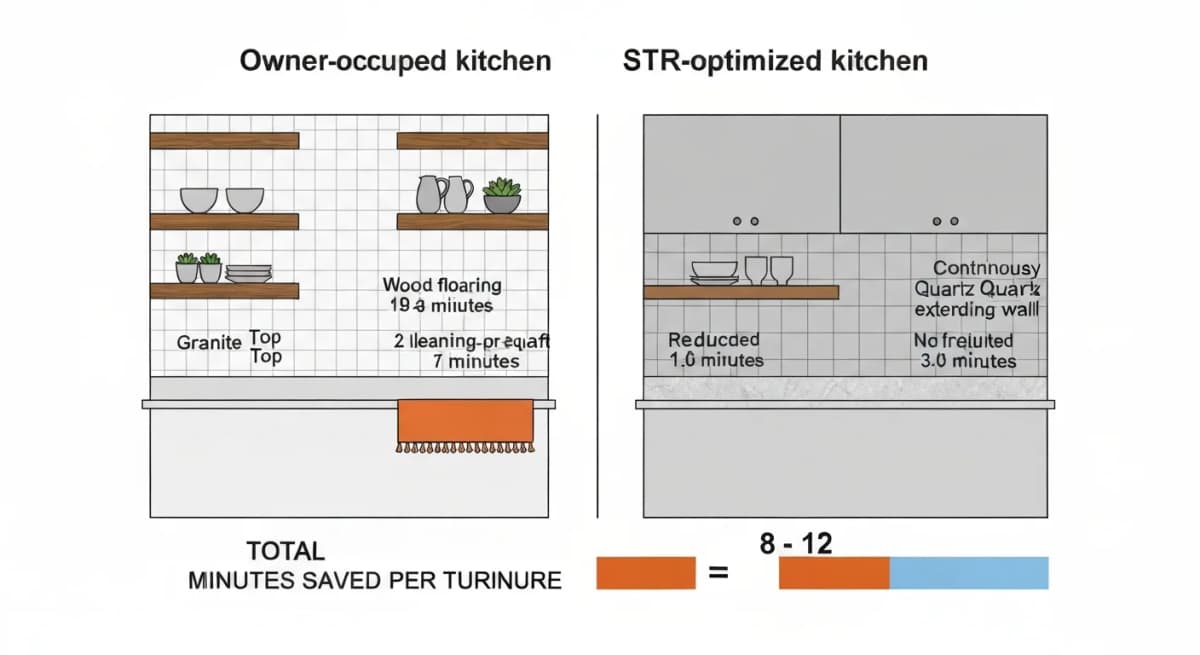
The single largest driver of kitchen cleaning time is the ratio of hard, easily-wiped surfaces to mixed-material surfaces. Mixed materials slow cleaners because each transition requires different cleaning products, techniques, or extra care.
STR-optimized hard-surface targets:
Continuous countertop run: Quartz or solid-surface counter with a back-splash of the same material running 4-6 inches up the wall. Eliminates the counter-to-grout transition that consumes cleaning time. Cost: same as separate counter + tile backsplash, sometimes slightly less due to single fabrication.
Hard-surface backsplash above counter-mounted splash: If a taller backsplash is desired (to the upper cabinets), a single large-format porcelain panel or a single quartz slab — not subway tile with grout lines. Grout lines hold cooking residue and require labor to clean; a single panel wipes in one pass.
Hard-surface flooring: Luxury vinyl plank (LVP), porcelain tile with large-format grout-minimal layout, or sealed concrete. Avoid wood flooring (high-maintenance, susceptible to water damage from guest spills) and small-format tile with extensive grout. Cleaner can mop in 3-4 minutes vs. 8-12 minutes for high-maintenance flooring.
Eliminate open shelving and floating shelves: Open shelves accumulate dust that requires regular wiping, and items on them require individual handling during turnover cleaning. Replace with enclosed cabinets — visually less interesting but operationally much faster.
Eliminate fabric elements: No fabric runners, no fabric chair cushions in kitchen dining areas, no upholstered window seats. Each requires laundering or spot-cleaning that adds time. Replace with vinyl, leather, or hard chairs that wipe.
The cumulative cleaning-time reduction from full hard-surface ratio: 8-12 minutes per turnover. This is the single highest-impact category in the article.
STR units where aesthetic distinctiveness is less critical than operational efficiency.
The kitchen reads as 'utilitarian' or 'commercial' rather than 'designer.' Some target guest demographics (urban-professional, design-conscious) may prefer more mixed-material kitchens.
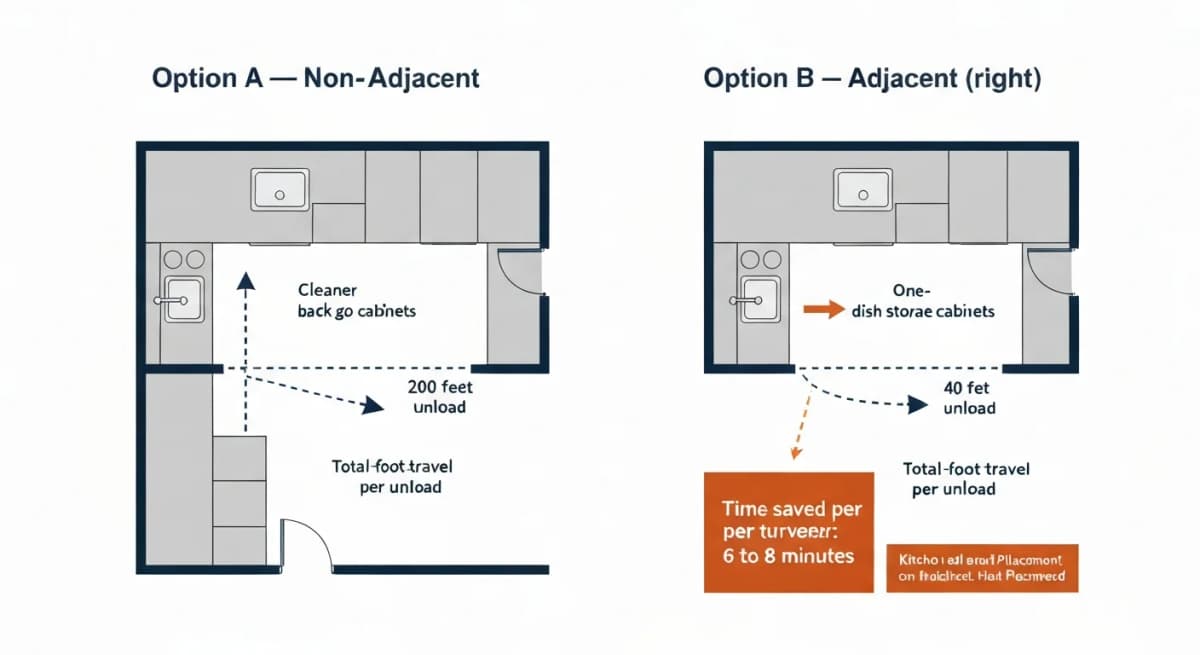
The dishwasher's position relative to dish-storage cabinets is one of the most overlooked design decisions in STR kitchens. The wrong placement multiplies cleaner foot-travel during dishwasher-unload.
Two configurations to compare:
Wrong: Dishwasher under the sink (typical placement in older Boise rentals), dish-storage cabinets 8-12 feet away on the opposite wall. The cleaner unloading the dishwasher walks back and forth between dishwasher and cabinets, carrying clean dishes a few at a time. Total foot-travel per unload cycle: 150-250 feet. Time: 12-15 minutes.
Right: Dishwasher directly adjacent to dish-storage cabinets (within 36 inches), positioned so the open dishwasher door doesn't block access to the cabinets. The cleaner unloads dishes from dishwasher to adjacent cabinet in single-arm motion without stepping. Total foot-travel: under 50 feet. Time: 5-7 minutes.
The cleaning-time reduction from correct dishwasher adjacency: 6-8 minutes per turnover. Over 80 turnovers per year, that's 8-11 hours of recovered cleaner time.
The placement decision should be made during cabinet layout planning, before cabinets are ordered. Specifying the right dishwasher position requires that the design include adjacent upper and lower cabinets for dish storage — typically the cabinet directly above the dishwasher (uppers for plates, glasses, mugs) and the cabinet directly to one side (drawer for utensils and serving tools).
One additional consideration: dishwasher quality affects turnover time. Cheap dishwashers with long cycle times (90+ minutes) limit turnover throughput; mid-range dishwashers with 50-70 minute "quick wash" cycles fit the typical 90-minute turnover window. Spec for a Bosch 800-series or equivalent with quick-wash capability. Cost: $1,100-$1,800 vs. $400-$700 for budget options. Payback: significant time savings per turnover and longer dishwasher lifespan under high-cycle use.
All STR kitchens, including those with limited layout flexibility. The adjacency is achievable in most kitchen footprints.
May conflict with sink placement if the sink also wants the prime location. The dishwasher adjacency usually wins on STR optimization grounds.
Owner-occupied kitchens accumulate utensils, cookware, dishes, and gadgets over years. STR kitchens should run a strictly curated single-set inventory: one of each item, no more.
The STR-optimized inventory:
One full set of dishes for the maximum guest count. For a 6-guest unit, 6 plates, 6 bowls, 6 glasses, 6 wine glasses, 6 mugs. Plus 2-3 of each as backup for breakage. No mismatched extras.
One set of cookware: Two sizes of pans (8" and 12"), one medium and one large pot, one baking sheet, one glass casserole dish. Skip the redundant items most kitchens accumulate.
One set of utensils: Six dinner forks, six dinner knives, six soup spoons, six teaspoons. Plus serving spoons, spatulas, tongs, can opener, bottle opener — one of each.
One coffee maker (with backup option offered: French press or pour-over, no third or fourth coffee-making device).
No specialty appliances: Skip the rice cooker, slow cooker, air fryer, bread machine, panini press, food processor. Each is a piece of equipment that gets used by maybe 1 in 30 guests, requires storage space, gets dirty in unexpected ways, and adds cleaning complexity.
The single-set discipline serves three purposes for STR operators:
(1) Cleaning time: cleaners count out what should be there and replace what's missing. With single-set inventory, the count is fast and any missing item is obvious. Mixed inventories require subjective judgment about whether things are missing.
(2) Storage simplicity: every cabinet has a designated single-set inventory. Cleaners restocking after dishwasher unload return each item to its designated place quickly. No "where does this go?" decisions.
(3) Guest experience: guests find what they need quickly because the inventory is minimal and visible. Over-stocked kitchens often have guests rummaging through cabinets and leaving them in worse order — increasing cleaning time on subsequent turnovers.
The single-set discipline saves 3-5 minutes per turnover and reduces inventory replacement cost over time.
All STR units. The discipline can be retrofitted to existing kitchens without remodeling — just inventory pruning.
Guests with specific cooking needs (rice-eating households without a rice cooker) may feel limited. Most guests accept the constraint as part of STR norms.
Build an STR kitchen that pays you back per turnover
STR kitchen design that prioritizes cleaning velocity over aesthetic showmanship returns $900-$1,650 in cleaning labor savings per unit per year. Schedule a consultation and we'll map your kitchen to your operator's actual turnover workflow.
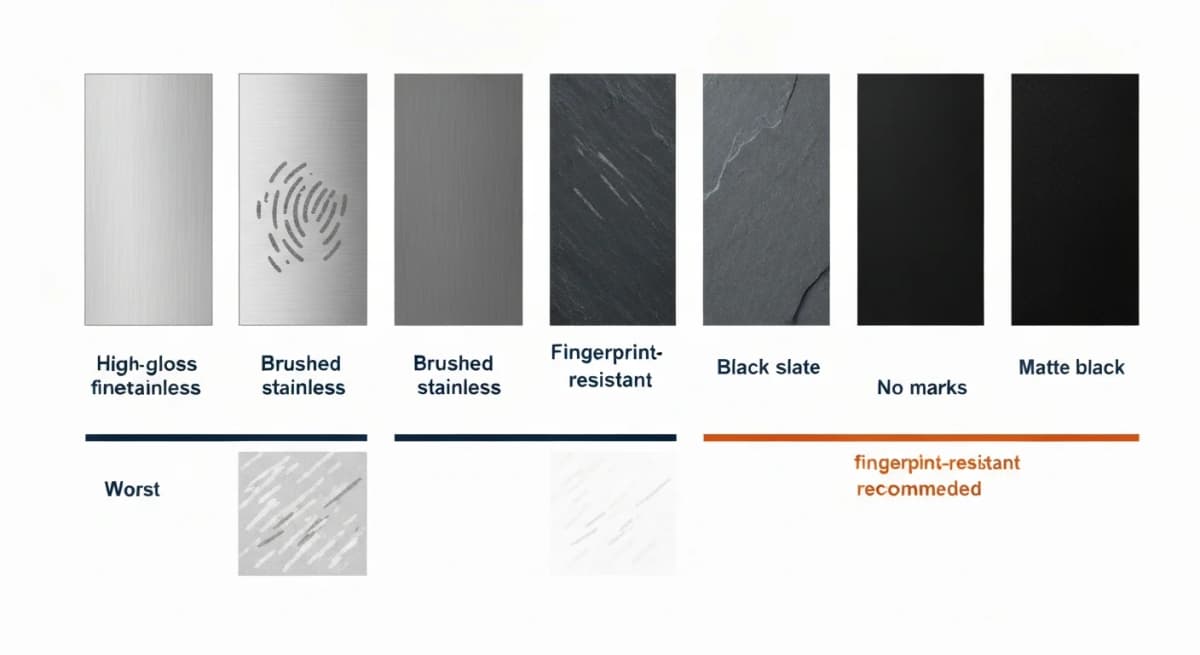
Stainless steel has been the default kitchen appliance finish for two decades. For STR units, it's the wrong choice. Standard stainless shows every fingerprint, smudge, and water mark — and guest hands are constantly on every appliance handle, refrigerator door, microwave door, and dishwasher front.
Finish options for STR-optimized kitchens:
Fingerprint-resistant stainless steel: Most major brands (LG, Samsung, KitchenAid, Whirlpool, GE) offer fingerprint-resistant finishes — a textured or coated surface that masks fingerprints visually. Wipes clean as fast as standard stainless but stays looking clean longer. Cost premium: $50-$200 per appliance.
Black stainless or graphite finish: Even better fingerprint-masking than fingerprint-resistant stainless. Hides smudges almost completely. Looks premium in listing photos. Cost: similar to fingerprint-resistant stainless.
Slate finish (GE): A matte gray-slate finish that hides fingerprints exceptionally well. The downside: limited to GE appliances, so the kitchen is locked into a single brand. Cost: similar to other premium finishes.
Matte black: Excellent fingerprint resistance. Reads as modern in listing photos. Cost: similar to other premium finishes.
What to avoid: high-gloss stainless steel, mirror-polished black, and any other appliance finish that shows fingerprints under listing-photo conditions. The cleaner can wipe stainless steel quickly but has to wipe it more frequently and more thoroughly to maintain photo-ready appearance.
The cleaning-time reduction from fingerprint-resistant finishes: 3-5 minutes per turnover. Plus the indirect benefit: between cleanings (during guest stays), the appliances stay looking clean, which contributes to guest perception of cleanliness and listing review scores.
Any STR unit specifying new appliances. The finish decision adds modest cost premium and pays back through cleaning time and guest perception.
Less customization flexibility — fingerprint-resistant finishes come in a narrower range of styles than full mainstream stainless steel.
Every guest touches cabinet handles dozens of times during a stay. Standard hardware finishes (polished chrome, brushed nickel, brass) show fingerprints and require regular wiping during turnover. STR-optimized hardware reduces this cleaning burden.
Hardware finish options:
Matte black hardware: Hides fingerprints completely. Modern aesthetic in listing photos. Cost: $4-$12 per handle/pull (similar to standard).
Matte brass or brushed bronze: Hides fingerprints well. Slightly more decorative than matte black. Cost: $6-$18 per handle/pull.
Honed/matte stainless: Better than polished chrome but not as good as matte black. Acceptable middle option. Cost: $4-$10 per handle/pull.
What to avoid: Polished chrome, polished brass, polished nickel. All show fingerprints aggressively and require constant maintenance.
Additional hardware considerations for STR:
Soft-close hinges and slides: Reduce cabinet door slamming and the resulting wear on cabinet boxes. Standard on most semi-custom cabinets; specify if not included by default. Cost: $20-$50 per cabinet.
Solid hardware construction: Avoid hollow-feel hardware that breaks under heavy use. The maintenance cost of replacing handles every 2-3 years due to STR breakage exceeds the upfront premium for solid hardware. Spend $8-$15 per pull rather than $2-$5.
Larger-than-standard pulls: 4-5 inch pulls vs. 3 inch knobs. Easier for guests to grip (less drop-and-break risk), faster for cleaners to wipe (single swipe vs. fiddling around a knob).
The cleaning-time reduction from optimized hardware: 1-2 minutes per turnover. Plus reduced breakage costs over the kitchen's lifespan.
All STR kitchens. Hardware is one of the easiest items to spec correctly and one of the highest per-dollar-impact decisions.
Hardware can be upgraded later if the initial spec was wrong, but the labor cost of replacing 20-30 cabinet pulls is significant compared to specifying correctly upfront.
Trash and recycling handling consumes a meaningful slice of turnover cleaning time. STR kitchens should have purpose-built waste zones that make removal fast and odor-management automatic.
Waste zone specifications:
Pull-out cabinet system with two bins: One for trash, one for recycling. Located adjacent to the dishwasher (so the cleaner can scrape plates directly into trash without crossing the kitchen). Cabinet depth typically 18-24 inches; bin capacity 13-30 gallons depending on STR turnover frequency.
Step-on or soft-close lid: Avoids hand-contact with bin lid; faster cleaning and better hygiene.
Liner pre-staging: A small shelf inside the waste cabinet stores 10-15 trash bag liners. Cleaner pulls a new liner immediately after removing the old one — no walking to storage.
Boise-specific recycle stream: Boise's curbside recycling program accepts paper, cardboard, aluminum and steel cans, and plastics #1, #2, and #5 in the blue cart; plastics #4–#7 go in the Hefty ReNew orange bag, and glass is not accepted curbside (drop-off sites only). Plan a small glass bin alongside the recycling bin. Guest signage in the kitchen indicates what's recyclable — reduces cleaner sorting time.
Composting (optional): If the STR unit offers composting (some Boise STRs market this as a feature for eco-conscious guests), a small countertop compost crock plus weekly compost pickup. Adds time per turnover for compost transfer; pays back through guest perception and review-mention frequency. Most STR operators in Boise opt out of composting for the operational simplicity.
Odor control: Cabinet-installed charcoal filter or activated carbon liner reduces odor between turnovers. Standard pull-out cabinets often skip this — worth adding for $20-$40.
The cleaning-time reduction from purpose-built waste zone: 2-4 minutes per turnover. Plus guest experience improvement (no overflowing bins mid-stay, no visible trash in listing photos).
All STR kitchens. Waste handling is one of the most-frequent tasks during cleaning, so optimization compounds across turnovers.
Pull-out waste systems consume a cabinet that could otherwise hold storage. For very small STR kitchens, this is a real tradeoff.
For STR operators across North End, the Bench, Garden City, and Hyde Park, our STR kitchen scope starts with explicit cleaner-workflow conversation — we ask the operator's cleaner what slows them down in their other units and design around those answers. The typical STR kitchen scope runs $1,500-$4,500 above comparable owner-occupied scope, driven by the appliance and finish upgrades that pay back through cleaning time. We also coordinate with the operator's furniture and decor budget to ensure the kitchen design supports the broader STR positioning (urban-professional, family, design-conscious, etc.).
For operators planning capital improvements on existing STR units, the highest-leverage retrofit items are: replacing standard stainless appliances with fingerprint-resistant finishes during normal appliance-replacement cycles, swapping cabinet hardware to matte finishes during cabinet-refinish projects, and installing a pull-out waste system if the kitchen has standard trash placement. None of these requires a full kitchen remodel; each can be done as a $400-$2,000 individual upgrade. See our Boise kitchen remodeling page for full-scope work and our rental property remodel guide for the broader rental-property framework.
What's the typical Boise STR kitchen remodel budget vs. an owner-occupied kitchen?
Boise STR kitchen remodels typically run $25,000-$55,000 for full-scope work — vs. $45,000–$70,000 for comparable owner-occupied work. The lower budget reflects mid-tier rather than premium material selections, simpler layouts (no custom millwork, no extensive specialty appliances), and the absence of luxury aesthetic upgrades that drive owner-occupied costs higher. The savings often go into business-critical items the STR operator values: durability, cleaning efficiency, and replacement-cycle planning. Worth noting: investing $1,500-$4,500 above the basic STR scope on STR-specific optimization (fingerprint-resistant finishes, pull-out waste system, fixed dishwasher adjacency) returns roughly $9,000–$24,750 in cleaning-labor savings over the kitchen's 10–15 year lifespan.
How does Boise's STR regulatory environment affect kitchen remodel decisions?
Idaho state law limits city STR licensing, and lodging taxes still apply, but neither significantly constrains kitchen design. The main remodel-relevant considerations: (1) Smoke and CO detectors must meet code (typically already required for any residential kitchen), (2) commercial-grade equipment isn't required in residential STRs (so standard residential appliances are fine), (3) ADA accessibility isn't typically required unless the STR is large enough to fall under commercial-lodging classifications. Operators should confirm current City of Boise requirements before significant capital investment; the regulatory environment can change.
What kitchen features do Boise STR guests actually value vs. what operators think they value?
Three discrepancies show up consistently in guest reviews. (1) Operators over-spend on specialty appliances (rice cookers, espresso machines, air fryers) — guests rarely mention these positively, and they add cleaning complexity. (2) Operators under-spend on basics (decent coffee maker, sharp knives, adequate cookware) — these get mentioned in negative reviews when they're missing. (3) Operators over-spend on visible aesthetic elements (custom backsplash, designer pendant lights) — these affect first-impression listing photos but rarely show in reviews. Iron Crest's STR scope discussions emphasize the basics over the specialty items and the everyday function over the photo-day aesthetic.
Should I include a kitchen island in an STR remodel?
Depends on kitchen size and target guest count. For STRs with 4+ guest capacity, an island provides valuable prep and dining surface, particularly for families. For 2-3 guest STRs, an island often eats critical floor space without adding usable function. The STR-specific consideration: islands require more cleaning surface and create additional crumb-and-spill collection zones, adding 2-3 minutes per turnover. For STR optimization, islands are worth specifying only when they meaningfully improve guest experience for the target unit size — not as a default 'kitchens should have islands' assumption.
Can I retrofit STR-optimized kitchen features to an existing unit without a full remodel?
Yes, in stages. The highest-impact retrofit items in priority order: (1) Replace appliances during normal replacement cycles with fingerprint-resistant or matte finishes — $1,800-$4,500 across major appliances over 2-3 years. (2) Swap cabinet hardware to matte black or matte brass — $200-$600 in materials, half-day labor. (3) Install pull-out waste cabinet system — $400-$1,200. (4) Replace open shelving with closed cabinets if applicable — $1,500-$4,000. (5) Replace cementitious-grout tile backsplash with continuous quartz or large-format panels — $2,500-$6,000. Doing all of these in stages over 3-5 years achieves STR-optimization without a single-project full remodel cost.
Build an STR kitchen that pays you back per turnover
STR kitchen design that prioritizes cleaning velocity over aesthetic showmanship returns $900-$1,650 in cleaning labor savings per unit per year. Schedule a consultation and we'll map your kitchen to your operator's actual turnover workflow.
These pages go deeper on the topics linked from this article. Read them before your consultation and you'll come in with sharper questions and a clearer scope.
The following government agencies, industry organizations, and official resources provide additional information relevant to your remodeling project.