
Drought-Conscious Boise Bathroom Remodels: WaterSense Fixtures, Water Rates, and the 1.28 GPF Reality
WaterSense bathroom fixtures cut household water use with no functional compromise, and in Boise the payback comes off the water and sewer bill rather than from any rebate. Here's the real math.
Quick answer
We won't give you a payback period, because the honest one depends on two numbers we don't have: your household's metered volume and your current combined water and sewer rate.
Boise's drinking water comes from Veolia Water Idaho, a regulated private utility whose rates are set through cases before the Idaho Public Utilities Commission; sewer is billed separately by the City of Boise. We are not going to quote you a rate-escalation percentage or an average annual bill — the current schedule is published by each of those two bodies, and it is the only figure worth planning against. What we can say without hedging is that every gallon a fixture doesn't use is billed twice in Boise, once as water and again as sewer, because sewer volume is calculated from metered water use. For homeowners planning a bathroom remodel, WaterSense-labeled fixtures cut fixture water use with no functional compromise.
This article covers the WaterSense fixture decisions during a Boise bathroom remodel, the real GPM (gallons per minute) and GPF (gallons per flush) math, what the fixtures actually pay back, and the broader water-conservation context for Treasure Valley households. The features add minimal cost ($0-$300 premium over standard fixtures) and produce measurable water and bill reductions over the bathroom's lifespan.
For broader sustainability and energy-efficiency context, see our sustainable green remodeling guide and energy-efficient remodeling guide. For the one utility incentive that does apply to a Boise bathroom remodel, see our heat pump water heater sequencing guide. This page focuses specifically on water-conservation fixtures for Boise bathroom remodels.
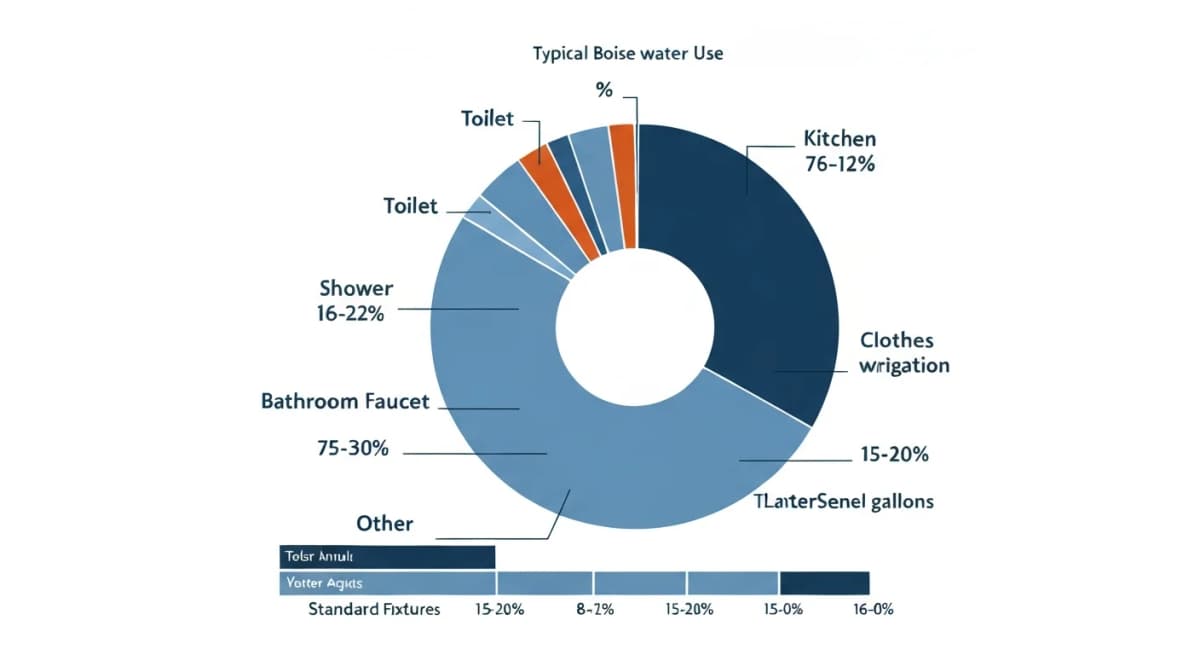
Two separate bills, two separate rate-setting bodies, and we are not going to reprint either schedule here — utility rates change and a number baked into an article goes stale silently. Do this instead, because it takes five minutes and gives you a figure that is actually yours:
Step 1 — find your water rate. Veolia Water Idaho supplies Boise's drinking water and publishes its current residential tariff; the rate is tiered, so heavier users pay more per thousand gallons. Read the per-1,000-gallon figure for the tier your household actually lands in.
Step 2 — find your sewer rate. The City of Boise bills sewer, and the charge is calculated from metered water use rather than from anything measured at the drain. Take the current per-1,000-gallon figure off the City's utility billing pages or your own statement.
Step 3 — add them. The sum is what a thousand gallons costs you. This is the number that makes fixture efficiency worth doing in Boise: you are not saving water at the water rate, you are saving it at the water rate plus the sewer rate.
Step 4 — pull your own volume. Your statement shows gallons per month. That, not a household-size average, is the multiplier.
Now the fixture side, which we can source. A WaterSense-labeled toilet uses 1.28 GPF or less against a 1.6 GPF federal maximum. A labeled showerhead flows 2.0 GPM or less against 2.5 GPM. A labeled bathroom faucet flows 1.5 GPM or less against 2.2 GPM. Multiply each reduction by how often your household uses that fixture, sum the gallons, and apply the combined rate from step 3. That arithmetic is verifiable end to end, which is why we would rather hand you the method than a savings range we cannot stand behind.
WaterSense is a voluntary EPA partnership program established in 2006 that certifies water-efficient products meeting specific performance and efficiency standards. The WaterSense label indicates the product uses at least 20% less water than the federal minimum standard while maintaining equivalent or better performance.
Specific WaterSense product categories relevant to bathroom remodels:
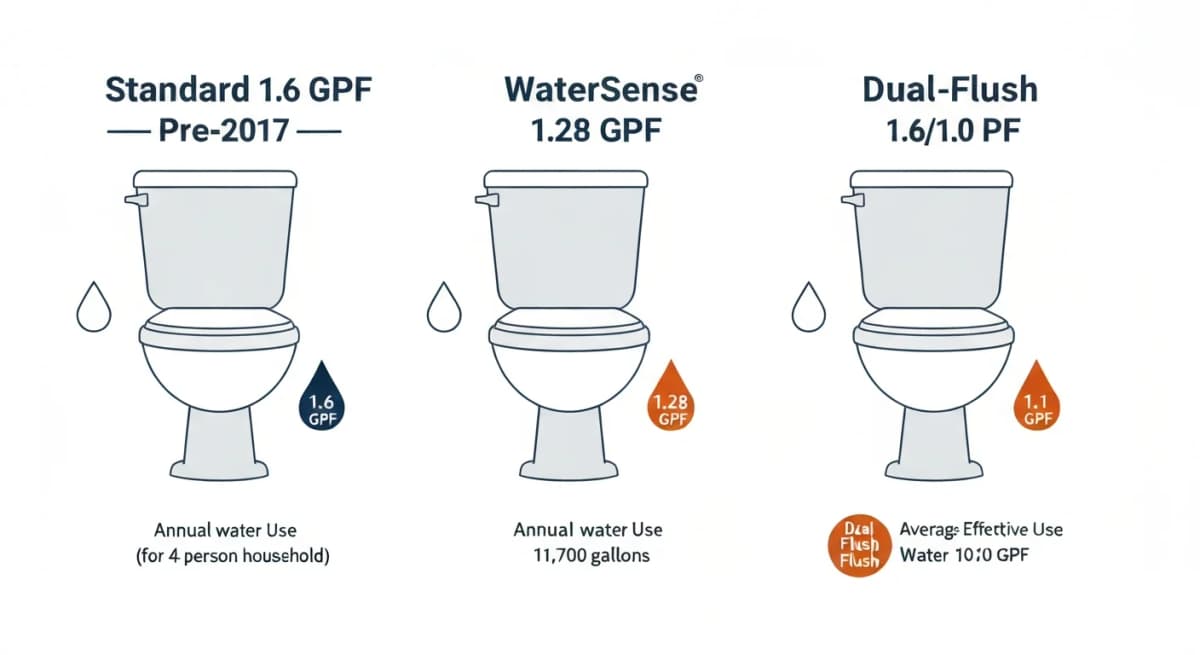
WaterSense toilets: Use 1.28 gallons per flush (GPF) or less, vs the federal maximum of 1.6 GPF. The 20% reduction is built into the certification.
WaterSense showerheads: Flow rate 2.0 gallons per minute (GPM) or less at 80 PSI, vs the federal maximum of 2.5 GPM. The performance requirement ensures showerheads deliver an acceptable user experience at reduced flow.
WaterSense bathroom faucets: Flow rate 1.5 GPM or less at 60 PSI, vs the federal maximum of 2.2 GPM. The 32% reduction is the largest of the bathroom fixture categories.
WaterSense products go through independent testing to verify both water efficiency and performance equivalence. Boise homeowners can verify WaterSense certification at the EPA website or via the WaterSense label on the product packaging.
The certification matters for:
Performance assurance: WaterSense products are tested to maintain functionality at reduced flow rates. Standard low-flow products without certification may underperform.
Code compliance: California, Texas, and some other states require WaterSense compliance for new construction or remodel scope. Idaho doesn't currently require WaterSense but the federal certification stands as a quality benchmark.
EPA's WaterSense program reports toilets as the largest single category of indoor household water use, ahead of showers, faucets and clothes washers. The federal maximum is 1.6 GPF for single-flush toilets; WaterSense-labeled toilets use 1.28 GPF or less.
Three toilet configurations for Boise bathroom remodels:
Standard 1.6 GPF toilet (federal minimum): Pre-WaterSense legacy specification. Adequate flush performance for typical household use. Cost: $150-$400.
WaterSense 1.28 GPF single-flush: Reduced water use with adequate flush performance for typical household use. Cost: $200-$500. Annual water savings vs 1.6 GPF for a 4-person household: 1,400-1,900 gallons.
Dual-flush toilet (typically 1.6 GPF / 0.8-1.0 GPF): Two flush options — full flush (1.6 GPF) for solid waste, reduced flush (0.8-1.0 GPF) for liquid waste. Average household effective rate: 1.0-1.2 GPF. Cost: $250-$700. Annual water savings vs 1.6 GPF for a 4-person household: 2,400-3,400 gallons.
The performance question:
Early-generation low-flow toilets (1994-2005) had real performance issues — clogging, inadequate solid-waste flushing, multiple flushes required. Modern WaterSense-certified low-flow toilets are functionally equivalent to 1.6 GPF toilets through improved bowl design, optimized water-jet engineering, and better trapway geometry. The performance concern from 1990s low-flow experiences is largely obsolete.
Brands worth considering for WaterSense bathroom remodel: Toto (Toto MS series, premium $400-$700, exceptional performance), American Standard (Champion 4 series, mid-range $250-$500), Kohler (Cimarron series, mid-range $300-$500), and Niagara (Stealth series, budget $150-$300 with very effective performance for the price).
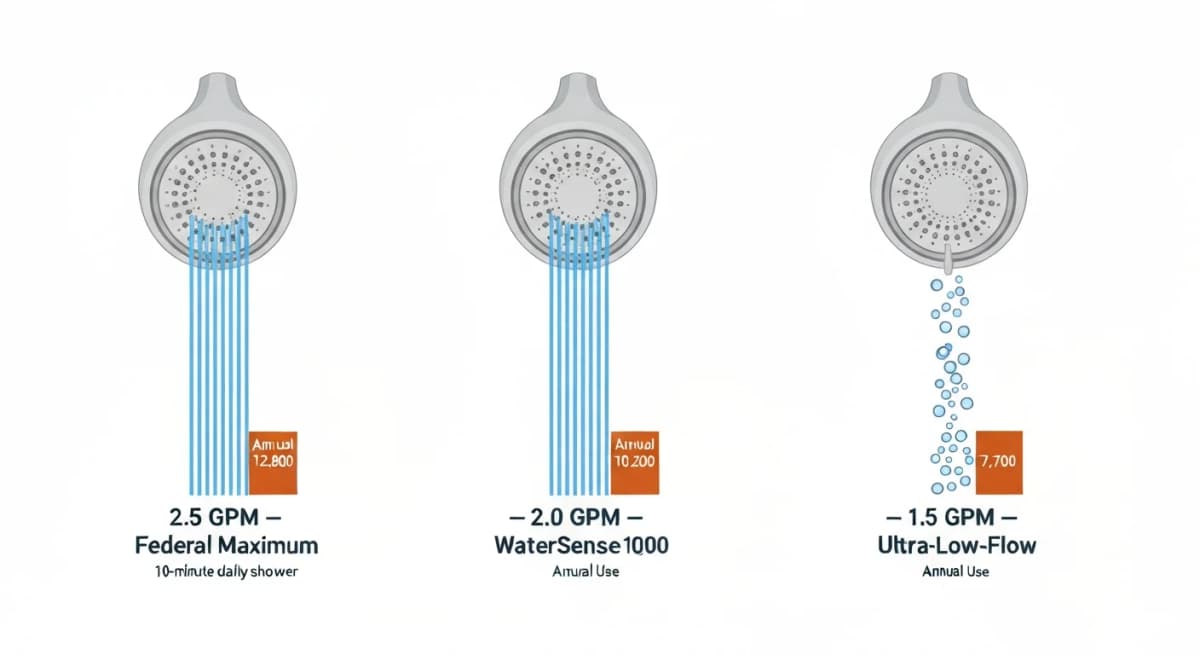
Showers are the next-largest indoor category after toilets in EPA's WaterSense breakdown. The federal maximum showerhead flow rate is 2.5 GPM at 80 PSI. WaterSense-certified showerheads flow at 2.0 GPM or less. Ultra-low-flow showerheads (1.5 GPM) reduce flow further but require careful selection for user experience.
Flow rate user-experience trade-off:
2.5 GPM standard: Traditional shower feel. Strong water pressure sensation. Highest water use.
2.0 GPM WaterSense: Slightly reduced pressure sensation vs 2.5 GPM but generally acceptable to most users. The flow reduction is partially compensated by improved nozzle engineering and aerated water flow patterns. Most users adjust within a few showers without complaint.
1.5 GPM ultra-low-flow: Noticeable flow reduction vs standard. Users sensitive to water pressure may not prefer this level. However, well-designed 1.5 GPM showerheads with thermostatic regulation and specific spray-pattern engineering can deliver acceptable user experience.
Specific recommendations for Boise:
For most Boise households: 2.0 GPM WaterSense-certified showerhead is the right balance of water savings and user experience. Most major brands offer 2.0 GPM models — Moen, Delta, Kohler, Hansgrohe, and others.
For households with multiple sensitive users: 2.0 GPM standard is the practical floor. Going below this for the sake of conservation typically produces user dissatisfaction.
For water-conscious households willing to optimize: 1.5 GPM showerheads from premium manufacturers (Bricor, High Sierra, Niagara) deliver good shower experience with significant water savings. Cost: $25-$80.
Annual water savings from upgrading from a 2.5 GPM showerhead to 2.0 GPM WaterSense (2-person household, 10-min showers daily): 4,200 gallons. From 2.5 GPM to 1.5 GPM: 7,300 gallons.
Plan a WaterSense bathroom remodel that pays for itself
WaterSense fixtures cut the gallons on both halves of a Boise utility bill — the water side and the sewer side that's calculated from it. Schedule a consultation and we'll spec the right combination of toilet, shower, and faucet for your water-use pattern and budget.
Faucets are a meaningful share of indoor use in EPA's WaterSense breakdown, though the bathroom lavatory is only part of that total. The federal maximum bathroom faucet flow rate is 2.2 GPM at 60 PSI. WaterSense-certified bathroom faucets flow at 1.5 GPM or less — a 32% reduction.
The reduced flow is achieved through faucet aerators that mix air into the water stream, producing the sensation of higher pressure flow at reduced actual volume. The user experience is essentially unchanged from standard faucets; the conservation is invisible.
Aerator types:
2.2 GPM standard aerator: Federal maximum, the default on most pre-2010 faucets.
1.5 GPM WaterSense aerator: 32% reduction with imperceptible user-experience change. Most modern WaterSense faucets ship with this aerator. Cost premium over standard faucet: typically $0-$50 (often no premium).
1.0 GPM ultra-low aerator: Further reduction available as aftermarket aerator replacement. May be noticeable for hot-water-fill tasks (sinks filling slower) but adequate for routine handwashing.
The hot-water savings consideration: bathroom faucet aerators reduce both cold and hot water use. The hot water reduction saves energy via reduced water heater work. For households with electric water heaters, the energy side is real but small next to the water and sewer saving — the hot water a lavatory faucet uses is a fraction of the household total.
Annual water savings from upgrading bathroom faucet from 2.2 GPM to 1.5 GPM (4-person household, normal use): 1,200-1,800 gallons. Modest compared to toilet and shower savings but cumulative across multiple bathrooms.
For households considering whether to retain a tub or switch to shower-only in a bathroom remodel, the water-conservation math is one consideration alongside lifestyle and resale factors.
Typical bath water use:
Standard residential tub: 35-50 gallons per full bath (depending on tub size).
Shower at 2.5 GPM standard, 10-minute shower: 25 gallons.
Shower at 2.0 GPM WaterSense, 10-minute shower: 20 gallons.
Shower at 1.5 GPM ultra-low, 10-minute shower: 15 gallons.
For households where a typical shower is 8-10 minutes, switching from tub baths to showers saves 10-35 gallons per use. For households where showers are longer (15-20 minutes), the savings narrow or reverse.
The honest assessment: tub vs shower is primarily a lifestyle and resale decision, not a water-conservation decision. The water-use difference is meaningful but not dramatic compared to other household conservation opportunities. If the household preference is for tub bathing, the conservation case for switching to shower-only is weak. If the household never uses the tub, switching to shower saves both space and water.
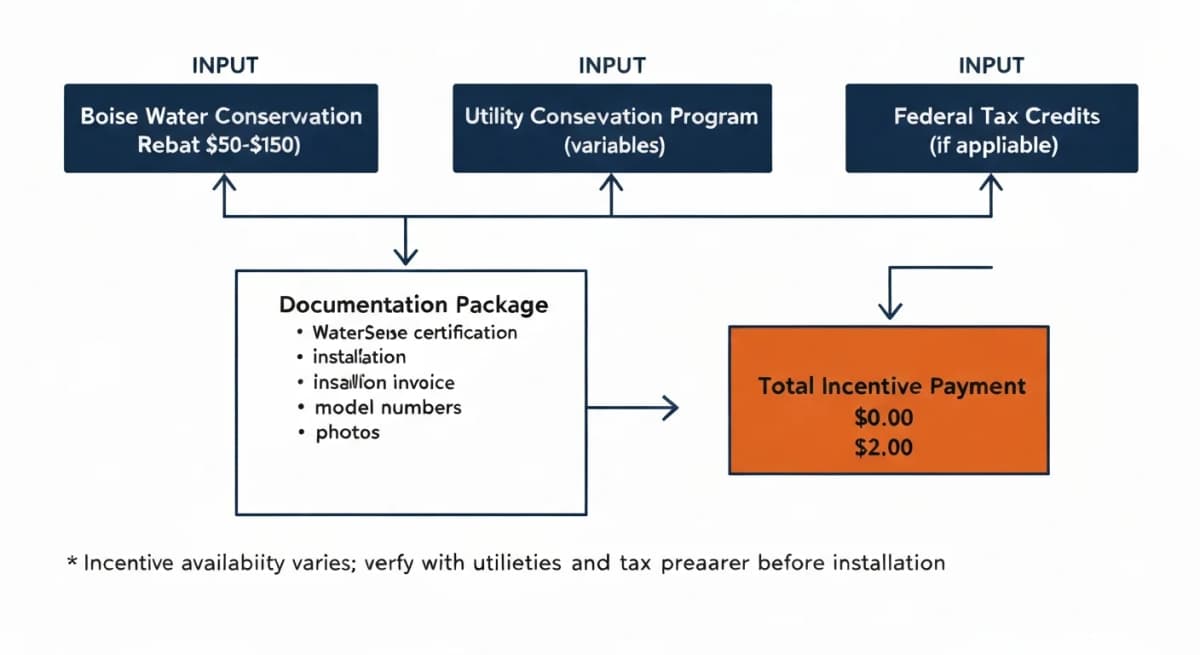
Homeowners frequently ask which rebate covers this. The honest answer is that we cannot point you to one, and you should plan the fixture budget accordingly.
The water utility: Boise's drinking water is supplied by Veolia Water Idaho, not by the City — the City of Boise handles sewer, trash, and utility billing. We are not aware of a current Veolia residential fixture rebate, and we won't send you chasing one. If you want to check, the utility's customer pages are the place to look.
Federal tax credits: There is no federal credit for water-efficient fixtures, and the energy-side credit people remember — Section 25C — is no longer available for property placed in service after December 31, 2025. Older articles that told you to bundle fixtures with a 25C claim are describing a program that has ended.
State programs: Idaho has no state-level water conservation rebate for residential fixtures. The Idaho Governor's Office of Energy and Mineral Resources runs a low-interest State Energy Loan Program for home energy efficiency work, which is financing rather than a rebate and is aimed at energy rather than water.
So the case for WaterSense in Boise rests entirely on the bill. That case holds up on its own: the premium over standard fixtures is $200-$500 for a full bathroom set, and every gallon saved is billed twice here, once by Veolia as water and again by the City as sewer, which makes every gallon you stop buying worth slightly more each year. A 1-3 year payback with no paperwork beats a rebate you have to hunt for and may not get.
For homeowners going beyond standard water conservation, greywater systems capture and reuse water from sinks, showers, and clothes washers for landscape irrigation. Greywater is differentiated from blackwater (toilet waste, kitchen sink) and is generally safer to reuse for non-potable applications.
Idaho's greywater regulations:
Idaho doesn't currently have specific state-level greywater regulations. Greywater system installation typically requires permitting through the local building authority (Boise PDS, Ada County DS) and meeting general plumbing code requirements. The lack of specific greywater regulation creates regulatory uncertainty — some jurisdictions are more permissive, some require detailed engineering review.
Greywater system types:
Laundry-to-landscape: Simplest greywater system. Diverts clothes washer outflow to landscape irrigation lines. Cost: $300-$800 for the installation. Captures 8,000-15,000 gallons annually for a 4-person household.
Branched drain system: Captures bathroom sink and shower water for landscape distribution. Cost: $2,500-$6,000 for installation. Captures additional 8,000-12,000 gallons annually.
Treated greywater system: Includes filtration and disinfection for potential indoor reuse (toilet flushing). Cost: $8,000-$20,000+ for residential installation. More involved permit process and inspection requirements.
Realistic Boise application:
Greywater systems make most sense in homes with: significant landscape irrigation needs (large gardens, lawns), specific water-conservation philosophy, technical interest in the system maintenance, and a contractor experienced in greywater installation.
For most Boise bathroom remodel households, greywater is a separate project beyond the bathroom scope itself. We can integrate greywater system rough-in during a bathroom remodel for households planning eventual installation (rough-in adds $500-$1,200 to the bathroom project, much cheaper than retrofit).
Iron Crest's WaterSense fixture conversations with homeowners focus on the practical math: which fixtures upgrade easily during the remodel, what the annual savings projection is, and whether the household's water-conservation philosophy supports going beyond standard WaterSense to ultra-low-flow specifications. For most Boise bathroom remodels, upgrading all bathroom fixtures to WaterSense costs $200-$500 above standard fixtures and saves $100-$250 annually for typical households — a payback of 1-3 years with the savings recurring throughout fixture lifespan.
For households interested in maximizing water conservation, the discussion includes greywater rough-in opportunities, dual-flush vs single-flush toilet choice, and 1.5 GPM ultra-low-flow showerhead selection. We document all WaterSense specifications in the project scope so the fixture performance is on record. For broader sustainability context, see our sustainable green remodeling guide and the bathroom remodeling service overview.
What's the realistic payback period for WaterSense bathroom fixtures in Boise?
We won't give you a payback period, because the honest one depends on two numbers we don't have: your household's metered volume and your current combined water and sewer rate. What we can give you is the cost side and the method. The premium for a full WaterSense set — toilet, showerhead, faucet aerator — over standard fixtures is $200-$500. The saving is the gallons each fixture stops using, multiplied by Veolia's current water rate plus the City of Boise's current sewer rate. Run that with your own statement in front of you and you'll have a payback figure that applies to your house rather than to an average one. The reason we recommend the upgrade regardless is that the premium is small in the context of a bathroom remodel and the reduction recurs for the life of the fixture.
Are WaterSense toilets really as effective as 1.6 GPF toilets?
Modern WaterSense toilets (post-2010 manufacture): yes, essentially equivalent. The technology has matured significantly since the 1990s low-flow era. Improved bowl geometry, optimized water-jet engineering, and better trapway design produce flush performance equivalent to 1.6 GPF toilets in real-world conditions. WaterSense certification testing verifies this performance with MaP (Maximum Performance) tests that simulate real waste conditions. The early-generation low-flow toilet concerns from the 1990s don't apply to current WaterSense certified products. Boise homeowners installing WaterSense toilets today should not experience the flush problems associated with first-generation low-flow toilets.
Should I upgrade my existing fixtures to WaterSense or wait for a bathroom remodel?
Depends on the existing fixtures. Faucet aerator replacement is a 5-minute job ($5-$15 for the aerator) — do this independently of any remodel. Showerhead replacement is straightforward ($25-$80 for the new head, 15-minute install) — also do independently. Toilet replacement requires more involved plumbing work and typically waits for either a remodel or a failure of the existing toilet. For homeowners planning a remodel in 2+ years, the small replacements (aerator, showerhead) make sense now; the toilet can wait for the remodel scope.
Do WaterSense fixtures void manufacturer warranties or require special installation?
No. WaterSense certification is supplementary to standard manufacturer warranties and installation requirements. The certification verifies water-efficiency performance but doesn't change the installation process or warranty terms. WaterSense fixtures install identically to standard fixtures of the same type. Manufacturer warranties on WaterSense fixtures are typically equivalent to or better than non-WaterSense fixtures.
Are there any downsides to WaterSense fixtures?
Few but real. (1) Some showerhead users sensitive to water pressure may notice the reduced flow at 1.5 GPM and prefer 2.0 GPM models. (2) Dual-flush toilets have two flush mechanisms (more parts to potentially fail) vs single-flush toilets. Failure rates are similar in modern manufacturing but the additional complexity is real. (3) Low-flow fixtures may concentrate solids in drains during the transition period; this typically resolves within 1-2 weeks as the household adapts to new flush patterns. None of these issues is significant enough to argue against WaterSense fixtures; they're worth knowing for setting homeowner expectations.
Can I install WaterSense fixtures myself in my Boise bathroom?
Showerhead and faucet aerator replacement: yes, easily, no permit needed for like-for-like fixture replacement. Toilet replacement: technically yes with reasonable DIY plumbing skills, but Boise plumbing code typically requires licensed plumber work for fixture replacement. Most homeowners use plumbers for toilet replacement to ensure code compliance and proper installation. For active remodel projects with broader plumbing scope, the WaterSense fixture installation is included in the licensed plumber's scope at no meaningful additional cost vs standard fixture installation.
Plan a WaterSense bathroom remodel that pays for itself
WaterSense fixtures cut the gallons on both halves of a Boise utility bill — the water side and the sewer side that's calculated from it. Schedule a consultation and we'll spec the right combination of toilet, shower, and faucet for your water-use pattern and budget.
These pages go deeper on the topics linked from this article. Read them before your consultation and you'll come in with sharper questions and a clearer scope.
The following government agencies, industry organizations, and official resources provide additional information relevant to your remodeling project.