
Boise Kitchen Counter Design for Bread and Pasta at Altitude: 6 Material and Layout Decisions for Treasure Valley Bakers
Serious bread and pasta making at Boise's 2,700-foot elevation behaves differently than at sea level. Counter material temperature, surface depth for full-batch kneading, and dedicated fermentation zones make the difference between recipe success and consistent disappointment. Six design decisions for Treasure Valley bakers.
Quick answer
Marble pastry boards work for occasional bakers; built-in marble insets are meaningfully better for serious bakers. The difference: pastry boards are typically 16-20 inches wide — adequate for pastry and pasta dough but too small for full-batch bread kneading.
Bread and pasta making at altitude has subtle but real differences from sea-level baking. Boise's 2,700-foot elevation reduces atmospheric pressure by about 9%, which affects dough hydration uptake, yeast fermentation speed, and gluten development. The home cook adapts recipe ratios; the kitchen design should support those adaptations through specific material and layout decisions.
Standard residential kitchen counter design — typically a single material run across all counter surfaces — doesn't accommodate altitude baking well. Quartz holds room temperature; warm hands working dough on quartz create progressively warmer dough across a long kneading session, accelerating fermentation in ways that wreck precision baking. Granite has variable temperature behavior. The right answer for serious bakers and pasta makers: specific material zones for specific tasks, with the cool-surface zone (marble or honed granite) dedicated to dough work.
This article covers six design decisions for Boise kitchens where bread and pasta making is a serious activity. Each addresses a specific altitude-related or task-specific need that standard residential kitchen design overlooks.
For the broader kitchen countertop material decision — comparing quartz, granite, butcher block, concrete, and the full materials catalog — see our kitchen countertop materials guide. This page focuses specifically on counter design for serious bread and pasta making at Boise's altitude, where the material and layout decisions are different from general-purpose kitchen design.
Boise's elevation produces specific changes to baking and dough behavior that affect kitchen design decisions.
Atmospheric pressure: At 2,700 feet, atmospheric pressure is approximately 13.3 psi vs. 14.7 psi at sea level — a 9.5% reduction. Lower pressure means less force compressing gas bubbles in dough during fermentation, so bread rises noticeably faster than the same dough at sea level and over-proofs more easily. Watch the dough rather than the clock — a recipe's stated proof time is written for sea level.
Water evaporation rate: At lower atmospheric pressure, water evaporates faster from open surfaces. Boise's dry climate (typical 25-40% relative humidity in winter, 15-30% in summer) compounds this. Dough surfaces dry faster, requiring covering during fermentation that wouldn't be necessary at sea level in humid climates.
Yeast activity: Dough rises faster at Boise's altitude because the gas yeast produces expands more under lower pressure. Combined with dryness-accelerated water evaporation, fermentation windows are tighter.
Gluten development: Faster rising and dry air mean dough can over-proof and dry out before the gluten structure is ready. At 2,700 feet the fixes are small — slightly less yeast, a little more liquid, shorter proofs — but they matter.
Pasta drying: Boise's low humidity and elevated UV exposure dry fresh pasta faster than at sea level. 4-6 hour drying times in Boise vs. 6-12 hours in humid coastal climates. For pasta makers, this is generally favorable (faster drying), but it requires more consistent humidity control during the drying process to prevent uneven drying.
The implications for kitchen design: the dough handling zone needs to support faster work cycles (you have less margin for over-fermentation), the fermentation control needs to be more precise (smaller windows), and the work surface temperature matters more (warm hands plus warm counter creates compounding heating that accelerates already-fast fermentation).
Establishing the baseline understanding for why Boise altitude baking differs from sea-level baking.
The altitude effects are real but subtle — non-baker household members may not appreciate the design accommodations the baker values.
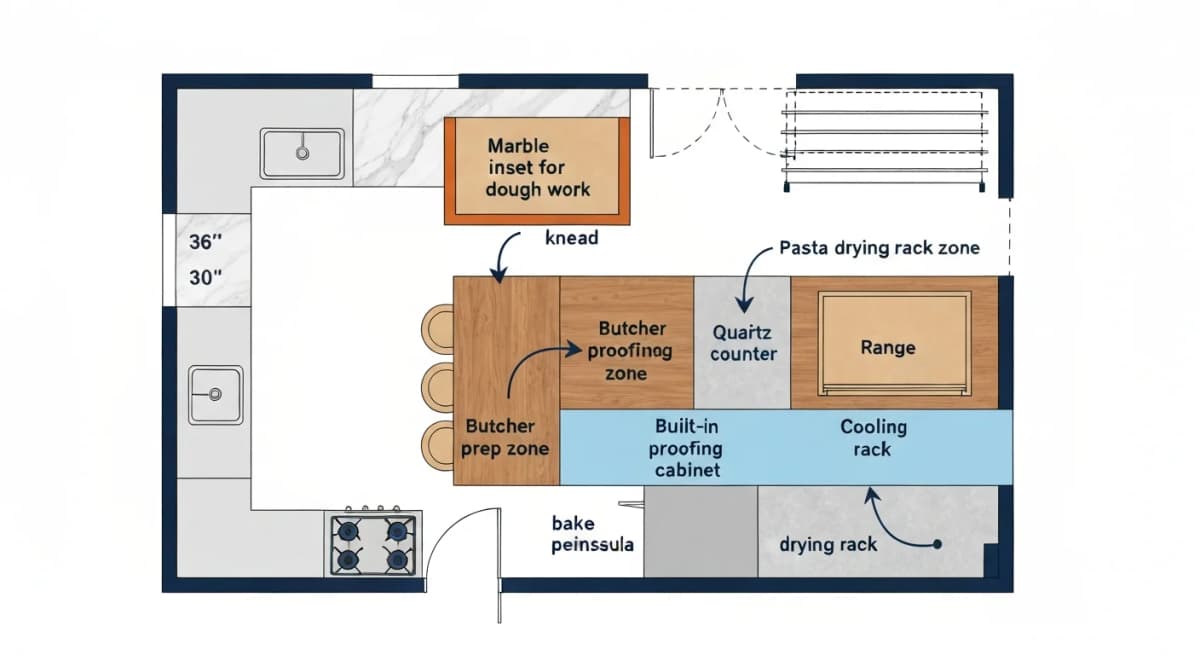
The single most valuable design decision for serious bakers: a dedicated marble inset zone within the main kitchen counter. Marble is the traditional baker's surface for specific reasons that haven't been improved upon by modern materials.
Why marble for dough work:
Thermal mass and cool surface: Marble has high thermal mass and conducts heat away from anything touching it, so it feels cooler than the surrounding air even at room temperature. That heat sink effect is crucial during dough work — the cool surface prevents the user's warm hands from progressively warming the dough across a long kneading session.
Non-stick characteristics: Marble's smooth surface and slight inherent porosity (when properly sealed) provides ideal release for sticky doughs. Bread doughs, pasta doughs, pastry doughs all release cleanly from properly maintained marble.
Heat-shock tolerance: Marble can handle warm metal bowls placed directly on it without damage (unlike some quartz formulations that can crack from thermal shock). This matters for bakers who pull doughs from refrigeration and need to work them.
Dimensions for a marble inset zone:
Minimum useful size: 30 inches wide by 24 inches deep. Accommodates pasta dough rolling and small bread batches. Adequate for occasional bakers.
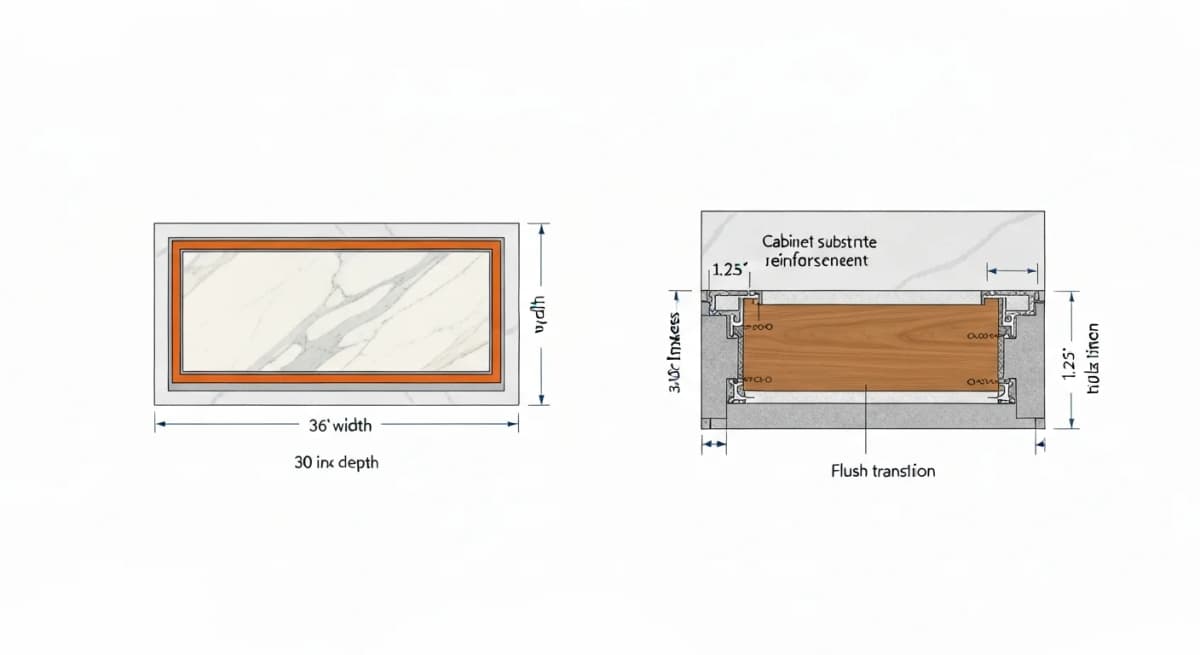
Recommended size: 36 inches wide by 30 inches deep. Accommodates full bread batches, large pasta dough rolling, and provides space for multiple dough portions during shaping. The right size for regular bakers.
Maximum useful size: 48 inches wide by 30 inches deep. For commercial-pace home bakers or for households running a small-scale bread CSA. Excess for occasional bakers but valuable for daily ones.
Installation specifications: the marble slab sits within a recessed cabinet substrate, flush with the surrounding quartz counter (typically a 1.25-inch standard counter thickness). The substrate provides structural support; the marble itself is supported across its full underside rather than at edges. Cost: $800-$2,400 for materials and labor on a typical 36 inch by 30 inch inset.
Marble selection: avoid honed marble (slightly more porous than polished and harder to maintain clean for food prep). Specify polished Carrara or Calacatta marble with a high-quality professional sealant. Re-seal every 6-12 months for maintained stain resistance.
Serious bakers (weekly or more frequent bread or pasta making).
Marble requires more careful maintenance than quartz — stains from coffee, wine, or acidic foods can etch if not promptly cleaned.
Standard residential counter depth is 25.5 inches. For serious baking and pasta making, this is too shallow — full-batch bread kneading requires more depth to accommodate the dough's expansion during work, and pasta rolling (especially with a hand-cranked pasta machine) requires reach distance for the rolled pasta sheets.
Depth recommendations:
Standard 25.5 inches: Adequate for small-batch baking (1-2 loaves, small pasta batches). Inadequate for serious work — full-batch bread doughs (3-4 loaves) extend beyond the standard depth during kneading.
Extended 30 inches: The right depth for the dedicated baking zone. Accommodates full-batch bread doughs, large pasta rolling, and provides space for cooling racks and shaping work simultaneously. Achievable by extending the cabinet depth in the baking zone while keeping standard 25.5-inch depth elsewhere.
Island-depth 36 inches: If the baking zone is on an island, the island depth can be 36-48 inches total (typically 36-inch cabinet depth plus 12-inch overhang for seating on the opposite side). The full 36 inches of work surface is essentially open for baking work. The right configuration when the kitchen layout supports it.
The increase from 25.5-inch to 30-inch depth in the baking zone consumes 4.5 inches of usable floor space in the kitchen. For most kitchens this is a manageable trade-off — the deeper counter consumes a small percentage of total kitchen floor area while providing meaningful baking-zone improvement.
Cabinet substrate considerations:
Standard 24-inch base cabinet: Doesn't support 30-inch counter depth. Use deeper base cabinets in the baking zone — 27-inch or 30-inch base cabinets are available in semi-custom and custom cabinet lines.
Custom cabinet construction: For irregular depths or for incorporating dough hooks and tool storage into the baking-zone cabinet construction, custom cabinet construction may be required. Cost premium: $500-$1,500 over semi-custom for the baking-zone cabinets specifically.
Reinforced supports for marble inset: If the baking zone includes a marble inset, the cabinet substrate needs reinforced supports under the marble. Marble weighs about 16 lb per square foot at 1.25-inch thickness; a 36 inch by 30 inch inset weighs about 120 pounds and requires structural reinforcement beyond standard cabinet construction.
Bakers working full-batch recipes (3-4 loaves at a time) and pasta makers with multi-pound dough batches.
Consumes more kitchen floor area than standard counter depth.
Design a kitchen that works as hard as your starter
Baker-optimized kitchen design integrates marble inset, proofing cabinet, cooling extension, and pasta drying into a coherent workflow. Schedule a consultation and we'll map your actual baking patterns to the design that supports them.
Bread fermentation success depends heavily on consistent temperature. Boise's seasonal temperature variation (winter kitchens can run 65-68 degrees F, summer kitchens 72-76 degrees F) creates inconsistent fermentation timing. Serious bakers benefit from a dedicated proofing cabinet with controlled temperature and humidity.
Proofing cabinet options:
Insulated cabinet with passive temperature control: A standard cabinet upgraded with insulation, glass door for visibility, and a small thermal mass element (water bowl, ceramic block) to stabilize temperature. Cost: $200-$600 for the cabinet modifications. Works best when ambient kitchen temperature is reasonably close to fermentation target (68-78 degrees F).
Active heating proofing cabinet: Adds a low-wattage heating element (typically 15-30 watts) with thermostat control. Maintains target temperature regardless of ambient. Cost: $800-$2,500 for built-in installation. Standard in higher-end home baker setups.
Refrigerated cabinet with humidity control: For long fermentations (overnight, multi-day cold ferment), a dedicated small refrigerator or wine refrigerator unit maintains 38-44 degrees F cool fermentation conditions. Cost: $400-$1,500 for the unit plus electrical install.
Commercial-grade proofing chamber: Full commercial proofing chamber with precise temperature and humidity control across the 38-90 degrees F range. Cost: $2,500-$8,500 for residential-sized commercial-grade units. For very serious bakers running multiple dough types simultaneously.
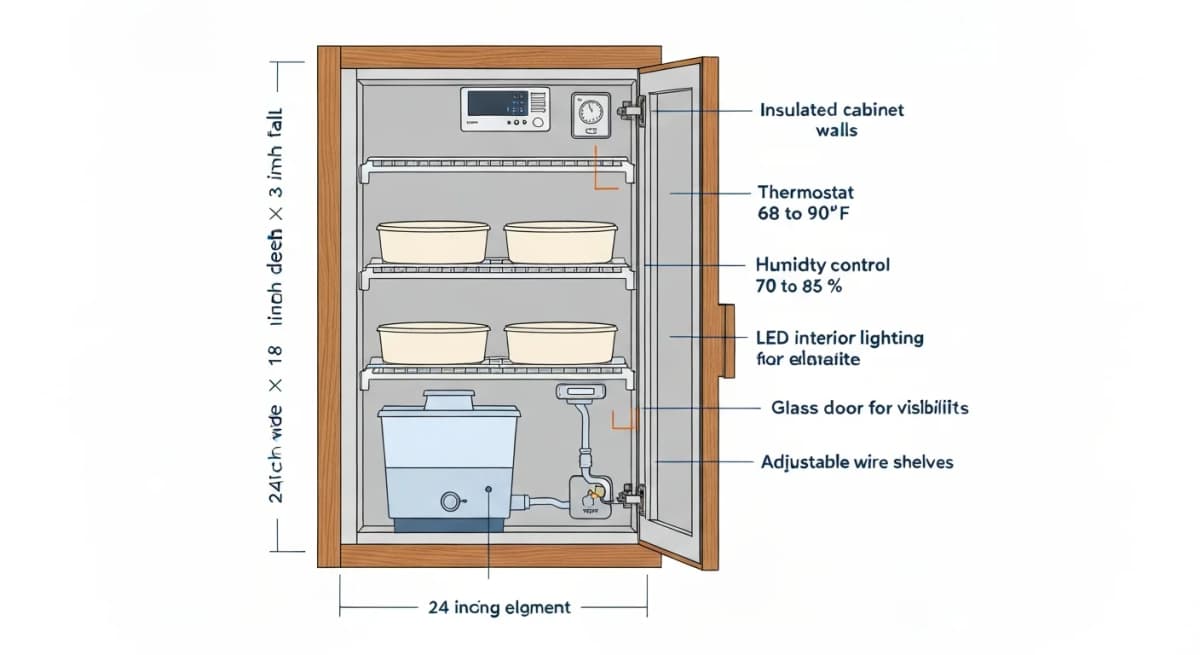
For most Boise serious bakers, the active heating proofing cabinet (option 2) is the right specification. It addresses Boise's seasonal kitchen-temperature variation, costs less than a commercial unit, and integrates cleanly into kitchen cabinetry. Typical specifications:
Cabinet size: 24 inches wide by 18 inches deep by 30 inches tall. Holds 3-6 dough containers depending on size.
Temperature range: 68-90 degrees F. Covers all standard bread fermentation needs.
Humidity control: Built-in water reservoir maintains 70-85% relative humidity (target range for bread fermentation).
Glass door: Insulated double-pane glass allows visual inspection without opening the cabinet (which lets heat escape).
Interior LED lighting: Soft LED illumination for visibility without significant heat addition.
Location: integrate the proofing cabinet near the marble inset zone, so dough can move from kneading to proofing without crossing the kitchen. Adjacent to the cooling racks or proofing-board storage simplifies the workflow.
Bakers who run controlled-fermentation recipes (sourdough, long-rise breads, multiple bread types per session).
Consumes a cabinet that could otherwise hold storage. Adds electrical work.
Fresh-baked breads and pastas need cooling time on racks — typically 1-2 hours for breads to cool fully before slicing, longer for some pastry items. The cooling zone shouldn't compete with active cooking; serious bakers benefit from dedicated cooling space.
Cooling zone options:
Peninsula extension dedicated to cooling racks: A peninsula extending 24-30 inches from the main counter run, with full counter surface for cooling rack placement. Doesn't typically include sink or other functions — purely a cooling surface. Cost: $1,500-$4,500 for the peninsula construction.
Island with cooling-zone: Use part of the island specifically for cooling, with the rest of the island serving general purposes. Less dedicated but works in kitchens where a full peninsula isn't feasible.
Wall-mounted folding cooling rack: A space-saving option — a steel rack that folds against the wall when not in use, extending out when needed. Cost: $200-$600. Appropriate for smaller kitchens where dedicated counter space isn't available.
Material considerations for cooling zones:
Quartz surface (most kitchens): Fine for cooling rack placement; cools breads adequately. Standard kitchen choice.
Stainless steel insert: Some serious bakers specify a stainless steel insert (similar to commercial bakery cooling tables) for faster heat dissipation. Cost: $400-$1,200 for the steel insert. Provides about 15% faster cooling than quartz surfaces.
Wood (butcher block) cooling surface: Some bakers prefer butcher block for cooling specifically because it provides slight insulation that prevents the bottom of the bread from condensing moisture (which can soften the crust). Trade-off: butcher block needs different maintenance than quartz.
Workflow integration: the cooling zone should be positioned so finished products don't compete with active cooking surfaces. Typical layout: main cook zone with range and primary sink on the perimeter, marble inset for dough work nearby, proofing cabinet adjacent to marble inset, cooling peninsula extending from the perimeter into the room. This sequence supports the baking workflow without crossing other kitchen activities.
Bakers who produce multiple loaves per session and need extended cooling space.
Dedicated peninsula or island extension consumes floor space that could be aisle or seating area.
Fresh pasta makers in Boise's dry climate dry pasta faster than at sea level, but the drying process still requires dedicated space and proper airflow. A built-in pasta drying rack system integrates this requirement into the kitchen design without consuming counter space.
Drying rack options:
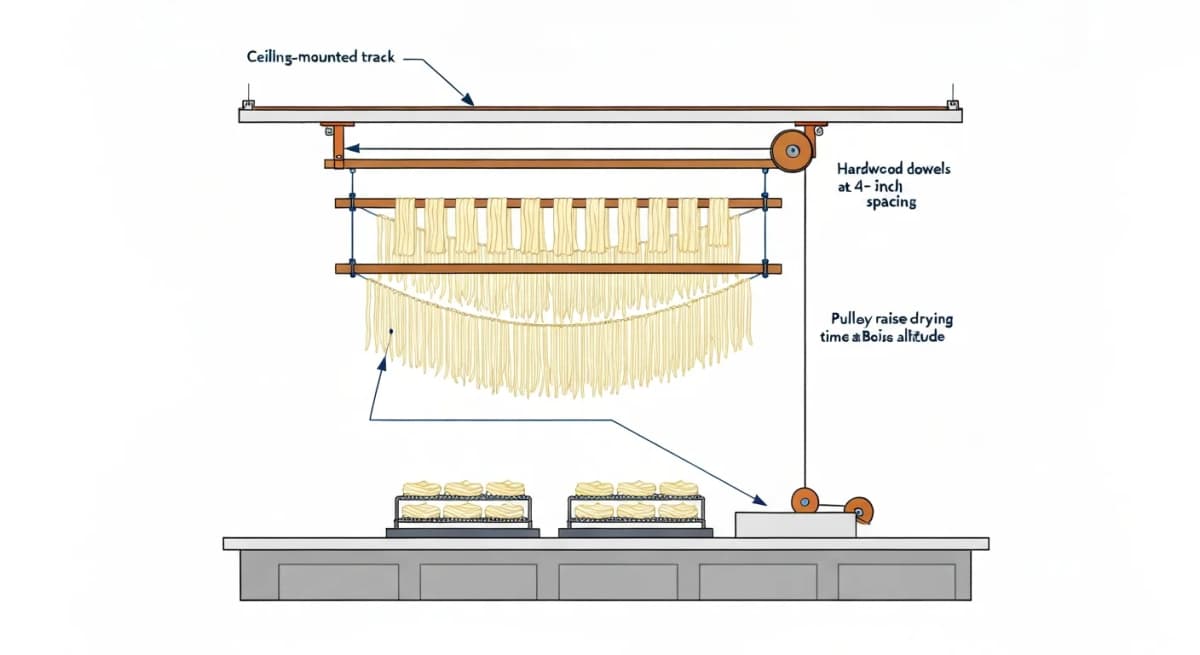
Ceiling-mounted track with adjustable dowels: A horizontal track mounted to the kitchen ceiling, with wooden dowels suspended below. The track can be raised and lowered to access the dowels for loading pasta strands. Provides 4-6 feet of usable drying length. Cost: $300-$800 for the track system plus install.
Wall-mounted folding rack: A wooden frame with horizontal dowels that folds flat against the wall when not in use. Provides 3-4 feet of drying length. Cost: $150-$400. Appropriate for kitchens where ceiling mounting isn't feasible.
Free-standing rack: A stand-alone drying rack stored elsewhere and brought out for use. The simplest and lowest-cost option but consumes kitchen floor space during use. Cost: $100-$300.
Commercial-style drying cabinet: An enclosed cabinet with built-in dowels, controlled humidity, and a small ventilation fan. Pasta dries in a controlled environment regardless of kitchen humidity. Cost: $1,800-$5,500 for built-in installation. For very serious pasta makers.
For most Boise pasta makers, the ceiling-mounted track is the right configuration. It doesn't consume counter or wall space during non-use, integrates cleanly into the kitchen aesthetic (the track is barely visible from typical angles), and provides adequate drying length for most pasta batches.
Installation specifications:
Ceiling clearance: Ceiling must be at least 9 feet high to allow the track to clear standard ceiling-mounted lights and ventilation. For 8-foot ceilings, wall-mounted alternatives are more practical.
Track location: Position the track over an area where dropped pasta strands won't contact food prep surfaces or create cleanup issues. Typical location: above an island or peninsula that's used primarily for cooling or non-cooking purposes.
Dowel material: Hardwood dowels (maple or birch, finished with food-safe oil) are standard. Avoid metal dowels — they conduct heat and can locally accelerate drying unevenly.
Ventilation considerations: Pasta drying in Boise's dry climate doesn't require active ventilation, but the area shouldn't be in direct line of strong air movement (e.g., directly under a ceiling fan or near an HVAC return vent) which can dry pasta unevenly.
Households making fresh pasta multiple times per month.
Ceiling-mounted track requires structural attachment to ceiling joists; not appropriate for drop ceilings or certain modern ceiling treatments.
Iron Crest's kitchen design process for serious-baker households includes an explicit conversation about baking patterns — type and frequency of bread baking, pasta-making volume, holiday and event baking, gift-baking patterns, and any commercial-side hobby work (farmers market participation, micro-bakery operations, etc.). The design reflects those actual patterns rather than a generic enthusiast template. For most active-baker households, the design includes a 36-inch marble inset, extended-depth baking zone, dedicated proofing cabinet, and a cooling peninsula. The cost premium runs $4,500-$12,500 above standard residential kitchen scope — modest for households where baking is a meaningful part of weekly activity.
For pasta-focused households (less common than bread-focused but increasing in Boise's growing food culture), we add the ceiling-mounted drying rack and may extend the marble inset to accommodate large pasta rolling. For both bread and pasta households, we integrate the design with the broader kitchen workflow so the baking work doesn't compete with daily cooking. For broader kitchen context, see our Boise kitchen remodeling page and the countertop materials guide.
Do I really need a marble inset, or can I just use a marble pastry board on top of quartz?
Marble pastry boards work for occasional bakers; built-in marble insets are meaningfully better for serious bakers. The difference: pastry boards are typically 16-20 inches wide — adequate for pastry and pasta dough but too small for full-batch bread kneading. Insets are 30-48 inches wide and dedicated to the work. Pastry boards also have edges that catch flour and dough and need to be moved for cleanup; insets are flush with the surrounding counter and clean up as one continuous surface. For bakers who bake 1-2 times per month, a pastry board is fine. For weekly bakers or anyone working multi-loaf batches, the inset is worth the cost.
What is the typical cost premium for a baker-optimized kitchen vs. standard residential kitchen?
On a typical $50-$80k Boise kitchen remodel, baker-optimized features add $4,500-$12,500. Specifically: 36-inch marble inset zone with structural reinforcement ($1,500-$3,000), extended 30-inch counter depth in the baking zone ($800-$2,000), built-in proofing cabinet with active heating ($1,500-$3,500), cooling peninsula construction ($1,500-$4,000), pasta drying rack system if applicable ($300-$1,000), and additional electrical for proofing cabinet circuitry ($200-$500). For households where serious baking is regular activity, the premium pays back through workflow improvement across the kitchen's 20-30 year lifespan.
Are there specific Boise-area appliances or specialty stores for serious baking equipment?
Several. Boise's independent kitchen-supply and restaurant-supply stores carry professional-grade home baking equipment, and local co-ops and bulk-food stores stock grains and baking supplies. For specialty pasta equipment, Williams-Sonoma at Boise Towne Square carries the mainstream lineup. For proofing cabinets and commercial-grade equipment, KaTom Restaurant Supply ships to Boise. For sourdough starters and local fermentation knowledge, Boise's artisan bakeries and the local baking community are the best resource. Most serious bakers in the Treasure Valley assemble equipment from multiple sources rather than relying on a single specialty retailer.
Does the baker-optimized kitchen design add or detract from resale value?
Mixed. For homes priced above $600k targeting culinary-interested buyers, marble inset zones and proofing cabinets read as premium features and contribute positively. For homes targeting broader buyer demographics, these features are essentially neutral — they don't actively detract but most buyers don't price them in. Cooling peninsulas and extended counter depth generally read as 'spacious kitchen' rather than 'baker-specific' and contribute positively across all price points. Pasta drying racks are the most niche feature; they appeal to specific buyers but are easily removed by less-interested buyers. Overall, baker-optimized kitchens are slightly positive on resale, primarily through the spaciousness perception rather than baker-specific feature recognition.
Can I retrofit baker-friendly features to an existing kitchen without a full remodel?
Partially. Specific retrofit options: (1) Marble pastry board placed on existing counters — $200-$800 for the board, no construction required. (2) Add a built-in proofing cabinet replacing existing cabinet space — $1,800-$4,500 if the existing cabinet can be modified for insulation and electrical access. (3) Install a ceiling-mounted pasta drying rack — $400-$1,000, requires structural anchoring to ceiling joists. (4) Replace a small section of existing counter with a marble inset — possible if the existing counter is being replaced anyway, costs essentially what the new section costs plus $500-$1,000 for the marble vs. matching the original material. Full marble inset retrofit while keeping the rest of the kitchen intact is generally not cost-effective; if you're touching the kitchen counters, do the full remodel scope.
Design a kitchen that works as hard as your starter
Baker-optimized kitchen design integrates marble inset, proofing cabinet, cooling extension, and pasta drying into a coherent workflow. Schedule a consultation and we'll map your actual baking patterns to the design that supports them.
These pages go deeper on the topics linked from this article. Read them before your consultation and you'll come in with sharper questions and a clearer scope.
The following government agencies, industry organizations, and official resources provide additional information relevant to your remodeling project.