
UV Fade in Boise Kitchen Cabinets: 6 Finish Selections by Window Orientation That Survive Treasure Valley Sun
Boise sees roughly 20–40% more UV than sea-level cities at the same latitude. Window orientation in your kitchen determines how fast standard finishes fade and which finishes hold up. Six decisions for matching cabinet finish to the actual UV exposure in your kitchen.
Quick answer
For a typical Boise kitchen with 25-35 cabinet doors and drawer fronts, the CV topcoat upgrade adds $1,500-$4,500 to the cabinet order. The premium reflects both the materials cost (CV is more expensive than latex) and the shop process (CV requires controlled-environment application and longer cure times).
Boise sits at roughly 2,700 feet, and UV intensity rises with elevation — the atmosphere above you is thinner, so less of the incoming ultraviolet is scattered out before it reaches a window. Boise is also a dry, frequently clear-sky climate, which means more hours of direct sun on an interior surface than a cloudier market at the same latitude. We don't have a sourced multiplier for how much more UV a Boise cabinet door sees than a Portland one, so we won't quote one. The practical impact is the part we see directly on our own projects: kitchen finishes in south- and west-facing Boise kitchens fade visibly years earlier than the same product in a shaded or north-facing room in the same house.
The fix isn't avoiding sunny kitchens — natural light is one of the highest-value features of a kitchen, and most Boise homeowners actively want it. The fix is matching cabinet finish selection to the actual UV exposure profile of the kitchen. This article maps fade resistance to window orientation and gives orientation-specific finish recommendations.
For broader cabinet decision-making — stock vs. semi-custom vs. custom, door styles, wood species, the full cabinet-selection framework — see our cabinet options guide. For the broader window selection that interacts with UV exposure (UV-filtering glass, low-E coatings, window-treatment strategies), see our window replacement guide for Boise. This page focuses specifically on cabinet finish selection given the UV profile of a specific kitchen.
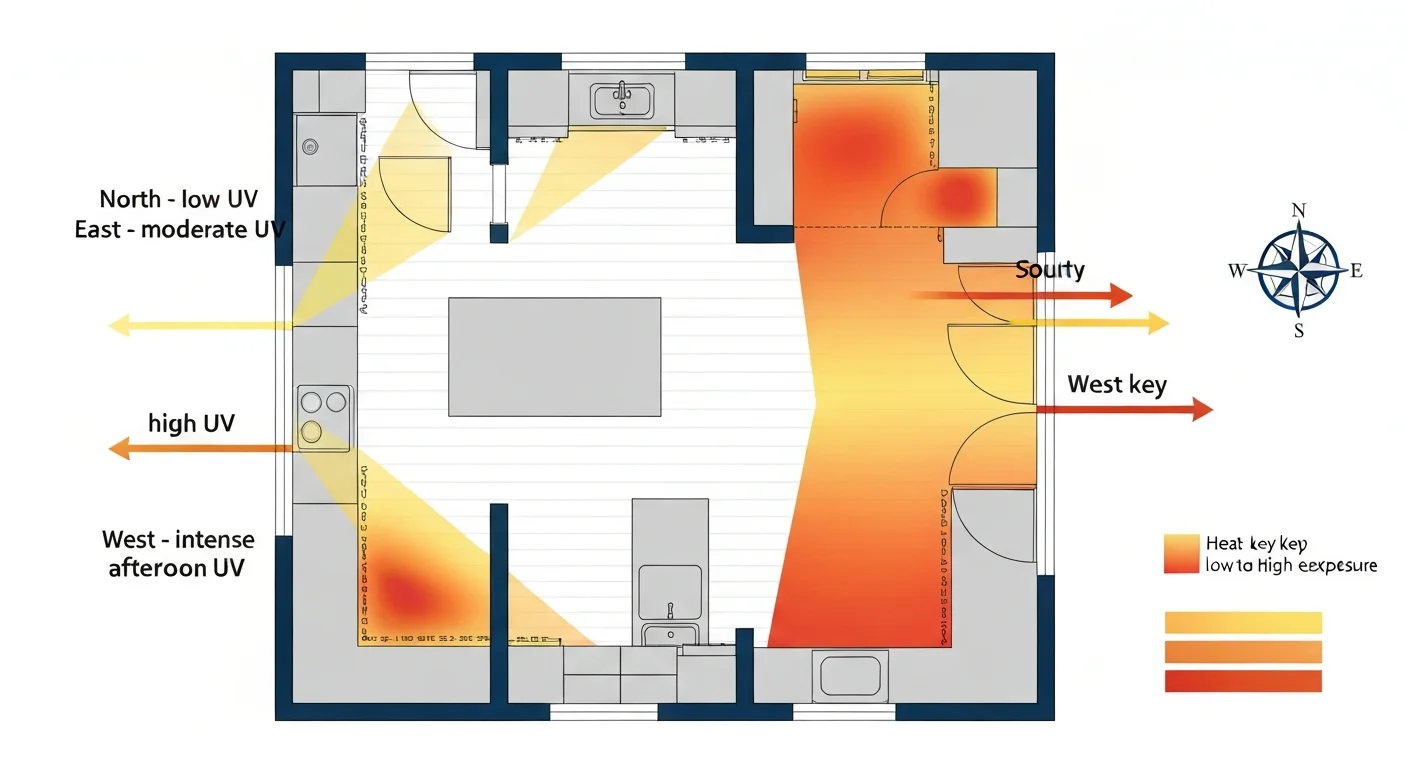
Ultraviolet radiation at the earth's surface depends on three primary factors: latitude (lower latitudes get more direct-angle sun), altitude (higher elevations have less atmospheric filtering), and cloud cover (sunny days mean more total UV).
Boise's combination produces unusually high residential UV exposure:
Latitude: 43.6 degrees north — comparable to Portland (45.5), Minneapolis (44.9), and Toronto (43.7). Mid-range latitude exposure.
Altitude: 2,704 feet base elevation, with foothills neighborhoods (East End, Highlands, Hidden Springs) at 3,000-3,800 feet. UV intensity rises with elevation, so the foothills kitchens sit under a slightly thinner column of atmosphere than the valley floor — a difference that is real but small compared with which direction the window faces.
Sunny days: 205 sunny days plus 75 partly-sunny days per year, totaling 280 days with measurable direct UV exposure. Portland gets 144 sunny days; Seattle gets 152. So Boise gets far more hours of direct sun per year than the Pacific Northwest reference cities.
The compounding effect: higher UV intensity per sunny day plus many more sunny days puts Boise's interior UV exposure well above the Pacific Northwest's at the same latitude. Cabinet finishes that hold up for 15 years in Portland visibly degrade in 6–10 years in Boise.
The implication isn't catastrophic — kitchens still work fine, finishes still look decent for years. But the timeline assumption is wrong if you're using Pacific-Northwest-typical lifespan estimates. Plan for accelerated finish lifecycles unless the cabinet specification explicitly addresses UV.
Calibrating realistic finish-lifespan expectations for Boise installations.
UV-resistant finishes typically cost 10-30% more than standard finishes; the choice involves explicit lifecycle math.
Kitchen cabinet finishes fall into six broad categories with substantially different UV resistance. Understanding the categories enables informed selection.
1. Natural (unstained) wood finishes (oil-finished, water-based clear sealer): Most vulnerable to UV. Natural wood color shifts visibly within 1-2 years of direct sun exposure. Different species respond differently — cherry darkens (sometimes desirably), oak yellows, maple darkens to amber, walnut lightens. For sunny kitchens, natural wood requires the most maintenance.
2. Stained wood finishes: The stain pigment provides some UV barrier, but most stained wood still shows visible fade within 5-8 years in Boise sun. Light stains fade fastest; dark stains hold up longer but eventually shift hue (often warming toward red-brown). The clear topcoat over the stain provides additional UV protection — quality of topcoat matters more than stain choice.
3. Painted finishes (water-based latex): Better UV resistance than stained wood because the pigment is opaque rather than translucent. Standard kitchen-grade latex paint fades 15-30% slower than stain. Limited durability against scratches and chips (which then reveal fade differential as the finish ages).
4. Painted finishes with conversion varnish topcoat: The current industry premium. Conversion varnish (CV) is a two-part catalyzed clear topcoat that provides UV barrier plus chemical resistance plus scratch resistance. Color-stable for 10-15 years even in high-UV applications. This is the right finish for sunny Boise kitchens. Premium pricing: roughly $60–$130 per door or drawer front above standard latex paint, typically $1,500–$4,500 per kitchen.
5. Lacquer finishes: Old-school cabinet finish, less common now. Better than latex paint for surface hardness but susceptible to UV-induced yellowing over time. Avoid for sunny kitchens.
6. Thermofoil or laminate cabinet doors: Plastic-veneer surface bonded to MDF substrate. UV resistance varies dramatically by manufacturer — high-quality thermofoil holds up well; budget versions yellow and peel. For sunny kitchens, specify only premium-grade thermofoil with documented UV stability.
The recommendation for most Boise kitchens with significant sun exposure: painted finish with conversion-varnish topcoat. The premium pays back through extended finish lifespan and reduced refinishing needs.
Selecting cabinet finishes with explicit UV-resistance criteria rather than pure aesthetic preference.
Conversion-varnish painted finishes limit color flexibility (some custom colors aren't available with CV topcoat) and add 4-6 weeks to lead time.
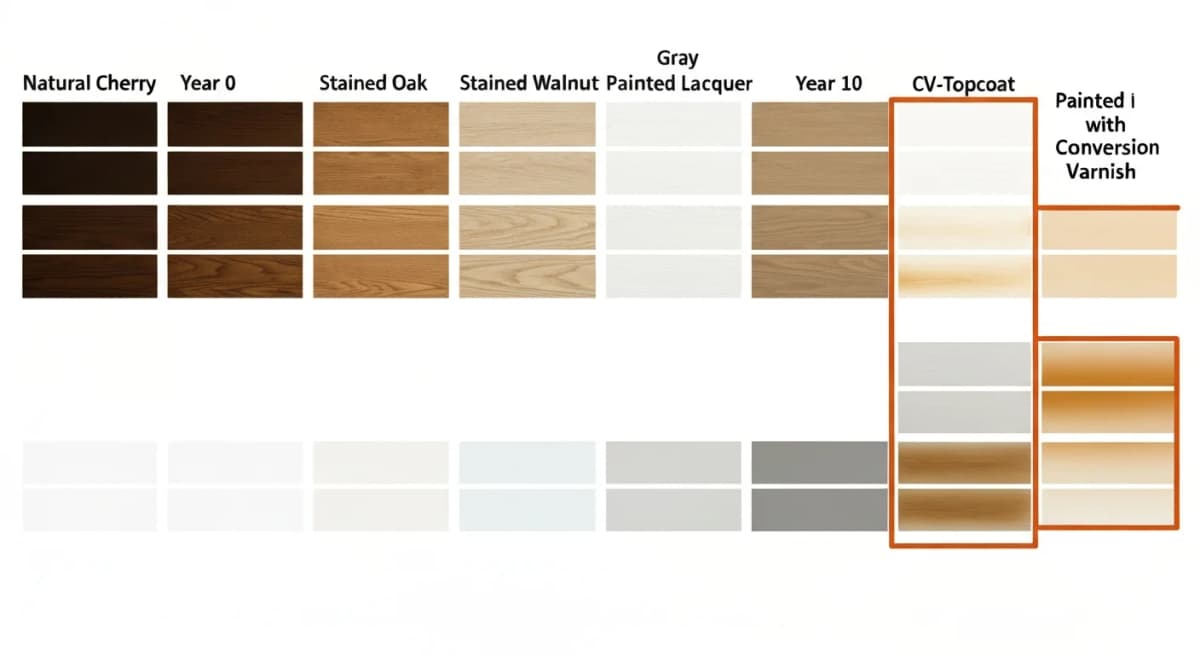
North-facing kitchens receive almost no direct sun exposure in the Northern Hemisphere. Indirect light reflects off other surfaces but the UV intensity that reaches cabinets is minimal — typically 10-15% of the UV that south-facing surfaces receive.
For north-facing kitchens:
Cabinet finish options: Essentially unrestricted by UV. Natural wood finishes hold up well. Stained finishes with standard topcoat hold up well. Painted finishes hold up well. Choose based on aesthetic preference and budget rather than UV resistance.
Long-term color stability: 15-20+ years typical for any quality finish in north-facing exposures.
Wood species considerations: The natural color of natural wood (cherry, walnut, maple) won't darken or shift significantly. Light stains hold up. This is the configuration where light-and-airy cabinet aesthetics (white painted, light maple, light gray stained oak) work without lifecycle compromise.
The one consideration: even north-facing kitchens have task lighting and ambient lighting that produces minor UV. Higher-intensity LED task lighting at full-spectrum color temperatures (5000K+) produces enough UV to slowly fade finishes over decades. For very long-lifespan considerations (50+ years), this matters; for typical 15-20 year horizons, it's negligible.
Practical implication for north-facing Boise kitchens: don't over-invest in UV-specific finishes. Spend the savings on other quality upgrades — better hardware, better drawer slides, better appliance integration.
Identifying when UV considerations aren't the primary cabinet decision driver.
None — north-facing exposure simplifies the cabinet finish selection.
Design cabinets that look as good in year 10 as in year 1
Cabinet finish selection that accounts for actual UV exposure produces a kitchen that stays photogenic across the full ownership horizon. Schedule a consultation and we'll map your exposure profile to the finish recommendations that fit.
East-facing kitchens receive direct morning sun for 2-4 hours daily, depending on season and any obstruction (trees, neighboring buildings). The UV exposure is moderate — sufficient to fade vulnerable finishes over 8-12 years but not as severe as south or west exposure.
For east-facing kitchens:
Recommended finish categories: Painted finishes (with or without CV topcoat), darker stained finishes, premium thermofoil. Natural unstained wood is acceptable if the homeowner accepts that color will shift over time.
Wood species to favor: Cherry (darkens beautifully in moderate sun, often considered desirable), walnut (color stabilizes), oak (some yellowing acceptable), maple (will amber-shift).
Wood species to avoid for natural finishes: Birch, beech (light woods that show UV degradation visibly).
Painted color recommendations: Most colors work. Avoid pure black or very dark navy if you want consistent appearance — even with CV topcoats, dark colors show fade more visibly than mid-tones. Light gray, white, sage green, pale blue, and warm taupe hold up well.
Long-term color stability: 10-15 years typical for well-specified finishes; some natural-wood finishes shift hue over this period (desirable for cherry, less so for maple).
East-facing kitchens balance the warm morning light experience (one of the most-valued kitchen attributes) against modest cabinet-fade risk. The finish selection should account for the exposure but doesn't require the most UV-resistant options. This is often the sweet spot where homeowners can have aesthetic preference satisfied without UV-driven compromise.
East-facing kitchens where morning sun is the dominant exposure pattern.
Some natural wood finishes (cherry, walnut) shift color over time. For homeowners who want frozen-at-installation appearance, paint with CV topcoat is the better choice.
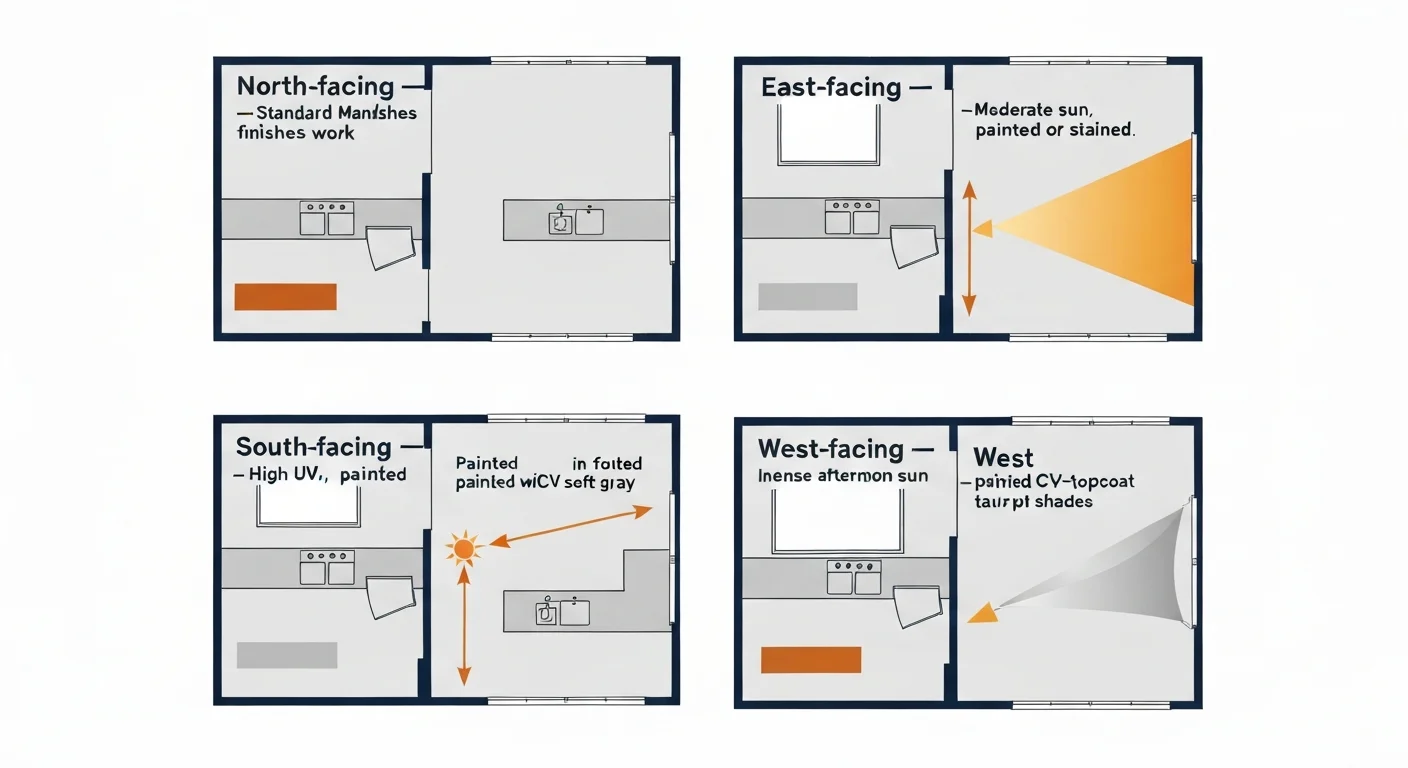
South-facing kitchens receive direct sun for 5-7 hours daily across the year. Summer exposure peaks midday when UV is most intense. This is the highest-UV interior exposure category in residential design.
For south-facing kitchens:
Recommended finish category: Painted finishes with conversion-varnish topcoat are essentially mandatory. Conversion varnish provides the UV barrier necessary for color stability over the cabinet's useful life. Stained wood finishes will fade visibly within 5-8 years; natural unstained wood finishes shift dramatically.
Wood species (if going with stained wood despite the UV exposure): Walnut is the most stable (and most expensive). Cherry will darken — acceptable if the homeowner wants this look. Oak yellows over time. Avoid maple, birch, beech.
Painted color selection: Mid-tones hold up better than extremes. Light gray, sage green, warm taupe, soft white (not pure white) — all hold up well with CV topcoat. Avoid very dark colors (navy, black) which show fade-to-uneven appearance. Avoid pure white which can yellow over time even with CV topcoat.
Window glazing intervention: South-facing kitchens are also the highest-value targets for UV-filtering window glazing. Low-E coatings are designed to block a large share of ultraviolet along with infrared, and manufacturers publish the figure for each specific glass package — look for it on the NFRC label rather than taking a general claim. If the existing windows are single-pane or non-Low-E double-pane, window replacement at the same time as the kitchen remodel is worth strong consideration. Boise sits in Climate Zone 5, where Idaho's adopted energy code sets a maximum U-factor of 0.32 for replacement windows, so that is the number the new units have to clear regardless of what the UV question decides. The window upgrade costs $4,000-$15,000 depending on size and count, but it extends cabinet finish lifespan and produces energy efficiency benefits separately. See our window replacement guide for full glazing specifications.
Long-term color stability with CV topcoat: 12-18 years typical even in heavy south-facing exposure.
Practical recommendation: spec painted cabinets with conversion-varnish topcoat in mid-tone colors. Add UV-filtering window glazing if existing windows aren't already Low-E. Plan for refinish or repaint at 12-15 years rather than expecting indefinite finish life.
South-facing kitchens with significant glazing area where UV exposure is the dominant finish-lifespan constraint.
Limits aesthetic flexibility — natural wood finishes are essentially off the table for color stability. Some homeowners may prefer to accept fade in exchange for natural wood look.
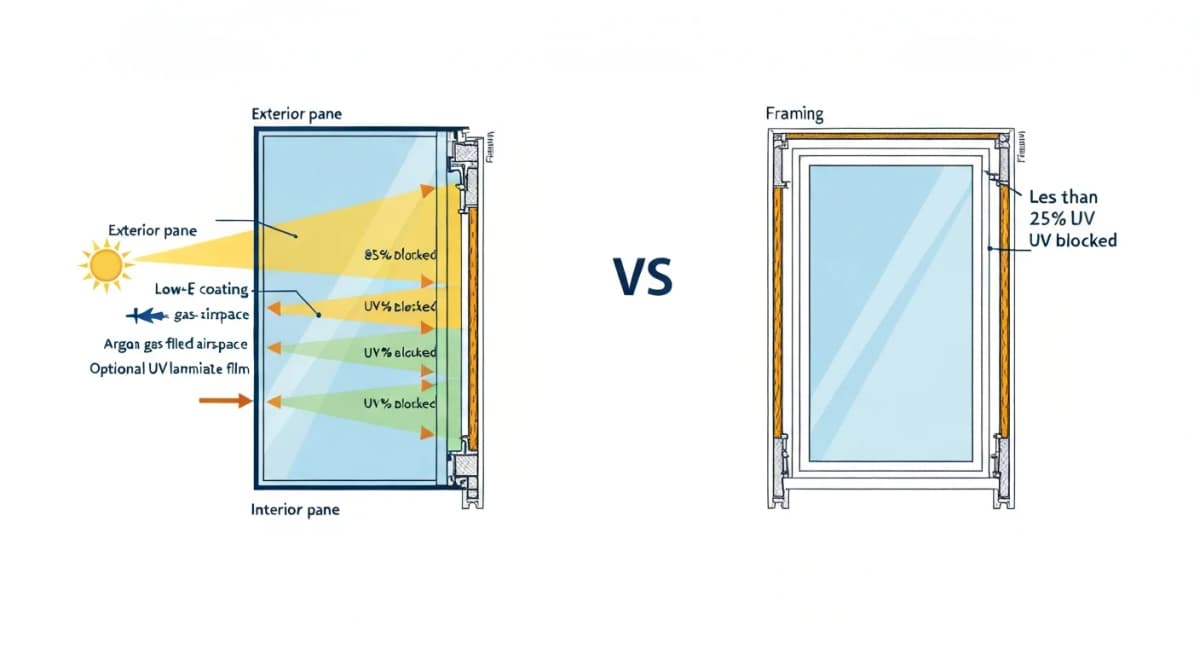
West-facing kitchens receive direct sun from early afternoon through sunset. The exposure is shorter than south-facing (typically 4-5 hours) but the angle and intensity are different — late-afternoon sun is lower in the sky, so it penetrates deeper into the room and falls at oblique angles on cabinet surfaces.
For west-facing kitchens:
Recommended finish category: Same as south-facing — painted finishes with conversion-varnish topcoat. The UV intensity is comparable; the temporal pattern is different but the cumulative annual exposure is similar.
Heat consideration: West-facing kitchens get heat exposure along with UV. Cabinet surfaces near the window can reach 110-130°F on summer afternoons. Some finishes (lower-quality lacquers, some thermofoils, water-based paints without CV topcoat) can soften at sustained high temperature. Specify finishes rated for sustained 140°F+ surface temperature.
Surface-temperature-tolerant finishes: Conversion varnish (excellent), high-quality thermofoil (good), powder-coated metal cabinet fronts (excellent — increasingly used in modern Boise kitchens), high-pressure laminate (good).
Window treatment integration: West-facing kitchens benefit substantially from cellular shades or solar shades that can be deployed during the highest-intensity afternoon hours. The treatment doesn't have to fully block the view; even 75% UV-filtering solar shades reduce cabinet UV exposure significantly while preserving daylight. Cost: $200-$600 per window.
Long-term color stability: 12-18 years typical with CV topcoat finishes. Slightly faster fade than south-facing exposure in some scenarios because the afternoon UV angle directly hits cabinet surfaces rather than the more diffuse south-facing light.
Practical recommendation: spec painted CV-topcoat cabinets, install UV-filtering Low-E window glazing, and add solar shade window treatments for late-afternoon deployment. The combined system produces cabinet finish lifespan comparable to north-facing kitchens.
West-facing kitchens where afternoon sun is the dominant exposure pattern.
Window treatments add ongoing operational consideration (deploy/retract). For homeowners who want fully open visual access at all times, the cabinet finish itself bears all the UV burden.
Iron Crest's cabinet specification process includes an explicit window-orientation assessment in every kitchen design meeting. We measure the actual window count, orientation, and glazing type, and we factor in any nearby tree cover, building shading, or roof overhang that affects direct sun penetration. The cabinet finish recommendation reflects that exposure profile rather than a one-size-fits-all default. For sunny exposures, conversion-varnish painted finishes are our default; for shaded exposures, we open up the full range of finish options including natural wood.
We also coordinate with window replacement scope when relevant. If the kitchen has older single-pane or non-Low-E windows and the homeowner is open to window upgrade, doing both at the same time produces the best lifecycle outcome, since the cabinet finish can then be specified against the glazing that will actually be in the wall. No utility here rebates windows — Idaho Power's residential incentives are heating, cooling, and water-heating equipment only — so the window case rests on comfort, condensation control, and the heating bill. For the broader kitchen scope, see our Boise kitchen remodeling page; for the window specifics, see our window replacement guide.
How much extra does a conversion-varnish painted finish cost vs. standard latex paint?
For a typical Boise kitchen with 25-35 cabinet doors and drawer fronts, the CV topcoat upgrade adds $1,500-$4,500 to the cabinet order. The premium reflects both the materials cost (CV is more expensive than latex) and the shop process (CV requires controlled-environment application and longer cure times). For sunny-exposure kitchens, the upgrade is worth it — the finish lasts 50-100% longer than standard latex and resists chemical exposure (cleaning products, food acids, water) far better. For shaded kitchens, the upgrade is optional and a homeowner can reasonably skip it without lifecycle concerns.
Can I add UV protection to existing cabinets without replacing them?
Limited options. Three approaches with varying effectiveness: (1) Apply UV-filtering window film to the kitchen windows — film manufacturers publish a UV-rejection figure for each product, so compare the spec sheets rather than the marketing; costs $8-$20 per square foot installed, and is reversible. Most effective intervention if existing windows aren't already Low-E. (2) Install UV-filtering window treatments (cellular shades, solar shades, plantation shutters) that can be deployed during peak-UV hours. Costs $200-$600 per window. (3) Re-finish the existing cabinets with a new conversion-varnish topcoat — requires sanding off the existing finish and re-spraying. Costs $4,000-$12,000 depending on cabinet count, much less than full cabinet replacement.
Does cabinet wood species matter for UV fade, or is it just about the finish?
Both matter. The finish provides the primary UV barrier, but wood species affects how the wood beneath the finish responds over time. Light woods (maple, birch, beech) show UV-induced yellowing and ambering more visibly. Dark woods (walnut, mahogany) shift hue more subtly. Cherry darkens dramatically in moderate sun — sometimes considered desirable. Oak yellows slowly. For naturally-stained or clear-finished cabinets where the wood color is visible, species matters significantly. For painted cabinets with opaque topcoats, the wood species underneath matters much less because the paint hides any wood color shift.
Do Boise's seasonal sun-angle changes affect kitchen finish lifespan?
Yes, in non-obvious ways. In summer, the sun is high in the sky (about 70 degrees above horizon at solar noon) — direct overhead light penetrates kitchens with skylights but doesn't reach far into rooms with vertical windows. In winter, the sun is low (about 24 degrees) — light reaches deeper into the room and falls at angles that hit cabinet surfaces directly. Counter-intuitively, south-facing kitchen cabinets often get more direct UV in winter than summer because the lower sun angle puts more direct exposure on vertical cabinet faces. The annual average smooths this out, but the seasonal pattern is worth knowing for kitchens with strong directional exposure.
Should I replace my kitchen windows at the same time as my cabinets if they're not already Low-E?
Often yes, especially for sunny exposures. The economic case: window replacement costs $4,000-$15,000 for a typical kitchen (varies with window count and size). Doing it at the same time as the kitchen remodel adds modest coordination cost ($500-$2,000 in additional project management and integration work) and avoids future construction disruption to the new kitchen. The lifespan-extension on cabinets is meaningful — UV-filtering windows can double cabinet finish lifespan. Plus the windows themselves deliver year-over-year energy efficiency benefits ($120-$300 annual heating/cooling savings for typical kitchen window count). For south-facing or west-facing kitchens with old single-pane windows, the combined remodel-plus-window-upgrade is often the right call.
Design cabinets that look as good in year 10 as in year 1
Cabinet finish selection that accounts for actual UV exposure produces a kitchen that stays photogenic across the full ownership horizon. Schedule a consultation and we'll map your exposure profile to the finish recommendations that fit.
These pages go deeper on the topics linked from this article. Read them before your consultation and you'll come in with sharper questions and a clearer scope.
The following government agencies, industry organizations, and official resources provide additional information relevant to your remodeling project.