
Boise Foothills Wildfire-Smoke Kitchen Air Quality: 6 Design Decisions for August-September Smoke Events
Boise foothills and broader Treasure Valley homes face wildfire smoke as a recurring summer reality, not an exception. Six kitchen design decisions that produce genuine indoor air quality protection during smoke events rather than just normal-condition ventilation.
Quick answer
Partially. Range hood replacement, MERV 13 HVAC filter upgrade, portable HEPA addition, and outlet-penetration sealing are all retrofit-feasible without major construction. Cost for partial retrofit: $1,500-$4,500. Major-construction items (filtered makeup air system, sealed kitchen envelope, whole-house HEPA) typically require full kitchen remodel scope to implement cost-effectively.
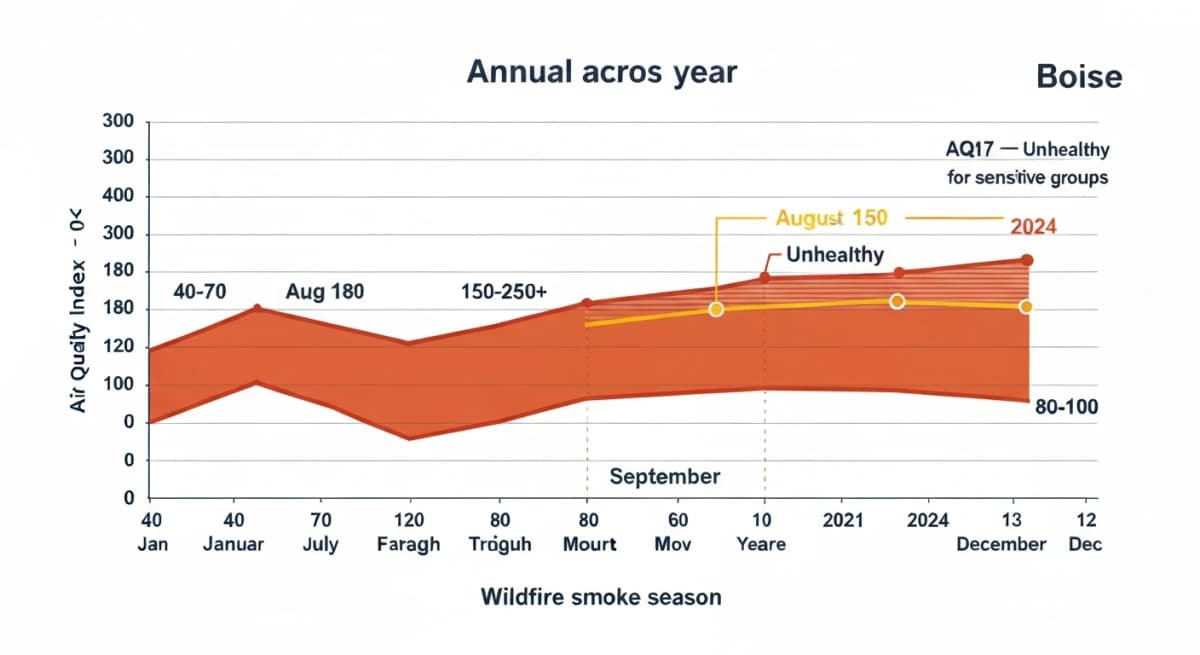
Wildfire smoke in the Treasure Valley is no longer a rare event — it's a predictable August-September seasonal pattern. Boise's foothills location, prevailing wind patterns, and proximity to major wildfire zones in Idaho, Oregon, California, and Washington produce smoke events that regularly push Air Quality Index (AQI) into the 150-300 range. The 2017, 2018, 2020, 2021, and 2024 fire seasons each had multiple weeks of AQI above 150 in Boise.
Standard residential kitchen ventilation is designed for normal cooking — not for indoor air quality protection during major smoke events. The standard range hood vents IN the smoke during exterior smoke events (the exhaust pulls outdoor smoky air through any leaks in the home envelope). Standard makeup air is unfiltered. Standard kitchen design assumes the outdoor air is acceptable.
This article covers six kitchen design decisions specifically for Boise homes (especially foothills and other smoke-vulnerable areas) where indoor air quality during smoke events matters. The investment runs $2,500-$8,500 above standard kitchen scope but produces a kitchen that maintains acceptable indoor air quality even during the worst smoke events.
For broader kitchen ventilation context — range hood sizing, makeup air at Boise's elevation, and standard ventilation strategy — see our kitchen range venting article. For broader HVAC and home air-quality context, see our HVAC guide for Boise.
Boise's geographic position and wind patterns produce reliable summer smoke events. Understanding the scale and frequency informs the design investment.
Recent wildfire-smoke seasons in Boise:
2017: Extended stretches of AQI above 150. Major Oregon fires.
2018: Extended stretches of AQI above 150. California and Oregon fires combined.
2020: Extended stretches of AQI above 150. Multiple major fire complexes across the western US.
2021: Multiple weeks above AQI 150 — one of the smokiest seasons on record for the Treasure Valley.
2023-2024 seasons: Continued elevated smoke days, varying by year.
Geographic factors that affect Boise smoke exposure:
Foothills location: Homes in the Boise foothills (Highlands, Warm Springs Mesa, East End above-canal, Hillside) often have higher AQI than valley-floor neighborhoods during smoke events due to elevation and wind exposure.
Treasure Valley topography: The Valley acts as a partial bowl, with smoke pooling during certain wind conditions. Some neighborhoods consistently experience worse smoke than others within the same metropolitan area.
Prevailing wind patterns: Summer westerly and southwesterly winds bring smoke from Oregon and California. Northerly winds bring Canadian fire smoke. East winds from Idaho's interior bring smoke from regional fires.
Why standard kitchen design fails:
Range hood vents IN smoke during smoke events: The exhaust pulls outdoor air through any leak in the home envelope. During heavy smoke, running the range hood for cooking actually accelerates smoke infiltration into the home. Homeowners often run hood less during smoke events for this reason — which makes cooking ventilation worse.
Unfiltered makeup air: makeup air systems — required under 2018 IRC M1503.6 for hoods over 400 CFM where a natural-draft fuel-burning appliance sits inside the air barrier — pull unfiltered outside air into the kitchen. During smoke events, this directly imports smoke.
Air-leakage in standard envelope: Boise homes built to standard code aren't sealed envelopes. Windows, doors, outlet penetrations, and exhaust pathways all allow outdoor air infiltration. Typical homes leak 0.3–1 air changes per hour under normal conditions (4–7 ACH50 under a blower-door test). During smoke events, that means the home's air is replaced with smoky outdoor air every one to three hours.
Standard HVAC filters: Most residential HVAC systems run MERV 4-8 filters. These don't filter PM2.5 smoke particles effectively. MERV 13+ filtration is needed for smoke.
For Boise homes in smoke-prone neighborhoods, addressing smoke event indoor air quality is a multi-year investment. Kitchen design contributes; whole-home envelope and HVAC matter more for overall protection.
Establishing the baseline understanding of why smoke-event kitchen design differs from standard.
The investment is real and ongoing. Some homes in less smoke-prone Boise locations may not need full smoke-protection design.
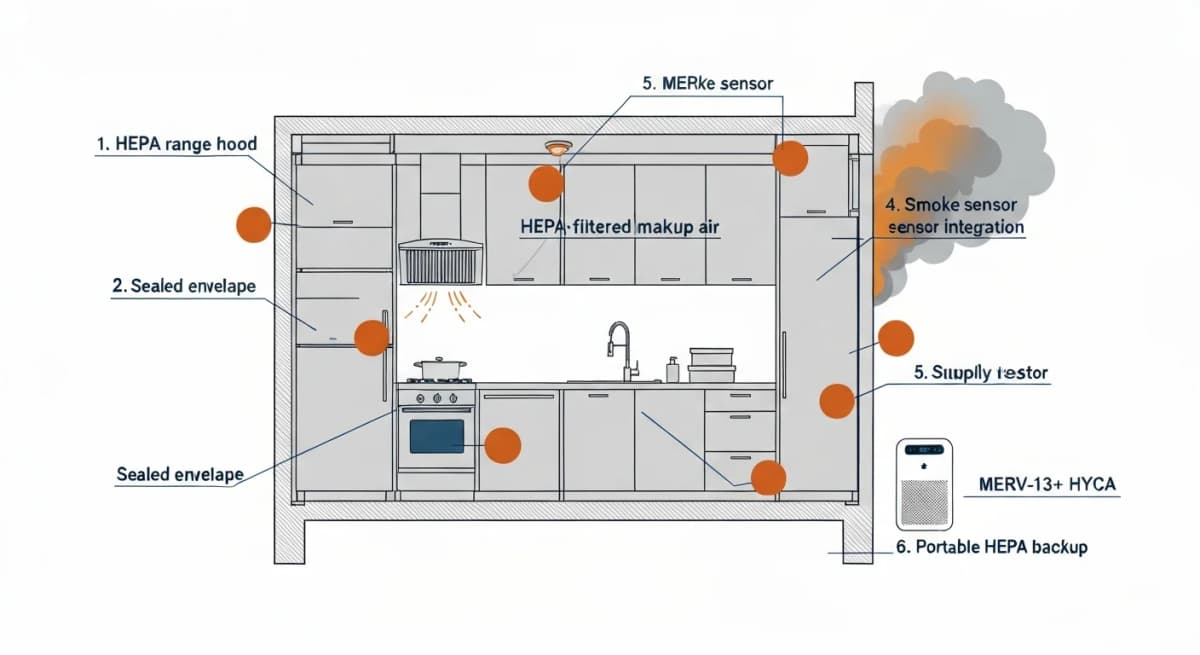
Standard range hoods exhaust cooking air to the exterior. Ducted residential hoods are not sold with true HEPA cartridges, so for smoke season the useful combination is a hood with a recirculation mode (so you are not pulling smoky outdoor air in through the make-up path) paired with a standalone HEPA purifier that filters the kitchen air.
Smoke-season hood and purifier specifications:
HEPA filter rating: True HEPA (99.97% efficient at 0.3-micron particles) or HEPA-style. Smoke particulate (PM2.5) is in the 0.1-2.5 micron range; HEPA filters capture this size range effectively.
Dual-mode operation: Vented mode (exhausts to exterior) and recirculation mode (filters and returns to kitchen). During smoke events, recirculation mode keeps smoky outdoor air from being pulled in.
Capture velocity: Capture velocity at the cooking surface determines effectiveness. Standard hoods provide 50-80 fpm at burner level. Premium hoods deliver 100+ fpm. Effective capture matters for both cooking smoke and recirculation-mode filtering.
Filter replacement schedule: HEPA filters need replacement every 6-18 months depending on use frequency. Cost: $40-$120 per filter. Plan for annual replacement during peak smoke season.
Specific brands and models:
Premium range hoods with a recirculation mode plus a separate HEPA purifier: Ducted hoods are not sold with HEPA cartridges, so pair a quality hood that can switch to recirculation during smoke events with a standalone HEPA purifier. Cost: $1,200-$3,500 for the hood plus install, plus the purifier.
Mid-range options: Some recirculating range hoods accept upgraded charcoal and particulate filter inserts. Cost: $200-$500 for the retrofit kit. Less effective than a standalone HEPA purifier but more affordable.
Recirculation-only hoods with high-efficiency filtration: Designed for kitchens where vented exhaust isn't feasible (apartments, retrofits). Limitation: doesn't exhaust cooking moisture, requiring active ventilation elsewhere. Cost: $400-$1,500.
Smoke event operation:
During heavy smoke (AQI 200+): Operate hood in recirculation mode only. Vented mode would pull smoky air in through other home leaks.
During moderate smoke (AQI 100-200): Hood operation manageable; some venting acceptable if necessary, with recirculation mode preferred.
During clear days: Standard vented operation; recirculation only as preference for energy savings.
Cost premium over standard range hood: $800-$2,800 (premium hood plus HEPA purifier vs $400-$800 standard residential hood). Meaningful but moderate within full kitchen remodel scope.
Boise homes in smoke-prone neighborhoods where cooking-event ventilation can't be normal-mode-only.
Higher upfront cost; ongoing filter replacement expense; recirculation-only mode doesn't exhaust cooking moisture.
Makeup air systems compensate for the air exhausted by range hoods above 400 CFM, and under 2018 IRC M1503.6 they are required where the home has a fuel-burning appliance that is neither direct-vent nor mechanical-draft inside its air barrier. Standard installations import unfiltered outside air. Smoke-protected installations include HEPA filtration on the incoming air.
Makeup air system options:
Standard makeup air (no filtration): the code-minimum arrangement where M1503.6 applies. Brings outdoor air in to replace exhausted air. During smoke events, directly imports smoke. Inadequate for smoke protection.
Makeup air with MERV filter: MERV 13+ filter on the incoming air. Catches some smoke particulate but not as effective as HEPA. Cost addition: $100-$300 for MERV 13 filter and housing.
Makeup air with HEPA pre-filter: True HEPA filtration on incoming makeup air. Captures smoke particulate effectively. Cost addition: $400-$1,200 for HEPA filter system and housing. The right specification for smoke-prone Boise homes.
Dual-mode makeup air: Makeup air system that can operate filtered or unfiltered depending on conditions. Filtered during smoke events; unfiltered during clear conditions (energy savings). Cost: $600-$1,800.
Integration with range hood:
Pressure-balanced operation: Makeup air activates automatically when range hood runs at high CFM. Maintains neutral pressure in the home — no negative pressure pulling in unfiltered air through leaks.
Manual override: Homeowner can activate makeup air system during smoke events even without range hood running. Provides filtered fresh-air supply to the kitchen.
HEPA filter maintenance:
Replacement schedule: Every 6-12 months for HEPA pre-filter on makeup air system. More frequent during heavy smoke years. Cost: $40-$150 per replacement.
Pre-filter check: Visual inspection monthly during smoke season. Heavily-loaded pre-filters indicate the system is capturing significant particulate.
Smoke event integration:
The combined system (HEPA range hood + filtered makeup air) means the kitchen can operate normally during smoke events with appropriate air quality maintenance. Standard kitchens essentially shut down for cooking during heavy smoke; equipped kitchens continue functioning.
Smoke-prone Boise homes where cooking continues during smoke events.
Significant cost addition. Ongoing filter maintenance.
Build a kitchen that works during smoke season
Wildfire-smoke protection is part of our standard Boise kitchen design for foothills and other smoke-prone locations. Schedule a consultation and we'll spec the right combination for your home and exposure profile.
Kitchen-specific envelope sealing reduces smoke infiltration paths. Beyond whole-home envelope sealing (which is its own bigger project), focused kitchen-area sealing makes a meaningful difference.
Kitchen-specific sealing improvements:
Window weatherstripping: Kitchen windows that haven't been re-weatherstripped in 10+ years often have gap-leakage. Re-weatherstrip (DIY $20-$80 or pro install $150-$400) reduces infiltration significantly.
Exterior door sealing: Kitchen-area exterior doors (often kitchen-to-mudroom or kitchen-to-deck) need door sweeps and jamb weatherstripping. Cost: $30-$100 in materials; DIY install.
Outlet and switch penetrations: Foam gaskets behind exterior-wall outlets and switches reduce air leakage. Cost: $20-$60 for the gaskets plus DIY install on each outlet. For a kitchen with 6-10 outlets/switches on exterior walls, total time 1-2 hours.
Range hood vent damper: Standard range hood exhaust dampers don't close tightly when hood isn't running. Upgrade to insulated, gasket-sealed damper. Cost: $30-$100. Significantly reduces back-draft during smoke events.
Exterior wall ventilation penetrations: Boise homes often have dryer vents, bathroom exhausts, and other penetrations near kitchens. Inspect and ensure dampers close tightly. Replace failing dampers ($30-$80 each).
Cabinet base sealing: Sink-cabinet penetrations for plumbing supply lines and drain are common air leak paths. Seal with foam or caulk during cabinet install. Cost: minimal during construction; $50-$150 for retrofit.
Whole-home envelope considerations:
The kitchen-specific improvements above contribute but don't fully solve the smoke infiltration problem. For comprehensive protection:
Whole-home air sealing: Professional energy-audit-driven sealing. Cost: $1,500-$4,500. Reduces overall infiltration rate substantially. Particularly valuable for pre-1990 Boise homes.
A blower-door home-performance assessment: a third-party test that locates the actual leakage paths instead of guessing at them. Idaho Power's published residential offers are the Heating and Cooling Efficiency Program, the A/C Cool Credit and the Shade Tree Project, so do not budget on the assumption that the utility will subsidise the audit — price it directly with an independent energy rater. Worth doing before you spend on sealing, so the money goes where the leaks are.
For Boise homes in smoke-prone neighborhoods, the combination of kitchen-specific sealing plus whole-home improvements produces meaningful indoor air quality protection during smoke events.
Smoke-prone Boise homes where reducing infiltration matters for both smoke and energy efficiency.
Modest upfront investment with ongoing benefit. Doesn't eliminate smoke infiltration entirely.
Modern smoke sensors can detect not just fire but also outdoor air quality and PM2.5 particulate. When integrated with home automation, the kitchen ventilation and HVAC can respond automatically during smoke events.
Smoke sensor options:
Indoor air quality monitors: Standalone sensors (PurpleAir, Awair, IQAir AirVisual) monitor indoor PM2.5, CO2, VOCs, temperature, humidity. Cost: $150-$500.
HVAC-integrated air quality sensors: Smart thermostats with built-in IAQ sensors. Activate filtration and ventilation based on readings. Cost: $200-$600 for smart thermostat with IAQ.
Combined indoor-outdoor sensors: Some systems monitor both indoor and outdoor air quality. When outdoor AQI elevates, the system automatically adjusts indoor ventilation strategy. Premium tier.
Smart home integration:
Automatic recirculation activation: When outdoor AQI exceeds threshold (e.g., 100), range hood automatically switches to recirculation mode. Makeup air system activates filtered intake. HVAC filtration ramps to max.
Automatic schedule adjustments: During smoke events, automatic schedule shifts kitchen ventilation from "exhaust during cooking" to "recirculation during cooking." Reduces homeowner attention required.
Notification system: Smartphone notification when smoke event begins or ends. Allows homeowners to manually adjust additional systems (windows closed, etc.).
Cost integration:
Basic standalone IAQ monitor: $150-$400. No automation; informational only.
Smart HVAC integration: $400-$1,200 for smart thermostat plus IAQ sensors. Some automation possible.
Full smart-home integration: $1,500-$4,500 including smart hub (SmartThings, Hubitat, or similar), IAQ sensors, smart hood controls, smart makeup air controls. Provides automated response.
Boise-specific monitoring resources:
PurpleAir community monitors: Many Boise residents have installed PurpleAir sensors, creating a community map (purpleair.com). Free reference for outdoor AQI in your specific neighborhood.
Idaho DEQ air quality monitoring: Idaho Department of Environmental Quality runs monitors throughout the Treasure Valley. Real-time data available at deq.idaho.gov.
EPA AirNow: Official EPA AQI for major Boise monitoring stations.
For smoke-prone Boise homes, smart sensor integration moves the smoke-event response from manual to automatic — significant convenience and indoor air quality benefit.
Tech-comfortable households wanting automated smoke-event response.
Adds cost and complexity. Manual operation is workable for less tech-oriented households.
The kitchen-specific systems above primarily address kitchen air quality. For whole-home air quality during smoke events, HVAC filtration and supplemental portable HEPA are essential complements.
HVAC filter upgrades:
Standard MERV 4-8: Inadequate for smoke particulate. Most older Boise homes have these filters.
MERV 11-12: Captures some smoke particulate. Compatible with most residential HVAC systems without modification. Cost premium: $20-$40 per filter over standard. Replacement every 3-6 months.
MERV 13+: Effective smoke particulate capture. Requires HVAC system rated for higher pressure drop. Most modern systems handle MERV 13; older systems may need fan adjustments. Cost: $40-$80 per filter, replacement every 2-4 months during heavy smoke seasons.
Whole-house HEPA filtration: Standalone HEPA filtration system integrated into HVAC ductwork. Captures essentially all PM2.5. Premium installation: $2,500-$8,000 plus filter replacements ($150-$400 annually).
Portable HEPA air purifiers:
Why portable: During smoke events, portable HEPA in the kitchen provides additional filtration that the HVAC system alone may not deliver. The portable unit operates at a much higher flow rate per square foot of room area than typical HVAC filtration.
Recommended models: Coway Mighty (300+ sq ft), Honeywell HPA300 (465 sq ft), IQAir HealthPro (700+ sq ft). Cost: $250-$1,500 depending on size and brand.
Placement: Run continuously during smoke events, positioned away from direct cooking air (the cooking generates its own particulate that the portable unit will be capturing). Often best position: opposite end of kitchen from the cooking area.
Filter replacement: Manufacturer-specified schedule. During heavy smoke years, replacement may need to happen 2x normal frequency. Cost: $50-$200 per filter set.
Boise-specific recommendations:
Foothills homes (highest smoke exposure): Whole-house HEPA filtration + MERV 13 HVAC + portable HEPA in kitchen during smoke events. Comprehensive multi-layer protection.
Valley-floor homes (moderate smoke exposure): MERV 13 HVAC filtration + portable HEPA in kitchen during smoke events. Cost-effective protection.
Cooking-intensive households: Portable HEPA in kitchen even during non-smoke times. Cooking generates significant indoor particulate; HEPA filtration improves daily air quality.
Multi-layer smoke protection for Boise homes where indoor air quality during smoke events matters.
Cumulative cost. Multiple systems requiring filter replacements.
Iron Crest's kitchen design for Boise foothills and other smoke-prone areas includes explicit wildfire-smoke discussion during the design phase. We coordinate range hood specification, makeup air system selection, and envelope-sealing recommendations to produce a kitchen that functions during smoke events. The cost premium runs $2,500-$8,500 above standard residential kitchen scope — modest within full kitchen remodel budget and high-value for the August-September smoke realities most Boise homes face. For broader range venting context including elevation considerations, see our kitchen range venting article; for HVAC context, see our HVAC guide.
Can I retrofit smoke-protection features to my existing kitchen?
Partially. Range hood replacement, MERV 13 HVAC filter upgrade, portable HEPA addition, and outlet-penetration sealing are all retrofit-feasible without major construction. Cost for partial retrofit: $1,500-$4,500. Major-construction items (filtered makeup air system, sealed kitchen envelope, whole-house HEPA) typically require full kitchen remodel scope to implement cost-effectively.
Will smoke protection features increase my electricity bill?
Modestly. Recirculation-mode range hood saves energy vs. vented mode (no makeup air imported and conditioned). Portable HEPA filtration adds $5-$25 per month in electricity costs during heavy operation periods. Whole-house HEPA filtration adds $10-$40 monthly. Total smoke-protection energy premium during heavy smoke seasons: $30-$80 per month over 2-3 months annually. Modest cost given the indoor air quality benefit.
How do I know if my home is in a high smoke exposure area?
Three indicators. (1) Check PurpleAir community sensors for your specific neighborhood — sensors near you reveal the actual outdoor AQI patterns. (2) Compare your address to Idaho DEQ monitors — closest monitor data is similar to your conditions. (3) Track your own experience: notice how often you have smoke smell, see haze, or experience eye irritation during smoke seasons. Foothills neighborhoods (Highlands, Warm Springs Mesa, East End, Hillside) typically have higher exposure than valley-floor. Households closer to canyon entrances (where smoke tends to flow) often have higher exposure.
Will smoke protection features add value at resale?
Modestly positive for higher-end homes. Buyers in Boise increasingly recognize the wildfire-smoke reality. HEPA range hoods, whole-house HEPA, and documented sealed envelopes are recognized features in the $600k+ home market. For homes below $400k, the features are essentially neutral on resale. For homes above $1M, the features may approach expected status for premium positioning.
Are there utility rebates for HVAC filtration upgrades in Boise?
No. Idaho Power's Heating and Cooling Efficiency Program covers equipment — heat pumps, central air conditioning, duct sealing, smart thermostats, evaporative coolers, whole-house fans — not filtration, and there is no filtration rebate from any utility serving the Treasure Valley. Duct sealing is the one adjacent item on the list, and it is genuinely worth pricing during a remodel because leaky return ducts pull smoky attic and crawl space air into the system. Budget the filtration scope as a comfort and health investment rather than an incentive-driven one.
Build a kitchen that works during smoke season
Wildfire-smoke protection is part of our standard Boise kitchen design for foothills and other smoke-prone locations. Schedule a consultation and we'll spec the right combination for your home and exposure profile.
These pages go deeper on the topics linked from this article. Read them before your consultation and you'll come in with sharper questions and a clearer scope.
The following government agencies, industry organizations, and official resources provide additional information relevant to your remodeling project.