
Boise Empty-Nester Master Bath: 6 Reasons the Conventional 'Keep One Tub' Advice is Wrong for 3+ Bath Homes
The 'always keep at least one tub' resale advice is based on family-buyer assumptions that don't fit empty-nester remodels in 3+ bath Boise homes. Six analyses showing why removing the master bath tub for a generous walk-in shower beats the conventional advice in your specific scenario.
Quick answer
Three quick ways to assess. (1) Ask your Realtor about the buyer profile in your specific neighborhood over the last 12-24 months — they can read it off MLS comparable sales analysis. (2) Look at recent comparable sales: homes that sold quickly and at premium per-square-foot pricing indicate the demographic of buyers responding to that neighborhood.
Talk to any Boise real estate agent about whether to remove a tub during a bathroom remodel and you'll hear the same advice: "Keep at least one tub in the home for resale." That advice is generally correct — for 2-bath family homes where the buyer pool prioritizes child-bathing. It's frequently wrong for 3+ bath homes where empty-nester buyers and downsizing professionals dominate the resale demand.
Specifically: in Eagle, Meridian's higher-end subdivisions, the Boise Foothills, parts of West Boise, and increasingly in the East End and Harris Ranch, a substantial portion of homes have 3 or more full bathrooms. Many of these homes will eventually trade hands between empty-nesters and downsizing households. For these buyers, a generous master bath walk-in shower frequently beats a tub-and-shower combination on perceived value — and the secondary bathrooms in the home satisfy any "we need a tub somewhere" requirement.
This article walks through six analyses showing when the conventional "keep one tub" advice is wrong for your specific scenario, with cost and resale-impact data specific to the Boise market.
For the broader tub-vs-shower decision framework — including family-home considerations, accessibility, and the general resale impact — see our walk-in shower vs bathtub Boise guide. For the conversion scope itself (plumbing, framing, finish), see our tub-to-shower conversion service page. This article focuses specifically on the empty-nester demographic in 3+ bath Boise homes where the conventional resale advice doesn't apply.
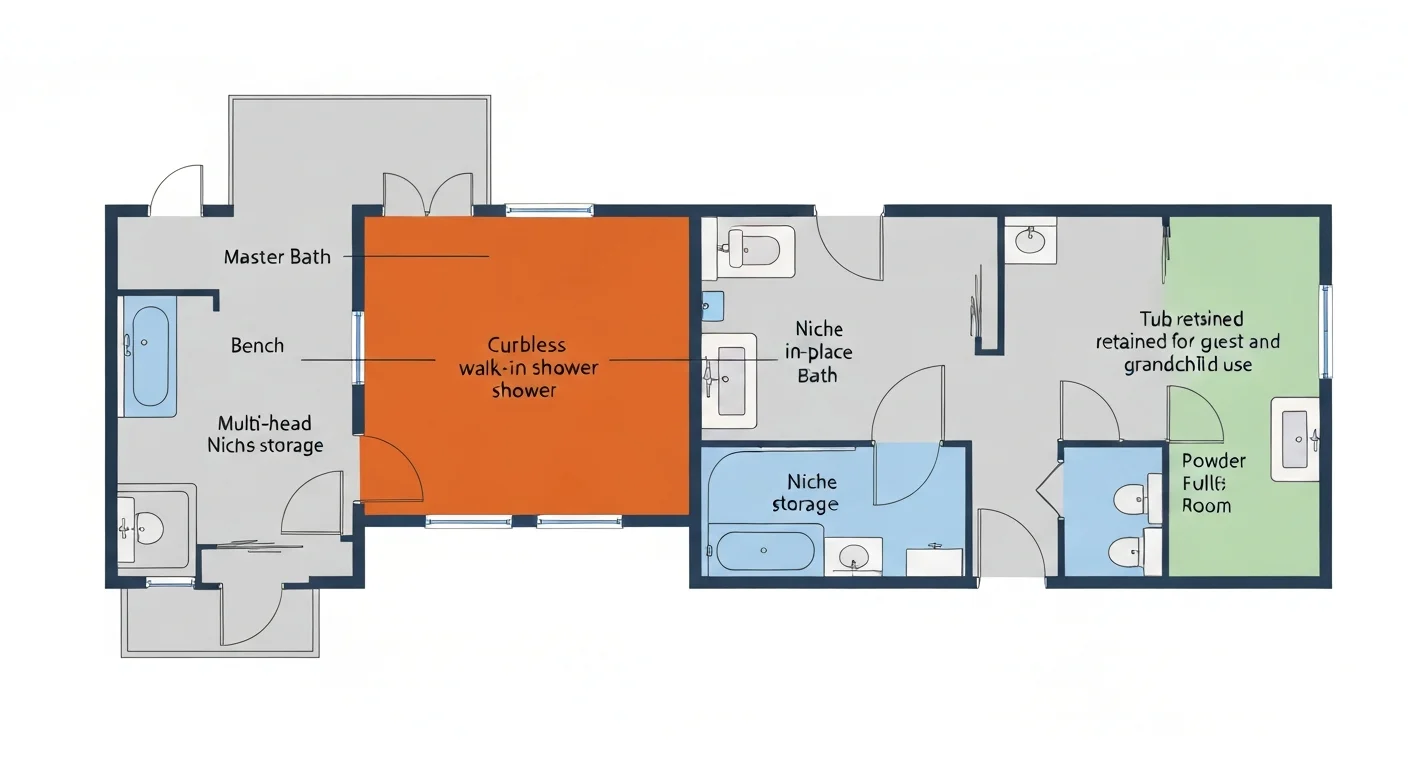
The "always keep at least one tub" advice originated in residential real estate practices from the 1980s-2000s. The reasoning was sound for the era and the typical 2-bath family home buyer:
Family buyers bathing young children: Parents of children under age 5-6 typically bathe rather than shower the kids. A home without a tub eliminates a major buyer category. For 2-bath homes where buyers are predominantly young families, removing the only tub significantly reduces the buyer pool.
Resale liquidity in family neighborhoods: Homes in family-buyer-dominant neighborhoods (subdivisions with elementary schools nearby, in the typical $300-500k price range, with 3-4 bedrooms) sell faster with a tub than without. Days-on-market matters to sellers.
Disability or aging considerations later in life: Some buyers want a tub for future-flexibility — even if they personally shower, they want the option of a soaking tub for relaxation or future use.
For 2-bath family homes in family-buyer neighborhoods, this advice still holds. Keep your tub if you're remodeling that bathroom.
But the advice was developed before Boise's housing stock and demographics had their current characteristics. Today's Boise market has shifted in several ways that invalidate the universal "keep one tub" advice:
Higher bath count in newer Boise homes: Many post-2000 Boise homes have 3 full baths (master, secondary, plus a separate guest bath or basement bath) plus a powder room. The "keep one tub" advice was developed for 2-bath homes where this was the only tub. In 3+ bath homes, removing the master tub still leaves 1-2 tubs in other bathrooms.
Empty-nester households are a real part of the Treasure Valley buyer pool: in some neighborhoods — Eagle, the Foothills, Harris Ranch, the premium Meridian subdivisions — the homes that turn over are routinely bought and sold by households whose children have moved out. We have not found a published, dated dataset that ranks Boise neighborhoods by buyer age, so treat this as a pattern to confirm with your own agent rather than a statistic.
Aging-in-place trends: Empty-nesters who plan to stay in their homes for 20+ more years are explicitly prioritizing walk-in showers over tubs for safety (slip hazards in tubs grow with age) and convenience. A home configured for aging-in-place has a meaningful resale advantage in empty-nester-dominant neighborhoods.
Downsizer buyer profile: Empty-nesters downsizing from large family homes to lower-maintenance properties want master bathrooms that fit their actual usage — and that usage is overwhelmingly showering, not bathing. A generous walk-in shower is a positive feature for this buyer, not a negative.
The result: for empty-nester-dominant neighborhoods with 3+ bath homes, the "keep one tub" advice is wrong because it's based on an outdated buyer profile. The actual buyer in your future resale is more likely to PREFER the walk-in shower.
Boise homeowners in empty-nester-dominant neighborhoods who are evaluating master bath remodel decisions.
Wrong neighborhood selection can still hurt resale. Family-dominant neighborhoods still follow the conventional advice.
The neighborhood-level demographic matters more than the home-level features. A 3-bath home in a family-buyer neighborhood faces a different resale calculus than the same home in an empty-nester-dominant neighborhood.
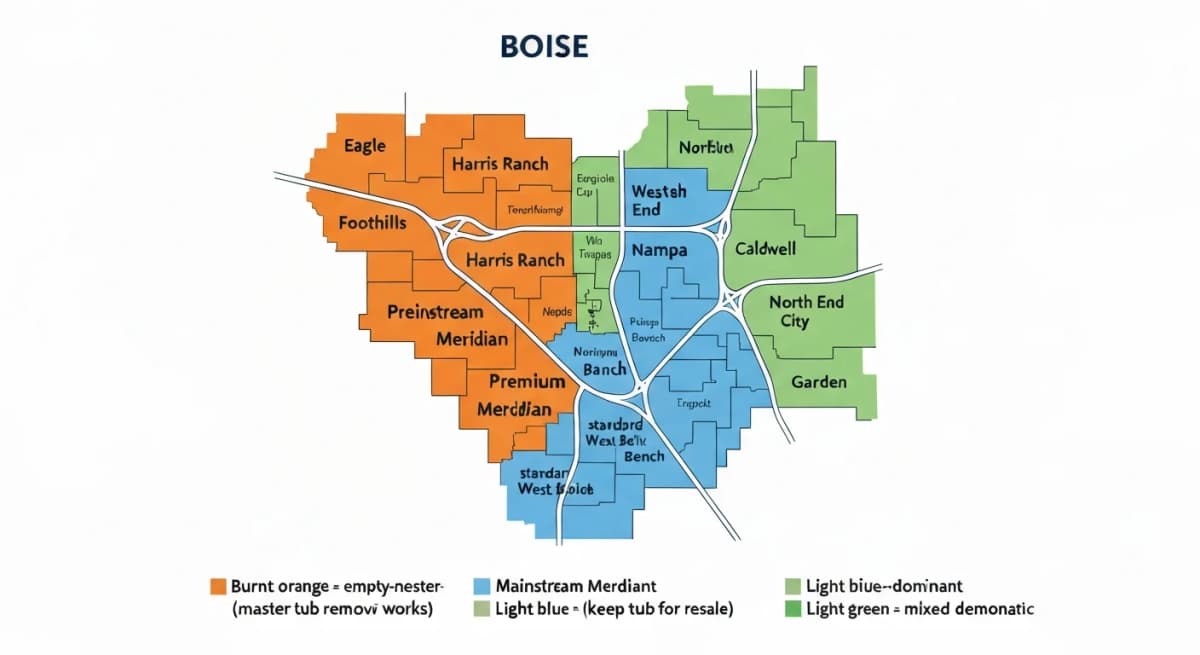
Empty-nester-dominant Boise neighborhoods (where master tub removal works):
Eagle: Established subdivisions with premium pricing that supports premium master bathroom investment. In the higher-priced Eagle homes we work in, a large walk-in shower reads as expected rather than optional.
Boise Foothills (Highlands, Warm Springs Mesa, Hillside, East End): Strong empty-nester demographic in established Foothills neighborhoods. Premium pricing, mature buyers, and aging-in-place priorities align with master tub removal.
Harris Ranch and Southeast Boise: Newer subdivisions with strong empty-nester buyer demand. Higher-end Harris Ranch homes regularly feature large walk-in showers without master tubs.
Premium Meridian (Sage Acres, foothills-adjacent areas): Higher-end Meridian subdivisions skew older. Family-buyer dominance is in the entry-level Meridian neighborhoods, not the premium ones.
West Boise (premium subdivisions): Mixed. Some West Boise neighborhoods are family-dominant; others (especially newer premium subdivisions) skew empty-nester.
The Bench (newer premium subdivisions only): Most of the Bench is family-dominant. But some pockets of newer, higher-end Bench construction follow empty-nester patterns.
Family-buyer-dominant Boise neighborhoods (keep your tub):
Mainstream Meridian (Cherry Lane area, central Meridian subdivisions): Strong family-buyer demand. Entry-level pricing. Master tub removal hurts resale.
Standard West Boise: Most West Boise outside premium subdivisions. Family-dominant.
Nampa, Caldwell, Star, Kuna: Strong family-buyer demand. Entry-level and mid-market pricing. Master tub removal not recommended for resale.
Garden City (most subdivisions): Mixed but trending family.
Boise Bench (typical mid-century subdivisions): Family-dominant.
How to verify your specific neighborhood:
Ask your Realtor for buyer-profile data: Most Boise Realtors track buyer demographics for their specific neighborhoods. Ask: "What's the typical buyer profile for homes in this neighborhood that have sold in the last 12 months?" Answers like "empty-nesters and pre-retirees" support master tub removal; answers like "families with school-age children" support keeping the tub.
Look at school zone influence: Homes in zones for in-demand elementary schools (especially private schools) attract family buyers regardless of house features. Homes in zones less-prized for elementary but valued for high school attract different demographics.
Check the bath count of nearby comparable sales: If recently sold homes in your neighborhood with similar bath counts (3+) featured walk-in showers rather than tubs, that's a strong signal that buyers in your market accept and prefer the configuration.
Determining whether your specific neighborhood matches the demographic profile where master tub removal works for resale.
Neighborhood profiles shift over time. What's empty-nester-dominant today may be family-dominant in 10 years.
The economic case for master tub removal involves both the conversion cost and the resale impact. Both should be quantified before deciding.
Conversion costs:
Basic tub-to-shower conversion (replacing tub footprint with walk-in shower): $7,500-$15,000 in a typical Boise master bath. Includes tub removal, shower pan installation, plumbing modification, new waterproofing, tile, glass enclosure, and trim. Same footprint as original tub.
Expanded walk-in shower (taking some of the existing shower footprint plus the tub): $10,000-$22,000 if the existing master bath already had a separate shower stall. Removing the wall between the tub area and the shower stall produces a much larger shower than either original space. Premium configuration but high-impact.
Curbless wet-room style with premium features: $18,000-$45,000 with curbless threshold, linear drain, frameless glass, multi-head shower, integrated bench, niche, and premium tile. The high-end version that maximizes resale impact in empty-nester-dominant neighborhoods.
Resale impact — and why we will not put a number on it:
We have no sourced, dated Treasure Valley dataset that isolates the list-price or days-on-market effect of removing a master tub, and neither does anyone else we have been able to check. The national remodeling cost-versus-value studies linked below report project categories, not this decision, and they do not break out Ada County. Any contractor who hands you a dollar figure for what tub removal does to your list price is estimating, not measuring. So here is the honest shape of it, with no numbers attached:
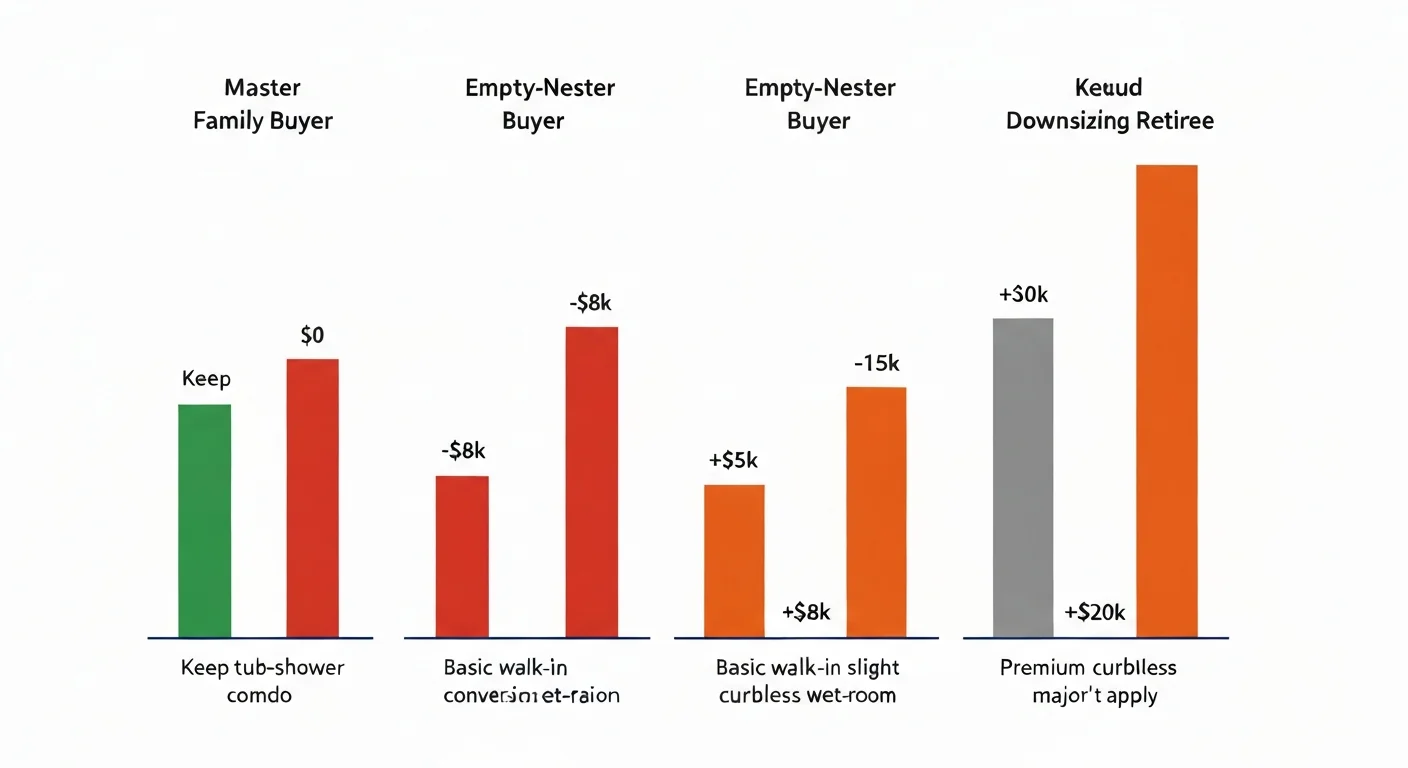
Family-dominant neighborhoods, removing the only tub: a real risk to the buyer pool. Parents of small children screen for a tub, and a listing without one drops out of some searches entirely. Don't do it.
Empty-nester-dominant neighborhoods, basic walk-in shower conversion: unlikely to hurt, unlikely to pay for itself at sale. The justification is the years you use it, not the closing statement.
Empty-nester-dominant neighborhoods, premium curbless wet-room conversion: the version most likely to be a positive at sale, because a large curbless shower photographs well and matches what this buyer is looking for. Whether it returns its cost is not something we can tell you.
Aging-in-place, accessibility-optimized conversion: valuable to a narrow, motivated slice of buyers. Narrow demand is not the same thing as a price premium.
The only honest total-economics framing: treat the conversion cost as the price of the years you will use the shower, divided across those years, and treat any resale benefit as upside you did not pay for. If the arithmetic only works when the resale line is filled in, the project isn't justified.
Family household considering master tub removal: don't. The buyer-pool argument runs against you and no finish level fixes it.
Boise-specific notes:
Hard water consideration: Boise's hard water creates more shower-glass cleaning burden than many markets. Empty-nesters often prefer easier-to-maintain showers (large clear-glass openings without complex framework). This factors into design but not into the basic remove-or-keep-tub decision.
Resale timing: If you're planning to sell within 1-2 years, the master bath remodel ROI is significantly different than if you'll own for 5-10+ years. The 1-2 year timeline favors keeping existing features and doing only minor cosmetic upgrades; 5-10 year timelines favor more substantial improvements.
Empty-nester homeowners in qualifying Boise neighborhoods who want to quantify the resale-vs-cost trade-off.
The math is sensitive to specific neighborhood, specific home characteristics, and market timing. General ranges apply; specific situations may differ.
Design a master bath that fits how you actually use it
Master tub removal isn't right for every Boise home — but for empty-nesters in 3+ bath homes in the right neighborhoods, a generous walk-in shower beats a tub-and-shower combination on both daily use and resale. Schedule a consultation and we'll walk through the analysis for your specific home.
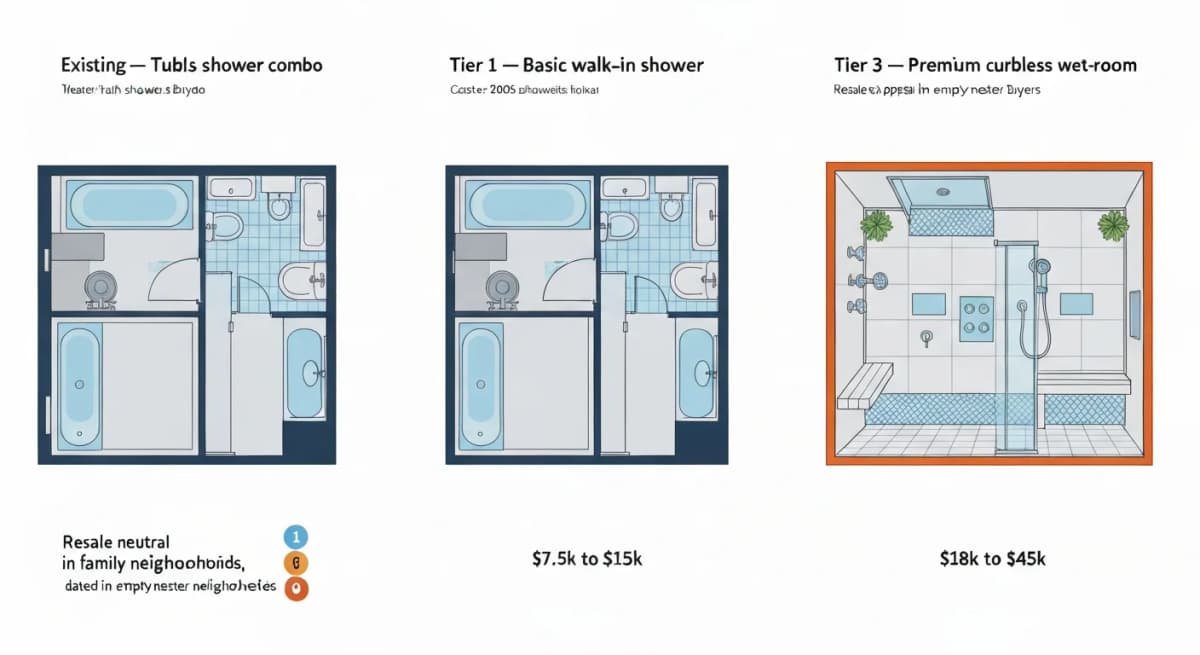
If you're proceeding with master tub removal, three configuration tiers offer different cost-vs-benefit profiles.
Tier 1: Basic walk-in shower in the tub footprint:
The simplest conversion. Existing tub removed; shower pan installed in the same 60-inch by 32-inch footprint; walls re-tiled; standard glass enclosure installed.
Cost: $7,500-$15,000.
Result: Functional walk-in shower in the same space as the original tub. Doesn't change the bathroom's overall layout. Compatible with most Boise master bathroom floor plans.
When to choose: budget constraints, no desire for significant bathroom reconfiguration, simple-and-clean priority.
Tier 2: Expanded walk-in shower combining tub and existing shower stall:
If the master bath already has both a tub and a separate shower stall (common in 1990s-2010s Boise master bathrooms), the wall between them can be removed and the combined space converted to a single large walk-in shower.
Cost: $10,000-$22,000.
Result: 60 inches by 48-60 inches walk-in shower with room for multiple showerheads, bench, and niche storage. Significantly more generous than the original tub footprint or the original shower stall.
When to choose: existing layout has both tub and separate shower stall, homeowner wants more shower space than the original tub footprint provided.
Tier 3: Curbless wet-room style:
Premium configuration. Floor extends from bathroom into shower zone without a curb. Linear drain handles water management. Floor tile is continuous from outside the shower to inside. Glass partial-height partition contains spray. Often combined with heated floor and multi-head shower system.
Cost: $18,000-$45,000.
Result: Hotel/spa aesthetic. Easy accessibility (no curb to step over). Maximum visual impact. Photographs exceptionally well for resale listings.
When to choose: premium home in empty-nester-dominant neighborhood, homeowner values aging-in-place accessibility, budget supports the premium configuration.
Configuration considerations specific to empty-nesters:
Future accessibility: Curbless configurations easily accommodate eventual wheelchair access if needed in 15-20+ years. Curbed configurations don't. For empty-nesters planning to age in place, curbless is the future-proof choice.
Bench: Built-in shower bench supports leg-shaving comfort, foot care, and provides seated showering option for users with limited stamina. The bench dimensions matter — see our shower bench ergonomics article for sizing.
Niche storage: Built-in storage niches keep shampoo and bath products organized without external shelving that collects mineral scale (a real issue in Boise's hard water). Multiple niches at different heights serve different users.
Multi-head shower system: Empty-nesters often appreciate the spa-like feel of multiple shower heads. See our multi-head shower water pressure article for the plumbing requirements.
Grab bars and reinforcement: Even if you don't need grab bars now, the framing should be reinforced to support them in the future. Cost is minimal during construction; retrofit is much more expensive.
Selecting the configuration tier that fits your budget, your bathroom layout, and your aging-in-place priorities.
Higher-tier configurations cost more but deliver more daily-use benefit and more resale impact. Lower tiers are economical but less differentiating.
Understanding what empty-nester buyers specifically value helps prioritize the remodel investments that produce resale return.
Empty-nester buyer priorities, as they come up in our own design conversations with this household type — not survey data:
Master bedroom suite as a sanctuary: Empty-nesters spend more time in their master suite than family-stage homeowners. The bedroom-bathroom suite is the primary daily environment. Premium features here have outsized impact on perceived home value.
Walk-in shower as expected: For homes priced above $500k in empty-nester-dominant neighborhoods, walk-in showers are increasingly the expected master bath configuration, not the premium feature. Homes without walk-in showers may be perceived as outdated.
Single-floor living configuration: Empty-nesters often prefer single-floor living. A master suite on the main floor (rather than upstairs) commands a meaningful premium. Two-story homes with all bedrooms upstairs are less desirable for this demographic.
Aging-in-place subtle integration: Empty-nesters want aging-in-place features that don't scream "this house is for old people." Subtle wider doorways, lever handles, curbless showers, blocking for future grab bars — all valued. Overt institutional-style accessibility features (giant grab bars, hospital-grade fixtures) are not.
Easy-maintenance materials: Empty-nesters often choose homes based on perceived maintenance burden. Quartz counters, porcelain tile, hard-surface flooring, and easy-clean shower glass all support this. Limestone, travertine, natural marble, and other high-maintenance materials sometimes work against the demographic preference.
Open-concept main living areas: Less specifically bathroom-related but worth noting. Empty-nesters often want flexible single-floor living with open kitchen-living-dining areas. If you're remodeling the master bath as part of a larger remodel, the broader layout matters.
Garage capacity for empty-nester hobbies: 2-car attached garage is the floor; 3-car or 2-car-plus-workshop is the preference. Not bathroom-related but relevant for the broader empty-nester-home positioning.
Outdoor entertaining space: Empty-nesters often entertain more than family-stage homeowners. Patio, deck, or covered outdoor space adds value.
What empty-nester buyers don't prioritize:
School zone quality: Doesn't matter to most empty-nesters. (Their kids are grown.)
Multiple children's bedrooms: Doesn't matter unless they explicitly want space for visiting grandchildren.
Bathtubs in master: The focus of this article. Most empty-nesters don't bathe in tubs regularly. Soaking tubs are sometimes valued in master baths but as a separate fixture from the daily shower — and a tub-and-shower combination is the wrong configuration for both functions.
Massive square footage: Often inverse — empty-nesters often prefer more efficient, lower-maintenance homes over larger square footage.
For Boise homeowners thinking about the empty-nester resale, the master bath walk-in shower fits squarely into the buyer's priorities. The "keep one tub" advice misses what this buyer actually wants.
Understanding the demographic's actual preferences rather than relying on outdated conventional wisdom.
Buyer preferences shift over decades, and this article describes what we see in 2026 rather than a tracked dataset. Design for how your household will use the room, since that part you can be sure of.
Synthesizing the previous five items into a decision framework you can apply to your specific situation.
Step 1: Confirm bath count.
Count actual full bathrooms (toilet + sink + shower or tub) in your home. Powder rooms (toilet + sink only) don't count. Half baths in pool houses, ADUs, or guest casitas may count depending on accessibility — consult your Realtor.
Bath count rule: master tub removal makes sense only when at least one other full bath in the home has a tub. For 2-bath homes (master + one secondary), this means keeping a tub in the secondary bath. For 3+ bath homes, this is essentially always the case.
Step 2: Identify your neighborhood demographic.
Use the neighborhood map in item 2 plus your Realtor's input. Confirm whether your buyer pool will be empty-nester-dominant or family-dominant. Empty-nester-dominant: proceed with conversion analysis. Family-dominant: keep the tub.
Step 3: Verify resale timing.
If you're planning to sell within 18 months, the remodel ROI is significantly different from longer-horizon analysis. Short-timeline remodels: minor cosmetic upgrades only. Long-timeline remodels (5-10 years of ownership): substantial improvements are economically reasonable.
Step 4: Match configuration to budget.
Use item 4's three tiers. Budget below $15k: tier 1 basic conversion. Budget $15-25k: tier 2 expanded conversion. Budget $25k+: tier 3 premium curbless. Higher budgets in empty-nester-dominant neighborhoods produce better ROI per dollar; lower budgets still produce positive but smaller returns.
Step 5: Coordinate with aging-in-place planning.
If you're planning to stay in the home 15+ years, build in aging-in-place features now. Curbless threshold, framing reinforcement for future grab bars, lever handles, wider doorway — all add minimal cost during construction but significant cost during future retrofit.
Step 6: Document and proceed.
Document the decision rationale (bath count, neighborhood demographic, configuration choice). This documentation supports the eventual listing and helps your Realtor explain the design choice to buyers.
Decision matrix summary:
Keep tub if: 2-bath home; family-dominant neighborhood; planning to sell within 18 months; budget very tight; homeowner personally uses bathtub regularly.
Remove tub for walk-in shower if: 3+ bath home; empty-nester-dominant neighborhood; 5-10+ year ownership planned; budget supports tier 2 or 3 conversion; homeowner doesn't bathe regularly.
For most empty-nesters in qualifying Boise neighborhoods, the second column applies. The conventional "keep one tub" advice is wrong for your specific situation.
Boise homeowners making the actual remove-or-keep decision for their specific home and circumstances.
The framework is general guidance — specific homes have specific factors that may shift the decision either way.
Iron Crest's master bath consultation for empty-nester households starts with the demographic and resale conversation before discussing fixtures or finishes. Empty-nester master bath conversions in Eagle, the Foothills, Harris Ranch, and premium Meridian follow a consistent enough pattern that we work from specific design templates for this market.
The typical scope on these projects runs $18,000-$32,000 for premium curbless walk-in shower conversion replacing the master tub. We coordinate aging-in-place features (curbless threshold, blocking for future grab bars, lever handles, wider doorway clearances) as standard inclusions rather than upgrades. For broader tub-to-shower conversion context, see our tub-to-shower conversion page; for the broader resale framework, see our walk-in shower vs bathtub resource.
What if I'm not sure whether my neighborhood is empty-nester-dominant or family-dominant?
Three quick ways to assess. (1) Ask your Realtor about the buyer profile in your specific neighborhood over the last 12-24 months — they can read it off MLS comparable sales analysis. (2) Look at recent comparable sales: homes that sold quickly and at premium per-square-foot pricing indicate the demographic of buyers responding to that neighborhood. If those sales featured walk-in showers without master tubs, that's strong signal the demographic accepts/prefers this configuration. (3) Walk the neighborhood — empty-nester-dominant neighborhoods have well-kept landscaping, fewer kids' bikes and toys in yards, and more lifestyle vehicles (golf carts, motorcycles, RVs). Family-dominant neighborhoods have the opposite signal pattern. Combining these three data points gives a reliable read on your specific block.
Will my insurance change after master tub removal?
No meaningful impact for homeowner's insurance. The bath fixture configuration doesn't affect insurance underwriting. The only insurance scenario where master bath remodel matters is during the construction window itself — make sure your contractor has appropriate liability and workers' comp coverage, and that your homeowner's policy is informed about active construction. After completion, the home is reassessed for property tax (Idaho's reassessment frequency varies by county; Ada County reassesses on a 5-year cycle), but the bath fixture change rarely triggers significant assessment increase unless it's part of a larger improvement.
What if I'm wrong about my neighborhood and a future buyer wants a tub?
The risk is real but manageable. Strategies to mitigate: (1) Document the design decision and the demographic analysis behind it. When listing, your Realtor can communicate the rationale to buyer agents. (2) Make sure at least one other full bath in the home has a tub. For 3+ bath homes this is essentially always the case. (3) Configure the master shower to be retrofit-friendly. If a future owner wanted to add a soaking tub to the bathroom, the plumbing and floor space should support it without major modification. (4) If the home is sold to a family-dominant buyer who specifically wants the master tub back, a basic tub installation in the bath area runs $4,000-$8,000 — meaningful but not catastrophic. The overall risk-adjusted ROI of master tub removal in qualifying neighborhoods remains positive even accounting for this scenario.
Does master tub removal affect home value differently for buyers paying cash vs. financing?
Generally no, but with one specific exception. Most empty-nesters in higher-end Boise neighborhoods are cash buyers or buyers with high down payments and strong credit. These buyers are buying based on the home's actual desirability rather than appraisal constraints. For financed buyers using FHA, VA, or other government-backed loans, the appraiser must use comparable-sales analysis that includes feature accounting. In empty-nester-dominant neighborhoods where comparable sales feature walk-in showers, the appraiser will value walk-in showers fairly. In family-dominant neighborhoods where appraisers may have less recent walk-in shower comparable data, the appraisal could come in slightly lower for the same home. This is more a feature of neighborhood mismatch than of the bath configuration itself.
Are there specific Boise contractors who specialize in empty-nester master bath remodels?
Several Boise contractors (including Iron Crest) have substantial experience with this specific scope. Look for contractors with documented portfolios in Eagle, Foothills, Harris Ranch, or premium Meridian who have completed tub-to-walk-in-shower master bath conversions for the empty-nester demographic. Ask specifically: 'How many master bath conversions have you done where the master tub was removed?' Answers under 10 suggest limited experience; answers over 25 suggest meaningful expertise. Also ask for references from past clients in the same neighborhood — empty-nester buyers in Eagle, for example, often have similar requirements and a recent satisfied client can speak to the experience.
Design a master bath that fits how you actually use it
Master tub removal isn't right for every Boise home — but for empty-nesters in 3+ bath homes in the right neighborhoods, a generous walk-in shower beats a tub-and-shower combination on both daily use and resale. Schedule a consultation and we'll walk through the analysis for your specific home.
These pages go deeper on the topics linked from this article. Read them before your consultation and you'll come in with sharper questions and a clearer scope.
The following government agencies, industry organizations, and official resources provide additional information relevant to your remodeling project.