
Boise 1990s Shower Vapor Barrier Failures: 6 Signs Your Shower is Leaking Behind the Tile (And Whether to Repair or Replace)
Boise showers built between 1990 and 2005 used a waterproofing system that's now reaching the end of its 25-30 year design life. Six warning signs that your shower's vapor barrier is failing, plus the cost analysis for membrane-only repair vs. full shower rebuild.
Quick answer
The original system was designed for 20-25 years of service. In Boise's relatively dry climate, well-maintained showers may go 25-30 years before visible failure signs appear. Showers with poor maintenance (no annual caulk replacement, no grout sealing, hard-water mineral buildup left untreated) often show signs at 18-22 years.
Between roughly 1990 and 2005, the standard residential shower waterproofing system in Boise (and most of the U.S.) was a 6-mil polyethylene vapor barrier installed behind cement board, with tile thinset and grout providing the visible waterproofing surface. The system was code-compliant at the time and worked well — for 20-25 years. After that, the poly barrier becomes brittle from temperature cycling, grout sealants fail, and water that gets behind the tile finds gaps in the aging waterproofing.
The math: a shower built in 1995 is now 31 years old. A shower built in 2000 is 26 years old. Both are at or past the design life of the original waterproofing. For Boise homes specifically, the dry climate means the failure pattern is different from humid coastal climates — but the failure is real, and it's accelerating across the Treasure Valley housing stock.
This article covers six warning signs that indicate your shower's vapor barrier is failing, plus the cost and scope analysis for the two remediation paths (membrane-only replacement vs. full shower rebuild). For Boise homes built between 1990 and 2005, this is an issue to address proactively rather than wait for the catastrophic failure (visible mold, subfloor collapse, framing rot) that costs 3-5 times more to remediate.
For the broader shower waterproofing system context — modern membrane systems (Schluter, Wedi, USG Durock), waterproofing tile applications, and the full shower remodel framework — see our shower waterproofing systems guide. This page focuses specifically on failure diagnosis and remediation for 1990-2005 era Boise showers with original poly-and-cement-board waterproofing.
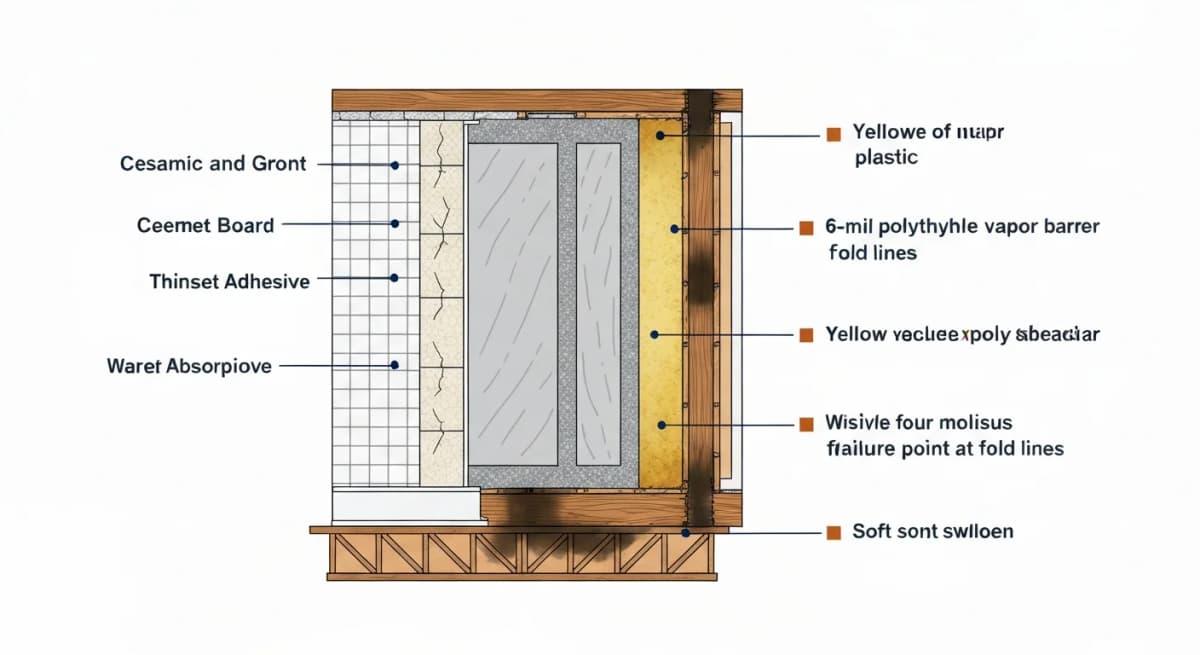
The 1990s residential shower waterproofing system has a specific failure timeline that's now playing out across Boise's housing stock. Understanding the mechanism explains why so many showers are reaching failure conditions simultaneously.
The original system specifications (1990-2005):
6-mil polyethylene vapor barrier: A thin sheet of plastic stapled to the wall studs before cement board installation. Functioned as the primary waterproofing layer — water that penetrated tile and grout was supposed to hit the poly and drain down to the shower pan.
Cement board (Durock, HardieBacker, WonderBoard): Installed over the poly barrier and screwed to studs. Provided the substrate for tile installation. Cement board is moisture-tolerant but not waterproof — water-resistant rather than water-impermeable.
Thinset and tile: Standard cement-based thinset and ceramic or porcelain tile. The grout joints were sealed with cementitious grout (early 1990s) or polymer-modified grout (late 1990s onward).
Why the system is failing 25-35 years later:
Polyethylene brittleness: 6-mil poly has a documented service life of approximately 25-30 years when subjected to repeated thermal cycling (which all shower walls experience daily). After this period, the material becomes brittle and cracks along stapling lines and fold seams. Once cracked, the waterproofing function is gone — water passes through.
Grout sealant degradation: Cementitious grout absorbs moisture over time. Polymer-modified grout has better long-term water resistance but still degrades. After 20-30 years, grout joints lose their water-resistance and allow capillary moisture penetration into the cement board.
Cement board moisture saturation: Once moisture passes the grout and reaches the cement board, it's absorbed. Over years of cyclical wetting and drying, the cement board breaks down and loses structural integrity. The interface between cement board and the (now-failing) poly barrier becomes a moisture transit path.
Sealant joint failure: Caulk and silicone joints at the shower-wall corners, the tub-tile transition, and the shower pan-tile transition all have shorter service lives than the bulk waterproofing. As these joints fail, water penetrates directly into the framing cavity without going through the waterproofing system at all.
Boise-specific factors:
Daily thermal cycling: Boise showers experience hot-cold thermal cycling year-round (hot water followed by cooler ambient). The temperature swing is similar to most U.S. climates but consistent — Boise's stable seasonal patterns mean predictable degradation rather than the freeze-thaw variability of some climates.
Hard water: Boise's hard water (about 6 gpg on average, up to ~13 gpg in well-fed zones) accelerates grout joint mineral deposition. Mineral deposits in grout pull the grout away from the tile edges over time, creating gaps that aren't visible from the surface but allow water penetration.
Dry interior climate: Boise homes run 15-30% relative humidity in winter and 25-40% in summer. The dry climate helps in that absorbed moisture in framing and subfloors can dry between shower events, slowing some failure modes. But it doesn't prevent the underlying degradation.
Boise homeowners with showers built 1990-2005 who haven't had the shower assessed in 5+ years.
The failure is gradual — at first the visible signs are subtle and easy to ignore. By the time damage is obvious, the remediation scope is significantly larger.
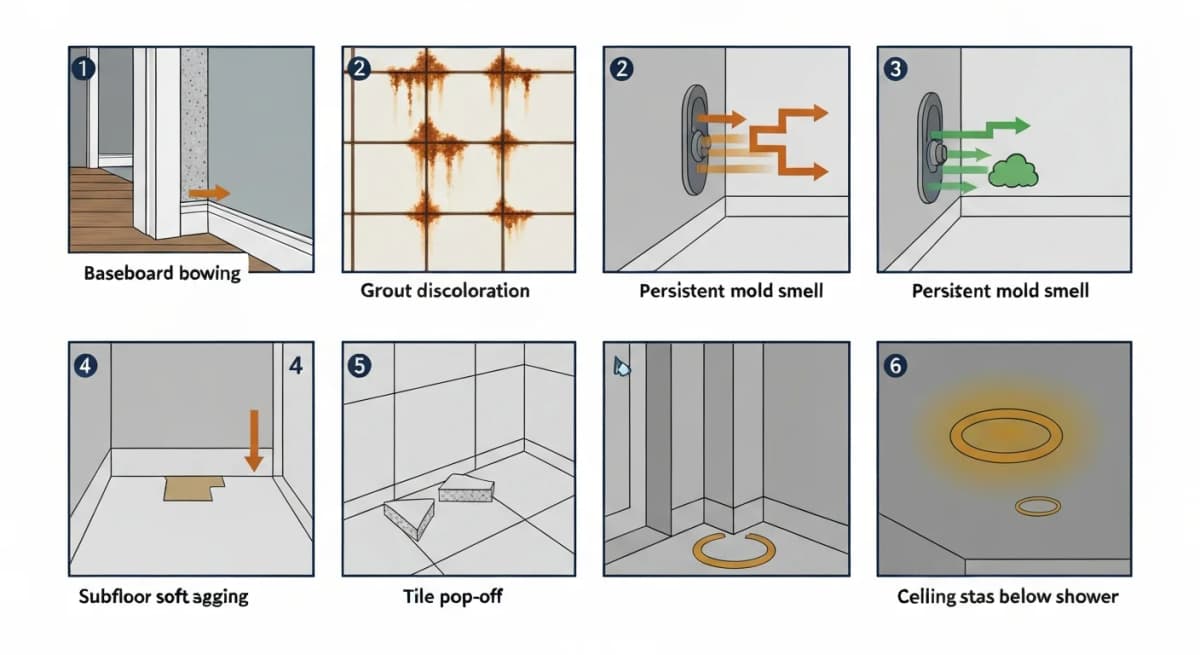
Six specific warning signs indicate vapor barrier failure or imminent failure. Each is independently diagnostic — any single one warrants professional assessment within weeks, not months.
1. Baseboard bowing or separation outside the shower wall: The wall on the opposite side of the shower (often a hallway or adjacent bedroom) shows baseboard or wall trim bowing outward, separating from the wall, or visible moisture stains. This indicates water has saturated the wall framing inside the shower wall cavity. Often the most visible early sign because it's outside the bathroom and harder to attribute to shower use.
2. Grout discoloration with brown or rust stains: Grout that's gone from white/gray to brown or rust-colored indicates iron or organic contamination from water that's been sitting behind the tile. Distinct from soap scum (white-gray) or mineral scale (white-tan). Brown discoloration in shower grout is essentially never cosmetic — it's a moisture transit indicator.
3. Persistent mold smell from the shower area: Mold growth requires moisture, organic substrate, and time. Mold smell from a shower indicates moist substrate behind the tile. The smell intensifies after the shower has been used and the temperature has cooled (creating condensation that activates mold metabolism). Boise's dry climate doesn't prevent mold growth in moist shower cavities — the cavities themselves stay wet long enough for mold to thrive even when the broader home humidity is low.
4. Subfloor soft-spot in front of the shower threshold: The floor area immediately in front of the shower threshold (where water might splash or drip during use) develops a soft, springy, or visibly sagging spot. The shower's subfloor framing is rotting from water that's been working through the failing waterproofing for years. This is one of the most expensive damage modes to remediate because it requires framing replacement.
5. Tile pop-off at the floor-wall transition: Tiles at the bottom course of the shower wall (where the wall meets the shower pan) become loose, develop visible movement when pressed, or actually pop off. This indicates water has penetrated behind the tile at the corner joint and the cement board substrate is breaking down.
6. Ceiling stain below an upstairs shower: For two-story Boise homes, a moisture stain on the ceiling below an upstairs shower indicates water has penetrated past the shower's waterproofing and is migrating through the structural floor system. Often visible as a yellow-brown ring on white ceiling paint or as a soft spot in textured ceiling material.
Any single one of these signs warrants professional assessment. Multiple signs warrant immediate scope conversation — the failure has progressed beyond early stage and the remediation scope likely involves significant framing repair.
For Boise homeowners noticing any of these signs in showers built 1990-2005, the assessment cost ($200-$400 for an experienced contractor or licensed plumber to inspect) is modest compared to the cost of continued degradation. Address proactively.
Boise homeowners doing routine home assessment or considering a bathroom remodel in a 1990s-2000s home.
Catching the failure early saves significant remediation cost but means tackling a project that you might prefer to defer.
The actual remediation decision (membrane-only repair vs. full shower rebuild) depends on the condition of the framing and subfloor behind the failing waterproofing. A proper assessment investigates this before any scope commitment.
What a quality framing assessment includes:
Visual inspection of accessible framing: Where possible (from below in basements, from adjacent room walls, or through small inspection openings), visual inspection of the framing surrounding the shower. Visible rot, soft spots, mold growth, or rust on metal fasteners indicates damage scope.
Moisture meter testing: Pinless moisture meters can detect moisture in framing through cement board and tile. Multiple test points around the shower perimeter reveal where moisture has accumulated. Typical Boise framing reads 8-12% moisture content; readings above 18-20% indicate active moisture saturation; readings above 25-30% indicate likely structural decay.
Endoscopic inspection (if needed): For inaccessible areas, a small inspection hole can be made (1-2 inches in diameter) and a borescope inserted to visually inspect framing. The hole is patched with similar material afterward. Cost: $200-$400 for the inspection scope.
Subfloor inspection: The subfloor in front of and beneath the shower is inspected for soft spots, rot, or sagging. For basement-accessible homes, viewing the subfloor from below is the most direct method.
Plumbing inspection: The existing plumbing rough-in is inspected for current code compliance. 1990s installations often have copper pipes that may be corroded or galvanized supply lines (more common in pre-1990 but sometimes in early 1990s) that need replacement. Pressure-balanced mixing valves (required by current code) may need installation.
What the assessment should produce:
Scope decision: Membrane-only repair (acceptable if framing damage is minimal and contained) vs. full shower rebuild (required if framing damage extends beyond the shower walls themselves).
Cost estimate: A reasonable range based on the specific damage found. Avoid contractors who quote without doing the assessment.
Timeline estimate: Membrane-only repair: 1-2 weeks of work, 1 week of shower downtime. Full rebuild: 2-4 weeks of work, 2-3 weeks of shower downtime.
Photographic documentation: Photos of the assessment findings for the homeowner's records and for insurance documentation if claims are relevant.
For Boise homeowners, several contractors and licensed plumbers in the Treasure Valley specialize in this type of assessment. Iron Crest performs these assessments as part of our shower remodel design phase. Plan on 2-4 hours for thorough assessment, with results typically delivered within 3-5 days of the inspection.
Homeowners who want to make an informed decision rather than accept the first contractor's recommendation.
Assessment cost ($200-$400) is added to the eventual remediation cost. But the savings from making the right scope decision dwarf this.
Stop water damage before it eats your subfloor
Vapor barrier failure assessment for 1990-2005 era Boise showers is included in our shower remodel design phase. Schedule a consultation and we'll inspect the framing, document the scope, and map the right remediation path for your specific situation.
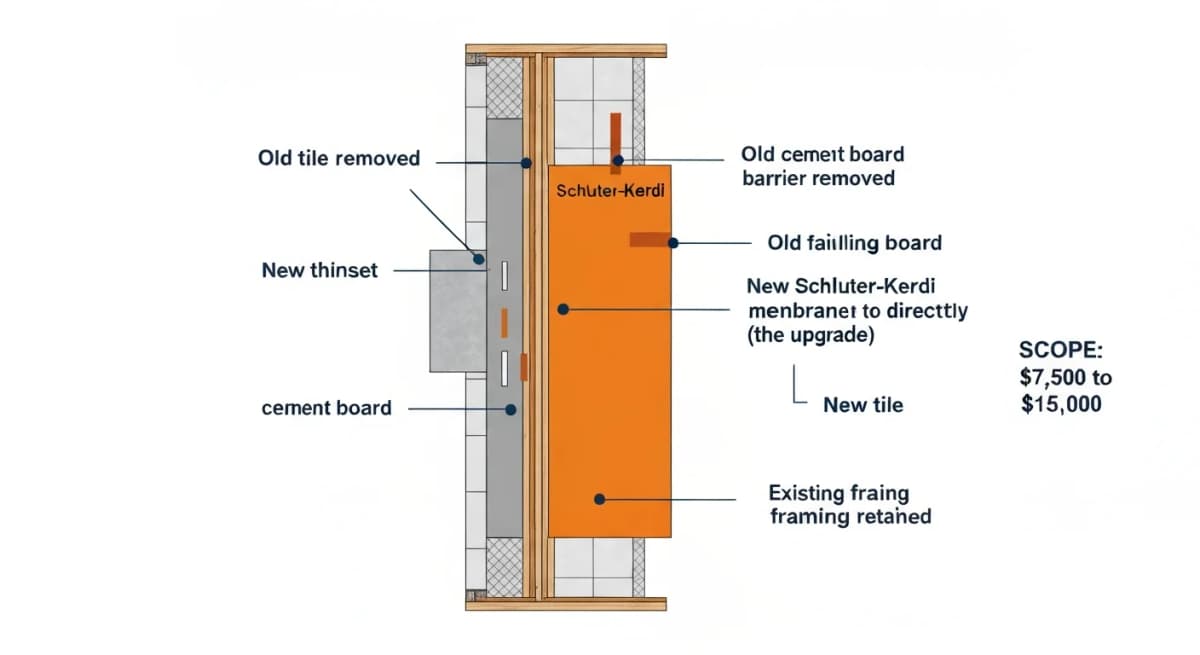
If the framing inspection reveals minimal moisture damage (under 18% moisture content, no visible rot, no structural compromise), membrane-only repair is the right scope. The repair replaces the failing waterproofing while keeping the existing framing, plumbing, and shower pan in place.
Membrane-only repair scope:
Demo: Existing tile, cement board, and failing poly barrier are removed from the shower walls. The framing and subfloor are exposed but not demolished. The shower pan stays in place. Plumbing fixtures stay.
Framing prep: Any minor moisture spots are dried (typically 2-4 days with dehumidifiers and fans), and any minor rot is treated with borate wood preservative.
New waterproofing membrane: Modern membrane systems (Schluter-Kerdi, Wedi, USG Durock Plus, KBRS) are installed directly to the framing. These are sheet membranes or board-style products that provide true waterproofing rather than the water-resistance of cement board.
New cement board: Installed over the membrane for tile substrate. Some membrane systems (Wedi, USG Durock Plus) integrate the substrate and don't require separate cement board.
New tile and grout: Tile is installed using current best-practice thinset and grout. Cementitious grout with polymer additives or epoxy grout (better for hard-water environments like Boise) is specified.
New shower fixtures: Showerhead, valve trim, and any accessories typically replaced as part of the remodel — modest additional cost compared to keeping old fixtures.
What membrane-only repair does NOT include:
Plumbing relocation or upgrade: Existing valve, supply lines, and drain remain. If code requires pressure-balanced valve and existing isn't, this is added scope.
Layout changes: Shower stays in existing footprint with existing dimensions. Door direction, ceiling height, and threshold height stay the same.
Subfloor replacement: Existing subfloor stays unless minor repair is needed. Major subfloor replacement triggers escalation to full rebuild scope.
Cost: $7,500-$15,000 for a typical Boise shower membrane-only repair. Cost drivers include shower size (larger shower = more materials and labor), tile selection (porcelain vs. natural stone vs. mosaic affects cost significantly), and any unexpected framing repair discovered during demo.
Timeline: 1-2 weeks of work, 1 week of shower downtime. The homeowner can typically continue using the rest of the bathroom (toilet, sink) during most of the project, with the shower itself being the only inaccessible feature.
When membrane-only repair is the right call: framing inspection clean or near-clean, homeowner is satisfied with existing shower layout and dimensions, budget is moderate, homeowner plans to stay in the home long-term but doesn't want luxury upgrades.
Boise homes built 1990-2005 with minimal framing damage and homeowners who want efficient remediation without scope expansion.
Doesn't address plumbing modernization unless explicitly added. Doesn't allow layout changes.
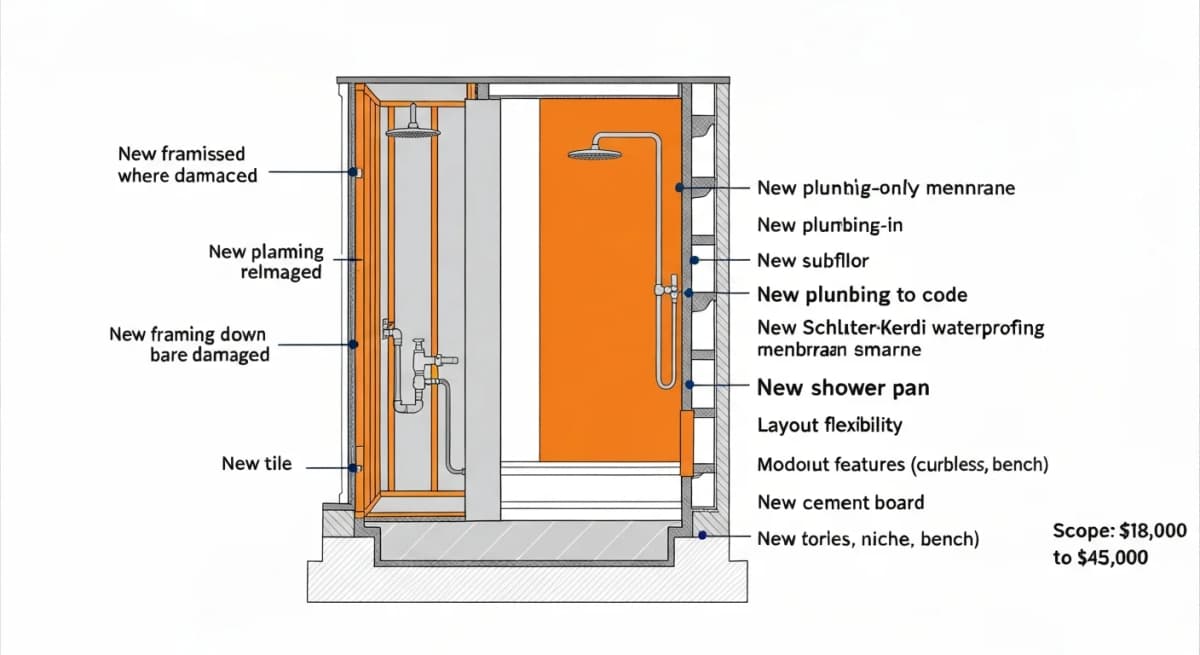
If the framing inspection reveals significant moisture damage (moisture content above 20-25%, visible rot, structural compromise, or substantial subfloor decay), full shower rebuild is the right scope. The rebuild replaces everything — framing where needed, plumbing, shower pan, waterproofing, and finishes.
Full rebuild scope:
Complete demo: Shower demolished to bare framing and subfloor. Any damaged framing replaced with new lumber and sister-joist reinforcement where structural. Damaged subfloor cut out and replaced with new plywood and joist reinforcement.
Framing repair and reinforcement: Beyond replacement of damaged members, the structural framing is upgraded if necessary — additional studs, joist sistering, blocking for shower accessories like grab bars and benches.
Plumbing modernization: All plumbing rough-in replaced with current-code components. Pressure-balanced mixing valve, ASSE 1016-compliant trim, modern supply lines (PEX-A or copper), and a current-code drain installation.
New shower pan: Either a tile-over-mortar custom pan or a manufactured pan (Schluter, Wedi, Tile Redi, others). Modern pans include integral curb or curbless options, integral linear drain or center drain, and proper slope to drain (1/4 inch per foot minimum).
New waterproofing system: Same as membrane-only repair but applied throughout the rebuilt shower — walls, pan, and any niches or benches.
Layout flexibility: Full rebuild allows layout changes — different shower dimensions, different door direction, different fixture positions, curbless threshold, new niches and benches, etc.
New fixtures and accessories: Showerhead, valve trim, grab bars, niche storage, bench, glass enclosure — all designed as one coordinated system.
Cost: $18,000-$45,000 for a typical Boise full shower rebuild. Major cost drivers:
Framing repair scope: Minor repairs ($500-$1,500) vs. major structural repairs ($3,000-$8,000+ if joists or load-bearing framing needs replacement).
Layout changes: Same footprint ($0 added scope) vs. shower expansion or relocation ($3,000-$8,000 added).
Pan type: Traditional curbed tile-over-mortar pan ($800-$2,500) vs. curbless integral drain pan ($2,500-$6,000).
Finishes: Mid-tier porcelain tile ($800-$2,000 in materials) vs. premium natural stone ($3,000-$8,000+).
Glass enclosure: Frameless glass ($2,500-$6,500) vs. framed glass ($800-$2,500) vs. shower curtain ($50-$500).
Timeline: 2-4 weeks of work, 2-3 weeks of shower downtime. Plus 4-6 weeks of design phase before construction starts (selection of finishes, fixtures, configuration). Total project timeline from contract signing to completion: typically 8-14 weeks.
When full rebuild is the right call: framing inspection reveals damage that membrane-only repair can't address, homeowner wants layout changes or modern features (curbless, multi-head, larger footprint, bench, niche), plumbing is approaching end-of-life and warrants modernization, homeowner is willing to invest in a 25-30 year improvement.
Boise homes with significant moisture damage or homeowners who want substantial improvements rather than just remediation.
Significantly higher cost and longer timeline than membrane-only repair. Justified by scope and the fresh-start quality of the result.
Homeowner's insurance treats shower vapor barrier failure differently than sudden water damage events. Understanding the coverage question helps homeowners plan financially.
General insurance principles for shower failure:
Sudden and accidental water damage: Most homeowner's policies cover sudden and accidental water damage — a broken pipe, a leak from an appliance, a roof failure. These claims typically result in coverage for both the water damage itself and the resulting building damage.
Gradual wear and tear: Most policies exclude gradual wear and tear. Vapor barrier failure from age and thermal cycling falls squarely into this category. Claims for "my 30-year-old shower's waterproofing failed" are typically denied as exclusion-covered events.
Resulting damage from gradual failure: The gray area. If your shower's waterproofing has been gradually failing for years and a sudden additional event (like a plumbing leak that was masked by the existing failure) accelerates damage, some insurance carriers may cover the sudden component but not the gradual baseline.
Specific Boise-area insurance scenarios:
Standard homeowner policies (most Boise carriers): Typically deny gradual-wear claims for shower vapor barrier failure but coverage varies by specific carrier and policy details. Read your policy or call your agent.
Specialty homeowner policies: Some specialty carriers (USAA for veterans, AMICA for high-end homeowners) have more generous coverage on gradual wear. Worth checking the specific policy.
Mold remediation coverage: Most policies have specific mold coverage limits (often $5,000-$10,000) regardless of the cause. If the shower failure has resulted in mold, this coverage may apply to the mold portion of the remediation even if the underlying water damage isn't covered.
Practical insurance strategy:
File the claim and let the insurer decide: Even if you expect denial, filing creates a record and sometimes results in partial coverage. The insurer's denial letter (if denial) is useful documentation for tax purposes (medical-related home modifications, for example).
Document everything: Photos before remediation, contractor assessment reports, moisture meter readings, mold testing results. Documentation supports any subsequent claim disputes or tax claims.
Don't delay remediation waiting for insurance decision: Continued water damage during the claim review period can void coverage entirely and increases the eventual cost of remediation. Address the issue while pursuing the claim.
Consult a public adjuster for complex cases: If damage is significant ($30,000+) and the insurer is hesitant, a public adjuster can negotiate on your behalf. Public adjusters work on a contingency fee set by their own agreement — ask for the percentage in writing before you sign, and note that Idaho regulates public adjusters through the Department of Insurance.
Homeowners with significant damage who want to maximize insurance coverage where applicable.
Insurance is unlikely to cover the gradual-wear baseline but may cover specific damage events. Worth pursuing if scope is large.
Iron Crest's shower remodel process always begins with a framing assessment for any home with a 1990-2005 era shower. We use moisture meters, visual inspection through small access points, and (when needed) endoscopic camera inspection to determine the actual scope before quoting. This 2-4 hour assessment saves homeowners thousands of dollars in either over-scoped contractor quotes or surprise mid-project change orders.
For most 1990s Boise showers we remediate, the scope falls between membrane-only repair ($7,500-$15,000) and modest full rebuild ($18,000-$28,000). The decision tree is straightforward once the assessment data is in hand. Iron Crest documents the assessment findings, presents the homeowner with both options where relevant, and explains the cost-benefit clearly. For broader shower scope, see our Boise shower remodeling page, and for the waterproofing systems specifically, see our shower waterproofing guide.
How long does a typical 1990s Boise shower last before vapor barrier failure becomes visible?
The original system was designed for 20-25 years of service. In Boise's relatively dry climate, well-maintained showers may go 25-30 years before visible failure signs appear. Showers with poor maintenance (no annual caulk replacement, no grout sealing, hard-water mineral buildup left untreated) often show signs at 18-22 years. For homeowners in 1990-2005 Boise homes who haven't done a major shower remodel, plan on either preventive remediation in the next few years or being prepared to address it when warning signs appear.
Can I just re-caulk the corners and seal the grout to extend the shower's life?
For a few years, yes — but it's a delaying tactic, not a fix. Re-caulking corners (replacing old silicone with new) addresses the most-common surface leak path and can buy 2-4 years before more significant remediation is needed. Sealing grout adds 1-2 years to grout-joint integrity. Neither addresses the underlying poly vapor barrier degradation. If you're planning to sell the home within 2-3 years, the maintenance approach may be cost-effective. If you're staying long-term, you're spending money on patches that don't fix the underlying issue. The cost of annual maintenance ($150-$400 for caulk + grout seal) over 5 years ($750-$2,000) often exceeds the cost difference between deferred-now-vs.-do-it-now membrane-only repair.
What's the difference between vapor barrier failure and a simple plumbing leak?
Different failure mechanisms, different remediation. Plumbing leaks are point-source water issues — a single pipe joint, valve, or supply line is leaking. They produce sudden water damage in a specific location. Vapor barrier failure is distributed — water is penetrating across the entire shower wall over years. Plumbing leaks are typically repaired by replacing the failed component ($200-$2,000 typical). Vapor barrier failure requires the broader remediation scope covered in this article. A plumbing leak can mask vapor barrier failure (or vice versa); a competent assessment distinguishes them.
Will fixing the shower also fix the mold smell, or is mold remediation separate?
Mostly fixes it. The shower remediation removes the moisture source that's feeding the mold; the mold itself typically dies off once dry conditions return. For minor mold issues (visible spots, light smell), the shower remediation alone usually resolves it. For significant mold (heavy black mold on framing, strong smell throughout the home, mold visible in adjacent rooms), additional mold remediation may be needed — typically $500-$2,500 for professional mold treatment of the affected framing. Health-sensitive household members or anyone with documented mold allergies should have the mold component professionally tested and treated regardless of severity.
Does fixing the shower require permits in Boise?
Depends on the scope. Membrane-only repair without plumbing changes typically doesn't require a permit (it's classified as cosmetic finishing work). Full shower rebuild requires permits because it involves plumbing modifications, structural framing repair, and electrical (if any fixtures are being added or moved). City of Boise permit fees: $150-$400 for a typical bathroom remodel permit. Inspection requirements: rough plumbing inspection (before drywall), final inspection (after completion). The permit process is well-established for Boise contractors and adds 1-2 weeks to overall timeline.
Stop water damage before it eats your subfloor
Vapor barrier failure assessment for 1990-2005 era Boise showers is included in our shower remodel design phase. Schedule a consultation and we'll inspect the framing, document the scope, and map the right remediation path for your specific situation.
These pages go deeper on the topics linked from this article. Read them before your consultation and you'll come in with sharper questions and a clearer scope.
The following government agencies, industry organizations, and official resources provide additional information relevant to your remodeling project.