
Bathroom-as-Sanctuary Design for Boise Healthcare Workers: 5 Decompression Elements That Help You Reset After a Shift
Healthcare workers at St. Luke's, Saint Alphonsus, and other Boise medical centers face sustained occupational stress. Bathroom-as-sanctuary design helps support decompression and recovery. Five specific design elements for healthcare-worker households.
Quick answer
Partially. Easy retrofits: warm-light bulb replacement, towel warmer addition, aromatherapy diffuser, natural-material accents (vanity replacement, towel/rug upgrades). Cost: $500-$2,500. Difficult retrofits: STC wall improvements, heated floors, premium quiet exhaust fan — these require demo and rebuild scope.
Healthcare workers in Boise — physicians, nurses, technicians, and support staff at St. Luke's, Saint Alphonsus, the VA, and other medical centers — face occupational stress that compounds over long careers. Burnout rates in healthcare are elevated, and recovery from each shift's stress matters significantly for long-term wellbeing.
Bathroom design is a small but meaningful contributor to post-shift recovery. The bathroom is the first sustained quiet space healthcare workers encounter after work — and the design either supports decompression or fails to. Five specific design elements that move the bathroom toward sanctuary rather than just utility.
This is a niche article — most homeowners don't optimize bathrooms for occupational stress recovery. But for the specific Boise healthcare-worker demographic (estimated 25,000+ healthcare workers in the Treasure Valley), bathroom-as-sanctuary design is one of the highest-return remodel investments.
For broader master bathroom remodel context, see our master bathroom complete remodel guide for Boise. For bathroom acoustic isolation specifically, see our sound isolation in multigenerational bathrooms article.
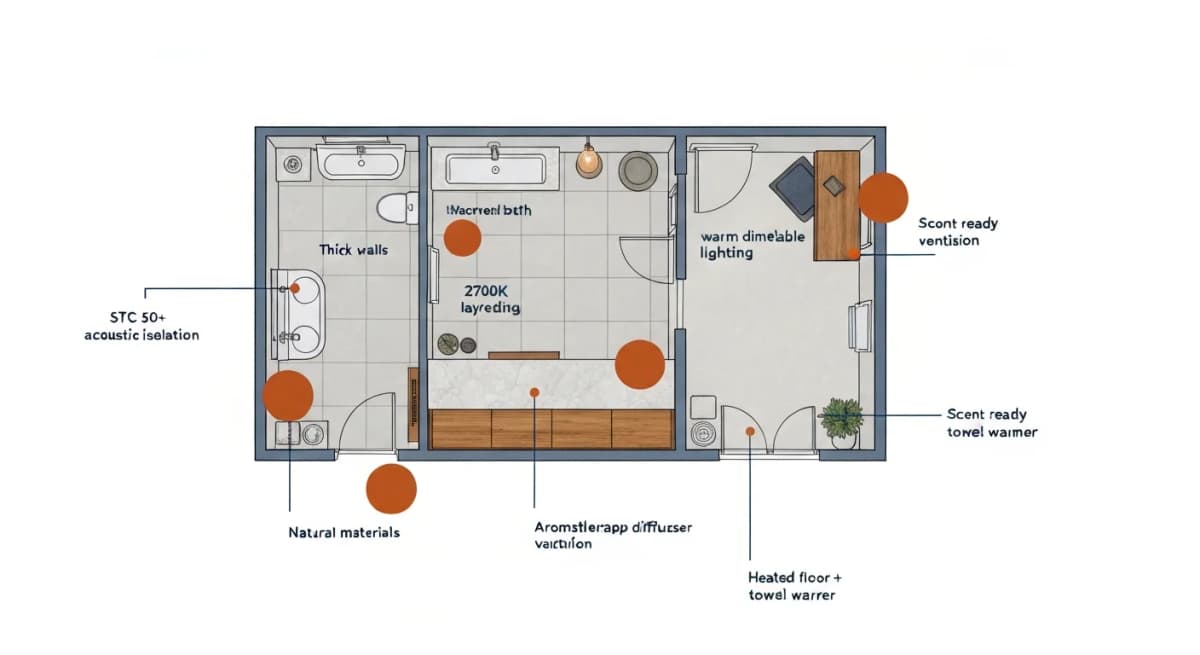
Sound is the highest-impact sensory factor for stress recovery. Healthcare workers spend their shifts surrounded by alarm sounds, conversations, and equipment noise. The first thing the brain needs upon arriving home is acoustic silence.
Sanctuary-bathroom sound isolation targets:
STC 50+ wall assemblies: See our sound isolation article for the construction methodology. STC 50 means household sounds (TV, conversations, music in other rooms) become essentially inaudible. The bathroom becomes an acoustic sanctuary.
Premium quiet exhaust fan (under 0.3 sones): Panasonic WhisperCeiling or equivalent. The bathroom's own ventilation shouldn't break the silence. Cost: $250-$500 for the fan plus install.
Quiet-flush toilet: TOTO, Kohler Veil, or equivalent premium quiet-flush model. Flush noise dropped from 70-85 dB (standard) to 50-65 dB (premium quiet). Cost premium: $300-$1,000 over standard toilets.
Acoustic pipe insulation: Wraps water supply and drain pipes to reduce sound transmission. Cost: $200-$600 for typical bathroom plumbing wrap. Critical when shower or bath use happens at times when other household members shouldn't be disturbed (early morning or late night shifts).
For healthcare workers specifically:
The 12-hour shift consideration: Many healthcare workers do 12-hour shifts ending at 7am or 7pm. Bathroom use happens at times when other household members may be sleeping or resting. Sound isolation supports the household, not just the worker.
The hospital-noise baseline: Healthcare workers have an elevated noise floor from work environment. Their home bathroom should provide a contrasting silence — not match the workplace.
Total cost for full sound-isolation sanctuary spec: $2,500-$5,500 above standard residential bathroom acoustics. Modest in the context of full bathroom remodel ($30-$60k typical for healthcare-worker demographic) and high-impact for decompression.
Every healthcare-worker household. Sound is the highest-leverage sanctuary element.
Wall STC improvements require new construction or major renovation. Difficult to retrofit.
Healthcare workplace lighting is typically harsh fluorescent or cool LED (4000K+). The bathroom should provide contrast: warm color temperature and full dimming control.
Sanctuary lighting specification:
Color temperature: 2700-3000K (warm to soft white): Lower than the 3000-3500K we recommend for most bathrooms. Warmer light signals relaxation to the brain. Cooler light signals work mode. Healthcare workers benefit from the warm-light environment after work.
CRI 90+ minimum: See our bathroom lighting Kelvin article. Even in a sanctuary context, color rendering matters for grooming tasks during morning hours.
Three-layer lighting plan: Ambient (recessed cans), vanity (side sconces or under-mirror LED), and accent (atmospheric uplights, candle-effect LED). Each layer on a separate dimmer.
Full dimming range (1-100%): Including very low settings (1-5%) for late-evening or pre-sleep use. Smart dimmers like Lutron Caseta or Maestro support fine-grained dimming.
Sunrise simulation lighting (optional): Smart bulbs that gradually brighten over 30 minutes simulating sunrise. Particularly useful for healthcare workers doing pre-dawn shift starts — provides gentle wake-up rather than abrupt full lighting.
Color-temperature-tunable (optional but valuable): Tunable LEDs that shift from 2700K (evening relaxation) to 4000K (morning getting-ready). Premium feature for healthcare workers with both pre-shift bright-light and post-shift relaxation needs.
Specific products:
Mid-range: Standard 2700K LED recessed cans with Lutron Caseta dimmer system. Cost: $400-$900 total for typical bathroom.
Premium: Philips Hue or LIFX smart bulbs in all fixtures, with smartphone app and voice control. Tunable color temperature, scheduling, scenes. Cost: $800-$2,500 total.
Spa-tier: Color-changing accent lighting in addition to standard fixtures. RGB LED strips behind floating mirror or in shower niche. Cost: $1,500-$4,000 total.
For Boise specifically:
Winter dim daylight makes the bathroom lighting carry more visual workload from October through March. The dimming and color-temperature controls become more important during these months. Healthcare workers doing morning getting-ready in dark winter mornings benefit from controllable bright work-mode lighting; relaxation use benefits from the dim warm settings.
Healthcare workers wanting clear contrast between workplace and home lighting environment.
Premium lighting cost is modest, but requires more electrical and dimmer infrastructure than basic bathrooms.
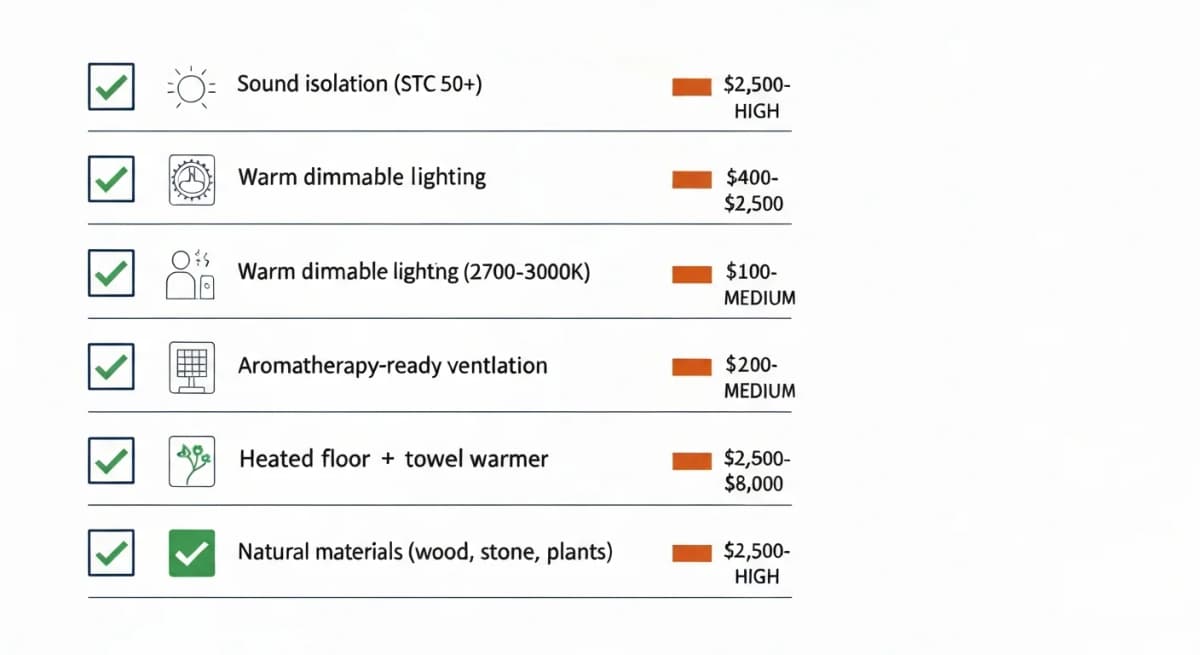
Scent is a powerful contributor to mood and stress reduction. Healthcare workplaces have strong scent associations (cleaning products, body fluids, hospital smells). The bathroom should provide either neutral scent or specifically chosen pleasant scents that the worker associates with decompression.
Aromatherapy-ready bathroom design:
Quiet, capable ventilation: Item 1's premium-quiet exhaust fan is also critical for scent control. Ventilation that activates only when needed (humidity sensor) means scents can build during desired moments and exhaust during shower use.
Dedicated scent diffuser location: Built-in shelf or niche for an essential oil diffuser. Position near the bathing area but not in direct steam path. Power outlet adjacent (don't run cords across counters).
Integrated diffuser in lighting fixtures: Some premium fixtures (Hammacher Schlemmer, Vitruvi) combine aromatherapy and lighting in one fixture. Convenient integration; cost premium $200-$600.
Scent storage: Closed cabinet for essential oils, candles, and scent products. Premium products lose potency in heat and light; protected storage extends life.
Direct ventilation control: The user should be able to turn ventilation on or off independently of automatic humidity-sensor activation. Sometimes you want scent retention; sometimes you want fast scent removal.
Recommended scents for decompression (varies by individual):
Lavender: Most-researched stress-reduction scent. Reliable choice for most users.
Eucalyptus: Respiratory clearing. Used in spa contexts.
Chamomile, sandalwood, or vetiver: Calming herbal scents.
Citrus (orange, lemon): Energizing rather than calming. Better for morning/pre-shift use.
For healthcare workers specifically:
Avoid scents that overlap with workplace scents. Hospital cleaning products often have lemon or pine bases — these scents may trigger work-stress associations. Lavender, eucalyptus, and sandalwood are typically safe choices.
Cost:
Basic aromatherapy-ready setup: $100-$300 in additional bathroom plumbing/electrical for diffuser integration plus scent storage. Plus $50-$200 for diffuser hardware and initial essential oils.
Integrated aromatherapy fixtures: $200-$800 premium for combined lighting-diffuser fixtures.
Modest investment for substantial decompression contribution.
Healthcare-worker households where mood and atmosphere matter for daily recovery.
Some household members may not appreciate scent — needs to be controllable and isolated.
Bathroom design that helps you reset
Sanctuary bathroom design for healthcare workers and other high-stress professions is a recognized scope area in our portfolio. Schedule a consultation and we'll design specifically for your decompression needs.
Temperature comfort signals safety and relaxation. Cold floors and cold towels after a shower are minor irritations that compound stress. Heated floors and towel warmers eliminate these irritations.
Heated bathroom floors:
Electric mat system: Heating element mat embedded under tile flooring. Activates via dedicated thermostat. Provides 80-95°F floor surface temperature.
Hydronic system: Water-loop system tied to home's hydronic heating. Higher install complexity; lower operating cost. Standard in custom-home construction.
Cost: $1,000-$3,500 for electric heated floor in a typical Boise bathroom. $2,500-$6,500 for hydronic.
Operating cost: $80-$200 per year electric (depending on use frequency and Idaho Power rates). Negligible for hydronic if home heating system already exists.
Boise-specific consideration: Boise's winter floor cold conditions (kitchen floors 50-58°F over crawl spaces; bathroom tile floors 55-60°F) compound with healthcare-worker schedule (showers at 6am or 8pm in low-energy state). Heated floors deliver disproportionate comfort improvement.
Heated towel warmers:
Electric models (most common): Wall-mounted, plug-in or hardwired. Heating bars or panels keep towels warm and ready. Some models include towel-warming and heating-room functions.
Hydronic models: Tied to home's hot water system. More expensive but no separate electrical use.
Cost: $400-$1,500 for the unit plus $200-$500 install.
Use pattern: Towel warmer activates 15-30 minutes before bathroom use. Towels are warm when needed without continuous operation.
Other temperature considerations:
Bathroom-specific HVAC zoning: If your home has zoned HVAC, the bathroom can be zoned separately. Bathroom kept at 70°F during use, 65°F other times. Cost: $500-$1,500 for zoning addition.
In-shower bench heating: Some premium shower benches integrate heating elements. Warm-bench-while-shaving comfort is significant. Cost: $300-$800 for the heating addition.
Programmable thermostat with sanctuary-mode preset: Pre-shift wake-up mode raises bathroom temperature to 72°F. Post-shift relaxation mode raises to 74°F. Sleep mode drops to 67°F. Cost: $150-$400 for smart thermostat.
Total cost for full temperature-comfort sanctuary spec: $2,000-$6,000 above standard residential bathroom temperature management. Pays back in daily comfort improvement and faster post-shift recovery.
Healthcare workers in Boise's cold-winter climate where bathroom temperature control supports recovery.
Higher cost; ongoing energy use (modest).
Material choice affects mood. Healthcare workplaces are typically dominated by hard, sterile, manufactured surfaces. Sanctuary bathrooms should provide contrasting natural materials.
Natural material categories:
Wood elements: Wood vanity (vs laminate or thermofoil), wood accent shelf, wood-frame mirror, wood-handle accessories. Use sealed but not over-finished wood — visible grain and natural texture matter. Cost premium: $500-$2,500 over manufactured materials.
Stone surfaces: Natural stone counter (quartzite, marble, or sealed granite) vs engineered quartz. Stone accent walls or backsplash. Natural stone has visual interest and tactile differentiation. Cost premium: $1,500-$5,000 over engineered alternatives.
Plant integration: Living plants in the bathroom. Specific bathroom-friendly species: pothos, philodendron, snake plant, bamboo, ferns (in high-humidity bathrooms). Plant care adds responsibility but provides daily natural-element exposure.
Window with garden view: If the bathroom window faces a garden or planted area, the view contributes to natural-element exposure even when inside. For homes without good views, frosted privacy glass with greenery beyond.
Natural textiles: Cotton towels (vs synthetic), wool or natural-fiber bath rugs. Linen window treatments. Tactile difference from sterile workplace materials.
The healthcare-worker specific case:
Healthcare workplaces use hard, easily-disinfectable materials for infection control. Stainless steel, hard plastics, vinyl flooring, fluorescent-lit drop ceilings. These materials are necessary for clinical environments but provide no sensory respite.
The bathroom-at-home provides the most direct contrast environment available. Natural materials in the home bathroom create the strongest perceptual shift from work to home.
Maintenance considerations:
Wood: Requires periodic re-sealing in moist environments. 2-3 year maintenance cycle.
Stone: Quartzite is essentially maintenance-free. Marble requires sealing and stain awareness. Granite middle-ground.
Plants: Daily-care responsibility. Best for households with one resident already gardening or otherwise interested.
Natural textiles: Slightly more laundry attention than synthetics. Cotton towels need more frequent washing; wool rugs need air-out drying.
Specific Boise considerations:
Dry climate: Boise's low humidity is actually friendly to natural materials. Wood stays stable; stone doesn't develop moisture issues; plants need extra watering attention but otherwise thrive.
Hard water: Affects stone surfaces (etching potential on marble). Specify durable stone (quartzite over marble) for hard-water resilience.
Total cost for natural-material sanctuary spec: $2,500-$8,500 above standard manufactured materials. Substantial premium but transformative aesthetic impact.
Healthcare workers wanting the strongest perceptual shift from workplace to home environment.
Natural materials require more maintenance than synthetic alternatives.
Iron Crest's bathroom design for Boise healthcare-worker households includes the five sanctuary elements as standard scope additions to the typical bathroom remodel. We work with Saint Alphonsus, St. Luke's, and VA healthcare workers across Treasure Valley locations — the typical scope premium for sanctuary design runs $8,000-$22,000 above standard residential bathroom remodel. For typical $35-$55k healthcare-worker bathroom remodels, the sanctuary premium represents 15-25% of total cost and delivers daily decompression benefit across a long career. For broader master bathroom context, see our master bathroom complete remodel guide.
Can I retrofit sanctuary design to an existing bathroom without full remodel?
Partially. Easy retrofits: warm-light bulb replacement, towel warmer addition, aromatherapy diffuser, natural-material accents (vanity replacement, towel/rug upgrades). Cost: $500-$2,500. Difficult retrofits: STC wall improvements, heated floors, premium quiet exhaust fan — these require demo and rebuild scope. For partial-retrofit budgets, prioritize lighting and natural materials (easy) and defer acoustic and temperature improvements until full remodel.
Is there research supporting these design elements for healthcare workers specifically?
Partly, and we want to be careful about how far we push it. There are established research literatures on biophilic design and stress, on healthcare-workforce burnout, on light and circadian timing in shift workers, and on scent and stress markers — but we are not citing a specific study for any of them here, and none of them tested a bathroom. (1) Biophilic-design work on natural-material exposure and stress recovery. (2) Healthcare workforce research on burnout and recovery patterns. (3) Circadian research on light-temperature signals — directly relevant for shift workers. (4) Work on specific scents (especially lavender) measurably reduce stress markers. The bathroom-specific application combines these established research areas; the combined design isn't formally researched but builds on solid component evidence.
What's the timeline for designing a sanctuary bathroom remodel?
Slightly longer than standard. The five sanctuary elements require more design coordination than standard bathroom remodels. Plan on 4-6 weeks of design phase before construction (vs 3-4 weeks for standard residential bathrooms). Construction timeline similar to standard premium bathroom remodel: 8-14 weeks from contract to completion.
Do these features add resale value beyond the cost premium?
Modestly. Sanctuary-design bathrooms in higher-end Boise neighborhoods (Eagle, Foothills, premium Meridian) read as premium features and contribute positively to listing pricing. In mid-tier neighborhoods, the features are positive but don't drive measurable list-price premium. For healthcare-worker demographic specifically, fellow healthcare buyers may specifically value the design intent — listing language can communicate this. Net resale impact: typically positive but proportionally less than the construction cost premium.
Are there Boise-area suppliers for premium sanctuary bathroom products?
Several. Stoneworks of Idaho (downtown Boise) carries premium natural stone. Saxton Group and Boise Tile Co. carry premium tile and stone. Hammacher Schlemmer at Boise Towne Square carries integrated wellness products. For premium fixtures and Aromatherapy-ready features, Ferguson Bath Kitchen and Lighting in West Boise has the broadest selection. For aromatherapy supplies, Boise-area health stores (Whole Foods, Trader Joe's, local independent retailers) carry essential oils and diffuser products.
Bathroom design that helps you reset
Sanctuary bathroom design for healthcare workers and other high-stress professions is a recognized scope area in our portfolio. Schedule a consultation and we'll design specifically for your decompression needs.
These pages go deeper on the topics linked from this article. Read them before your consultation and you'll come in with sharper questions and a clearer scope.
The following government agencies, industry organizations, and official resources provide additional information relevant to your remodeling project.