
Allergen-Resistant Bathroom Design for Boise's Brutal Pollen Seasons
Boise's juniper, grass, and sage pollen seasons run February through September. The bathroom — where allergens collect on clothing and skin during outdoor activity — needs design that doesn't compound the problem. Eight choices that meaningfully reduce allergen accumulation.
Quick answer
The cost premium for incorporating all the design features in this article runs $800-$2,500 above a standard Boise bathroom remodel of equivalent scope. Specifically: HEPA-grade exhaust fan upgrade ($400-$900), low-VOC paints and finishes ($100-$300 premium), epoxy grout vs cementitious ($150-$350), CARB 2 or NAUF cabinetry ($200-$800 premium), clothing-handoff zone built-ins ($400-$1,200).
Boise's pollen seasons are among the most pronounced in the West. Juniper pollen (mid-February through early April) drives intense respiratory symptoms in the population that's sensitive to it. Grass pollen (May through July) follows. Late-season sage and weed pollens (August through September) close out the year. For Boise homeowners with seasonal allergies, asthma, or chemical sensitivities, the bathroom is one of the most-pollen-impacted rooms in the home — it's where pollen on clothing and skin gets washed off, where damp environments encourage mold growth, and where ventilation choices either remove allergens or accumulate them.
Standard bathroom remodel design doesn't address these factors specifically. The eight design decisions below are the ones we incorporate when clients identify allergy or sensitivity concerns at the project's start. The features add a modest cost premium ($800-$2,500 above standard scope) and produce a bathroom that meaningfully reduces allergen accumulation for sensitive household members.
For the broader bathroom ventilation context (whole-home moisture and air-quality strategy), see our bathroom ventilation guide. For sustainable-materials and low-VOC remodel discussion across the whole home, see our sustainable remodeling guide. This page is specifically about allergen-resistant bathroom design and how to spec a bath that reduces pollen, mold, and VOC accumulation for sensitive households.
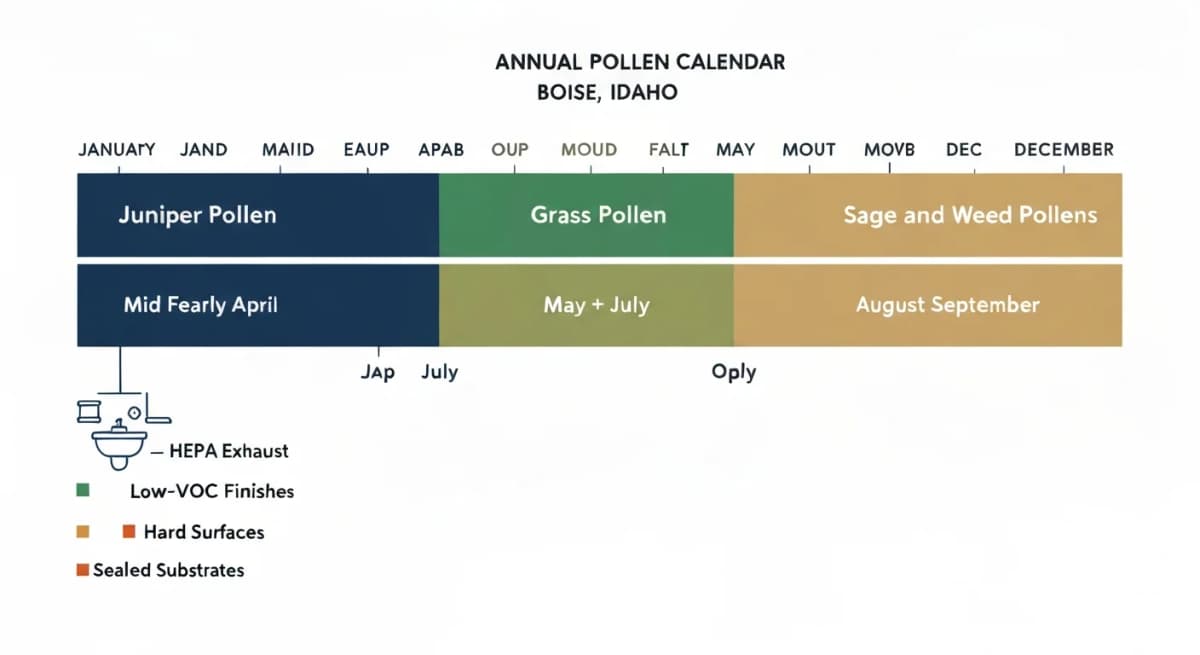
The Treasure Valley's allergen pattern has a specific local character for several reasons: the Snake River Plain creates concentrated air-flow patterns that move pollen along predictable corridors, the mix of irrigated agriculture (grasses), urban juniper landscaping, and surrounding sagebrush produces overlapping pollen seasons, and the dry climate keeps pollen airborne longer than humid environments.
The annual pattern:
Mid-February through early April: Juniper pollen. The most intense season for sensitive Boise residents. Juniper is extensively planted as foothills landscaping and the wind carries the pollen across the entire metro area. Peak daily levels can reach 1,500+ grains per cubic meter (high range by national standards).
Late April through May: Tree pollens. Cottonwood, ash, elm, and mulberry add to the load.
May through July: Grass pollen. Driven by Treasure Valley's extensive irrigated grass agriculture and residential lawn pollination. Peak in early June.
August through September: Sage and weed pollens. Driven by surrounding rangeland sagebrush and roadside weeds. Peak in late August.
Effectively, Boise has only 2-3 months of low-pollen conditions (mid-October through mid-February, plus a brief dip in late summer). For households with seasonal allergies or asthma, bathroom design that supports allergen-removal routines matters year-round, not just seasonally.
For households with allergy-sensitive members, the bathroom plays a specific role in the home's allergen-management routine: it's where pollen and outdoor allergens accumulated during the day get washed off and removed. The household routine is typically: enter from outside, remove outerwear, remove shoes, head to bathroom, shower or wash, change into clean indoor clothes. Each step happens at a transition zone — and the bathroom is the highest-pollen-concentration moment in the routine because clothing and hair are removed and washed there.
Without design support, this routine spreads pollen through the home. Clothes carry pollen to the laundry. Shoes track pollen across other floors. Hair retains pollen until showered. Standard bathroom design doesn't account for any of this.
Design-supported decontamination routines include: a designated clothing-handoff zone (covered hamper directly at the bathroom entry), an outerwear hook outside but adjacent to the bathroom for jackets and hats, dedicated shoe storage that contains pollen-laden footwear, and ventilation that captures pollen released during clothing removal before it disperses through the home.
The cost of these design features is modest — typically $400-$1,200 in additional cabinetry and fixture scope. The function reduces in-home pollen accumulation meaningfully for sensitive members.
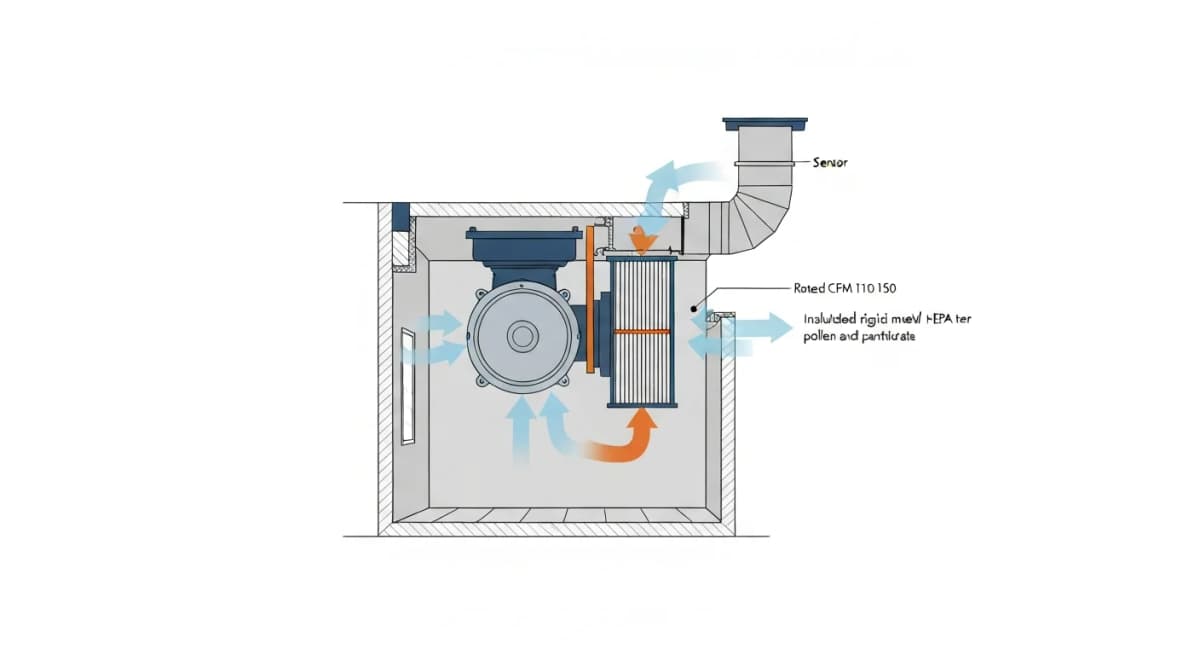
Bathroom exhaust fans serve two functions: moisture removal (preventing mold) and air-quality control (removing odors, particulates, allergens). Standard residential exhaust fans are sized for moisture only — typically 50-80 CFM for a master bath, adequate for steam removal but undersized for allergen capture.
Allergen-resistant exhaust spec:
Higher CFM rating: 110-150 CFM for a master bath (vs 50-80 standard). The higher airflow rate cycles the bathroom air more frequently — typically 8-12 air changes per hour during operation. For a 100 sq ft bathroom, this is the difference between particulate-laden air sitting in the room for 30+ minutes vs being exhausted within 8-10 minutes.
HEPA-grade filtration: Some premium exhaust fan models (Panasonic WhisperGreen Select, Broan-NuTone HEPA series) include HEPA-grade filter cartridges in the exhaust path. The filter captures pollen and fine particulate before exhausting, reducing what's discharged outside (where it could re-enter through other home openings). For households with HEPA whole-home air filtration, this matches the spec.
Timer or humidity-sensor activation: Run-on timers (60-90 minutes after the user leaves) or humidity-sensor controls ensure the fan operates long enough to fully cycle the bathroom air. Standard installations with manual switch operation typically have the fan running 5-10 minutes — insufficient for full air cycling.
Rigid metal duct routing: Required for code (flex duct is prohibited for bathroom exhaust over short runs) and meaningful for fan performance. Each elbow reduces effective CFM by ~25%, so direct routing matters. Insulated duct prevents condensation that becomes a mold-growth point.
Cost: $400-$900 for a HEPA-equipped exhaust fan vs $80-$200 for a standard residential fan. Total install with proper ducting and electrical: $600-$1,400.
Households with documented allergy or asthma sensitivity, particularly those in foothills or higher-pollen Boise neighborhoods.
HEPA fans have slightly higher operating noise (typically 1-2 sones vs 0.3-0.8 for premium quiet fans). Worth knowing for sensitive households where the bathroom is also a quiet zone.
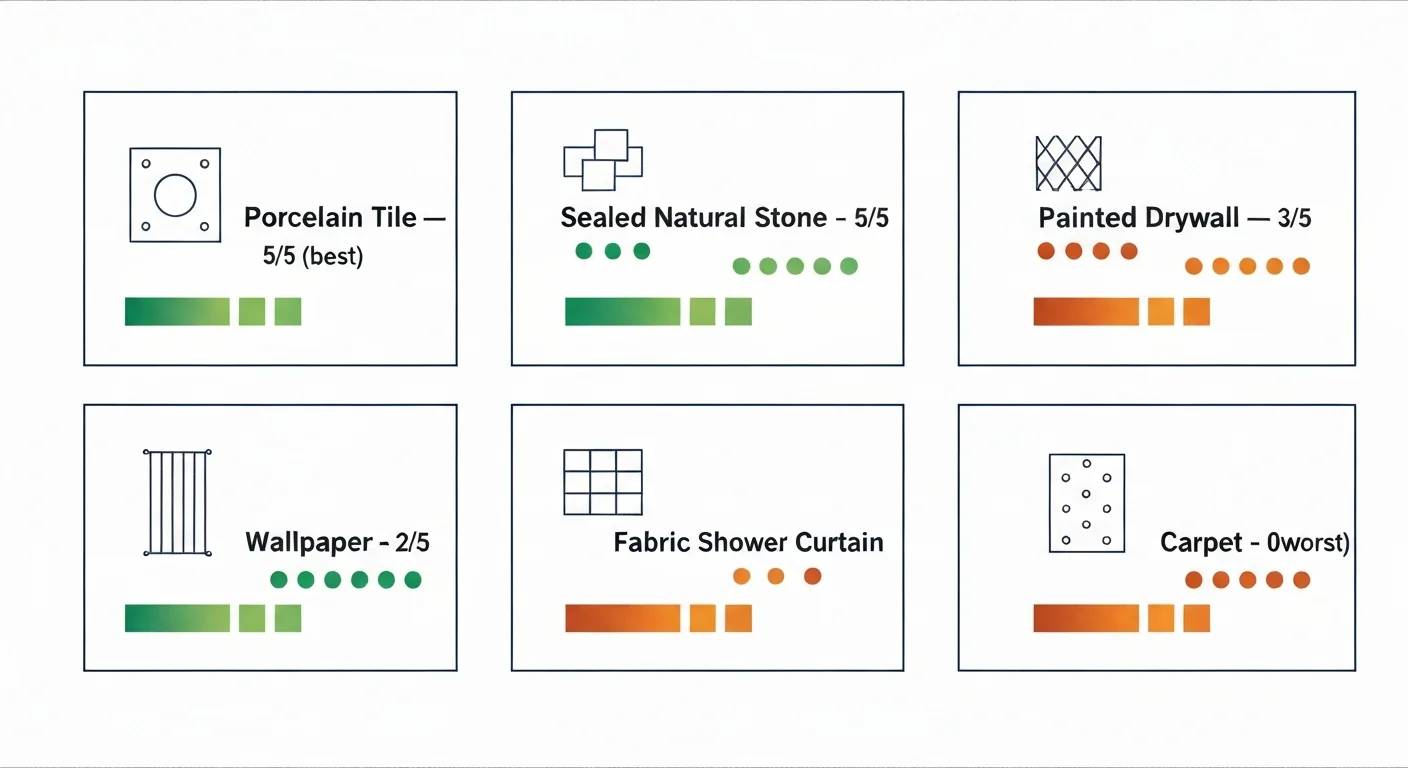
Allergens accumulate on surfaces in proportion to the surface's porosity and texture. Smooth, non-porous, easy-to-clean surfaces accumulate less. Porous, textured, or fabric surfaces accumulate more. The right bathroom material spec for allergen-sensitive households prioritizes hard surfaces across the board.
Material rankings for allergen accumulation (low to high):
Lowest accumulation: Porcelain tile (sealed grout), polished or honed natural stone (sealed grout), painted glass or acrylic panels, stainless steel, glass mirrors, solid-surface countertops (Corian, quartz). These shed pollen and particulate easily during cleaning.
Moderate accumulation: Painted drywall (allergen accumulates on textured surfaces less than smooth), unpainted plaster, ceramic tile with unsealed grout, wood vanity (especially with deep grain), laminated cabinet surfaces. Requires more frequent cleaning to manage.
High accumulation: Wallpaper (especially textured), bathroom rugs, fabric shower curtains, fabric-upholstered seating, decorative fabric items. These hold pollen and particulate even with regular cleaning.
Very high accumulation: Carpet (in bathrooms — rare but seen in older Boise homes), heavy curtains over windows, dense textile decor. Generally remove during allergen-sensitive bath remodel.
The design discipline: spec hard surfaces as the default for every bathroom element. Use frameless glass shower enclosures (not fabric curtains). Use quick-dry bath mats (microfiber or quick-dry materials, not cotton terry) that can be machine-washed weekly. Use minimal soft furnishings.
Design a Boise bathroom that helps with the pollen, not against you
Allergen-resistant bathroom design starts with understanding your household's specific sensitivity profile. Schedule a consultation and we'll model the right exhaust, materials, and clothing-handoff zone for your home's allergen-management needs.
Volatile organic compound (VOC) emissions from paint, sealants, adhesives, and cabinetry compound respiratory irritation for allergy-sensitive household members. The off-gassing peaks during the first 30-90 days after installation but continues at lower levels for months. For households where one or more members has documented respiratory sensitivity, low-VOC material spec is mandatory rather than optional.
Specific material categories:
Paint: Zero-VOC paint products (Benjamin Moore Aura, Sherwin-Williams Harmony, Behr Premium Plus Ultra). Cost premium: $5-$15 per gallon vs standard paint. Available at most Boise paint retailers.
Caulk and sealants: Low-VOC silicone and latex caulk products. The standard caulk used in tile installation is typically high-VOC during cure (3-7 days). Low-VOC alternatives exist but require specific selection — most installers default to standard products unless asked.
Adhesives and thinset: Standard tile thinset is typically low-VOC. Some specialty adhesives (carpet, vinyl flooring) are higher VOC. For bathroom applications, the standard thinset is generally fine; non-tile flooring adhesives need specific spec attention.
Cabinetry: Most cabinet boxes use formaldehyde-emitting MDF or particleboard. CARB Phase 2-compliant (California Air Resources Board) products limit formaldehyde emissions; the more rigorous "NAUF" (no added urea formaldehyde) products eliminate them. Specifying CARB 2 minimum is the right baseline for allergen-sensitive bathrooms; NAUF is the premium upgrade ($800-$2,500 across a typical bathroom cabinet package).
Wood finishes: Water-based polyurethane and water-based stains have much lower VOC profiles than oil-based equivalents. For any wood elements (vanity, trim, accent panels) in the bathroom, specify water-based finishes.
Mold growth in bathrooms triggers respiratory symptoms in many allergy-sensitive household members — even at low levels not visible to the eye. The right material spec for shower walls, floors, and high-moisture areas prevents mold growth at the substrate level rather than relying on cleaning to manage it after it appears.
Specific substrate choices:
Cement board (Wonderboard, Hardibacker): Standard for tile installations. Mold-resistant by design — the cement formulation doesn't support mold growth. Use as the substrate for all tile surfaces in shower and tub surrounds.
Mold-resistant drywall (purple-board / 'M-Board'): Required for any drywall in bathroom wet areas per IRC. Treats the gypsum core with mold-resistant additives. Standard residential bathroom code; should be present in every bath remodel regardless of allergen sensitivity.
Sheet membrane waterproofing (Schluter KERDI, similar): Prevents moisture penetration into the substrate. For allergen-sensitive bathrooms, this should be specified for the entire shower enclosure, not just the floor — extends to the back wall, side walls, and floor as a continuous membrane.
Epoxy grout: Same logic as the STR bathroom durability article — epoxy grout is non-porous and doesn't absorb moisture or harbor mold. Cementitious grout in bath applications is porous and supports mold growth at the surface and within the grout matrix. For allergen-sensitive bathrooms, epoxy grout is the right call across all wet-area applications.
Cost: epoxy grout adds $150-$350 above cementitious. Mold-resistant substrate adds modest cost ($100-$300 over standard). Sheet membrane vs traditional waterproofing adds $300-$700.
For households with significant allergy sensitivity, integrating air-purification capability into the bathroom remodel scope is worth considering. Three approaches:
Standalone HEPA air purifier: A countertop or floor-standing unit (Coway AirMega, Honeywell HEPA, etc.) placed in the bathroom. No remodel-scope changes required. Cost: $150-$400. Effective but adds counter clutter and electrical use.
Whole-house HEPA integration: If the home's HVAC system has whole-house HEPA filtration capability or can have it added, ensure the bathroom is on a dedicated supply duct (not return-only) so filtered air actively enters the bathroom. The HVAC return ducting in many bathrooms is poor — air comes in from adjacent rooms and returns through hallway ducts, which can recirculate pollen. Dedicated bathroom supply with active filtered air reduces this. Cost: depends on HVAC retrofit scope; $400-$1,500 for a single-bathroom duct addition.
Bathroom-dedicated UV-C light: UV-C lights installed in the bathroom HVAC return duct kill airborne mold spores and bacteria. Less effective for pollen (UV doesn't degrade pollen efficiently) but useful for mold-spore reduction. Cost: $200-$500 for the UV-C unit + electrical install.
For most allergen-sensitive Boise households, the right combination is standalone HEPA air purifier in the bathroom (for immediate effect) plus eventual whole-house HEPA integration (for long-term coverage). UV-C is a niche addition that only addresses mold spore-borne issues, not pollen.
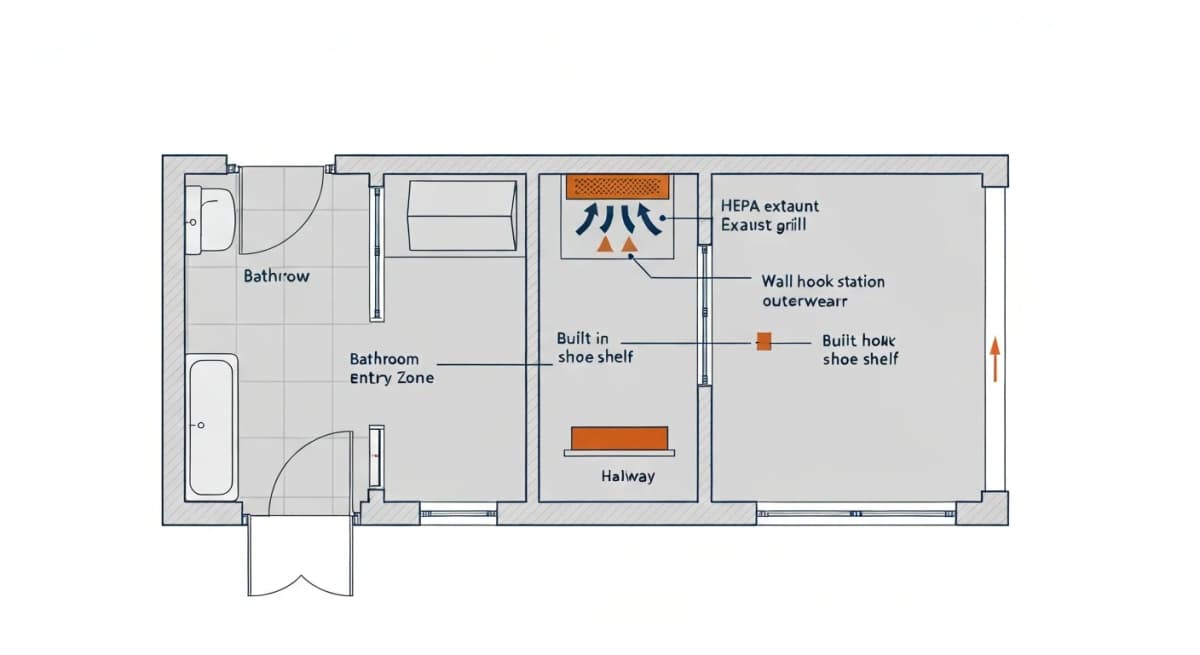
The single largest pollen-introduction event in a bathroom is the removal of outerwear and clothing after outdoor exposure. Pollen is released from fabric into the air during this step. If the released pollen disperses into the rest of the home (carried on air currents, settling on surfaces), the household's overall pollen burden compounds.
The designed clothing-handoff zone captures the pollen at the source:
Covered hamper at bathroom entry: A built-in hamper with a sealed lid or sliding-door enclosure positioned at the bathroom entry. Worn clothing goes directly into the hamper, not on the floor or counter. The sealed enclosure prevents continuing pollen release into the bathroom air.
Outerwear hooks outside the bathroom: Jackets, hats, and other outerwear contain the most pollen. Hooks just outside the bathroom door (in the hallway or mudroom) let the user remove outerwear before entering the bathroom — keeps the highest-pollen items out of the bathroom entirely.
Dedicated shoe storage: Shoes accumulate pollen on the soles. A small bench or built-in cubby with shoe storage near the bathroom entry (or in the mudroom if available) keeps outdoor footwear out of the bathroom proper.
Active exhaust during transitions: A motion-activated boost on the exhaust fan that activates when entering the bathroom captures clothing-released pollen at the source. Pairs with the HEPA-grade exhaust spec from item 3.
Cost for the full clothing-handoff zone integration: $600-$1,500 in cabinetry and built-in scope, depending on the bathroom layout and whether the hamper integrates with existing cabinetry. For households where outdoor activity is frequent (foothills hikers, runners, dog walkers), the function is high-value.
Iron Crest's bathroom design process for allergen-sensitive households starts by identifying the specific sensitivity profile — diagnosed allergies, asthma triggers, chemical sensitivities, mold sensitivity — and the household's outdoor-activity pattern. The answers shape the design priorities. A household with severe juniper allergy and daily outdoor activity needs different design choices than a household with general seasonal allergies and limited outdoor exposure. We adjust the spec accordingly rather than applying a single allergen-friendly template.
For broader allergen-and-respiratory-health context in Boise homes, the EPA and AAFA (Asthma and Allergy Foundation of America) publish guidance that informs our material spec. We integrate that into the design at no premium beyond the materials-cost difference. For the broader Boise bathroom remodel context, see how we run bathroom remodeling in Boise and our bathroom ventilation guide.
How much does an allergen-resistant bathroom remodel cost compared to standard?
The cost premium for incorporating all the design features in this article runs $800-$2,500 above a standard Boise bathroom remodel of equivalent scope. Specifically: HEPA-grade exhaust fan upgrade ($400-$900), low-VOC paints and finishes ($100-$300 premium), epoxy grout vs cementitious ($150-$350), CARB 2 or NAUF cabinetry ($200-$800 premium), clothing-handoff zone built-ins ($400-$1,200). On a typical $25,000-$45,000 bathroom remodel, the allergen-resistance premium is 3-8% of the total project. Modest cost for households where the function matters.
Is the HEPA exhaust fan upgrade worth the cost for a household without diagnosed allergies?
For households without specific allergy sensitivity, the HEPA exhaust fan is generally not worth the cost premium. Standard quiet exhaust fans (Panasonic WhisperFit, Broan-NuTone Sensonic) at 70-110 CFM provide adequate moisture removal and modest air-quality improvement at a fraction of the cost. The HEPA upgrade is justified when a household member has documented allergy or asthma sensitivity that's affected by airborne particulates, when the home is in a high-pollen area (foothills, near sage rangeland), or when the household includes immunocompromised members. For everyone else, a quality non-HEPA quiet fan is the right spec.
Can I retrofit allergen-resistant features into an existing bathroom?
Most yes, with varying difficulty. Exhaust fan upgrade is straightforward — swap the existing fan for a HEPA-grade unit (typically 2-3 hours of labor plus the new fan cost). Material changes (paint, sealants, grout) require strategic refresh work rather than full demolition. Built-in clothing-handoff zone is the hardest retrofit because it typically requires modifying existing cabinetry or built-ins. The realistic retrofit approach: tackle the easiest items (exhaust fan, paint, hamper addition) as a refresh scope ($1,000-$2,500) and address the rest during the next bathroom remodel. The full allergen-resistant spec is best implemented during a full remodel for cost and disruption reasons.
How do I know my bathroom remodel uses low-VOC materials?
Specify the requirement at the design phase and verify during installation. Specifically: ask your contractor to provide CARB 2 or NAUF cabinet certifications, specify zero-VOC paint product names by brand (Benjamin Moore Aura, Sherwin-Williams Harmony, Behr Premium Plus Ultra), ask for low-VOC caulk and sealant products (most major manufacturers have these), and request water-based finishes for any wood elements. During installation, the actual product cans should be visible — confirm the products on site match what was specified. Iron Crest documents all material selections in the project scope and provides product specifications to the homeowner at project close for any future air-quality testing or allergy management.
Will an allergen-resistant bathroom design help with severe asthma or chronic respiratory conditions?
Modestly, yes. The design features above primarily reduce environmental allergen exposure within the bathroom and the household. For severe asthma or chronic respiratory conditions, the design supports broader health management but doesn't replace medical care or environmental controls outside the bathroom. The full allergen-management plan for severe sensitivity typically involves whole-home HVAC HEPA filtration, allergen-impermeable mattress and pillow covers, regular allergen testing, and consultation with allergy and pulmonary specialists. The bathroom-specific design choices are one valuable component of that broader plan rather than a comprehensive solution. For households with severe sensitivity, integrating the bathroom design choices into a coordinated whole-home allergen-reduction strategy produces the best results.
Are there allergens specific to Boise that aren't well-addressed by national allergen-resistance guidelines?
Yes, several Boise-specific factors. Juniper pollen levels in the Treasure Valley regularly exceed levels seen in many national markets — national allergen guidelines underestimate the load. Sagebrush pollen is highly concentrated in fall and not addressed by humid-region allergen guides. Treasure Valley irrigation creates seasonal moisture spikes that affect mold growth patterns differently than non-irrigated regions. Wildfire smoke in late summer overlaps with sage pollen season and compounds respiratory load. The local AAFA chapter and Boise allergy practices (St. Luke's, Saint Alphonsus, allergist practices in Eagle and Meridian) provide regional guidance that incorporates these factors. For severe-sensitivity households, working with a Boise-region allergist informs design choices in ways that national guidelines don't.
Design a Boise bathroom that helps with the pollen, not against you
Allergen-resistant bathroom design starts with understanding your household's specific sensitivity profile. Schedule a consultation and we'll model the right exhaust, materials, and clothing-handoff zone for your home's allergen-management needs.
These pages go deeper on the topics linked from this article. Read them before your consultation and you'll come in with sharper questions and a clearer scope.
The following government agencies, industry organizations, and official resources provide additional information relevant to your remodeling project.