
Sound Isolation in Multigenerational Boise Bathrooms: 5 STC Rating Decisions for Privacy Across Generations
Privacy is the unstated need in multigenerational bathroom design. Standard residential wall assemblies (STC 30-35) transmit toilet flushes, plumbing sounds, and conversations between rooms. Five decisions for STC 50+ bathroom sound isolation that produces actual privacy.
Quick answer
Partially. Door upgrade (solid-core or acoustic) is easy retrofit ($200-$2,500). Fan replacement is easy retrofit ($300-$1,200). Wall assembly improvements require demo and rebuild — typically only feasible during full bathroom remodel scope.
Multigenerational households living together — adult children with aging parents, returning adult children, three generations under one roof — face an unstated design challenge: bathroom privacy. Standard residential construction transmits bathroom sounds at intelligible levels through walls. Toilet flushes, plumbing noises, conversations, and other sounds reach adjacent rooms in ways that don't matter for nuclear families but matter substantially for multigenerational households where personal privacy is more valuable.
The technical metric is Sound Transmission Class (STC). Standard residential walls test STC 30-35 — meaning loud speech is intelligible through the wall. STC 45-50 makes speech mostly unintelligible. STC 55+ produces genuine privacy. The cost premium to achieve STC 50+ in a bathroom is modest ($1,500-$4,500) and the daily-comfort improvement for multigenerational households is substantial.
This article covers five decisions for designing bathroom sound isolation that delivers actual privacy.
For the broader multigenerational home remodel framework — accessibility, ADU integration, separate living spaces — see our multigenerational home remodel guide for Boise. This page focuses specifically on bathroom acoustic privacy.
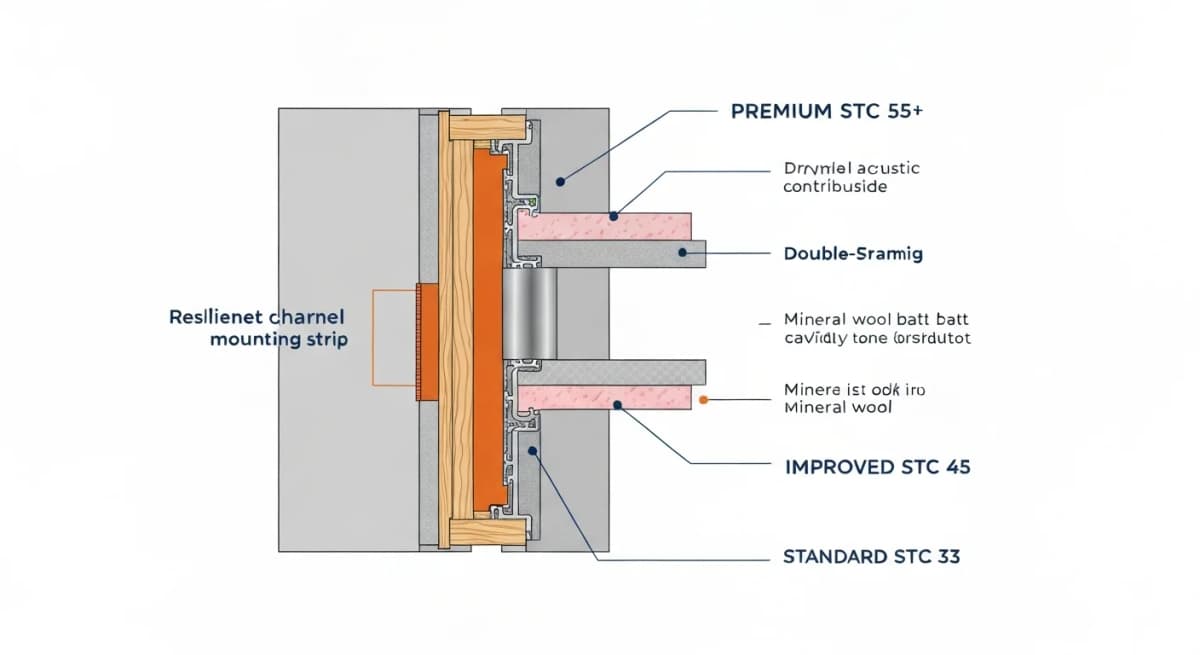
Sound Transmission Class (STC) is a logarithmic measurement of how well a wall assembly blocks sound. Higher numbers = better isolation. The scale is unintuitive at first; understanding the practical meaning helps make design decisions.
STC ratings and practical meaning:
STC 25-30: Loud speech easily understood through wall. Whispered conversations may be audible. Standard interior partition wall (single layer 1/2-inch drywall on each side of 2x4 studs, no insulation). Most pre-2000 Boise residential construction.
STC 30-35: Loud speech intelligible. Normal speech faintly audible. Standard residential bathroom wall (single layer drywall, batt insulation in stud cavity). Most current Boise residential construction.
STC 40-45: Loud speech distinguishable as speech but not intelligible. Better-spec hotel walls or premium residential applications. Achieved with improved insulation, double-layer drywall, or resilient channel.
STC 50: Loud speech essentially inaudible. Normal speech not heard. Genuine privacy threshold. Premium hotel walls.
STC 55-60: Sound essentially completely isolated. Even running water from plumbing is barely audible. Top-tier residential construction; commercial recording studios; premium hotel suites.
STC 60+: Premium acoustic isolation. Sound is unmeasurable for most residential applications. Recording studio construction.
For multigenerational bathroom privacy, STC 50 is the threshold where the bathroom feels genuinely private. STC 55-60 is premium. Below STC 45, the privacy is inadequate for multigenerational household needs.
What determines STC rating:
Mass: Heavier wall assemblies block more sound. Double-layer drywall vs single-layer adds 5-7 STC points.
Decoupling: Mechanical separation between the two sides of the wall reduces sound transmission. Resilient channel, double-stud assemblies, staggered-stud assemblies all decouple the wall.
Damping: Materials that absorb vibration (mineral wool insulation, acoustic damping compounds like Green Glue) reduce sound transmission.
Sealing: Air gaps transmit sound disproportionately. Sealed wall-to-floor, wall-to-ceiling, and outlet penetrations significantly improve effective STC.
Establishing baseline understanding before specifying construction details.
Higher STC ratings cost more and consume more wall thickness.
The wall assembly is the highest-impact sound isolation decision. Specifying the right construction during the bathroom remodel produces lifetime privacy benefits.
Assembly tiers:
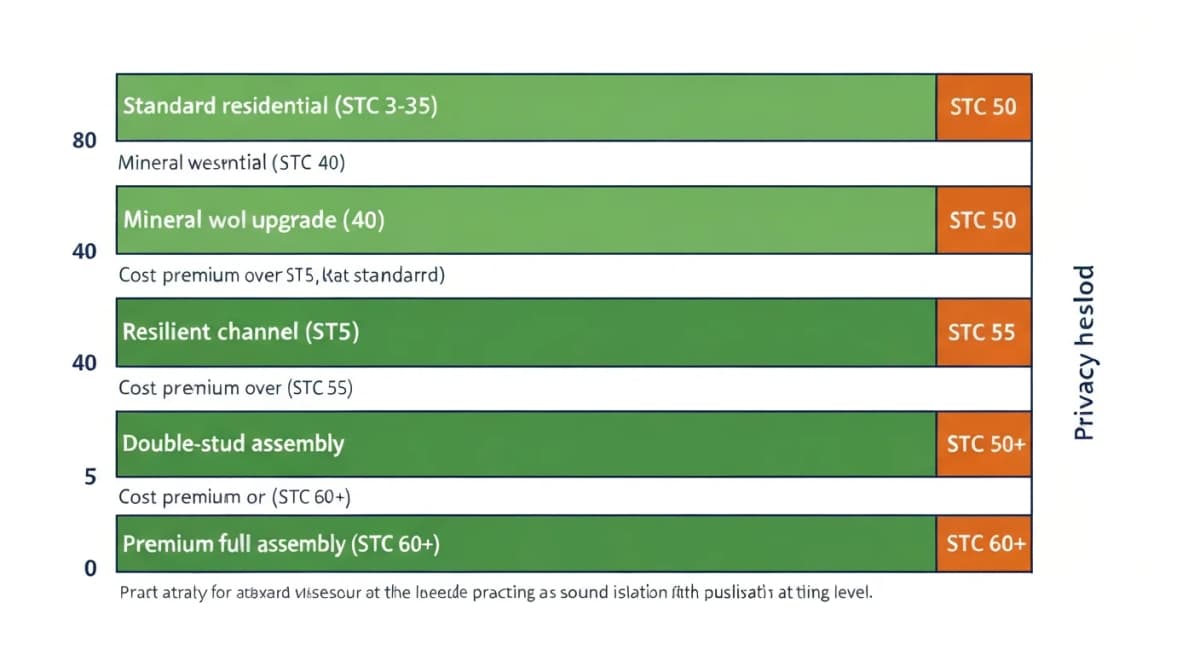
STC 30-35 (standard, often inadequate): Single layer 1/2-inch drywall both sides, fiberglass batt insulation in 2x4 stud cavity. Most pre-2020 Boise bathrooms. Inadequate for multigenerational privacy.
STC 40-43 (improved with mineral wool, ~$300-$600 premium over standard): Single layer drywall both sides, mineral wool batt insulation (Roxul Safe'n'Sound or similar) instead of fiberglass. Mineral wool is denser and provides better acoustic absorption. Modest improvement.
STC 45-48 (improved with double layer drywall, ~$800-$1,500 premium): Double layer 5/8-inch drywall on one or both sides, mineral wool insulation. The added mass increases STC. Acceptable for multigenerational privacy in low-traffic situations.
STC 50-53 (improved with resilient channel, ~$1,200-$2,500 premium): Resilient channel installed on one side, mineral wool insulation, double layer drywall on resilient-channel side. Resilient channel decouples one drywall layer from the studs, reducing sound transmission. The recommended baseline for multigenerational bathrooms.
STC 55-60 (double-stud or staggered-stud, ~$2,000-$4,500 premium): Two parallel wall framing systems with a gap between them, no studs touching both sides. Mineral wool insulation, double-layer drywall, possibly Green Glue damping compound. Premium acoustic isolation.
The cost-benefit math for multigenerational bathrooms:
STC 30 (no upgrade): $0 premium. Inadequate privacy. Daily friction in multigenerational household.
STC 45-48 (mid-tier upgrade): $800-$1,500 premium. Adequate privacy in most scenarios. Right baseline for typical multigenerational bathroom.
STC 50-53 (premium-tier upgrade): $1,200-$2,500 premium. Excellent privacy. Right specification when budget supports it.
For most multigenerational bathroom remodels we recommend STC 50+ assembly. The premium ($1,200-$2,500) is modest compared to the total bathroom remodel cost ($25-$45k typical) and the daily-life benefit compounds across the household's residency.
Specifying the right wall assembly during bathroom remodel design.
Higher STC consumes more wall thickness (double-stud assemblies are 8-10 inches thick vs 4.5 inches standard).
Wall assembly improvements address voice and ambient sound but don't fully address plumbing-generated noise (toilet flushes, water hammer, drain noise). Plumbing-specific quieting requires separate intervention.
Plumbing noise sources and remediation:
Toilet flush noise: Standard residential toilets generate 70-85 dB at flush. Premium quiet-flush toilets (TOTO, Kohler Veil, American Standard Champion) operate at 50-65 dB. Cost premium: $300-$1,200 for the toilet upgrade.
Drain noise: Cast iron drain pipes are quieter than PVC by 5-8 dB. For high-priority sound isolation, specify cast iron drain stack from the bathroom. Cost premium: $400-$1,200 vs PVC.
Acoustic pipe insulation: Wrapping water supply and drain pipes with acoustic insulation (Sound Choice acoustic pipe insulation or similar) reduces sound transmission through the plumbing rough-in. Cost: $200-$600 for typical bathroom plumbing wrap.
Water hammer prevention: Water hammer (sudden pipe noise from valve closure) is loud and disruptive. Install water hammer arrestors at fixtures. Cost: $50-$150 per fixture, $200-$500 total for bathroom.
Fixture isolation gaskets: Rubber gaskets between fixtures and the wall/floor reduce mechanical vibration transmission. Cost: minimal, often included in fixture install.
Integration recommendations:
Standard residential bathroom: Skip plumbing quieting beyond basic fixture isolation. Plumbing noise is acceptable for typical residential needs.
Multigenerational bathroom: Specify quiet-flush toilet, cast iron drain stack, and acoustic pipe insulation. Combined cost: $1,000-$2,500 above standard plumbing.
Premium acoustic bathroom: All of above plus water hammer arrestors and full fixture-isolation gasketing. Combined cost: $1,500-$3,500.
For Boise multigenerational households where one user's bathroom use shouldn't disturb other household members in adjacent rooms, the plumbing quieting investment is worthwhile.
Multigenerational bathrooms where plumbing noise has been a complaint.
Plumbing quieting requires plumber buy-in and adds modest scope cost.
Build a bathroom that doesn't broadcast
Multigenerational bathroom acoustic isolation is a standard scope inclusion in our remodels for households where privacy is the priority. Schedule a consultation and we'll spec the right combination for your home.
Bathroom exhaust fans are required by code for ventilation but produce noise that can be disruptive in multigenerational households. The right fan delivers required CFM at low noise levels.
Fan noise specifications:
Standard residential fans: 2.0-4.0 sones (loud). Common in budget installations. Operating noise approximately 50-60 dB. Disruptive in quiet households.
Mid-tier residential fans: 0.7-1.5 sones (quiet). Common in mid-budget installations. Operating noise approximately 35-45 dB. Acceptable for most residential applications.
Premium quiet fans: 0.3-0.7 sones (very quiet). Premium fan brands (Panasonic WhisperCeiling, Broan Sensonic, Delta Electronics). Operating noise approximately 25-35 dB. Difficult to hear from outside the bathroom. Right specification for multigenerational privacy.
Whisper-quiet fans: Under 0.3 sones. Top-tier residential. Essentially inaudible from outside the bathroom.
Fan placement for sound isolation:
Ducted vs in-line fans: Standard fans mount in the ceiling and exhaust directly above. In-line fans mount in the duct away from the bathroom (in the attic or chase), with the duct running to a quiet ceiling grille. The motor noise stays in the duct, not in the bathroom. Significant noise reduction. Cost premium: $200-$600 over standard fan.
Duct insulation: Acoustic insulation around the exhaust duct reduces sound transmission through the duct to other rooms. Cost: $100-$300 in duct insulation materials.
Vibration isolation: Rubber gasketing where the fan unit meets the ceiling framing reduces vibration transmission. Cost: minimal, often included.
Specification recommendations:
Standard multigenerational bathroom: Panasonic WhisperCeiling FV-08VKS3 (0.3 sones, 80 CFM) — about $200-$300 for the fan. Most cost-effective premium-quiet option.
Premium multigenerational bathroom: In-line fan installation with quiet ceiling grille. Cost: $500-$1,200 installed. Essentially inaudible from outside the bathroom.
The combined effect of premium-quiet fan plus the wall assembly improvements: a bathroom that's genuinely private even during active use. Multigenerational household members no longer track each other's bathroom schedules by sound.
All multigenerational bathroom remodels. The fan upgrade is modest cost for substantial impact.
Premium-quiet fans cost more than standard fans but the noise improvement is significant.
Even with high-STC walls, sound leakage at the bathroom door and threshold can negate the wall investment. The door is typically the weakest acoustic link.
Door upgrades:
Standard hollow-core interior door: STC 17-20. Sound passes through with little reduction. Almost no acoustic isolation.
Solid-core door: STC 27-32. Significantly better than hollow-core. Cost premium: $150-$400 per door. Standard upgrade for any sound-conscious bathroom.
Acoustic-rated door: STC 35-45. Premium doors designed for acoustic isolation (Krieger, Eggers, Marshfield). Cost: $800-$2,500 per door. Right specification for premium multigenerational bathrooms.
Seal and threshold details:
Door gasket weatherstripping: Standard adhesive weatherstripping around the door frame reduces air gaps and sound transmission. Cost: $20-$60 in materials, DIY install. Significant improvement over no weatherstripping.
Acoustic door seal kit: Premium gasket system including frame seals, threshold sweep, and astragal seals. Cost: $80-$300 for the kit, plus install labor. Brings door performance closer to wall performance.
Automatic threshold seal: Spring-loaded threshold that drops down when door closes to seal floor gap. Cost: $200-$500 for premium threshold. Eliminates the floor-gap sound leak.
HVAC duct considerations:
Shared duct runs: If the bathroom HVAC duct is connected to the same trunk as adjacent rooms, sound transmits through the duct path. Specify isolated ducting or acoustic duct insulation. Cost: $300-$1,000.
Door undercut: Standard residential interior doors have 1/2-inch to 1-inch undercuts for return-air flow. This gap is a major sound leak. Solutions: install duct return register elsewhere (eliminates the undercut requirement) or use a threshold seal that closes the gap when the door is shut.
Total cost for door and threshold upgrades in a typical multigenerational bathroom: $400-$1,200 for solid-core door with acoustic gasket kit and threshold seal. Pays back daily in privacy.
Multigenerational bathroom remodels where the wall STC has been upgraded and the door is now the weak link.
Premium door and seal hardware is visible — some aesthetic considerations.
Iron Crest's multigenerational bathroom design includes explicit acoustic specification conversations. We discuss household composition, privacy priorities, and budget constraints, then specify wall assembly, plumbing quieting, fan selection, and door details accordingly. For most multigenerational bathrooms we target STC 50+ wall assembly, premium-quiet exhaust fan, and solid-core door with acoustic gasketing. The cost premium runs $2,500-$6,000 above standard residential bathroom acoustics — modest within a $25-$45k full bathroom remodel scope. For broader multigenerational scope, see our multigenerational home remodel guide.
Can I retrofit STC improvements without a full bathroom remodel?
Partially. Door upgrade (solid-core or acoustic) is easy retrofit ($200-$2,500). Fan replacement is easy retrofit ($300-$1,200). Wall assembly improvements require demo and rebuild — typically only feasible during full bathroom remodel scope. Plumbing quieting is mostly bathroom-remodel-scope work. For existing bathrooms with no remodel planned, focus on door and fan upgrades; defer wall and plumbing work to future remodel scope.
What's the difference between STC and other acoustic ratings I might see?
STC is the most common residential rating but has limitations. Outdoor-Indoor Transmission Class (OITC) is similar but tests with lower-frequency sources. Field Sound Transmission Class (FSTC) tests actual installed walls vs laboratory walls — typically 5-10 STC points lower than lab STC. For residential planning, STC is the standard metric. For very high-priority acoustic projects, consult an acoustic consultant for full spectrum analysis.
Do high-STC walls add to home value?
Modestly. Premium acoustic isolation in bathrooms is a recognizable luxury feature but rarely appraised at a specific dollar premium. For multigenerational households with specific privacy needs, the value is daily-use rather than resale. For typical residential resale, premium acoustic specification is a slight positive but not transformative.
Will quiet fans handle Boise winter humidity loads?
Yes. Premium quiet fans (0.3 sones at 80-110 CFM) handle typical Boise residential bathroom humidity loads. Boise's dry climate means humidity loads are lower than humid coastal regions, so quiet-fan CFM specifications are typically adequate. Specify with humidity-sensing automatic control for optimal performance.
Does sound isolation affect bathroom moisture or ventilation?
If done correctly, no. The wall assembly improvements (insulation, drywall, resilient channel) don't affect ventilation. Plumbing quieting doesn't change drain or supply function. Door seals can affect return air flow — this requires duct system review during design (item 5 covers this consideration).
Build a bathroom that doesn't broadcast
Multigenerational bathroom acoustic isolation is a standard scope inclusion in our remodels for households where privacy is the priority. Schedule a consultation and we'll spec the right combination for your home.
These pages go deeper on the topics linked from this article. Read them before your consultation and you'll come in with sharper questions and a clearer scope.
The following government agencies, industry organizations, and official resources provide additional information relevant to your remodeling project.