
Dual-User Bathroom Layouts for Boise Couples Sharing One Bathroom: 6 Designs That Reduce Queue Stress
Pre-1950 Boise bungalows often have only one bathroom serving the entire home. For couples sharing daily, layout design determines whether mornings work or feel like a constant queue.
Quick answer
Roughly 50-60 sq ft minimum for meaningful dual-user upgrades. Below this, even compact dual sinks struggle to fit while leaving aisle space. 70-90 sq ft is comfortable for full dual-user implementation (separate vanities + pocket-door toilet + glass shower separation).
Many Boise homes — particularly pre-1950 bungalows, smaller mid-century ranches, and modest historical builds — have a single bathroom serving the entire household. For solo occupants this is fine. For couples and small families sharing the bathroom, design choices determine whether morning routines flow smoothly or constantly conflict over the same fixtures.
This article covers six layout strategies for one-bathroom homes that let multiple users share more effectively. The features add modest cost during a remodel ($800-$3,000) but produce significant daily-quality-of-life improvement for shared-bathroom households.
For broader bathroom layout context, see our bathroom layouts guide. This page focuses on shared-use scenarios where multiple household members need bathroom access simultaneously or in rapid succession.
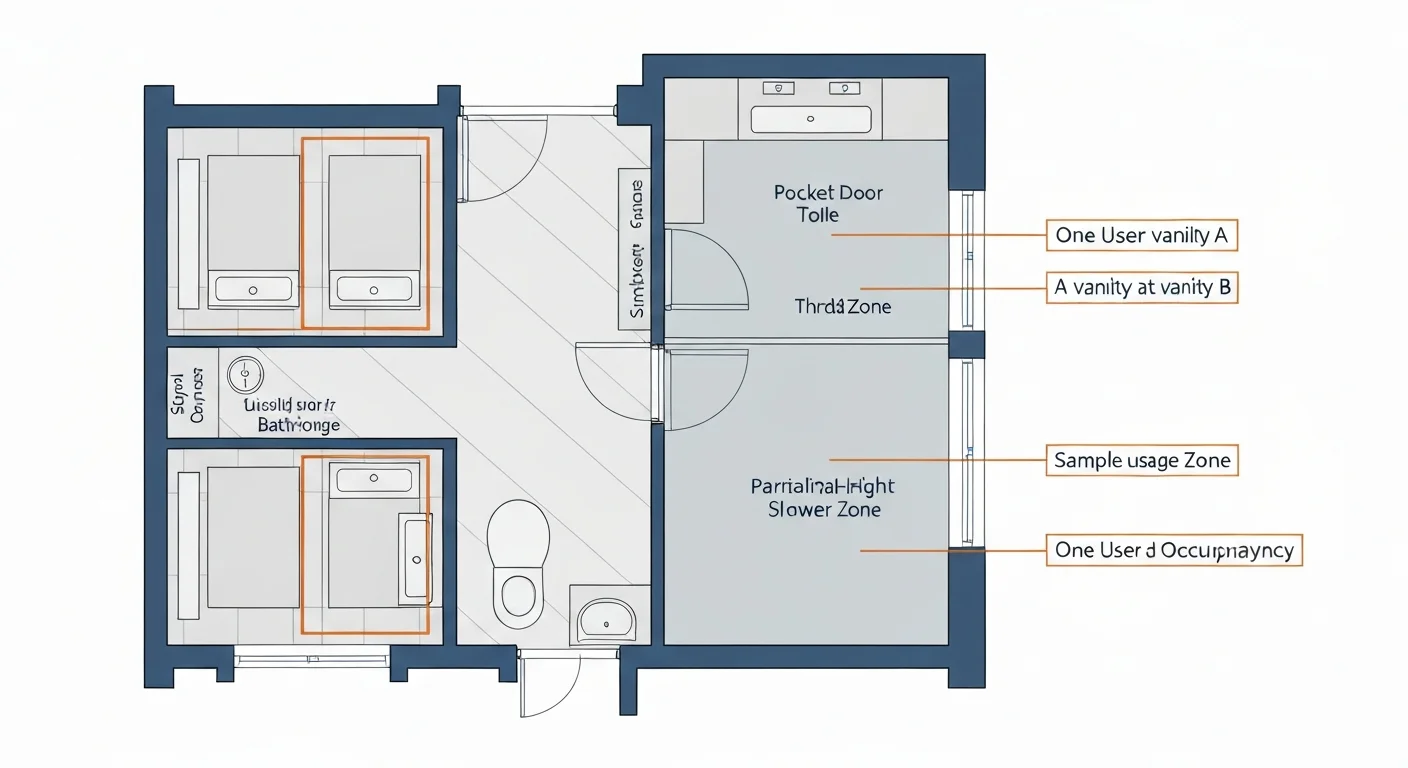
Pre-1950 Boise bungalows (North End, Hyde Park, East End) were typically built with one bathroom regardless of household size. The single-bathroom layout was the standard for the era and remained common in smaller mid-century construction. For Boise homes in this category — typically 1,000-1,500 square feet with 2-3 bedrooms — adding a second bathroom is either impossible (no available footprint) or requires significant scope (addition, basement bath, half-bath conversion).
For households accepting the single-bathroom configuration, dual-user layout design becomes the practical optimization. Six approaches address the most common queue points: multiple sinks for simultaneous grooming, separated toilet privacy, shower-vanity separation, mirror station multiplexing, and routine sequencing.
The honest math: a dual-user-optimized bathroom remodel costs $25,000-$45,000 in Boise for a typical pre-1950 bungalow scope. The same home with a basement bath addition runs $30,000-$55,000. The dual-user layout is typically cheaper than adding a second bathroom and avoids the structural complexity, but doesn't add a true second bathroom for resale or for when both users are home.
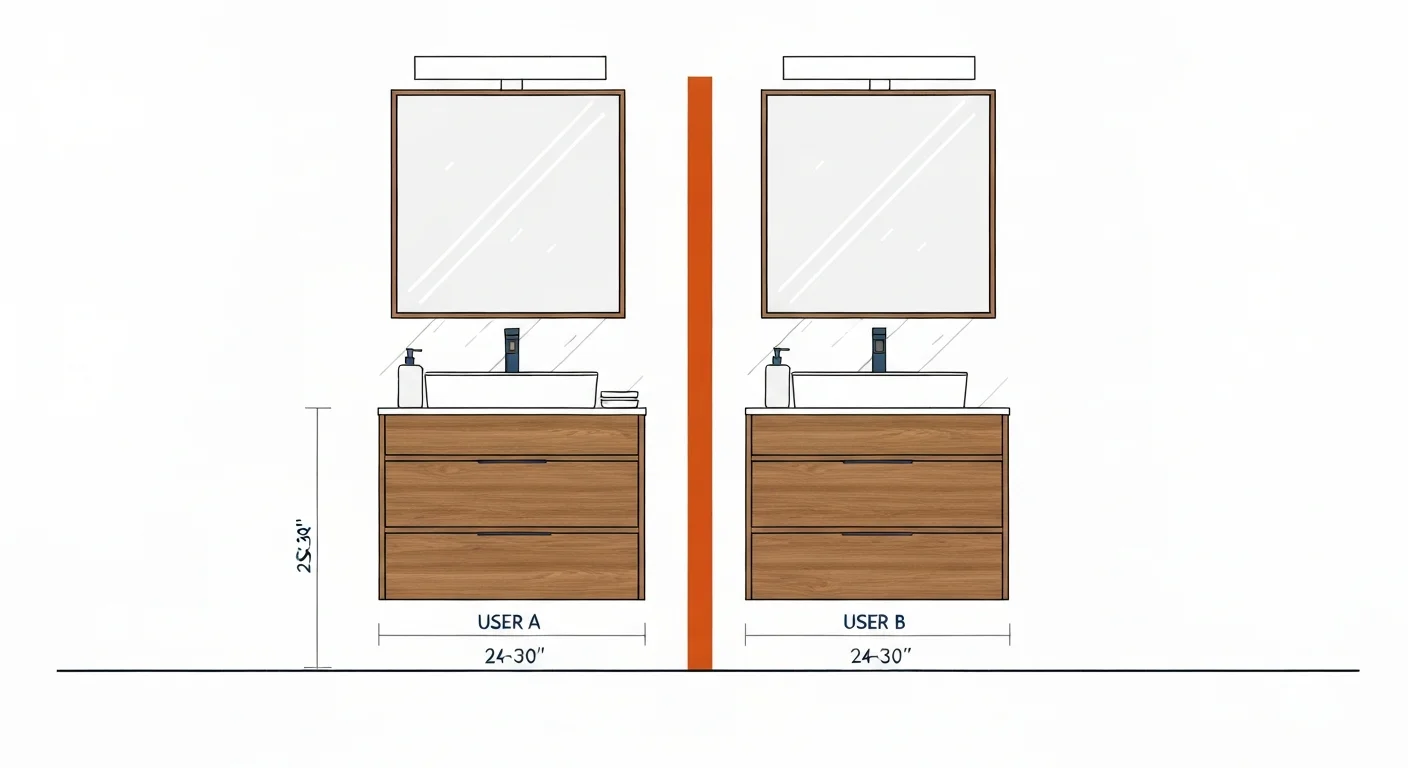
The single highest-impact dual-user upgrade is replacing a single shared vanity with two separate sinks at separate counter stations. Even small bathrooms (50-70 sq ft) can accommodate two compact vanities (24-30 inches each) at opposite walls or at different sections of a single longer wall.
Configuration options:
His-and-hers vanity: A single counter (60-72 inches long) with two integrated sinks, one mirror split into two sections or two separate mirrors. Most common implementation. Cost: $1,800-$4,500 for the vanity and counter.
Separate vanities at opposite walls: Two compact (24-30 inch) vanities, one on each wall. Each user has dedicated counter, mirror, and drawer space. Requires more wall length but feels more separated. Cost: $2,200-$5,500 total.
The morning routine: while one user is at vanity station A (brushing teeth, applying makeup), the other can be at vanity station B (shaving, grooming) — both functions happen simultaneously without interference.
Every couple sharing a single bathroom. The function-per-dollar of dual sinks vs single is consistently the highest of any dual-user upgrade.
Requires sufficient wall length (typically 60+ inches). Smaller bathrooms (under 50 sq ft) may not have the space.
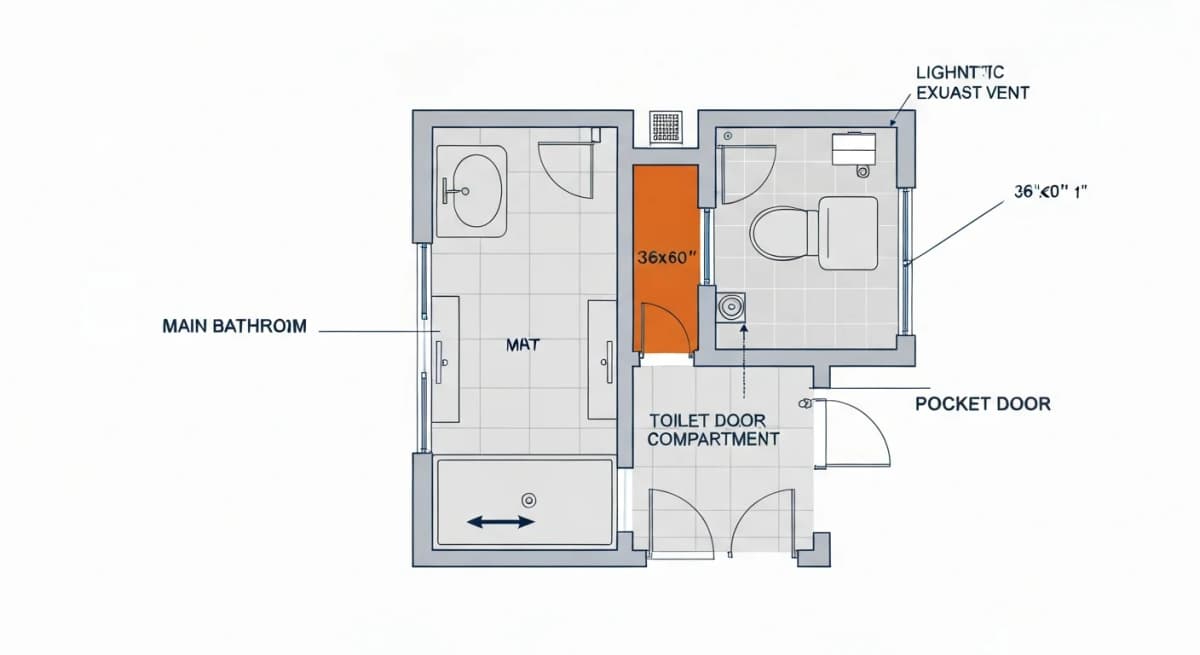
The pocket-door toilet compartment (sometimes called a "water closet") creates a small separate enclosure for the toilet only, accessed by a pocket door from the main bathroom. The configuration lets one user use the toilet privately while the rest of the bathroom (vanity, shower) remains available for the other user.
Specifications:
Compartment size: Minimum 30x60 inches (per IRC R307 toilet clearance requirements). Most installations are 36x60 to 36x72 for comfortable use.
Pocket door: Sliding pocket door (vs swinging door) saves the floor clearance that a swing door would require. Typically 30-inch door slab.
Lighting: Dedicated overhead light in the compartment.
Exhaust ventilation: Required per code; either dedicated exhaust fan in the compartment or shared with the main bathroom exhaust through a vent grille.
Cost: $1,800-$4,500 to add a pocket-door toilet compartment during a bathroom remodel. The structural scope includes the wall framing, pocket-door track, electrical for lighting, and ventilation. Worth the cost for households where toilet privacy concurrent with bathroom use matters.
For bathrooms large enough to support separation, designating the shower zone with a partial-height wall, frosted glass partition, or full enclosure with door creates visual privacy between the shower user and the rest of the bathroom. One person can shower while another uses the vanity or toilet without direct sight lines.
Implementation options:
Frosted glass partition (partial height): 5-6 foot tall frosted glass wall separating the shower from the main bathroom. Light passes through; sight lines blocked. Most popular implementation.
Full glass enclosure: Frameless or framed glass shower enclosure with door. Same privacy plus contains shower water spray. Increasingly the default for new bathroom remodels regardless of dual-user considerations.
Partial knee-wall: 3-4 foot tall knee-wall separating shower from vanity zone. Less privacy than glass alternatives but adds visual separation.
For shared bathrooms where one person prefers showering with curtain-only privacy and others want more separation, the glass partition is the practical compromise.
Design a single-bathroom layout that works for two daily users
Dual-user bathroom design starts with understanding the household's actual routine conflicts. Schedule a consultation and we'll model the right layout upgrades for your specific bathroom size and morning routine pattern.
Beyond the basic dual-sink setup, design choices for mirror placement and storage routing can reduce queue conflicts further. Two specific patterns:
Independent mirror stations: Rather than a single large mirror over the vanity, two separate mirrors at the appropriate heights for each user. Allows simultaneous grooming without one user blocking the other's view.
Sequence-aware storage: Drawer and cabinet organization that supports each user's routine independently. His-side storage on one end (razor, beard products, work tools); her-side storage on the other end (makeup, hair products, skincare). The routine sequence works in parallel.
Implementation cost: minimal during a remodel — typically $200-$600 in additional cabinet hardware and drawer accessories. The function benefit is real for households with mature shared-bathroom routines.
For very small bathrooms (40-50 sq ft) where multiple dedicated zones won't fit, design the layout to support linear workflow — users enter, complete the routine in sequence (toilet → sink → shower or reverse), and exit. The linear approach is less ideal than parallel zones but reduces queuing in space-constrained homes.
Implementation:
Routing optimization: Position fixtures along a single wall or in a tight U-shape so users can move through the bathroom space without backtracking. Toilet near entry, sink in middle, shower at far end.
Quick-cycle features: Features that speed individual routines (instant-hot-water taps, quick-cycle exhaust fans, fast-warming heated floor) reduce total time per user, reducing total queue time for households.
Routine separation by time: Households where users have meaningfully different schedules can stagger bathroom use without requiring layout changes.
For very small bathrooms, the linear approach is the realistic answer. Households should accept that fully simultaneous use isn't possible and design for fast-cycle routines instead.
An underused option for one-bathroom Boise homes: place a small vanity station in the master bedroom or in a hallway alcove for grooming activities that don't require water (makeup application, hair styling, dressing). Splits the bathroom's vanity function from the bathroom proper.
Implementation:
Bedroom vanity: Small built-in or freestanding vanity (24-36 inches wide) in the master bedroom. Includes mirror, drawer storage, lighting, electrical outlet for hair tools. No plumbing.
Hallway alcove vanity: If the master bedroom is small, a small alcove in the adjacent hallway can host the vanity. Less elegant but functionally similar.
Closet conversion: A small closet can become a dedicated grooming station with mirror, lighting, and drawer storage. Frees the bathroom for water-only functions (toileting, showering, hand washing).
Cost: $1,500-$4,000 to add a bedroom or alcove vanity station during a broader remodel. The function adds significant flexibility to shared-bathroom households without requiring a true second bathroom.
Iron Crest's dual-user bathroom design conversations start with the household's morning routine: who needs what at what time, what causes the worst queue conflicts currently, and what trade-offs the household will accept. The answers shape which of the six layouts above fit best. For most one-bathroom Boise homes, the dual-sink upgrade is the highest-impact decision; pocket-door toilet compartment adds significant value if the bathroom is large enough; bedroom vanity station works when even modest dual-zone bathroom isn't feasible.
The dual-user layout improvements typically add $2,000-$6,000 to a single-bathroom remodel. Modest cost; significant daily-quality-of-life return. For households who'll continue sharing a single bathroom long-term, the spec is well-justified. For broader bathroom remodel context, see our bathroom remodeling service overview.
What's the minimum bathroom size that supports dual-user layout?
Roughly 50-60 sq ft minimum for meaningful dual-user upgrades. Below this, even compact dual sinks struggle to fit while leaving aisle space. 70-90 sq ft is comfortable for full dual-user implementation (separate vanities + pocket-door toilet + glass shower separation). For bathrooms under 50 sq ft, the realistic approach is linear workflow optimization plus consider bedroom vanity station for grooming functions.
Does dual-user layout improve resale value?
Modestly positive. Buyers viewing a one-bathroom home appreciate dual-sink configurations and toilet privacy as quality-of-life features. The value isn't as significant as adding a true second bathroom but it's positive across most price tiers in the Treasure Valley. For homes priced under $400k, the dual-user layout reads as a 'thoughtful design' positive without being a major price driver.
Can I add a pocket-door toilet compartment to an existing bathroom without major remodel?
Possible but typically requires significant scope. The pocket-door track installation, new wall framing, electrical for compartment lighting, and potentially additional ventilation — collectively this is essentially a partial remodel of the bathroom. Cost: $2,500-$5,500 as a focused project. Most homeowners include it during a planned bathroom remodel rather than as a standalone project.
Are there code requirements that affect dual-user layouts?
Yes, IRC clearance requirements apply equally regardless of how many users share the bathroom. Each fixture needs proper clearance per IRC R307 (typically 21 inches in front of toilet/sink, 30 inches in front of shower opening). Dual-user layouts require the bathroom to be large enough to support the clearance requirements of all fixtures simultaneously, not just sequentially. Boise PDS inspectors verify these clearances at final inspection.
Design a single-bathroom layout that works for two daily users
Dual-user bathroom design starts with understanding the household's actual routine conflicts. Schedule a consultation and we'll model the right layout upgrades for your specific bathroom size and morning routine pattern.
These pages go deeper on the topics linked from this article. Read them before your consultation and you'll come in with sharper questions and a clearer scope.
The following government agencies, industry organizations, and official resources provide additional information relevant to your remodeling project.