
Adding a Master Bath to a Slab-on-Grade Boise Ranch: 3 Routes That Actually Pencil Out
Boise's 1960s-80s ranch homes on slab-on-grade foundations create a specific structural challenge for master bath additions. Three viable construction approaches, ranked by cost and disruption.
Quick answer
Total project cost typically runs $30,000-$65,000 for a complete master bath addition (toilet, shower, sink, vanity, lighting, ventilation, all finishes) in a Boise slab-on-grade ranch. Breakdown by approach: slab cut $35,000-$65,000 (highest because of concrete work), raised floor $30,000-$55,000 (mid-range, no concrete), sewage pump $32,000-$58,000 (mid-range, no concrete but mechanical component).
Bench, Vista, Southeast Boise, and Garden City contain large numbers of 1960s-80s ranch homes built on slab-on-grade foundations. These homes typically have one or two full bathrooms in the original layout, with the master bedroom often lacking a private ensuite. Modern household expectations call for a master bath off the master bedroom — and adding one to a slab-on-grade ranch is structurally more involved than the same project in a home with a crawl space or basement.
The fundamental problem: master bath additions require new plumbing rough-in for the toilet, shower, and sink. In a home with a crawl space, plumbing routes through the floor framing and ties into the existing waste system relatively easily. In a slab-on-grade home, the plumbing routing has to either cut through the slab, route above the slab through a raised floor structure, or use sewage-pump-assisted layouts that move waste upward to existing waste lines.
This article covers the three viable approaches, the realistic Treasure Valley cost math for each, and the structural and design implications that determine which approach fits a specific home.
For broader master bathroom remodeling context, see our master bathroom complete remodel guide. For curbless shower drainage on slab-on-grade specifically, see our curbless shower clay soil analysis. This page focuses on adding a complete master bath addition (toilet, shower, sink) to a home that didn't have one — typically involving structural modifications beyond standard remodel scope.
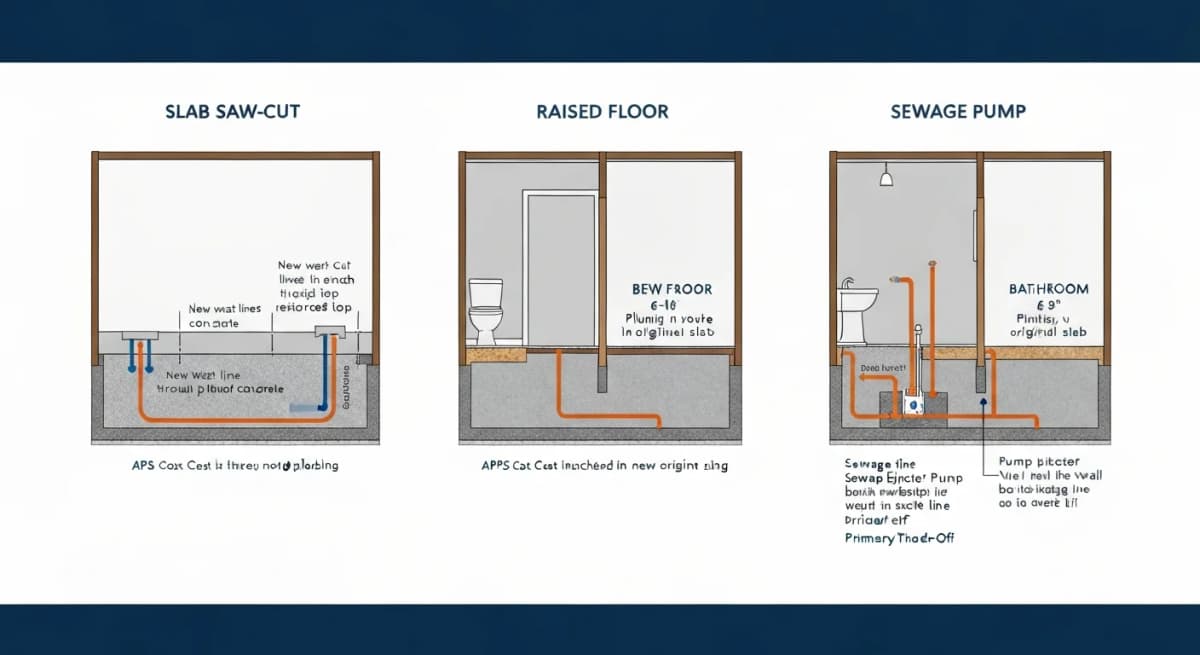
Most 1960s-80s ranch homes in the Treasure Valley were built on slab-on-grade foundations — a 4-inch concrete slab poured directly on compacted gravel and soil, with no crawl space or basement underneath. The construction was cost-effective for builders and worked well for the typical residential layouts of the era (3 bedrooms, 1.5-2 bathrooms in a 1,200-1,800 sq ft footprint).
For modern households wanting to add a master bath (typically a 7th-9th decade upgrade for these homes), the slab foundation creates structural and plumbing complications:
No floor-cavity space for plumbing: Standard residential plumbing routes through the joist space between floors. Slab-on-grade has no such space; plumbing has to route through the slab, above it, or be lifted to an existing waste line via pump.
Concrete demolition required for slab-cut approach: Removing concrete to install plumbing trenches is structural work that requires saw cutting, breaking out the concrete, excavating to allow plumbing installation, then reconstructing the slab. Significantly more involved than typical bathroom remodel demolition.
Drain slope requirements: Plumbing waste lines need 1/4 inch per foot of slope to gravity-feed to the existing waste main. From the new fixtures back to the existing waste line, the slope has to be maintained. In long runs (typical for additions on the far side of the home from the existing plumbing), the slope requirement may not be achievable without raising the bathroom floor.
Tie-in to existing waste line: The new bathroom plumbing has to connect to the home's existing sewer main. Locating the existing line, accessing it for tie-in, and modifying it for the new connections requires similar structural work to the new bathroom plumbing.
The three approaches below address each of these challenges differently, with different cost and disruption profiles.
The most structurally direct approach: saw-cut the existing slab to create trenches for new plumbing, install the new waste lines and supply lines, and restore the slab with new concrete fill.
Process:
1. Identify the routes for new plumbing (typically toilet drain, shower drain, sink drain, and supply lines back to the existing waste main and supply system).
2. Mark the cut lines on the slab. Saw-cut typically 8-12 inches wide and as long as needed for the plumbing routes.
3. Break out the concrete in the cut trenches. Excavate to required plumbing depth (typically 6-12 inches below the slab top).
4. Install plumbing rough-in. Tie into the existing waste line. Install supply rough-in. Pressure-test the new plumbing.
5. Backfill with gravel and compact. Install new vapor barrier over the new plumbing. Pour new concrete to match the original slab elevation. Allow cure time (typically 5-7 days for full cure).
6. Install new flooring over the restored slab to match adjacent floors.
Cost: $8,000-$16,000 for the slab work portion of the master bath addition. The full master bath project (including framing, plumbing fixtures, finishes, etc.) typically runs $35,000-$65,000.
Pros: Maintains a flat floor across the home (no step transition between the new bathroom and adjacent rooms). Plumbing is permanently routed in the slab with no ongoing maintenance considerations. Acceptable for any home layout regardless of bathroom location.
Cons: Most expensive of the three approaches. Most disruptive during construction (concrete cutting produces significant dust and noise; the slab takes 5-7 days to cure before flooring can be installed). Cure time extends the overall project timeline.
Best fit: Homes where the budget supports the cost and the household can tolerate the construction disruption. The standard choice for high-end master bath additions in Boise ranch homes.
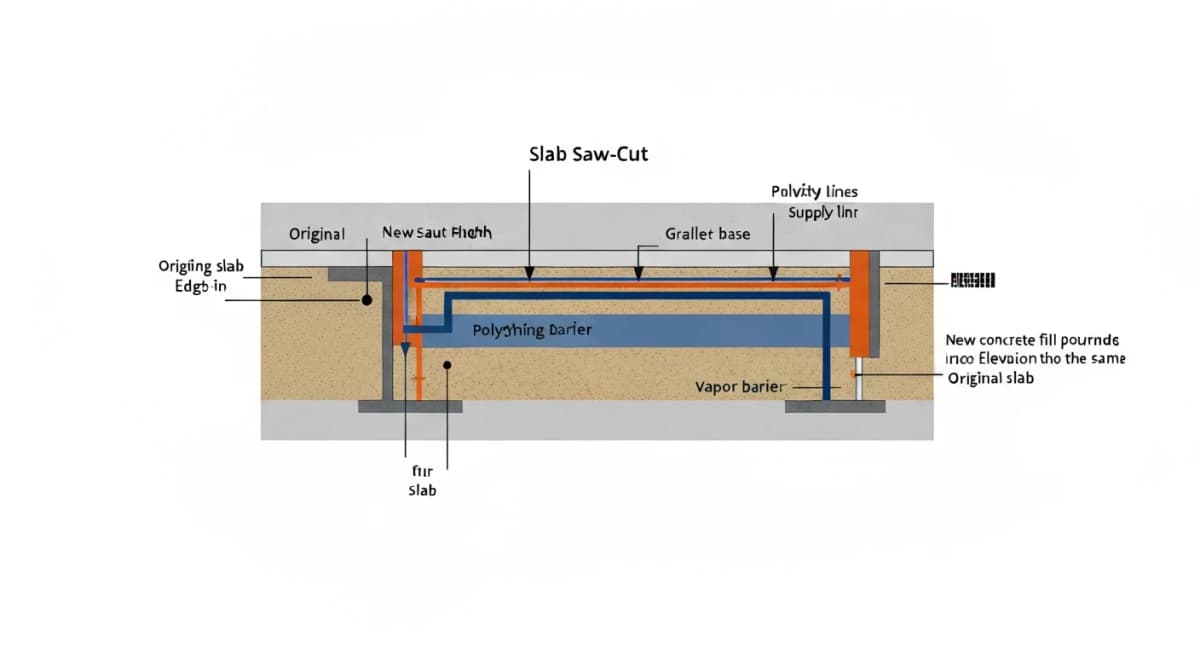
Treasure Valley soils under residential slabs are typically clay-loam with seasonal expansion and contraction (see our curbless shower clay soil analysis for the full structural context). Cutting through a slab on clay soil requires specific structural considerations:
Cut sealing: The slab cut introduces a structural discontinuity that becomes a stress concentrator for seasonal soil movement. To prevent differential settlement at the cut joint, epoxy dowel re-anchoring at the cut perimeter (typically 3/4-inch dowels every 12 inches) ties the new concrete to the existing slab.
Sub-base compaction: The excavated trench must be re-filled with properly compacted gravel base (95% Proctor compaction minimum) before the new concrete is poured. Inadequate compaction allows settlement of the new concrete, which compounds the joint-stress issue.
Vapor barrier integrity: The new concrete pour requires a continuous vapor barrier underneath, properly lapped with the existing slab's vapor barrier where possible. Without continuous vapor barrier, moisture from the soil can rise into the slab and affect flooring above.
Concrete mix: 3,500+ PSI concrete with proper aggregate sizing for the trench width. Standard residential 2,500 PSI concrete is inadequate for trench-restoration applications where stress concentrations are higher than typical slab pours.
Boise PDS inspection: the slab restoration work requires inspection at the rough-in stage (plumbing inspector verifies new pipework and connections) and at the slab-restoration stage (building inspector verifies the proper restoration, vapor barrier, and slab continuity). Skipping any of these creates inspection failure that delays the project.
Iron Crest's standard practice: epoxy dowel re-anchoring is non-negotiable; sub-base compaction is verified with a portable density gauge; vapor barrier is continuous and inspected before concrete pour. The structural work adds $400-$900 to the slab-restoration cost vs minimum approach, and produces a result that survives Treasure Valley seasonal soil movement for the bathroom's full lifespan.
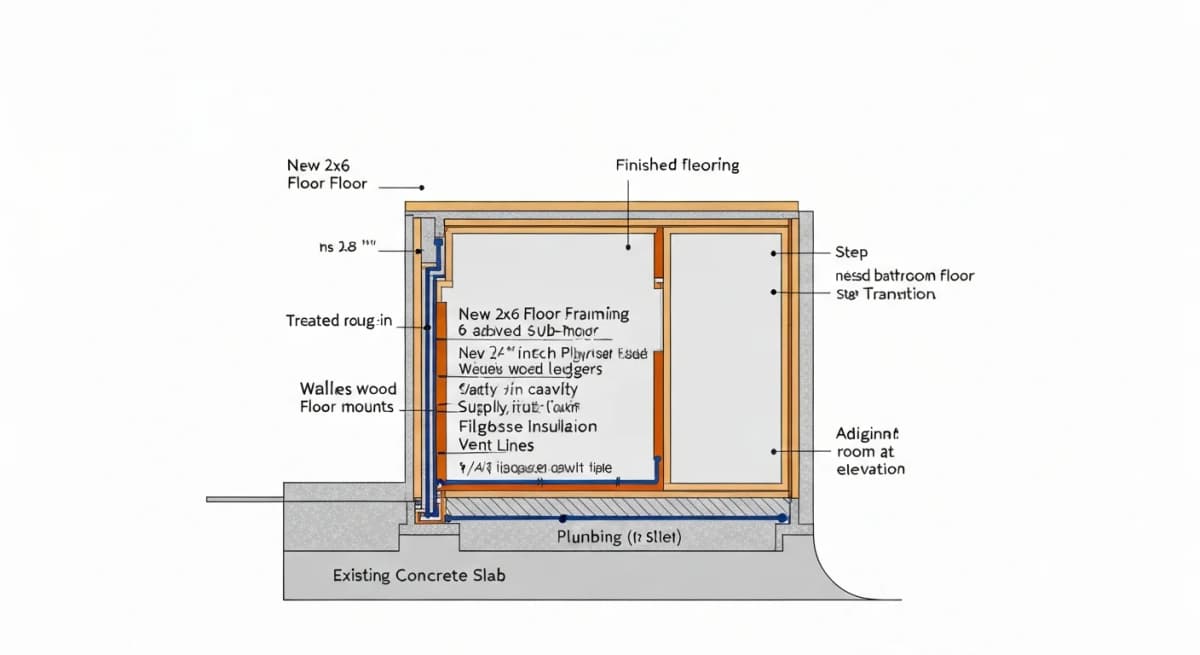
The alternative when slab cutting isn't feasible or affordable: build the new bathroom floor 6-8 inches above the original slab, routing all plumbing in the cavity space below the raised floor.
Process:
1. Frame a new sub-floor 6-8 inches above the existing slab using 2x6 or 2x8 lumber on the new bathroom area.
2. Route plumbing (waste, supply, and vent) through the cavity space. The waste line tie-in to the existing main is the most challenging part — the existing main is at or below slab level, requiring the new waste line to drop down to it at the tie-in point.
3. Install fiberglass batts or rigid foam insulation in the cavity for thermal break (the slab is meaningfully colder than room air in winter; insulation prevents floor heat loss).
4. Install new sub-floor (3/4-inch plywood) over the new framing.
5. Install new bathroom flooring (typically tile) on top of the new sub-floor.
6. Handle the doorway transition between the raised bathroom floor and the adjacent room at original slab elevation. Options: a small step (acceptable for non-ADA-compliant designs); a sloped transition strip (works for low-mobility users); a more elaborate sloped doorway threshold (more complex but creates flush transitions for accessibility).
Cost: $4,000-$8,000 for the floor build-up portion. Significantly cheaper than slab cutting because no concrete work is required. Full master bath project: $30,000-$55,000.
Pros: Avoids slab cutting and concrete work. Faster construction (no cure time). Acceptable for households that can tolerate a step transition at the bathroom entry.
Cons: Step at the bathroom doorway is a permanent feature. For accessibility-sensitive households, this is unacceptable. The raised floor reduces the ceiling height in the new bathroom by 6-8 inches, which can be tight in homes with original 8-foot ceilings (final bathroom ceiling height becomes 7'4" to 7'6").
Best fit: Homes where the master bath addition is in a location distant from existing plumbing (slab cutting cost would be high), the household accepts the step transition, and the original ceiling height supports the build-up.
Plan your slab-on-grade ranch master bath addition with the right structural approach
Three approaches exist; the right one depends on your home's layout and your priorities. Schedule a consultation and we'll evaluate the bathroom location options against the structural and cost implications of each approach.
The 6-8 inch step at the bathroom doorway is the design feature most often discussed with homeowners considering the raised-floor approach. Three design strategies handle the transition:
Simple step: A single step at the doorway, with the bathroom side at the raised elevation and the adjacent room side at original slab. Cheapest and easiest. Visible step is a permanent design feature. Not ADA-compliant.
Sloped transition strip: A short (2-3 ft) sloped flooring section between the bathroom and adjacent room that gradually rises from slab elevation to raised floor elevation. Slope typically 4-6 inches per foot. Walkable but not ADA-compliant. Creates a transition zone that's visible but less abrupt than a step.
Sloped doorway threshold (extended ramp): A longer (4-6 ft) ramp from slab elevation to raised floor that meets ADA slope guidelines (1:12 ratio). Most accessible option. Requires the most floor space in the adjacent room. May affect the door swing or require door modification.
For most slab-on-grade ranch master bath additions, the simple-step approach is selected for cost and design clarity. ADA-compliant options exist but require more space and design complexity.
Code consideration: Idaho residential code does not require ADA-compliance in residential master bath additions. The decision is design-and-lifestyle, not regulatory. For households planning to age in place, the accessibility consideration may favor the sloped transition approach or the alternative slab-cut approach (which has no step).
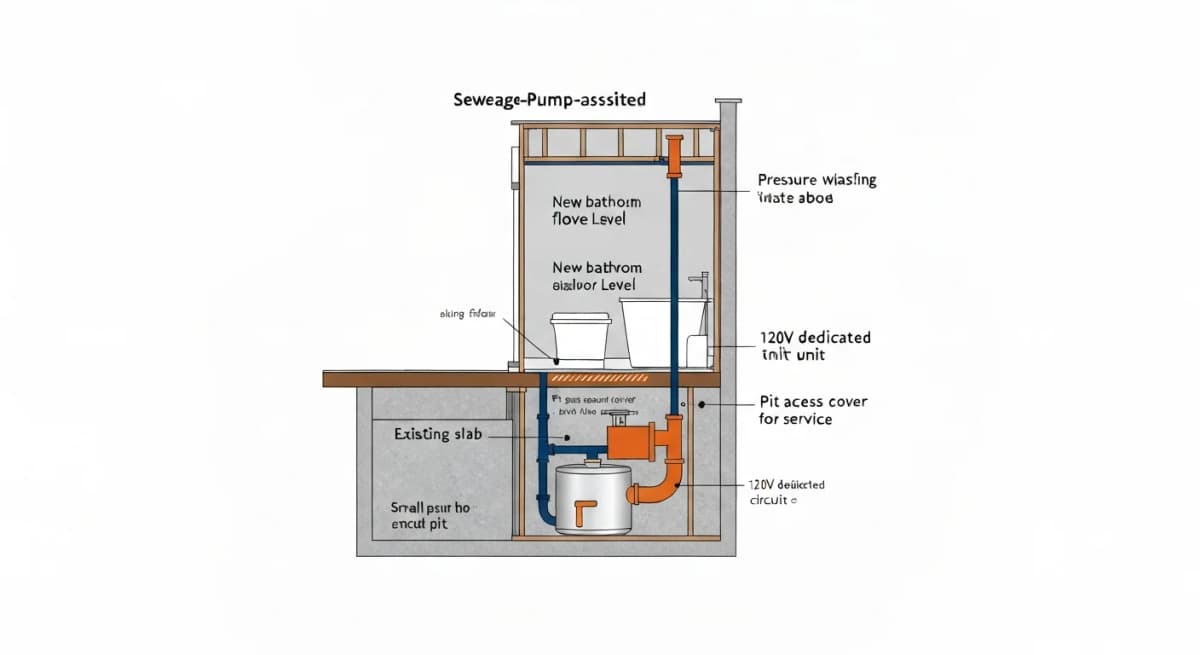
The third approach uses a sewage-ejector pump to move waste from below-grade fixtures upward to the existing waste line. This is the right choice when neither slab cutting nor raised floor works — typically because the existing waste line is significantly above the new bathroom location.
Process:
1. Excavate a pit beneath the new bathroom area to accommodate the sewage ejector pump (typically 24x36 inches and 24 inches deep).
2. Install the sewage ejector pump unit. Standard residential units handle gravity-fed waste from 2-3 fixtures (toilet, shower, sink) and pump it through a small pressure line up to the existing waste main.
3. Run the pressure discharge line from the pump up to the existing waste main. The discharge line can route through walls and ceilings to reach the tie-in point.
4. Install standard plumbing rough-in for the new fixtures, gravity-feeding into the pump pit.
5. Restore the floor above the pump pit. The pump location requires an access cover for service.
Pump specifications: typical residential sewage ejector pumps are 1/2 to 1 HP, capable of handling 25-50 GPM at lift heights up to 25 feet. Cost: $1,200-$2,800 for the pump plus $1,500-$3,500 for installation.
Total master bath addition cost using sewage pump approach: $32,000-$58,000.
Pros: Works in any home layout regardless of existing waste line elevation. Avoids slab cutting and raised floor build-up. Useful when the new bathroom is far from the existing waste main (or below it in homes with above-grade plumbing).
Cons: Introduces a mechanical component (the pump) that requires periodic maintenance and eventually replacement. Pumps fail with age; expect a pump replacement every 10-15 years. Pump operation produces some noise during cycles (typically 30-60 seconds per cycle). Power outage means temporary loss of the bathroom (battery-backup options exist but are expensive).
Best fit: Homes where the other two approaches aren't feasible. Typically homes with the existing waste line at a high elevation (basement waste main with main floor master bath) or where the new bathroom location is far from the existing main and slab cutting cost becomes prohibitive.
The right approach depends on three factors: bathroom location relative to existing plumbing, budget, and household accessibility needs.
Bathroom location 8-15 feet from existing waste main, budget supports premium scope: Slab cut approach. Maintains flush floors, gives the highest-quality result, and the cost is justified by the larger budget.
Bathroom location 15-30 feet from existing waste main, budget moderate: Raised floor approach. Avoids the expensive long slab-cut run, accepts the step at the doorway, and saves $4,000-$8,000 vs slab cut.
Bathroom location 25+ feet from existing waste main, or above-grade plumbing not feasible: Sewage pump approach. Handles the difficult plumbing layout but introduces ongoing maintenance and reliability considerations.
Household requires accessibility (aging in place, mobility-limited users): Slab cut approach. The flush-floor transition is non-negotiable for accessibility. Budget should support this approach regardless of other factors.
Household plans to sell within 5-7 years: Lean toward slab cut. Flush floors with no transitions reads better in listing photos and to buyers; the raised-floor step or sewage-pump complexity may produce buyer concerns.
For most Boise slab-on-grade ranch master bath additions, the decision is between approaches 1 and 2. Approach 3 (sewage pump) is a less-common third option used in specific structural situations. The right answer for your home depends on the specific layout and the household's priorities — we walk through this during the pre-construction design phase.
Three implementation issues we see most often on slab-on-grade master bath additions:
Pitfall 1: Under-budgeting the structural scope. Master bath additions in slab-on-grade homes have higher structural costs than in homes with floor framing. Homeowners comparing cost to standard master bath remodels often under-estimate the slab work or sewage pump cost. The fix: get itemized cost breakdowns from the contractor that separate fixture/finish costs from structural/plumbing costs, and verify the structural cost is appropriate for the chosen approach.
Pitfall 2: Not verifying existing waste line capacity. Adding a second full bathroom to a home that's been running on one bathroom for 50+ years can stress the existing waste main, particularly in homes built before modern code requirements. Before commiting to the master bath addition, the existing waste line should be inspected (typically via camera scope) to verify capacity and integrity. Cost: $200-$500 for the camera inspection. Saves the surprise of mid-project waste-line failure that requires emergency replacement scope.
Pitfall 3: Ignoring HVAC integration. Master bath additions need heating and cooling capacity. In slab-on-grade ranch homes, the original HVAC system may not be sized for the additional bathroom load. The HVAC system either needs to be evaluated for capacity or supplemented with localized heating (electric heated floors, mini-split heat pump, or other dedicated unit). Plan this during design phase to avoid post-construction discoveries of insufficient bathroom heating or cooling.
Each pitfall has a clean fix when identified at design phase. Iron Crest's pre-construction process includes existing-waste-line inspection, HVAC capacity verification, and itemized cost breakdown by scope category — eliminating the most common surprise sources before the project starts.
Iron Crest's process for slab-on-grade master bath additions starts with a structural walkthrough of the proposed location. We identify the existing waste line location, measure the distance from the proposed bathroom to the tie-in point, evaluate the slab condition for cutting (or determine that raised floor or sewage pump is required), and verify the existing HVAC capacity for the new bathroom load. The pre-construction analysis takes 2-3 hours and produces a project scope with itemized cost breakdown by approach option.
For households considering this addition, the right time to bring in a contractor is during the design conversation — before committing to a specific bathroom location. The location decision dramatically affects which approach is feasible and the project cost. We help clients evaluate multiple location options before committing. For broader master bathroom remodel context, see how we run bathroom remodeling in Boise and our master bathroom complete remodel guide.
How much does a master bath addition typically cost in a Boise slab-on-grade ranch?
Total project cost typically runs $30,000-$65,000 for a complete master bath addition (toilet, shower, sink, vanity, lighting, ventilation, all finishes) in a Boise slab-on-grade ranch. Breakdown by approach: slab cut $35,000-$65,000 (highest because of concrete work), raised floor $30,000-$55,000 (mid-range, no concrete), sewage pump $32,000-$58,000 (mid-range, no concrete but mechanical component). Additional cost factors: bathroom size (90-120 sq ft typical), distance from existing plumbing, fixture quality tier, structural framing complexity (full new walls vs partial), and broader project scope (if combined with other home modifications).
Do I need a building permit for a master bath addition in Boise?
Yes, multiple permits typically required: building permit (for new structural framing, walls, roof modifications), plumbing permit (for new fixtures and waste/supply rough-in), electrical permit (for new circuits, GFCI receptacles, lighting), mechanical permit (for HVAC tie-in and exhaust fan). All issued by Boise PDS or the appropriate city authority. Combined permit cost typically $400-$900 for a master bath addition project. Iron Crest handles all permitting and inspection scheduling as part of standard project scope. Permit and inspection process adds 1-2 weeks to the overall project timeline.
How long does a typical slab-on-grade master bath addition take?
Slab cut approach: 10-14 weeks. The longer timeline reflects concrete cure time and the more involved structural scope. Raised floor approach: 7-11 weeks. Faster because no concrete cure required. Sewage pump approach: 8-12 weeks. Middle range, modestly more complex than raised floor due to pump installation and electrical scope. For all approaches, the project timeline depends on: permit and inspection scheduling (typically 2-3 weeks total), material lead times for fixtures and finishes (2-6 weeks depending on selections), contractor availability (varies seasonally), and weather considerations for any exterior modifications.
Will a master bath addition affect my Boise home's property taxes?
Expect an increase. The addition adds livable square footage (typically 90-120 sq ft) and raises the home's bathroom count, and Ada County's assessment will reflect both. We can't give you the dollar figure: we have no sourced figure for the assessment change, and the levy rate varies by taxing district and is reset annually. Call the Ada County Assessor about your parcel and read the levy rate off your own tax notice — that is the only way to get a number that applies to your address. For broader context, see our <a href='/resources/property-tax-impact-remodeling-boise'>property tax impact of remodeling guide</a>.
Is a slab-on-grade master bath addition worth the cost vs simply remodeling the existing bathroom?
Depends on the household's bathroom-count and use-pattern needs. Master bath addition is justified when: (1) the household currently shares one bathroom and wants the privacy of separate master-bath access, (2) the home's existing layout has the master bedroom distant from the existing bathroom (forcing nightly trips through the house), or (3) the household plans to sell within 5-10 years and the addition would meaningfully increase resale value. Master bath addition is not justified when the existing bathroom serves the household adequately and the household values the larger living space over additional bathroom capacity. The right answer is honest assessment of household needs vs the meaningful cost premium of master bath addition.
Can I do part of the slab-on-grade master bath work myself to reduce cost?
Limited yes. Most homeowners can handle: demolition of existing wall finishes if applicable, painting and trim work after rough-in is complete, fixture installation and final hookups for the simpler fixtures (vanity, hardware, lighting), and final cleanup. Idaho licenses the plumbing and electrical trades through DOPL, so the plumbing rough-in (slab work, waste line tie-in, fixture rough-in) and the electrical rough-in including circuits and GFCI go to licensed tradespeople; structural framing changes and HVAC work are permitted and inspected rather than trade-licensed, but they are the parts of an addition where a mistake is structural. The trade work is where most of the labour cost sits, so the DIY savings on the homeowner-eligible portions are modest against the time they take. For households with strong DIY skills, the cleanest split is contractor handles all rough-in and the homeowner handles paint, trim, and finish details.
Plan your slab-on-grade ranch master bath addition with the right structural approach
Three approaches exist; the right one depends on your home's layout and your priorities. Schedule a consultation and we'll evaluate the bathroom location options against the structural and cost implications of each approach.
These pages go deeper on the topics linked from this article. Read them before your consultation and you'll come in with sharper questions and a clearer scope.
The following government agencies, industry organizations, and official resources provide additional information relevant to your remodeling project.