
Selling Your Boise Home? 7 Bathroom Upgrades That Out-Earn a Full Remodel
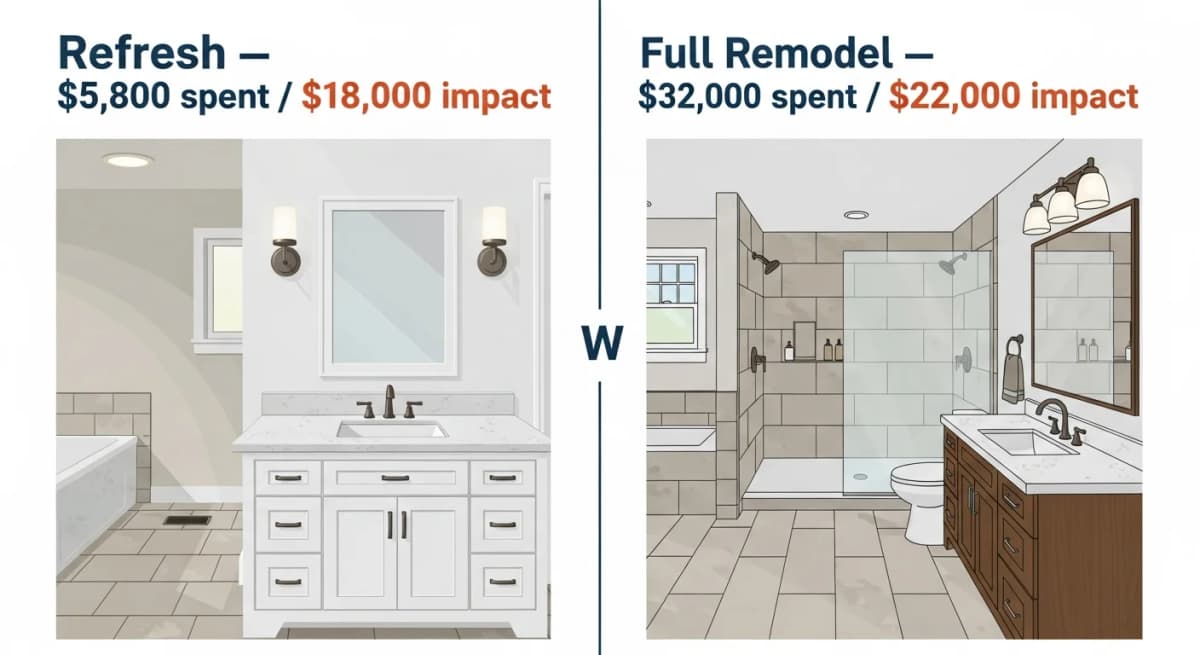
If you're listing your Boise home in the next 60–90 days, a $30,000 bathroom remodel is almost never the right move. A $4,000–$8,000 strategic refresh on the same bathroom typically out-earns it. Here's the item-by-item math.
Quick answer
Most refresh-scope work doesn't require permits, but a few items do. Like-for-like vanity replacement (no plumbing relocation) typically doesn't require a permit. Like-for-like fixture replacement (faucet, showerhead, toilet) typically doesn't require a permit.
Boise sellers consistently ask the same question during their listing prep: "Should I remodel the bathroom before we list?" Our answer, from the pre-listing projects we've run, is almost always no — and we want to be precise about what that answer rests on. There is no published, dated dataset for what a bathroom remodel returns at sale in Ada County. The national cost-versus-value studies linked at the foot of this page are national and category-level; they do not resolve to a Treasure Valley list price. So we are not going to quote you a recovery percentage, and you should be wary of anyone who does.
What we can say plainly: a full bathroom remodel is a large, slow, disruptive expense that lands right in the window when a seller least wants disruption, and it takes the room out of service for weeks. A strategic refresh — what we call a "presentation-grade upgrade" — is a handful of targeted items at $400–$1,500 each, typically $4,000–$8,000 all in, that are visible in photographs and finish in days rather than weeks. The case for the refresh is not a return multiple; it is that it costs a fraction of a remodel, carries a fraction of the schedule risk, and changes the first impression the listing photos make. Below are the seven items we'd do first in a Boise pre-listing bathroom, the realistic Treasure Valley cost for each, and the situations where a full remodel still makes sense.
For the broader resale context across all remodel types (kitchens, bathrooms, additions, whole-home), our seller's remodeling ROI guide is the comprehensive resource. This page goes deeper on one specific decision — pre-listing bathroom refresh versus full remodel — with item-by-item Treasure Valley cost figures.
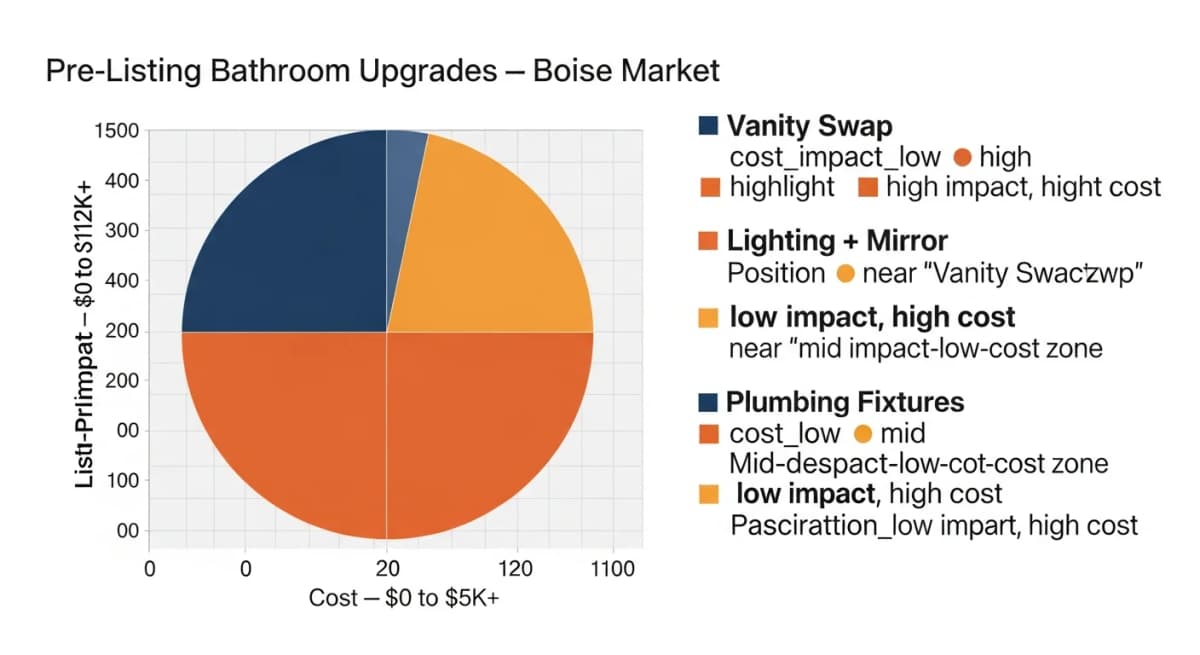
Three factors decide whether a pre-listing bathroom investment should be refresh or remodel: the bathroom's current condition, the home's price tier, and the time-to-list window.
Current condition: If the bathroom has active issues — water damage, broken tile, non-functional fixtures, code violations — those have to be fixed regardless. A buyer's inspection will flag them, and they become negotiation leverage that costs more in price reduction than the original repair would have cost. Fix the broken stuff first.
If the bathroom is functional but dated (1990s builder-grade finish, oak cabinets, beige tile, cultured marble), refresh is almost always the better math. The bones are sound; the appearance is what drives buyer perception.
If the bathroom has serious layout problems (no shower, only a tub; no window/ventilation; severely undersized; inaccessible plumbing), refresh can't address them. A full remodel might be justified — but only if the home's price tier supports the additional spend.
Price tier: Homes listing under $400,000 typically don't recover full-remodel costs. The market doesn't price in $25k bathrooms at that tier; the comparable sales reflect refreshed-not-remodeled bathrooms. Homes listing $400k–$700k can sometimes recover remodel costs but rarely in a tight pre-listing window. Homes above $700k more reliably price in remodeled bathrooms, particularly in Eagle, foothills, and Harris Ranch.
Time-to-list: Anything under 60 days favors refresh. Anything over 90 days might support remodel scope if the math otherwise works. The remodel window is real — schedules slip, materials backorder, inspections wait. We've seen 8-week target remodels stretch to 14 weeks for reasons no one anticipated. A 6-week target refresh almost always lands close to plan.
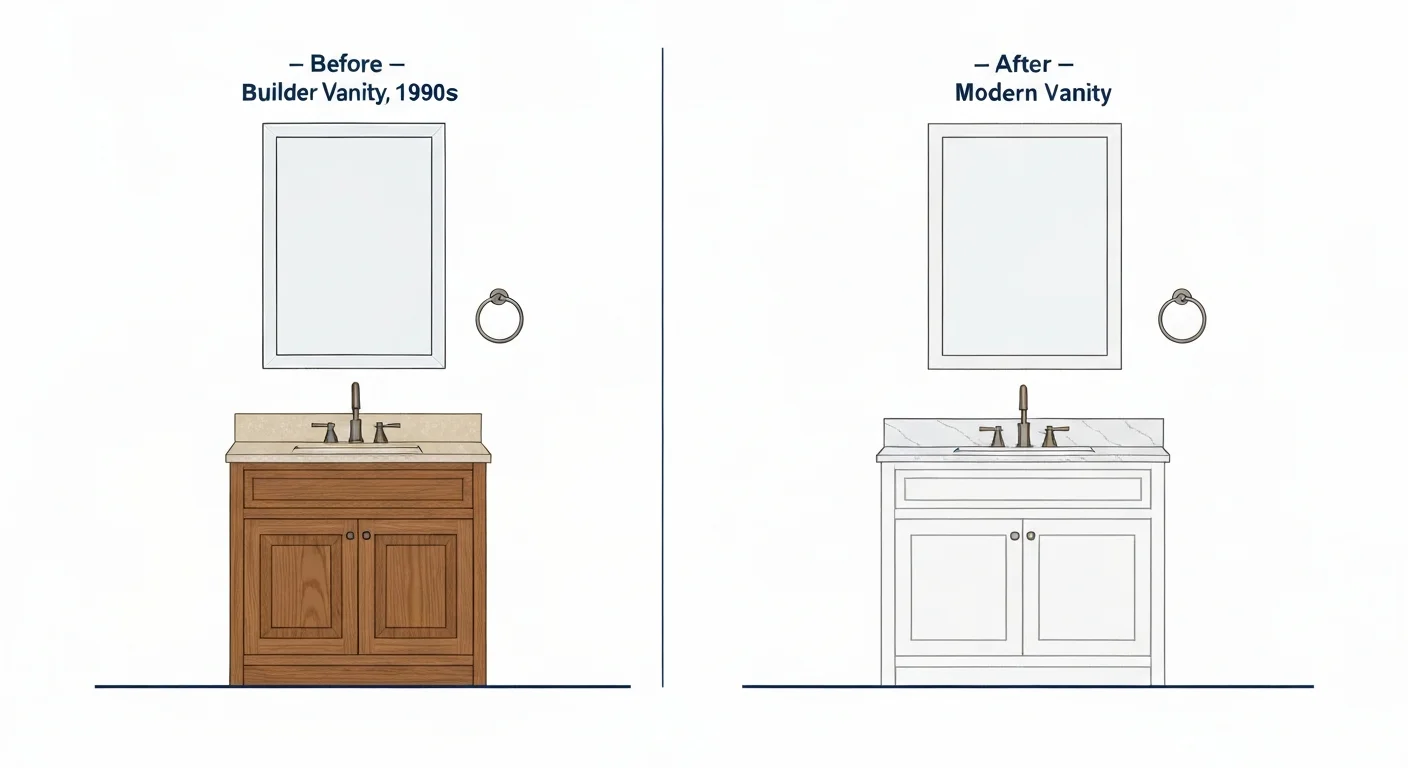
Replacing the bathroom vanity is the most impactful single refresh item in the Boise listing market. Three reasons:
The vanity is the visual focal point of the bathroom. Listing photos and showing visits both center on the vanity. A modern vanity reads as "updated bathroom" even when the tile and tub are original. A dated oak-front 1990s vanity reads as "original bathroom" no matter how clean the rest of the space is.
The install is fast and clean. A vanity swap is typically a 1–2 day install — disconnect the existing vanity, remove, install the new unit with new faucet, connect plumbing, install the new top. Minimal demolition, no tile work required, no permits typically.
The market has caught up. Mid-range vanities ($800–$1,800 for a 36–48 inch unit with quartz top) now read as "premium" in the under-$500k market and "current" in the $500k–$800k market. Premium vanities ($2,500–$4,500) read as "high-end finish" in the $800k+ market. The price-to-impact ratio is excellent at all tiers.
Treasure Valley cost (estimate): $1,400–$3,200 installed for a single vanity (36–48 inches) with quartz top, new faucet, and disposal of the original. Adds an additional $800–$1,500 for double-vanity (60–72 inches). We have no sourced figure for what that does to a list price, and we won't invent one — the case for it is that a dated vanity is the first thing a buyer's eye lands on in a listing photo.
Every pre-listing bathroom refresh budget should start with the vanity. It's the highest-leverage item.
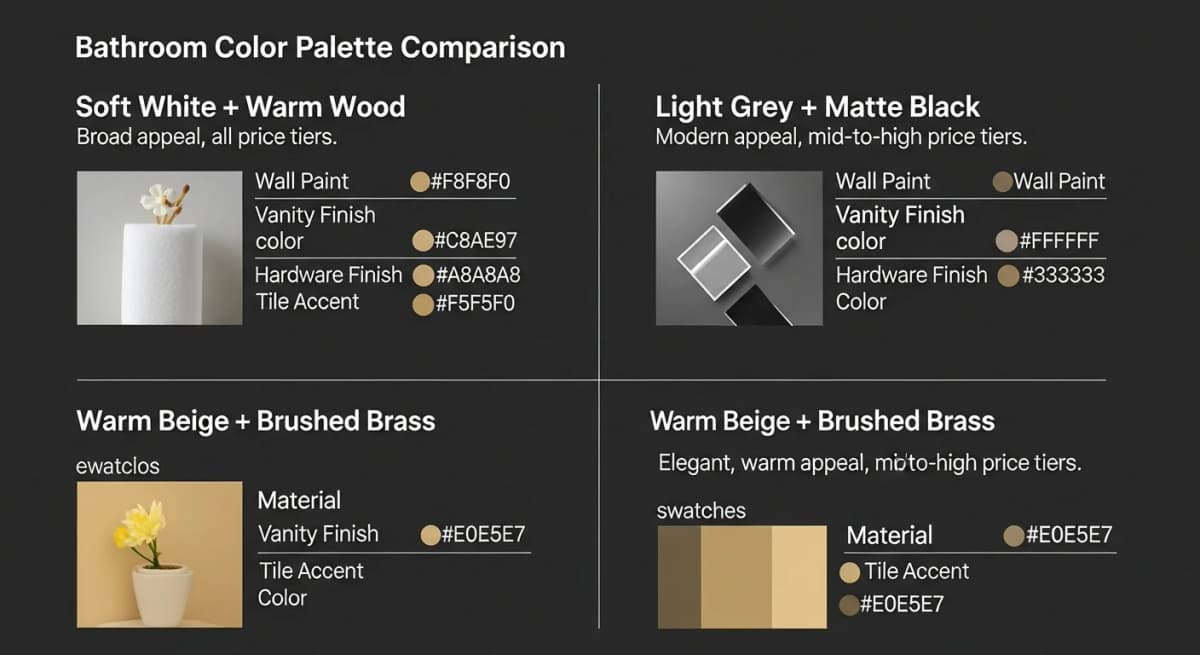
Custom colors and finishes that read as 'the seller's taste' can backfire. Spec broad-appeal colors (warm white, light gray, soft wood) rather than statement pieces.
Outdated bathroom lighting is one of the strongest signals of "dated bathroom" that buyers register, often subconsciously. The Hollywood-bar bulb strip above a mirror — common in 1980s–2000s Boise homes — reads instantly as "from a previous era." Replacing it with a modern fixture (or with proper sconces flanking the mirror) and updating the mirror itself is the second-most-impactful refresh item.
Three configurations work for pre-listing:
Option A: Modern bar fixture above mirror ($120–$320 fixture, $200–$400 install). Fastest, simplest. Sometimes shadows the user's face but adequate for listing presentation.
Option B: Twin sconces flanking the mirror ($300–$700 fixtures total, $400–$800 install — adds wall-rough-in if not present). Better lighting function, more contemporary aesthetic. Best when the wall geometry already accommodates it.
Option C: LED-edge-lit mirror replaces both the mirror and the dedicated fixture ($400–$900 mirror, $250–$450 install). Contemporary form factor, integrated function. Increasingly the default in Eagle and Harris Ranch master baths.
Pair the lighting update with a mirror update — a modern framed mirror (or the LED-edge-lit option) replaces the typical builder-grade frameless mirror or beveled-edge mirror that signals "1990s build." Treasure Valley cost for the lighting + mirror combination: $800–$2,000, and it is the change most visible in a photograph taken from the doorway.
Every bathroom with original or dated lighting. Particularly impactful when paired with the vanity swap as a coordinated finish update.
If the wall doesn't have rough-in for flanking sconces, the install adds electrical work that takes more time and triggers a permit. Plan for it during the refresh schedule.
Plumbing fixtures (faucet, showerhead, toilet) are small individual items that collectively shift the bathroom's perceived age dramatically. Replacing all three for under $1,500 in materials is the third-highest impact category for pre-listing investments.
Faucet: Replace any chrome polished faucet from the 1990s or earlier. Modern matte black, brushed nickel, or brushed brass faucet ($150–$400) signals "updated." We typically spec mid-range Moen, Delta, or Pfister lines for pre-listing because warranty support is straightforward for the next homeowner.
Showerhead: Replace builder-grade chrome heads with a rain-style or large-face showerhead ($80–$250). Photographs well; functional appeal to buyers is meaningful.
Toilet: Replace any pre-1995 toilet (commonly identifiable by tall tank, round bowl) with a modern dual-flush or low-flow elongated bowl ($250–$500 plus $200–$300 install). Newer toilets photograph better and signal water efficiency. Modern skirted toilets (smooth one-piece exterior) read as more current than two-piece round-bowl units.
Total: $700–$1,500 in materials plus $400–$700 in plumber labor for all three. Finish-matching all three at once is what makes the room read as deliberate rather than patched.
Every pre-listing refresh where the existing fixtures are 10+ years old. Particularly effective in 1990s and early 2000s Boise homes.
Coordinate finishes across the three fixtures so they read as intentional. Mismatched finishes (chrome faucet, brushed nickel handles, polished bronze showerhead) read as 'piecemeal updates' rather than 'updated bathroom.'
Repainting the bathroom in a modern neutral color is the lowest-cost item in the refresh list and one of the highest impact-per-dollar items. The wrong wall color (think saturated taupe, dated mauve, 1990s peach) signals "behind the times"; a current neutral signals "ready to move in."
The colors we see used most often in pre-listing prep across the Boise market are warm whites (Sherwin-Williams "Alabaster," Benjamin Moore "White Dove"), soft warm grays (SW "Agreeable Gray," BM "Edgecomb Gray"), and pale warm beiges (SW "Accessible Beige"). Trend-forward colors (deep navy, charcoal, sage green) work in some upscale markets but are risky in mid-tier listings — buyers either love them or use them as negotiation leverage.
The trim is often more important than the wall color. Original 1990s yellowed-white trim or stained wood baseboards date the bathroom instantly. Repainting trim in a clean modern white (semi-gloss, SW or BM Premium grades) is the visual equivalent of taking 10 years off the room. The labor is more involved than wall paint because trim requires careful prep and multiple coats, but it pays back in perception.
Treasure Valley cost (estimate): $400–$900 for paint and supplies, $600–$1,400 for labor on walls and trim. It is the cheapest line on this list and the one that changes the room's read the most per dollar spent.
Every pre-listing refresh. The cost is low enough that it always belongs in the budget.
Avoid feature walls and accent colors during pre-listing prep. Save those for the next homeowner's taste; keep the listing-prep palette neutral and broad-appeal.
Plan your pre-listing bathroom refresh with an eye on actual list-price math
We run pre-listing bathroom refreshes as fixed-scope, 7–14 day projects in coordination with your listing agent. Schedule a no-pressure consultation and we'll model the refresh items, sequence the work to your target list date, and quote against the realistic Treasure Valley resale impact.
Tile replacement is the most expensive item in a bathroom refresh budget, and the right approach depends on the existing tile's condition. Three tiers of intervention:
Tier 1 — Grout refresh only ($300–$600). If the tile itself is in decent shape but the grout is stained, mildewed, or yellowed, professional grout cleaning and recoloring is a half-day job that visibly refreshes the entire tile installation. Single most cost-effective tile-related intervention.
Tier 2 — Tile refinishing or partial replacement ($1,200–$2,500). If the tile color or pattern is dated (mauve squares, 4-inch beige tile from the 1990s, large fan-pattern tile with dark grout) but functionally sound, professional tile refinishing (epoxy coating to a new color) can update the appearance without demolition. Effective for floor tile, tub surrounds, and shower walls in some cases. Lasts 3–8 years before maintenance.
Tier 3 — Full tile replacement ($3,500–$8,000+). Necessary if the tile has significant damage (cracks, severe water damage, broken pieces) or if the existing color is so dated that refinishing won't read as current. Adds significant time to the project (3–7 days for shower or floor) and triggers waterproofing work in shower applications. Usually only justified in higher-tier listings or when the existing tile has actual condition issues.
For most pre-listing budgets, tier 1 or tier 2 delivers adequate impact without consuming the refresh budget. Save tier 3 for full remodels.
Bathrooms with sound but dated tile. Tier 1 (grout refresh) is the universal recommendation; tier 2 (refinishing) works for specific color situations; tier 3 (replacement) is rarely the right pre-listing call.
Tile refinishing has finite lifespan. The next homeowner will eventually want to replace, but the listing-prep impact is real and the cost is meaningfully less than full replacement.
The last layer of pre-listing refresh is the small-item finish coordination: cabinet hardware, towel bars, toilet paper holder, robe hooks, mirror frame, door handle. Individually, each item costs $20–$80. Collectively, the bathroom hardware can be replaced for $250–$500. The impact is disproportionate because finish-coordinated hardware reads as "intentionally designed" rather than "accumulated over the years."
The discipline: pick one finish (matte black, brushed nickel, brushed brass, or polished chrome) and apply it consistently across every hardware item in the bathroom. Mixing finishes — chrome faucet, brushed nickel handles, brass hooks, oil-rubbed bronze toilet flush handle — reads as "piecemeal" no matter how nice each individual piece is.
The same logic applies to softgoods staging during the listing window. New shower curtain ($30–$80), new bath rug ($25–$60), new towels in a coordinated color story ($50–$120), and a tasteful counter accessory or two ($40–$100). The total staging cost ($150–$350) reads as "well-presented bathroom" to buyers walking through.
This is also where the listing photography pays back. A bathroom that's been refreshed but photographed without thoughtful staging looks less updated than the actual finish work. Coordinate with the listing photographer and stager — most agents have a stager they work with.
Every bathroom refresh. The hardware coordination is the polish step that pulls the rest of the refresh together visually.
Don't over-stage. The bathroom should look lived-in but tidy; over-styled bathrooms read as 'staged' and trigger buyer skepticism rather than aspiration.
A typical pre-listing bathroom refresh budget for the Boise market lands at $4,500–$7,500 for a single bathroom (primary or guest). The allocation that consistently works:
Vanity, top, and faucet: $1,400–$3,200 (30–40% of budget)
Lighting and mirror: $600–$1,400 (12–18%)
Plumbing fixtures (showerhead, toilet, faucet finishes): $700–$1,500 (12–20%)
Paint and trim: $400–$1,000 (8–13%)
Tile work (grout refresh or refinishing): $300–$1,500 (8–20%)
Hardware and accessories: $250–$500 (5–8%)
Contingency / unforeseen: $400–$700 (8–10%)
For sellers with budgets above $7,500, the math typically tips toward including more substantive tile work or expanding to a second bathroom. For sellers under $4,500, prioritize vanity + paint + hardware as the highest-impact subset that still produces meaningful list-price gain.
Realistic timeline: a coordinated pre-listing bathroom refresh that includes all of the above runs 7–14 working days, including paint cure time and the small plumbing inspections that some Boise jurisdictions require for fixture changes. Plan for completion 7–14 days before listing photos to allow for staging and final touch-up.
Three conditions justify a full bathroom remodel in pre-listing scope:
Condition 1: The home is in a price tier where the comp set has remodeled bathrooms. In Eagle, Harris Ranch, Northwest Boise foothills, and similar upscale segments where most $850k+ listings have fully remodeled primary baths, NOT remodeling can be a competitive disadvantage. In that comp set the dated bath is what a buyer prices against, and remodel scope in the $25,000–$45,000 band is what it takes to match the neighbours.
Condition 2: There are functional issues that buyers will flag. Active leaks, mold issues, broken tile, non-functional fixtures, severely inadequate ventilation — these become inspection points and negotiation leverage. Better to address them as a remodel scope (where the cost is documented and warranted) than as concessions during contract negotiation.
Condition 3: The pre-listing window is long enough to accommodate the remodel. If the seller is planning to list in 90+ days and has flexibility on that timeline, full remodel becomes more viable. Under 60 days, the remodel is fighting against the schedule and usually under-delivers on both timeline and quality.
If two of these three conditions apply, lean toward full remodel. If only one applies, lean toward strategic refresh. If none apply, refresh is almost certainly the right call. For broader context on bathroom-remodel decision logic and the cost expectations, see our bathroom remodel ROI page and the deeper resource on budget bathroom remodels that keep existing plumbing.
Iron Crest's pre-listing bathroom work is a different scope than our standard remodel — faster, more presentation-focused, less invasive. We run them as fixed-scope projects with clear deliverables and a 7–14 day target completion window. The team that does these projects is the same that does our full remodels, which means the finish quality is at remodel-grade even when the scope is refresh. We coordinate with the homeowner's listing agent on color choices, hardware finish, and photography timing to ensure the work supports the actual listing strategy rather than just being a generic update.
For Boise homeowners planning a sale, the right time to start a pre-listing bathroom refresh is 6–8 weeks before the target listing date. That allows for material lead times (vanities and quartz tops have 2–3 week lead times typically), the work itself (1–2 weeks), and the staging window (1 week). For more on the broader pre-listing remodel context, the bathroom remodeling service overview covers our process across both refresh and full-remodel scopes.
Do I need permits for a pre-listing bathroom refresh in Boise?
Most refresh-scope work doesn't require permits, but a few items do. Like-for-like vanity replacement (no plumbing relocation) typically doesn't require a permit. Like-for-like fixture replacement (faucet, showerhead, toilet) typically doesn't require a permit. Lighting replacement on an existing circuit typically doesn't require a permit. Paint, hardware, and grout work never require permits. The exceptions: any work that relocates plumbing or electrical (moving a faucet position, adding sconces where no rough-in exists, replacing the toilet's drain location) requires a permit. Tile work that involves substrate replacement may require a permit if waterproofing is being modified. Our team handles all permitting decisions and Boise PDS coordination as part of the standard project scope, so the homeowner doesn't have to navigate this directly.
Why doesn't this article tell me what each upgrade adds to my list price?
Because we cannot source that number and neither can anyone else quoting it to you. There is no published, dated dataset that isolates the list-price effect of a specific bathroom upgrade in Ada County. The national cost-versus-value studies are national and report whole project categories, not a vanity swap in Boise. The dollar figures on this page are our own cost estimates for doing the work in the Treasure Valley — those we can stand behind, because we quote them. The value side belongs to your listing agent, who can price your specific home against the comps that actually sold in your neighborhood. Treat this page as the cost half of the conversation and take the value half to the agent.
Should I refresh the primary bath or the guest bath if my budget only supports one?
Primary bath, in nearly every case. Buyers spend the most listing-tour time in the primary bath, listing photos feature it more prominently, and the primary bath's perceived condition has more weight in the buyer's overall home evaluation. The guest bath gets less scrutiny — a clean, presentable, but un-refreshed guest bath rarely costs material list-price impact. The exception is homes where the guest bath has visible condition issues (water damage, broken fixtures, severely dated tile) that a buyer's inspection would flag. In that case, addressing the condition issue in the guest bath is higher-priority than upgrading the primary. Always fix functional problems before adding cosmetic upgrades anywhere in the home.
What if my bathroom doesn't have a tub — do I need to add one before selling?
Generally no, with one exception. The 'every home needs at least one tub for resale' rule is partially outdated in the Treasure Valley market. Walk-in showers are increasingly preferred in primary baths, particularly for buyers over 45 or planning aging-in-place. Homes with the primary bath as walk-in only and a guest bath with a tub are perfectly competitive at most price tiers. The exception is family homes targeted at buyers with young children — in some neighborhoods (parts of Meridian, Eagle, Star where family-buyer concentration is high), having at least one tub somewhere in the home matters. If the home has at least one tub anywhere, the primary bath being shower-only is fine. If the home has zero tubs, consider adding one to a guest or secondary bath as part of pre-listing prep — typically a $4,000–$8,000 add depending on existing layout.
How long do pre-listing bathroom refreshes typically take?
For a coordinated full refresh (vanity, lighting, fixtures, paint, hardware, optional tile work): 7–14 working days from kickoff to final cleaning. Breakdown: 1–2 days for vanity removal, plumbing rough-in adjustments, and vanity install. 1 day for lighting and electrical updates. 1 day for plumbing fixture swaps. 2–3 days for paint and trim work (including dry time between coats). 1–2 days for any tile work (grout refresh or refinishing). 1 day for hardware install and final detailing. Add 2–4 days of buffer for material delivery, scheduling around dependencies, and final touch-up. Plan for the refresh to be completed 7–14 days before listing photos to allow for staging and any small adjustments after the homeowner sees the finished work.
What's the worst pre-listing bathroom mistake I can make?
Choosing finishes that read as 'the current owner's taste' rather than 'broadly appealing.' We've seen sellers commit to bold paint colors, statement tile patterns, vibrant cabinet finishes, or unusual hardware combinations because they personally loved the look — and then under-perform at listing because the buyer pool reads the bathroom as 'I'd have to redo this.' The second-worst mistake: over-investing in a refresh when the comp set in the price tier doesn't support the spend. A $12,000 bathroom refresh in a $350k home doesn't recover the spend because buyers at that price point aren't pricing in $12,000-finish-level bathrooms. Match the refresh investment to the price tier. The third-worst: spending on refresh items while ignoring a condition issue that the inspection will catch — a $400 leak that becomes a $4,000 negotiation point because the seller didn't address it during prep.
Is hiring a contractor really worth it for a refresh-scope project versus DIY?
For a single-bathroom refresh in the $4,000–$8,000 range with all the items in this article, the contractor version costs more than the materials alone, because you're buying labour and scheduling as well as parts — get the delta as a quote rather than as a rule of thumb, since it moves with how much of the list involves a licensed trade. The trade-offs are real. Professional advantages: schedule reliability, finish-quality consistency, permit handling, coordinated material sourcing (the contractor's vendor relationships save real money on some items), and the warranty that comes with professional installation. DIY advantages: lower upfront cost if the homeowner has the skills, full control over decisions, and the freedom to stretch the work over evenings and weekends. For a seller in a tight pre-listing window with limited DIY experience, professional work is almost always worth it — the schedule reliability alone is critical when the listing date is fixed. For a seller with strong DIY skills and a flexible timeline, the math can favor DIY. We work with both groups; we just ask the homeowner to be honest about their actual DIY capability before committing.
Plan your pre-listing bathroom refresh with an eye on actual list-price math
We run pre-listing bathroom refreshes as fixed-scope, 7–14 day projects in coordination with your listing agent. Schedule a no-pressure consultation and we'll model the refresh items, sequence the work to your target list date, and quote against the realistic Treasure Valley resale impact.
These pages go deeper on the topics linked from this article. Read them before your consultation and you'll come in with sharper questions and a clearer scope.
The following government agencies, industry organizations, and official resources provide additional information relevant to your remodeling project.