
Converting a Powder Room to a Full Bathroom in a Pre-1980 Boise Home: 5 Realistic Layout Paths
Most pre-1980 Boise homes have one full bath and one half bath. Adding a second full bath without building an addition means borrowing space from somewhere. Five specific approaches that work in the typical Treasure Valley housing stock.
Quick answer
Yes for every approach, with slightly different scope. The conversion triggers plumbing permit (for new shower drain rough-in and shower valve), electrical permit (for new dedicated circuit or GFCI upgrade), mechanical permit (for new exhaust fan), and sometimes building permit (for structural modifications).
The pre-1980 Boise housing stock — North End bungalows, Hyde Park duplexes, Bench ranches, East Boise post-war homes — was typically built with one full bathroom and, if the budget allowed, one half bath (powder room) on the main level. That arrangement worked for the smaller families of the era. It doesn't work as well for modern households: two-bath floor plans are the contemporary expectation, and adding a second full bath changes how the house works every morning. We would not put a resale figure on it — there isn't a sourced one for this market — but the daily-livability case stands on its own.
The challenge: pre-1980 Boise homes don't have spare bathroom footprint sitting unused. Adding a shower (the primary feature distinguishing a half-bath from a full bath) requires roughly 30-50 additional square feet of bathroom area — space that has to come from somewhere. The five layouts below cover the most common ways we add that space to existing Boise homes without building an addition. Each works in specific structural and floor-plan configurations; the right approach depends on what's adjacent to the existing half-bath.
For broader full bathroom remodel context, see our bathroom remodeling service overview. For basement-bath additions (an alternative approach to adding a second full bath without converting an existing half-bath), see our basement bathroom addition guide. This page focuses on converting an existing main-floor half-bath into a full bath through space-borrowing strategies.
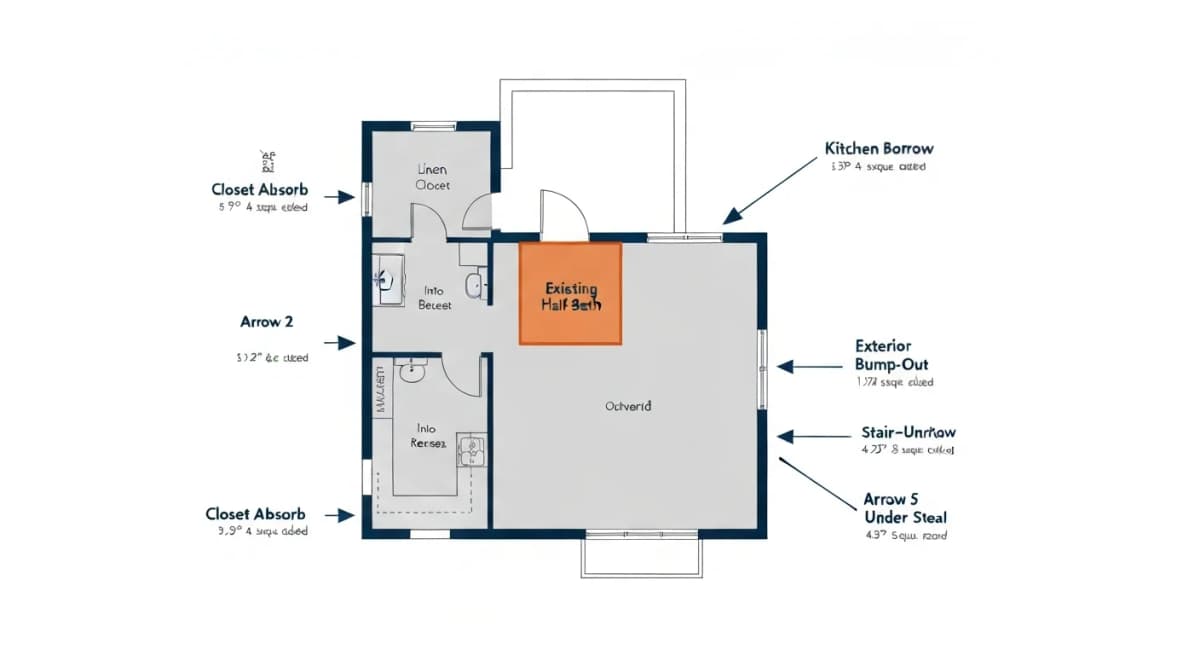
Most pre-1980 Boise half-baths share a few characteristics. They're small (typically 18-28 square feet). They contain only a toilet and a small vanity/sink. They're located near the home's main living areas (off the hallway or off the kitchen) for daytime convenience. The plumbing rough-ins are minimal — a single waste line, single supply line, and a small vent stack.
Adding a shower turns the room into a full bath. The IRC defines a full bath as containing a sink, toilet, and either a tub or shower. The shower adds:
Plumbing scope: Additional supply lines (hot and cold), additional waste line (shower drain at floor level), additional ventilation (often shared with toilet but sometimes separate).
Structural scope: Waterproofing, tile substrate, shower pan or curbless construction (see our curbless shower analysis for slab considerations).
Space scope: Minimum 30x30 inch shower compartment per IRC 417.6 (36x36 or larger preferred for functional use). The space has to come from somewhere — adjacent rooms, hallway, exterior addition, or under-stair area.
The five approaches below address the "where does the space come from" question. The structural and plumbing scope is similar across approaches; the differentiator is which direction the bathroom expands.
The most common pre-1980 Boise half-bath is adjacent to a linen closet, coat closet, or small utility closet. The closet absorb approach takes that adjacent closet's footprint and incorporates it into the expanded bathroom — typically 18-32 square feet of added bathroom space.
How it works:
Remove the wall between the existing half-bath and the closet. Demolish the closet's interior (shelving, light fixture). Extend the bathroom's plumbing, electrical, and lighting into the new combined footprint. Install a shower in the absorbed closet area, typically a 30x36 or 36x36 inch compartment. Reconfigure the existing half-bath's layout if necessary to optimize the new combined space.
Pros: Lowest cost of the five approaches because the demolished wall is non-bearing in most cases and the closet's existing electrical (lighting) is reusable. No exterior wall modifications required. Adjacent space is typically accessible without major framing work.
Cons: Eliminates the closet, which the household has to relocate elsewhere. For linen closets in particular, this can be an inconvenience — bathroom linens may need to move to a bedroom closet or hallway storage. Also, the closet absorb produces a bathroom with two distinct zones (original half-bath + absorbed closet) that may have an awkward layout — particularly if the closet's depth doesn't match the bathroom's other dimensions.
Cost: $18,000-$32,000 in Treasure Valley pricing for a typical pre-1980 Boise home. Lower-end is achievable with stock fixtures and budget-tier tile; upper-end allows quartz vanity top, premium tile, and mid-tier fixtures.
Boise homes with an adjacent linen, coat, or utility closet that the household can relocate elsewhere. The most common feasible approach in the Treasure Valley pre-1980 housing stock.
Closet relocation needs to be planned during design. If no alternative storage exists elsewhere in the home, this approach may not work.
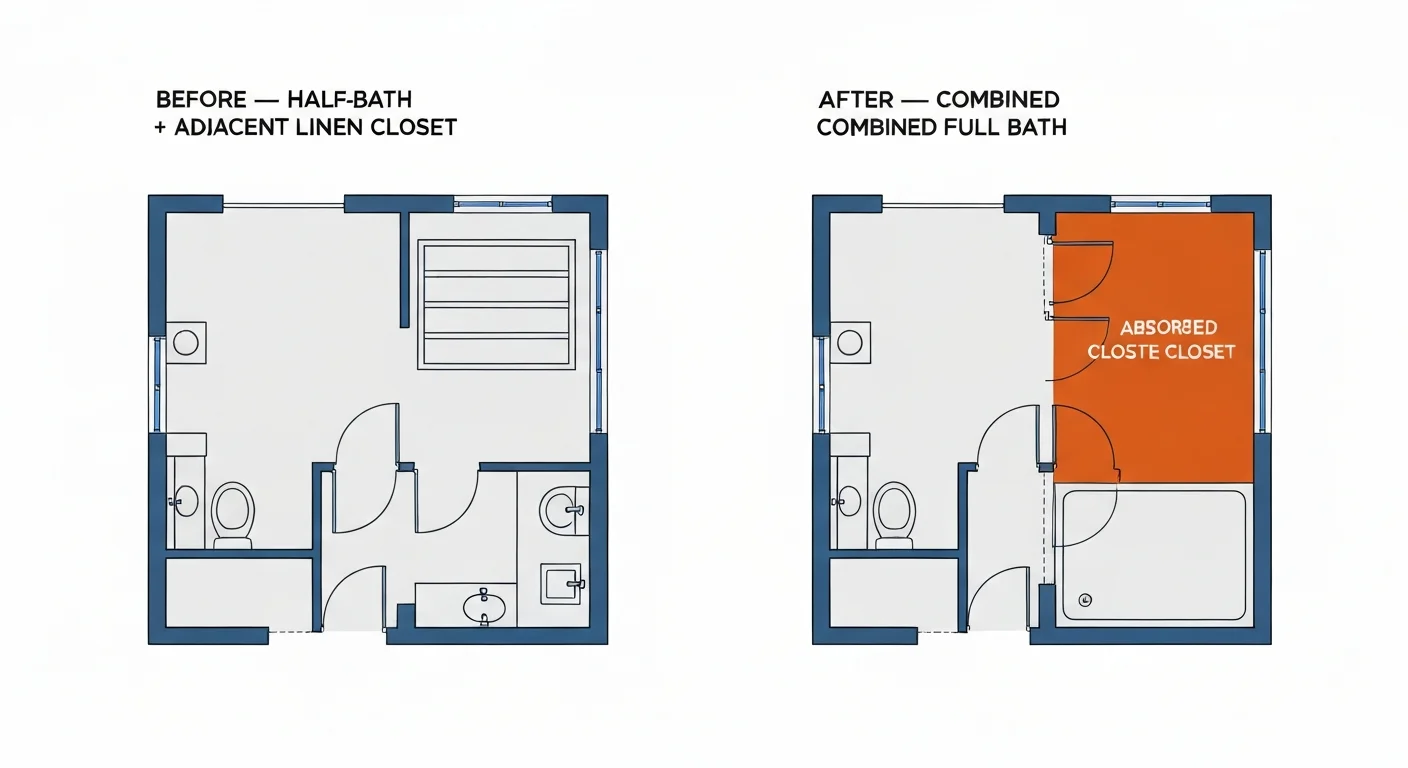
When no closet is adjacent, the hallway is often the next-best option. The hallway recess approach extends the bathroom's footprint into the adjacent hallway by 18-30 inches, creating space for a shower compartment along what was previously the hallway wall.
How it works:
Identify the hallway segment adjacent to the existing half-bath. Move the existing bathroom wall outward into the hallway by 18-30 inches. The hallway's effective width shrinks by that amount (typically from 42-48 inches to 18-24 inches — usable but narrower). Install the shower in the new recessed area.
Pros: Works when no closet is adjacent. Doesn't require relocating storage. Structurally straightforward — the wall being moved is non-bearing.
Cons: Hallway becomes narrower, which can affect furniture moving, walker/wheelchair access, and visual feel of the home. Some Boise homes have hallways that are already narrow (40-44 inches) — recessing further into a hallway under 40 inches is impractical because the resulting hallway would fail code minimums (IRC R311.6 requires 36 inches minimum hallway width). Verify hallway-width math during design phase.
Cost: $22,000-$38,000 in Treasure Valley pricing. The cost premium over closet absorb comes from the hallway-wall move, which involves more drywall and trim work, and sometimes a new doorway location if the existing bathroom entry is affected.
Homes where no closet is adjacent to the half-bath but the hallway is wide enough (44+ inches minimum) to allow the recess without violating code minimums.
Hallway narrows. Confirm walker/wheelchair access and furniture moving needs before committing.
When the half-bath is on an exterior wall and no internal space is available, a small exterior bump-out adds 30-60 square feet of bathroom area by extending the home's footprint outward. This is the most expensive of the five approaches but produces the highest-quality finished bathroom because the design isn't constrained by existing internal layout.
How it works:
Demolish the exterior wall adjacent to the half-bath. Build a small foundation extension (typically 6-10 feet wide by 4-6 feet deep) under the new bump-out area. Frame the new exterior walls and roof. Install windows for natural light. Run new plumbing and electrical into the bump-out. Complete the bathroom inside the new combined footprint.
Pros: Largest added square footage of the five approaches (30-60 sq ft vs 18-32 for closet absorb). New exterior windows provide natural light, which dramatically improves bathroom feel. No internal storage or hallway compromises required. The expanded bathroom can be configured in any layout, not constrained by existing walls.
Cons: Highest cost of the five. Requires foundation work, which adds complexity in Boise's freeze-thaw clay soil environment. Triggers more involved Boise PDS permits including building permit for the structural addition. Boise PDS inspectors check setback compliance (lot lines, easements). The addition has to match the home's existing exterior finish (siding, roofing) which can be difficult for older homes with discontinued materials.
Cost: $48,000-$85,000 in Treasure Valley pricing. The larger share of that is the shell — foundation, framing, and weather-tight exterior — rather than the bathroom finishes inside it, which is why an addition costs multiples of remodelling an existing bathroom of the same size.
Homes where the half-bath is on an exterior wall, the lot has adequate setback for the bump-out, and the budget supports the higher-end approach. Best long-term result of the five options.
Significantly higher cost. Longer project timeline (typically 10-16 weeks vs 4-8 for the internal-space approaches). More extensive permits and inspections.
Add a second full bath to your pre-1980 Boise home — the right way for your layout
Half-bath conversion isn't a one-size-fits-all decision. The right approach depends on what's actually adjacent to your existing half-bath. Schedule a consultation and we'll walk the five options against your home's structural and layout reality.
Less common but viable in specific layouts: borrow space from an adjacent kitchen or kitchen pantry. The pre-1980 Boise homes where this works are typically those with oversized galley kitchens where the pantry or one end of the counter run can be sacrificed to create bathroom space.
How it works:
Identify the kitchen-adjacent wall to the half-bath. Demolish the wall and pantry/counter run adjacent. Build a new wall further into the kitchen, creating 18-30 square feet of additional bathroom space. Restore the kitchen's now-smaller footprint with new cabinets, counter, and updated layout.
Pros: Sometimes the only path when no closet, hallway, or exterior wall is available. The kitchen's plumbing infrastructure is sometimes reusable (the existing kitchen plumbing wall can serve the new bathroom plumbing).
Cons: Shrinks the kitchen meaningfully — typically 24-36 linear inches of cabinet/counter lost. This may be unacceptable in homes where the kitchen is already cramped. Requires kitchen remodel scope simultaneously (the affected area needs new cabinets, counter, and finishes), which adds significantly to project cost. Plumbing complexity: kitchen and bathroom plumbing have different code requirements (kitchen sinks can't be on the same drain as toilets, for example) so the existing kitchen plumbing isn't always directly transferable.
Cost: $35,000-$58,000 in Treasure Valley pricing because of the bundled kitchen remodel scope. Higher than closet absorb or hallway recess but lower than exterior bump-out.
Homes with oversized kitchens that can absorb the loss of cabinet/counter linear footage. Particularly common in 1950s-60s ranch homes with large galley kitchens.
Shrinks the kitchen. Make sure the kitchen impact is acceptable before committing. Worth modeling the new kitchen layout during design phase.
Niche but underutilized in pre-1980 Boise homes: borrow space from under an open staircase. The stair-under steal works when the half-bath is adjacent to or near a staircase with usable space underneath.
How it works:
Identify the under-stair space adjacent to the half-bath. If the existing under-stair area is open (used for storage, closet, or unfinished space), incorporate it into the bathroom. The triangular shape under the staircase typically accommodates a shower compartment well — the head height at the entry of the shower is full (8 feet typical), tapering toward the back of the shower (4-6 feet at the back). With a curbless or low-curb shower design, the head clearance issue is manageable for most users.
Pros: Captures wasted space (under-stair storage areas are typically inefficient). No external structural changes. Doesn't impact storage that was being meaningfully used (most under-stair closets store rarely-accessed items). The resulting shower has interesting architectural character.
Cons: Triangular shower shape requires custom enclosure design (glass, curbless slope direction, shower head placement). Some users find the sloped ceiling uncomfortable, particularly taller users. Plumbing routing through floor structure adjacent to a staircase can be complex. Boise PDS inspectors require additional structural verification when modifying floor systems near staircases.
Cost: $24,000-$42,000 in Treasure Valley pricing. The custom shower enclosure work adds cost vs standard rectangular shower; the savings come from no major structural modification of exterior walls or major rooms.
Homes with open staircases and unused or inefficient under-stair space. Common in 1920s-40s North End bungalows with original staircases.
Sloped ceiling restricts head clearance for tall users. Verify with the household during design phase.
Regardless of which expansion direction you choose, all five approaches face the same Boise PDS code requirements. The constraints that most often shape the design:
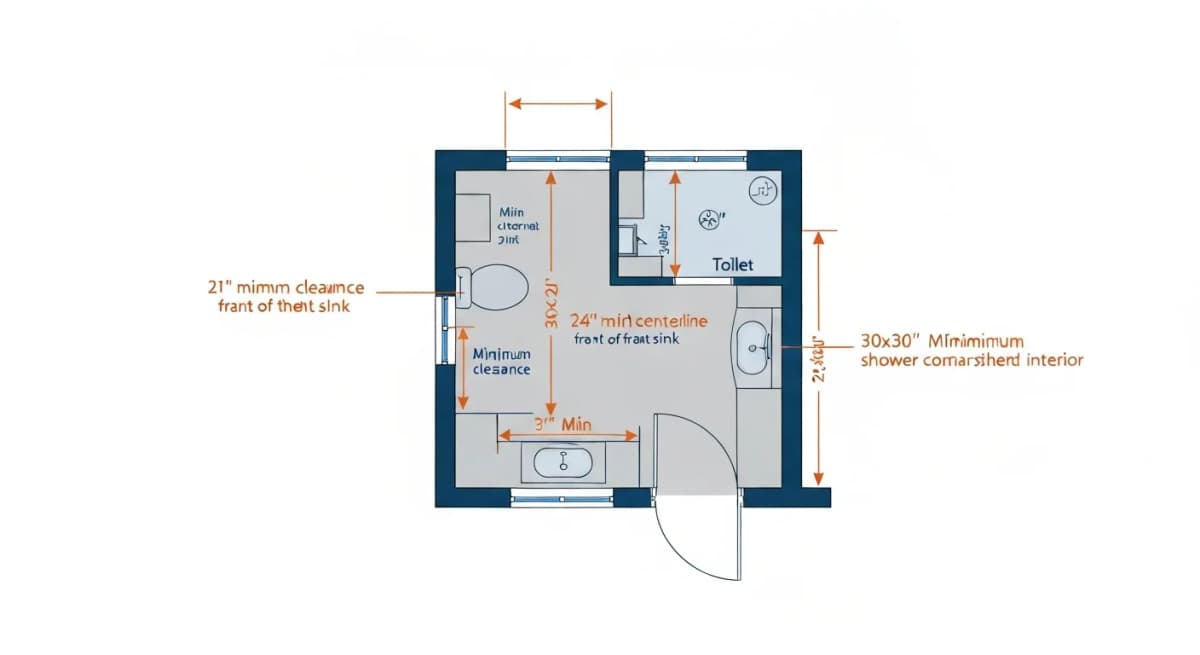
Practical minimum floor area: A bathroom with a shower realistically needs about 25 square feet of floor area once fixture clearances are met. Most pre-1980 half-baths are 18-28 sq ft, so any expansion has to add enough space to clear this threshold.
IRC R307 Clearances: Minimum 21-inch clearance in front of the toilet and sink, 30-inch clearance in front of the shower opening, and 30x30 inch minimum shower compartment interior (most modern showers are 32x32 or 36x36).
IRC R303.3 Ventilation: Mechanical exhaust ventilation required (50 CFM minimum, 80+ CFM recommended for shower bathrooms). Must vent to exterior, not into attic or another room.
NEC 210.11(C)(3) Bathroom Circuit: Dedicated 20-amp branch circuit for bathroom receptacles required.
NEC 210.8(A)(1) GFCI Protection: All bathroom receptacles must be GFCI-protected.
IPC 503 Bathroom Ventilation: Bathroom drainage system must vent properly — adding a shower drain to an existing half-bath plumbing tree requires verifying the vent stack capacity. Often the existing vent stack is adequate for one fixture (toilet) but needs upgrade to handle two-fixture loads (toilet + shower drain).
Boise PDS inspectors verify all of these at final inspection. Designing within the code minimums from the start avoids re-work and additional inspections.
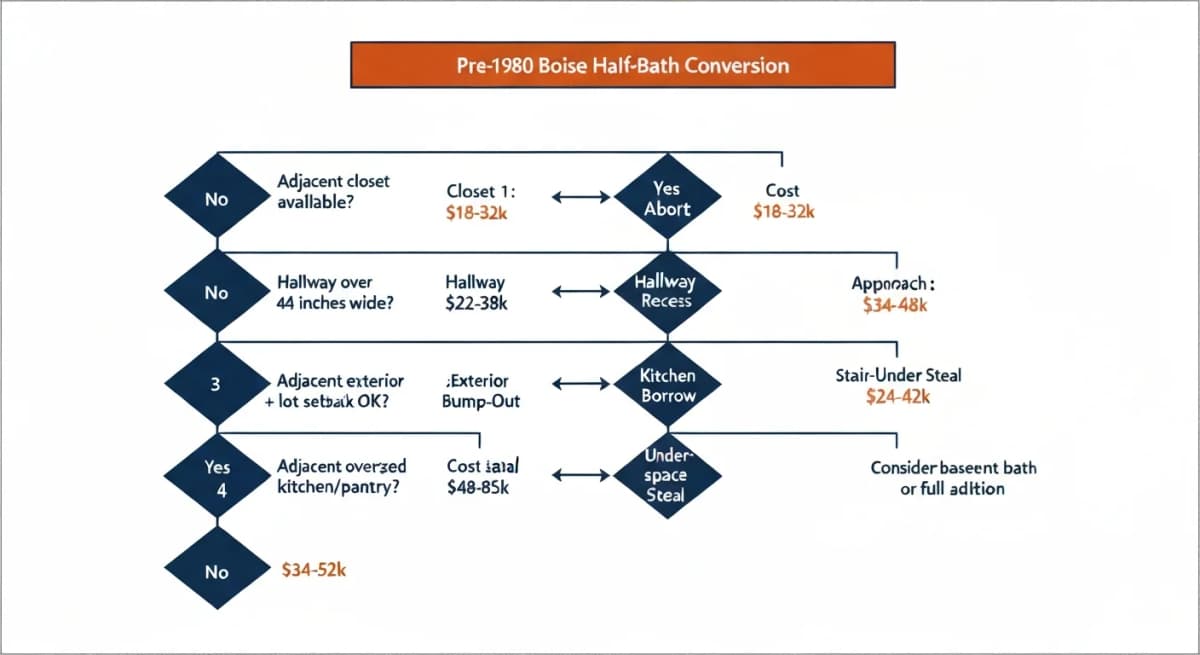
The right approach depends on what's actually adjacent to your half-bath. The decision typically works in this order:
Step 1: Identify all adjacent spaces. List every room, closet, hallway, exterior wall, and under-stair area that touches the existing half-bath. Most homes have 2-4 candidates. Map each candidate's approximate square footage available.
Step 2: Apply structural feasibility test. Closet absorb: closet must be non-essential (the household has alternative storage). Hallway recess: remaining hallway must be 36+ inches wide. Exterior bump-out: lot setbacks must allow. Kitchen/pantry borrow: kitchen must be oversized enough to absorb the loss. Stair-under steal: staircase must be open and head clearance adequate.
Step 3: Rank by cost. Closet absorb is cheapest ($18-32k), then stair-under ($24-42k), hallway recess ($22-38k), kitchen/pantry borrow ($35-58k), exterior bump-out ($48-85k). For most pre-1980 Boise homes, closet absorb is both the most-feasible and cheapest path.
Step 4: Consider household impact. Closet relocation: where will the displaced contents go? Hallway narrowing: are there mobility concerns? Kitchen shrinkage: is the kitchen acceptable smaller? Exterior addition: does the bump-out affect curb appeal?
Step 5: Confirm with the contractor and PDS. A pre-construction walkthrough verifies structural feasibility (non-bearing walls, plumbing routing options). The Boise PDS plans review confirms the final layout meets code.
For homeowners considering this conversion, the right time to involve a contractor is at design-phase exploration — before committing to a specific approach. The five approaches are not interchangeable; the right answer for your home depends on which adjacent spaces are available.
Iron Crest's process for half-bath-to-full-bath conversions in pre-1980 Boise homes starts with a structural walkthrough. We identify the candidate adjacent spaces, verify each for non-bearing wall status and plumbing routing feasibility, and present the homeowner with the realistic options. Most pre-1980 Boise homes we work in have 2-3 viable approaches; we help compare cost, household impact, and timeline before committing. The conversion typically runs 4-12 weeks depending on approach — closet absorb and hallway recess at the shorter end, exterior bump-out at the longer end.
On resale, the honest position is that we can't quantify it: there is no published, dated Treasure Valley dataset isolating what a second full bath does to a sale price. What is structurally true is that bath count is one of the fields a buyer filters on and an appraiser records, so going from one-and-a-half to two full baths moves the house into a different search result — which matters most in the price tiers where two baths is the expectation rather than the exception. For broader bathroom remodel context, see how we run bathroom remodeling in Boise and our seller ROI guide.
Do I need a building permit to convert a half-bath to a full bath in Boise?
Yes for every approach, with slightly different scope. The conversion triggers plumbing permit (for new shower drain rough-in and shower valve), electrical permit (for new dedicated circuit or GFCI upgrade), mechanical permit (for new exhaust fan), and sometimes building permit (for structural modifications). Approach 3 (exterior bump-out) requires a full building permit including foundation, framing, and exterior modifications inspections. Iron Crest handles all permitting and inspection scheduling as part of standard project scope. Combined permit cost typically runs $400-$1,200 depending on approach and scope.
What's the typical timeline for a half-bath to full-bath conversion in Boise?
Approach 1 (closet absorb): 4-7 weeks. Approach 2 (hallway recess): 5-8 weeks. Approach 4 (kitchen/pantry borrow): 7-10 weeks. Approach 5 (stair-under steal): 6-9 weeks. Approach 3 (exterior bump-out): 12-18 weeks. The exterior bump-out's longer timeline reflects the foundation cure time (3-7 days), framing inspection scheduling, weather dependencies for exterior work, and the structural verification at multiple inspection stages. Internal-space approaches don't have weather dependency and can typically run in parallel phases.
Will converting a half-bath to a full bath affect my Boise property taxes?
Expect some increase. Ada County assesses market value, and bathroom count is one of the characteristics that feeds the assessment alongside square footage and condition. We can't tell you the size of the change: we have no sourced figure for what a half-to-full conversion does to an Ada County assessment, and the levy rate differs by taxing district and changes annually. The reliable way to find out is to ask the Ada County Assessor directly about your parcel, and to check your own current levy rate on your latest tax notice rather than working from a rule of thumb. For broader context, see our <a href='/resources/property-tax-impact-remodeling-boise'>property tax impact of remodeling guide</a>.
Can I do the conversion while still living in the home?
Yes for all five approaches. The conversion affects only the bathroom and immediately adjacent space, so the rest of the home remains usable. The main consideration: the household loses access to the half-bath during the work (typically 4-12 weeks depending on approach). If the home has another bathroom (most pre-1980 Boise homes have at least the main full bath), the household uses that during the conversion. For exterior bump-out projects, exterior wall openings during framing create temporary weather exposure that we manage with proper sheeting and tarping. We work with families on timing and scheduling to minimize disruption.
Is converting a half-bath to a full bath worth the cost compared to adding a basement bathroom?
Depends on the home and use case. Half-bath conversion adds main-floor convenience and improves daily livability for households. Basement bathroom addition adds bathroom capacity but in a less-accessible location. For households with mobility considerations (elderly residents, knee/hip issues), main-floor conversion is strongly preferred. We won't put a market-value figure on either one — there is no sourced Ada County dataset that isolates what a bathroom addition does to a sale price, and the cost side is the only half we can quote honestly. Decide it on lifestyle: main-floor wins for daily use, basement is acceptable when the household doesn't need additional main-floor access. See our basement bathroom addition guide for more on the basement path.
Are there pre-1980 Boise homes where none of the five approaches work?
Rare but yes. The cases where no approach works: homes with no adjacent closet AND a hallway already below 36 inches AND no accessible exterior wall AND no oversized kitchen AND no under-stair space. This combination is uncommon but does occur in some 1920s-30s Hyde Park and East End cottages with extremely tight footprints. In those cases, the realistic options are: build a second bathroom in a different location entirely (often a bedroom-converted-to-bathroom approach), accept the existing one-full-bath layout, or consider a basement bathroom addition. We evaluate this at the pre-construction walkthrough and tell the homeowner honestly if none of the five approaches will work for their specific home.
Add a second full bath to your pre-1980 Boise home — the right way for your layout
Half-bath conversion isn't a one-size-fits-all decision. The right approach depends on what's actually adjacent to your existing half-bath. Schedule a consultation and we'll walk the five options against your home's structural and layout reality.
These pages go deeper on the topics linked from this article. Read them before your consultation and you'll come in with sharper questions and a clearer scope.
The following government agencies, industry organizations, and official resources provide additional information relevant to your remodeling project.