
Boise Bathroom Lighting Kelvin Strategy: 6 Lighting Decisions for Skin-Tone Accuracy in Dim Winter Daylight
Boise winters average 9-10 hours of daylight with significant overcast periods. Bathroom lighting selection that ignores this seasonal context produces makeup-and-grooming results that look wrong outside the bathroom mirror. Six lighting decisions for accurate skin tone perception year-round.
Quick answer
Yes, for the Kelvin and CRI improvement. Swap existing standard LED bulbs (typically CRI 80, 2700-3000K) for premium CRI 90+ LEDs at 3000-3500K. Brands like Soraa, Waveform Lighting, Yuji, and Phillips MasterColor offer high-CRI residential LEDs.
The most common Boise bathroom lighting complaint we hear: "I put on makeup or shave in the morning and it looks fine in the mirror, then I walk into natural daylight and it looks completely different." The issue isn't the user or the products — it's the lighting Kelvin temperature and color rendering of the bathroom vanity lighting. Boise's specific seasonal daylight pattern compounds the problem in ways that warm-climate lighting guides don't address.
Boise sits at 43.6 degrees north latitude. In December, the sun stays low in the sky, daylight runs 9 hours and 5 minutes, and overcast conditions are common. Indoor lighting carries proportionally more of the visual workload during these months. The lighting Kelvin (color temperature) and CRI (color rendering index) specifications that work fine in summer often fail in winter conditions — particularly for skin tone perception during makeup application, shaving, hair coloring, and other tasks where color accuracy matters.
This article covers six lighting decisions that produce skin-tone-accurate bathroom lighting across Boise's seasonal range. Each decision involves specific Kelvin and CRI specifications backed by lighting science rather than aesthetic preference.
For the broader bathroom design and lighting context — including layered lighting strategy, fixture types, switching and dimming, and full bathroom lighting plans — see our lighting design guide for Boise. This page focuses specifically on Kelvin and CRI selection for bathroom vanity lighting where skin tone accuracy matters.
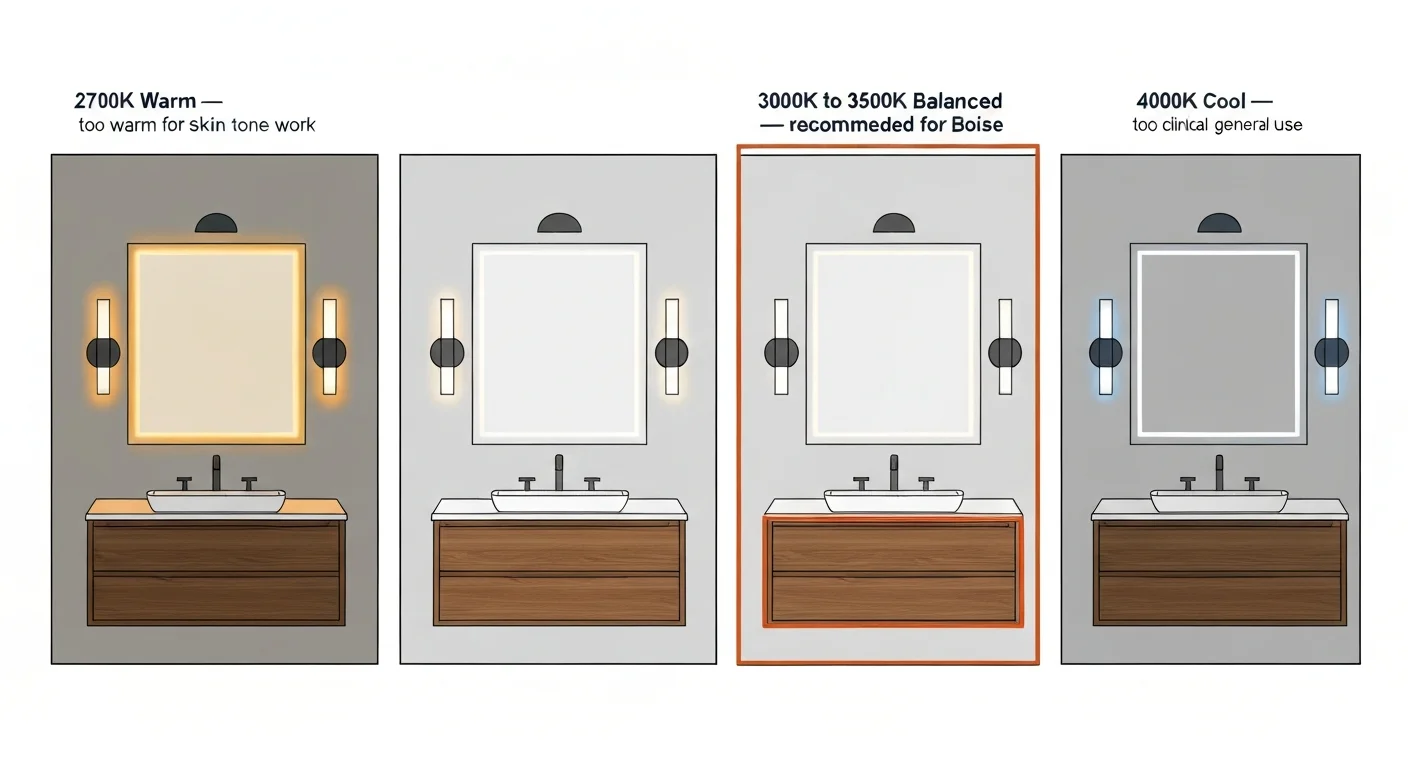
Kelvin (K) measures the color temperature of light — the visual warmth or coolness of the light's spectrum. The scale runs from warm low numbers to cool high numbers:
2200-2700K (very warm, "candlelight" to "incandescent"): Strong yellow-orange tint. The classic warm incandescent bulb glow. Flattering for evening relaxation but unsuitable for accurate color work.
2700-3000K (warm white): The traditional warm-tone residential lighting standard. Comfortable for most home settings; tends to make skin look warmer than it actually is.
3000-3500K (neutral warm): Often called "soft white." A bit cooler than traditional warm white but still on the warm side of neutral. Common in modern residential applications.
3500-4500K (neutral to cool): "Bright white" or "neutral white." Closer to daylight; reduces the warm-shifting effect on perceived skin tone. Common in commercial settings and increasingly used in residential task lighting.
4500-5500K (cool white to daylight): Strong blue-white tint. Used in commercial and industrial settings. Often too cool for residential daily use.
5500-6500K (daylight to overcast daylight): Matches natural daylight color. Used in photography studios and color-critical commercial applications.
The practical implication for bathrooms: the Kelvin temperature directly affects how skin tone, makeup color, hair color, and clothing color appear under the bathroom lighting. The correct Kelvin selection produces a bathroom where what you see in the mirror matches what you'll see outdoors — within reason.
Why "within reason" matters: no indoor lighting perfectly matches outdoor daylight, because outdoor daylight varies throughout the day and across seasons. The goal of bathroom lighting Kelvin selection isn't to perfectly match outdoor light; it's to produce a stable, predictable color environment where the user knows that what they see in the bathroom is consistent with what they'll see outside.
Establishing baseline understanding of Kelvin before making product selection decisions.
Different household members may prefer different Kelvin temperatures — see item 6 for handling preference differences.
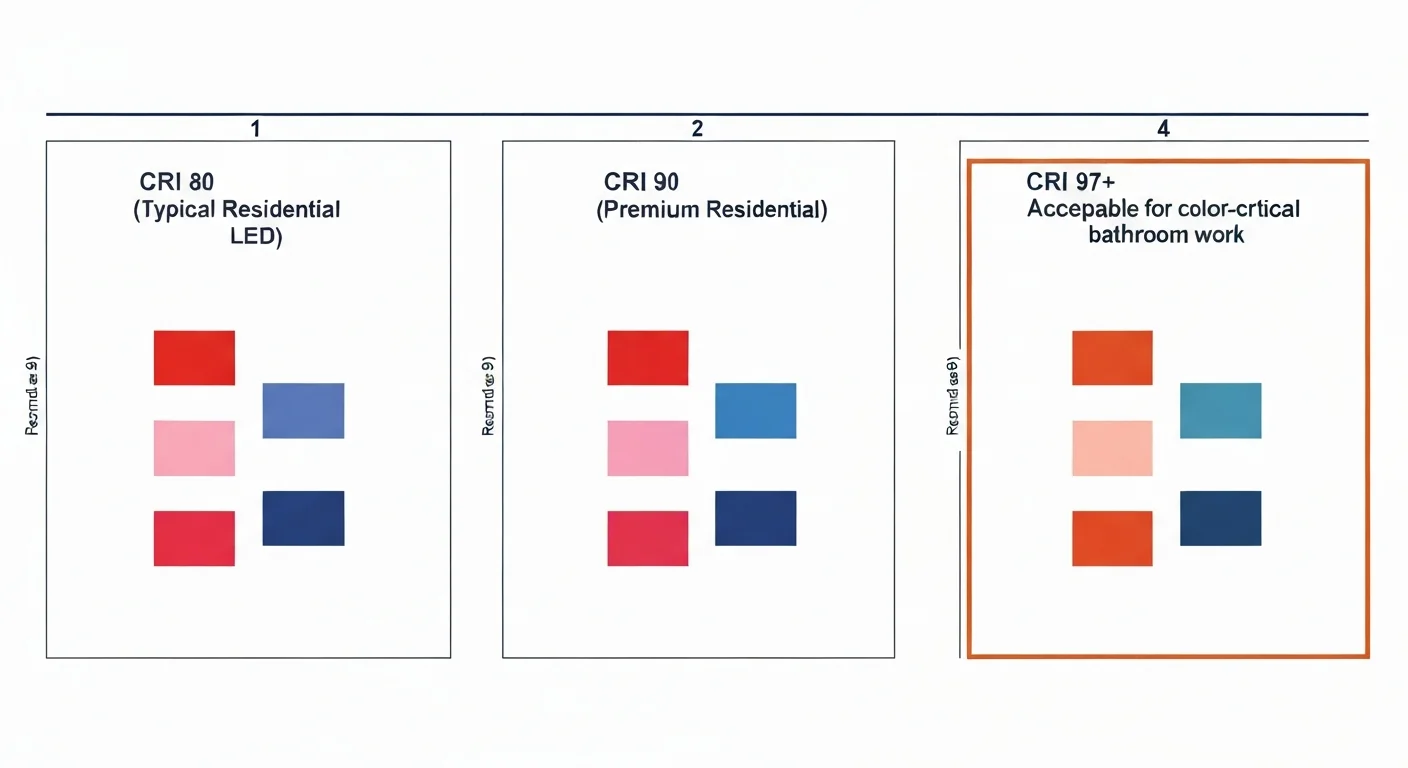
Color Rendering Index (CRI) measures how accurately a light source renders the full spectrum of colors compared to natural daylight. CRI is rated on a scale of 0-100, with 100 representing perfect color rendering.
CRI ranges and implications:
CRI 60-70 (low quality): Found in budget fluorescent lighting and some inexpensive LEDs. Colors look distorted; reds and pinks especially suffer. Inappropriate for any color-critical application including bathroom vanity lighting.
CRI 75-80 (typical residential LED): The default for inexpensive residential LED bulbs. Color rendering is mediocre — adequate for general illumination but problematic for skin tone perception. This is what most bathrooms currently have, and it's the primary reason for the "looked fine in the bathroom, looked different outside" complaint.
CRI 80-89 (mid-tier): Common in modern residential LED lighting. Acceptable for general use but still has visible color rendering issues for skin tone and makeup.
CRI 90+ (premium residential): The minimum for color-critical applications including bathroom vanity lighting. Reds and pinks render accurately. Skin tone perception is reliable. This is the right specification for bathroom vanity lighting.
CRI 95-97 (professional/commercial): Used in retail clothing, art galleries, and photography studios. Indistinguishable from natural daylight for most viewers.
CRI 98+ (studio grade): Photography and film studio lighting. Overkill for residential bathrooms.
Practical specification: for bathroom vanity lighting, specify CRI 90+ minimum. The cost premium over CRI 80 LEDs is modest — typically $5-$15 per bulb or $20-$80 per fixture. The improvement in daily user experience is substantial.
An additional metric: R9 score. This measures the specific accuracy of red color rendering, which is the most common shortfall in LED lighting. CRI 90 bulbs can have R9 scores anywhere from 20 (poor red rendering) to 90+ (excellent). For bathroom lighting where skin tone perception matters, specify R9 50+ in addition to CRI 90+. Premium LED brands (Soraa, Waveform, Yuji, Phillips MasterColor) publish R9 specifications; budget brands often don't.
Households where makeup application, shaving, or other skin-tone-critical tasks happen daily.
CRI 90+ LEDs cost more than budget LEDs. The premium is modest but adds up across all bathroom fixtures.
Boise's seasonal daylight pattern is the specific environmental factor that complicates bathroom lighting selection.
Annual daylight context:
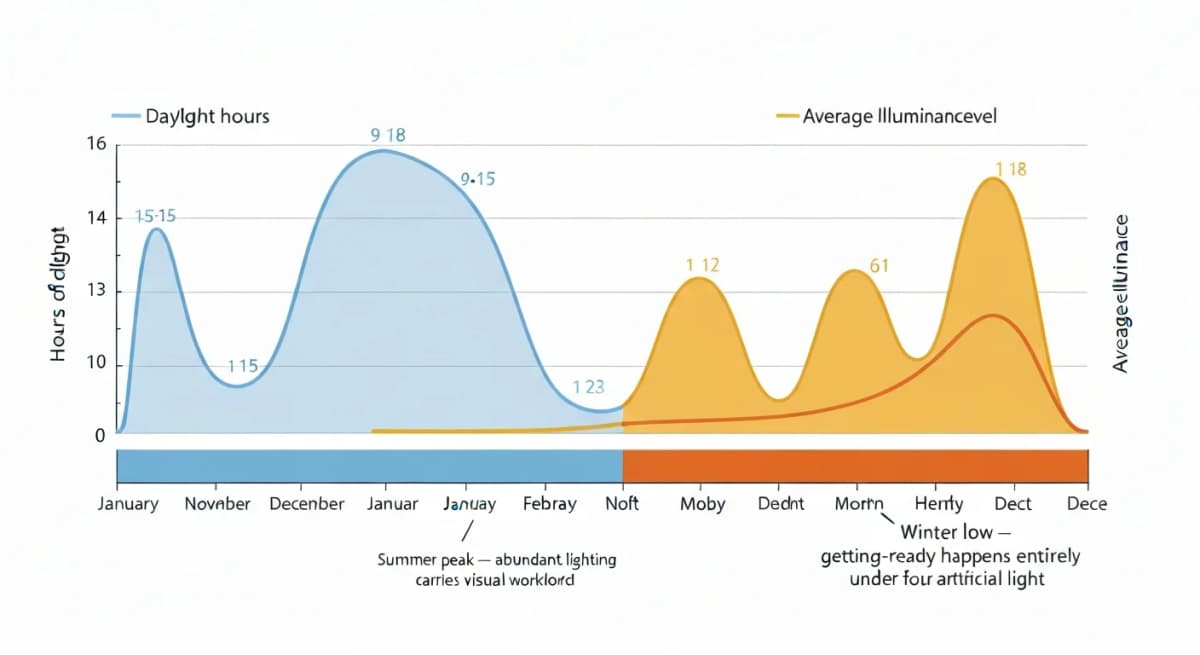
December (winter solstice): 9 hours 5 minutes of daylight. Sun rises around 8:00 AM, sets around 5:05 PM. Morning getting-ready typically happens before sunrise. December is also Boise's cloudiest stretch, so outdoor illuminance on a typical morning is far below peak summer daylight even after sunrise.
March-April (spring equinox): 12 hours of daylight. Sunrise around 7:00 AM in early April. Morning getting-ready often happens at dawn with weak natural light.
June (summer solstice): 15 hours 18 minutes of daylight. Sunrise around 5:55 AM. Morning getting-ready happens with abundant natural light.
September-October (autumn equinox): 12 hours of daylight, declining quickly. Morning getting-ready happens at dawn with diminishing natural light.
The implication: bathroom lighting selection should optimize for the worst-case scenario, not the best case. In winter, the user gets ready entirely under artificial light. The Kelvin and CRI of that artificial light determines what they see in the mirror, with no daylight reference to recalibrate.
Specifically for Boise:
Kelvin selection target: 3000-3500K is the right range for Boise bathroom vanity lighting. Slightly warmer than commercial neutral white (3500-4000K), slightly cooler than traditional residential warm white (2700-2800K). This range produces skin tone perception that maps reasonably well to both winter dim daylight and summer bright daylight.
Avoid 2700-2800K: Traditional residential warm white. Looks comfortable but shifts skin tone perception warmly. Makeup applied to look correct under 2700K looks orange-yellow outdoors. Common in older Boise homes; one of the first lighting upgrades to make.
Avoid 4000K+ except for specific accent uses: Cool lighting looks "clinical" or "harsh" for general bathroom use. May be appropriate for specific task lighting (close work like tweezing or specific makeup application) but not for general vanity illumination.
3000-3500K with CRI 90+ and R9 50+: The combined specification that produces reliable skin tone perception in Boise winter conditions while still feeling comfortable for general use.
Year-round Boise residents who do significant getting-ready work in winter months.
3000-3500K may feel slightly cooler than the traditional warm-white Boise homeowners are used to. Adjustment period typically 1-2 weeks.
Design bathroom lighting that gives you accurate color year-round
Bathroom lighting that accounts for Boise's seasonal daylight pattern saves daily frustration with skin tone perception. Schedule a consultation and we'll specify the right Kelvin, CRI, fixture positions, and layered lighting for your bathroom.
Beyond Kelvin and CRI specification, the physical position of bathroom vanity lighting fixtures affects skin tone perception. Specifically: overhead down-lights create face shadows that distort skin tone perception; side-positioned vanity lights eliminate these shadows.
Fixture position analysis:
Overhead recessed can light (single can directly above mirror): Creates dramatic shadows under the eyes, nose, and chin. Makes skin look more lined and shadowed than it actually is. Common in older Boise bathrooms; one of the most problematic configurations.
Overhead vanity bar (4-5 light fixture above mirror): Reduces but doesn't eliminate the eye-socket and nose shadow problem. Better than single overhead but still creates uneven illumination.
Side sconces (two vertical fixtures flanking the mirror): Light enters from both sides at face level. Eliminates eye-socket and nose shadows. Skin tone perception is balanced and accurate. This is the right configuration for vanity lighting.
Bath bar over mirror plus side sconces: Combination. The overhead provides general illumination; the sconces provide face lighting. Best for larger bathrooms where the overhead can serve as ambient illumination.
Linear LED strips along mirror edges: A modern approach. Continuous LED strips on the left and right sides (or top and bottom and sides) of the mirror provide even, shadow-free illumination. Becoming popular in higher-end bathrooms.
For Boise bathroom remodels, the right configuration depends on bathroom size and budget:
Standard mid-budget: Side sconces at the vanity (vertical fixtures positioned at face height, 60-65 inches above floor) plus ambient overhead lighting. Combined Kelvin: 3000-3500K, CRI 90+.
Higher-budget premium: Side sconces plus mirror-integrated LED edge lighting plus ambient overhead. The LED edge provides flat, shadow-free face lighting; the sconces provide depth.
Budget retrofit: If the bathroom has an existing overhead vanity bar that can't be replaced, add a single sconce on the wall to one side of the mirror (often easier to install than full pair of flanking sconces). Provides partial improvement over pure overhead.
Any bathroom remodel where vanity lighting is being addressed. The fixture position decision is essentially free at remodel time.
Side sconces require wall space adjacent to the mirror, which limits very small bathrooms.
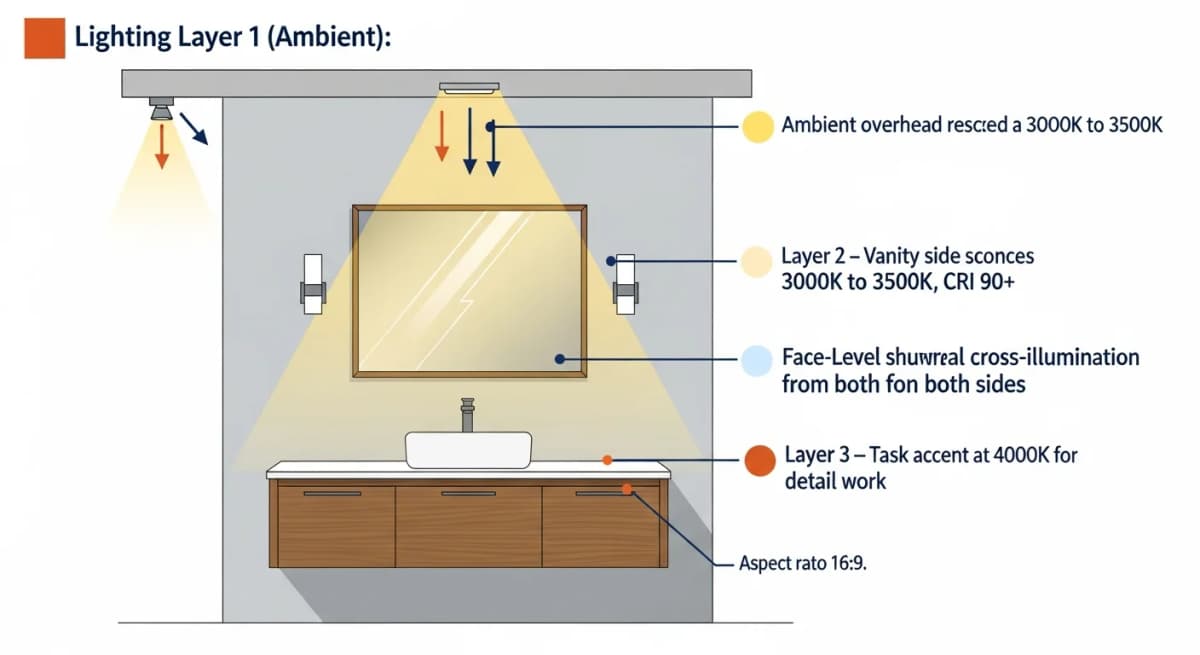
Sophisticated bathroom lighting design uses three coordinated layers, each with its own Kelvin and CRI specifications.
The three layers:
Layer 1 — Ambient lighting: General illumination for the entire bathroom. Sources: recessed cans, ceiling-mounted fixture, possibly a chandelier or pendant in larger bathrooms. Kelvin: 3000-3500K. CRI: 90+. Intensity: dimmable from very bright to relaxing-bath low intensity.
Layer 2 — Vanity face lighting: Specifically illuminates the user's face at the mirror. Sources: side sconces and/or mirror-integrated LED strips. Kelvin: 3000-3500K (matching ambient). CRI: 90+ minimum, 95+ ideal. Intensity: high enough for detailed makeup or shaving work; ideally dimmable for evening relaxation use.
Layer 3 — Task and accent lighting: Specific high-intensity light for detailed tasks or atmosphere. Sources: shower light (separate from main lighting), reading light over a tub if applicable, accent uplights for atmosphere, or close-work task lights at the vanity for detailed makeup. Kelvin: variable depending on use case — 3000K for atmosphere, 4000K for detailed close-work tasks. CRI: 90+ for color-critical task lights; CRI is less critical for atmospheric accent lighting.
The integration matters as much as the individual specifications. Three principles for layered bathroom lighting:
Consistent Kelvin across ambient and vanity: The ambient and vanity layers should use the same Kelvin temperature so that face appearance is consistent whether the user is at the mirror or elsewhere in the bathroom. Different Kelvins in different layers create perceptual mismatch.
Separate switching for each layer: Each layer should be independently controllable. Three-switch or three-dimmer configuration. Allows the user to dial in the right lighting for the task — bright vanity for makeup, dim ambient for bath, off entirely for night-time bathroom use.
Dimming compatibility: All fixtures should be on dimmable circuits with compatible dimmer switches. Standard dimmer switches don't work properly with all LED bulbs; specify Lutron Caseta or similar premium dimmers for reliable LED dimming performance.
Cost premium for layered lighting design vs. single-layer overhead-only: $1,500-$4,500 in additional fixtures, wiring, and switching. For a bathroom that's being remodeled anyway, this is a small fraction of total project cost and produces meaningful daily improvement.
Bathroom remodels where the user spends significant time on grooming and the bathroom is also used for relaxation.
Requires three-fixture coordination and slightly more complex electrical work.
Premium LED fixtures increasingly offer tunable Kelvin — the ability to shift the color temperature electronically between warm and cool. This is the right solution for households with different user preferences or different time-of-day lighting needs.
Tunable LED applications:
2700K to 4000K range: The most common tunable range. Allows users to select warm-white for evening relaxation and cool-neutral for morning getting-ready. Cost premium: 30-60% above non-tunable LEDs.
2200K to 6500K range: Full studio-grade tunable. Allows precise Kelvin selection for any application. Cost premium: 100-200% above non-tunable LEDs.
Circadian/Tunable wifi-enabled: Smart fixtures that automatically shift Kelvin throughout the day — warmer in morning and evening, cooler in midday. Marketed for circadian rhythm support. Cost premium: 50-100% above non-tunable plus subscription for some platforms.
Use cases for tunable LEDs in Boise bathrooms:
Multi-user households with different Kelvin preferences: One household member prefers warm (2700K), another prefers cool (4000K). Tunable allows both to use the same bathroom without compromise. This is the most common justification for tunable LEDs.
Different time-of-day use patterns: Morning makeup application benefits from cooler Kelvin (closer to daylight, matches what the user will see outside); evening relaxation benefits from warmer Kelvin (relaxing). Tunable provides both.
Seasonal lighting changes: Winter dim daylight may call for slightly cooler bathroom Kelvin to compensate; summer abundant daylight may call for slightly warmer Kelvin to balance the daylight already entering the bathroom. Tunable enables seasonal adjustment.
For bathrooms where these use cases apply, the tunable LED premium is well-justified. For simpler households with single users and consistent preferences, fixed-Kelvin LEDs at 3000-3500K serve perfectly well at lower cost.
Specification note: tunable LEDs typically have slightly lower CRI than fixed-Kelvin LEDs at any given price point (the tunable mechanism adds complexity that compromises spectrum purity). Specify CRI 90+ at the user's most-used Kelvin setting; some tunable LEDs have CRI 85-88 across the range, which is acceptable for general use but suboptimal for skin tone work.
Multi-user households or bathrooms with both morning getting-ready and evening relaxation use.
Higher cost than fixed-Kelvin LEDs. Slight CRI compromise on some tunable products.
Iron Crest's bathroom lighting specification includes Kelvin, CRI, and R9 specifications for every fixture in the design. We default to 3000-3500K with CRI 90+ and R9 50+ for vanity and ambient layers, with the option to upgrade to tunable LEDs where the household preference profile justifies it. The cost premium for proper lighting spec vs. budget-LED defaults runs $400-$1,200 in additional fixture and bulb costs — modest in the context of a full bathroom remodel and substantial in daily user experience improvement.
For bathrooms not currently being remodeled, lighting upgrade can be done as a standalone project. Replacing fixed-Kelvin LED bulbs with CRI 90+ premium LEDs of the same Kelvin runs $40-$200 per bathroom. Replacing problematic overhead-only fixtures with side sconces or LED edge lighting is a fixture-replacement project (typically $400-$1,800 in materials plus electrician labor). For broader lighting context, see our Boise lighting design guide and our Boise bathroom colors and styles resource.
If I'm not remodeling my bathroom right now, can I just swap bulbs to get better lighting?
Yes, for the Kelvin and CRI improvement. Swap existing standard LED bulbs (typically CRI 80, 2700-3000K) for premium CRI 90+ LEDs at 3000-3500K. Brands like Soraa, Waveform Lighting, Yuji, and Phillips MasterColor offer high-CRI residential LEDs. Cost: $5-$20 per bulb. A typical bathroom needs 4-8 bulbs; total cost $40-$160 for a meaningful lighting upgrade. The bulb swap doesn't address fixture position (overhead vs. side sconce) which requires actual fixture replacement, but it addresses the Kelvin and CRI portion of the problem with minimal investment.
What's the cost premium for premium LED bathroom lighting vs. standard budget LED?
Specific cost comparison: standard LED bulbs (CRI 80, fixed 2700K or 3000K) run $3-$8 per bulb. Premium CRI 90+ LEDs at 3000-3500K run $10-$25 per bulb. For a typical bathroom with 4-6 bulbs across vanity and ambient fixtures, premium bulb premium is $30-$100. For full premium fixture specification (LED edge lighting in mirror, premium side sconces, premium recessed cans), premium spec adds $300-$1,200 to fixture cost above the same bathroom with budget specifications. Total premium for full upgrade across lighting and fixtures: $400-$1,300. Modest within a full bathroom remodel scope ($25-$45k typical Boise mid-budget).
Do bathroom lighting Kelvin recommendations change based on the bathroom's primary user demographic?
Slightly. For households with users primarily wearing minimal makeup, fixed Kelvin at 3000K serves well. For households where makeup application is daily and detailed, slightly cooler Kelvin (3300-3500K) provides better skin tone accuracy. For households with users who do specific color-critical tasks (hair coloring, eyebrow tinting, etc.), close-work task lighting at 4000K supplementing the 3000-3500K ambient is ideal. For older users with diminishing color vision sensitivity, slightly higher CRI (95+ vs. 90+) becomes more valuable than further Kelvin adjustment. The base recommendation of 3000-3500K with CRI 90+ is the right starting point for most Boise households; specific demographic considerations refine the spec.
Are dimmer switches compatible with all LED bulbs and fixtures?
No — dimmer compatibility is one of the most frequent LED issues we see in Boise bathroom remodels. Standard dimmer switches (older designs intended for incandescent) often produce flickering, buzzing, or non-linear dimming behavior with LED bulbs. The fix: specify LED-compatible dimmers (Lutron Caseta, Maestro, Sunnata; Leviton Decora Smart; Legrand) which are designed for LED loads. Cost: $30-$80 per dimmer vs. $8-$15 for standard dimmers. Verify dimmer compatibility with each LED bulb or fixture by checking the manufacturer's compatibility list — most premium LED brands publish dimmer compatibility data. Specifying the dimmer and the LED together, as one system, is what prevents the problem — it is almost always a mismatch rather than a defective bulb.
Does bathroom mirror selection affect lighting performance?
Yes, in subtle ways. Standard residential bathroom mirrors are made with float glass and silvered backing — typical reflectance around 80-85% with slight green tint. Premium bathroom mirrors use low-iron glass with copper-free silver backing — higher reflectance (90-95%) and neutral color rendering. For color-critical work like makeup application, premium mirrors produce more accurate color rendering than standard mirrors at the same lighting level. Cost premium: $200-$800 per mirror depending on size. Worth considering for primary master bath mirrors; less critical for secondary bathrooms.
Design bathroom lighting that gives you accurate color year-round
Bathroom lighting that accounts for Boise's seasonal daylight pattern saves daily frustration with skin tone perception. Schedule a consultation and we'll specify the right Kelvin, CRI, fixture positions, and layered lighting for your bathroom.
These pages go deeper on the topics linked from this article. Read them before your consultation and you'll come in with sharper questions and a clearer scope.
The following government agencies, industry organizations, and official resources provide additional information relevant to your remodeling project.