
Aluminum Branch Circuit Wiring in 1965-1975 Boise Kitchens: 7 Decisions Before You Touch a Single Outlet
Aluminum branch wiring was code-compliant when installed in mid-1960s through mid-1970s Boise homes but is now classified as a fire hazard by the CPSC. Kitchen remodels in these homes hit specific decision points the average homeowner doesn't know exist.
Quick answer
Three quick sources. (1) Ada County Assessor's Office property records — searchable online via the parcel ID, shows year built and construction era. (2) Your property's title or closing documents from when you purchased — typically include year built. (3) For homes near the 1965-1975 era boundary, check the actual breaker panel and any visible cable jackets for the aluminum identifiers covered in item 2 of this article.
Between 1965 and 1975, the U.S. residential construction industry briefly used aluminum branch circuit wiring (the wiring that runs from breaker panel to receptacles and switches) as a cost-saving alternative to copper. Boise homes built in that decade — substantial portions of the Bench, Garden City's early subdivisions, parts of West Boise, and the first wave of Meridian development — frequently carry aluminum branch wiring that's still in service today.
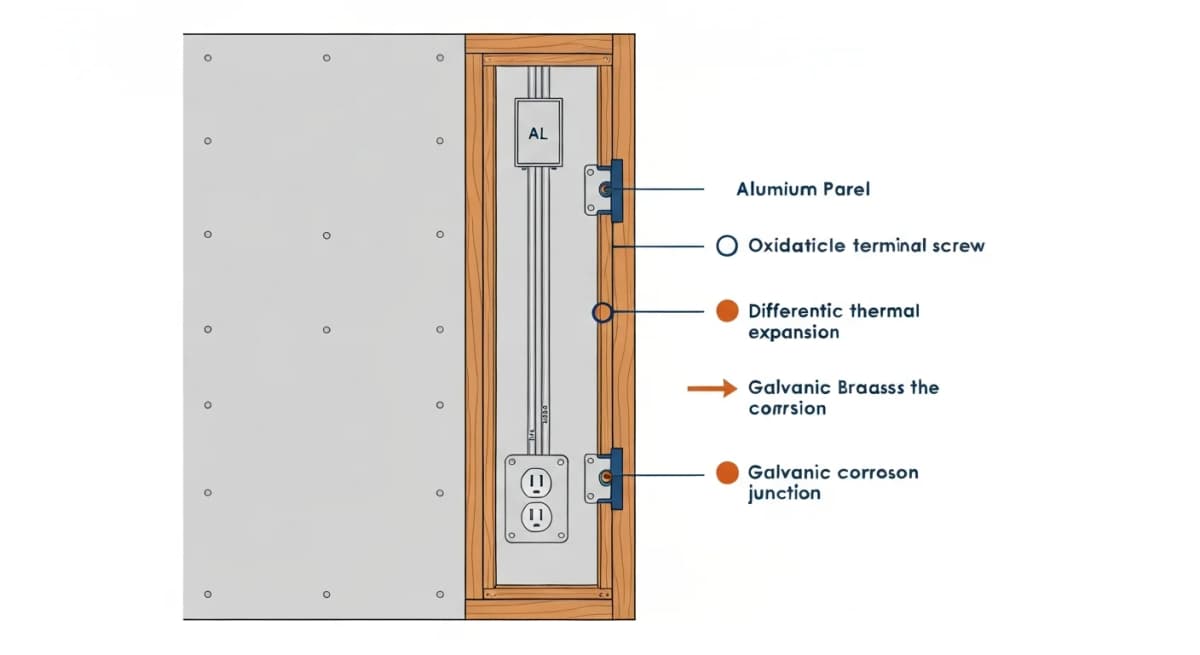
The U.S. Consumer Product Safety Commission classifies aluminum branch wiring as a fire hazard: homes with it are 55 times more likely to have at least one connection reach "fire hazard conditions" than homes with copper wiring. The hazard isn't the aluminum itself — it's the connection points (receptacles, switches, splices) where aluminum oxidizes, expands and contracts at a different rate than the brass terminal screws, and eventually creates high-resistance arcing connections.
This isn't knob-and-tube wiring (covered in our K&T article) — those are different eras, different hazard profiles, different remediation paths. This article walks through the seven decisions specific to aluminum branch wiring in Boise kitchen remodels, with cost ranges and code requirements for each path.
For the broader electrical scope context — full-home rewire decisions, panel capacity, GFCI/AFCI code, and the full residential electrical framework — see our electrical remodel guide for Boise. For the related but distinct knob-and-tube wiring scenario in pre-1950 Boise homes, see our knob-and-tube kitchen wiring guide.
Aluminum branch wiring shipped during a specific 10-year window (1965-1975) and was used selectively by builders making cost decisions during that era. Boise neighborhoods where it shows up most often:
Boise Bench (especially central and west Bench): Substantial 1965-1975 construction stock. Aluminum branch wiring is common in homes from this era. Often combined with original aluminum service entrance conductors (which is a different and lower-risk scenario — service entrance aluminum is still code-compliant; branch circuit aluminum is the hazardous one).
Garden City: The 1960s-1970s subdivisions north of Chinden Boulevard. Higher concentration of aluminum branch wiring than most Boise neighborhoods — Garden City builders during that era leaned more heavily on aluminum cost savings.
West Boise (Cole/Ustick/Maple Grove area): First wave of subdivisions in this area dates to the late 1960s. Aluminum branch wiring common in homes from 1966-1972.
Northwest Boise (Glenwood area): 1970-1975 subdivisions. Some aluminum branch wiring, though copper had largely returned to dominance by the early 1970s.
Early Meridian (Cherry Lane and east): The original 1970s Meridian developments before the 1980s growth wave. Aluminum branch wiring shows up regularly in homes from that vintage.
Less likely: North End (mostly pre-1950, predates aluminum era), Foothills (mostly post-1980), Hyde Park (mixed but mostly pre-1965), Eagle (mostly post-1980).
If your home was built between 1965 and 1975 and you don't know what wiring it has, an electrical inspection is worth $200-$400 — and essential before any kitchen remodel scope. If your home was built outside this window, aluminum branch wiring is much less likely (though not impossible — some 1976-1980 homes still have it where older inventory was used).
Boise homeowners with homes built 1965-1975 who haven't had electrical assessed.
Inspection cost is modest but identifying aluminum wiring opens up a larger conversation about remediation scope.
Homeowners can identify aluminum branch wiring through several visual checks before bringing in an electrician.
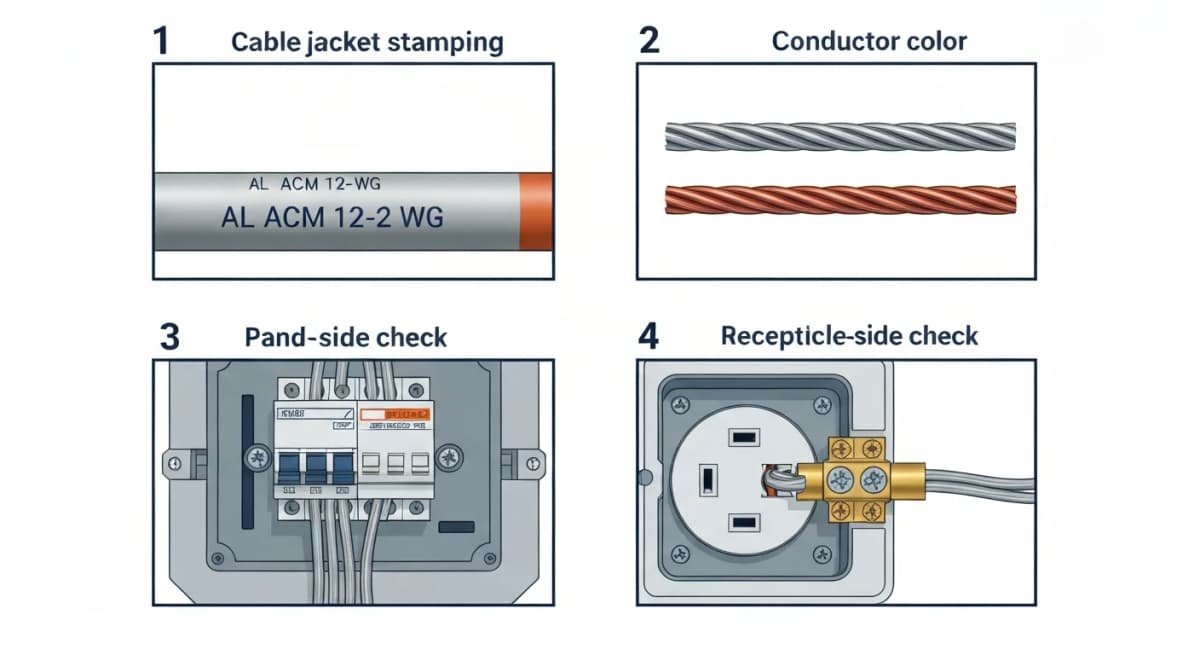
Cable jacket stamping: Romex-style cable (the flat plastic-sheathed cable common in residential wiring) has manufacturer markings stamped repeatedly along the jacket. For aluminum wiring, the jacket will read "AL" or "ALUMINUM" or "AL ACM" (aluminum conductor material). For copper, it'll read "CU" or no metal designation. Look at any exposed cable in the basement, attic, or garage.
Wire color at receptacles: Remove a receptacle cover plate (turn off the breaker first; you don't need to remove the receptacle itself, just the cover). The visible wire color tells you: silver-gray = aluminum, reddish-bronze = copper. If you see solid silver-gray wires terminating at the receptacle screws, it's aluminum.
Wire color at the breaker panel: Open the panel cover (this requires the main breaker off for safety, or you can have an electrician do this). The wires entering each individual circuit breaker should be visible. Silver-gray = aluminum branch wiring; reddish = copper.
Receptacle markings (CO/ALR): Some receptacles in aluminum-wired homes have been replaced at some point with CO/ALR-rated receptacles. These receptacles have "CO/ALR" stamped on the metal yoke. If you see CO/ALR markings on existing receptacles, that's strong evidence the home has aluminum wiring.
Wiring termination notes from inspections: If you have a pre-purchase home inspection report or any prior electrical inspection paperwork, search the text for "aluminum," "Al," "ACM," or "CO/ALR." Inspectors typically flag these conditions explicitly.
If any single one of these checks comes up positive for aluminum, the next step is electrician assessment (not DIY remediation). The remediation options have specific code requirements that homeowners shouldn't attempt without licensed electrical scope.
One important note on partial wiring: some homes have aluminum branch wiring for SOME circuits and copper for others. This happens when partial rewiring was done over the years. The identification process needs to cover all circuit endpoints, not just one or two.
Homeowners who want to confirm whether they have aluminum wiring before scheduling an inspection.
DIY identification is the first step but doesn't replace licensed electrician assessment for the actual remediation plan.
Understanding why aluminum is hazardous helps homeowners evaluate which remediation option fits their situation. The hazard mechanism is specific.
The four problems with aluminum branch wiring at connection points:
1. Oxidation: Aluminum forms an oxide layer (aluminum oxide) when exposed to air. The oxide is an electrical insulator — not a conductor. As the oxide layer builds at terminal screws and splice points, the connection's electrical resistance increases. Higher resistance produces more heat per unit of current flowing through.
2. Differential thermal expansion: Aluminum expands and contracts more with temperature than either brass (the material of terminal screws) or copper. As current flows and heats the connection, aluminum expands more than the surrounding metal. As current stops and the connection cools, aluminum contracts more. Over thousands of heating-cooling cycles, the aluminum slowly creeps out from under the screw, loosening the connection.
3. Galvanic corrosion at copper-aluminum junctions: Where aluminum wire meets a copper-based component, galvanic corrosion accelerates oxidation. The combination of dissimilar metals plus moisture produces faster oxidation than aluminum alone.
4. Cold flow under pressure: Aluminum is softer than copper and cold-flows under sustained mechanical pressure. The terminal screw clamps the wire when the receptacle is installed; over years, the aluminum wire deforms under the screw pressure, reducing contact area and increasing resistance.
The cumulative effect: connections that started with low resistance and proper contact slowly degrade to high-resistance, high-heat conditions. At sufficient heat, the connection point ignites surrounding combustibles (wood framing, paper insulation, dust). This is the fire mechanism.
CPSC data quantifies it: homes with aluminum branch wiring are 55 times more likely to have at least one connection reach 'fire hazard conditions' than homes with copper (CPSC Publication 516).
The hazard isn't theoretical. The U.S. Consumer Product Safety Commission's publication on aluminum wiring (CPSC Publication 516) reports that homes wired with pre-1972 aluminum branch circuits are far more likely than copper-wired homes to have at least one connection at an outlet reach fire-hazard conditions, and recommends specific repair methods rather than leaving the connections alone.
Understanding why remediation matters and what the actual failure mode is.
The hazard is statistical — not every aluminum connection will fail. But the cost of remediation is low relative to the risk.
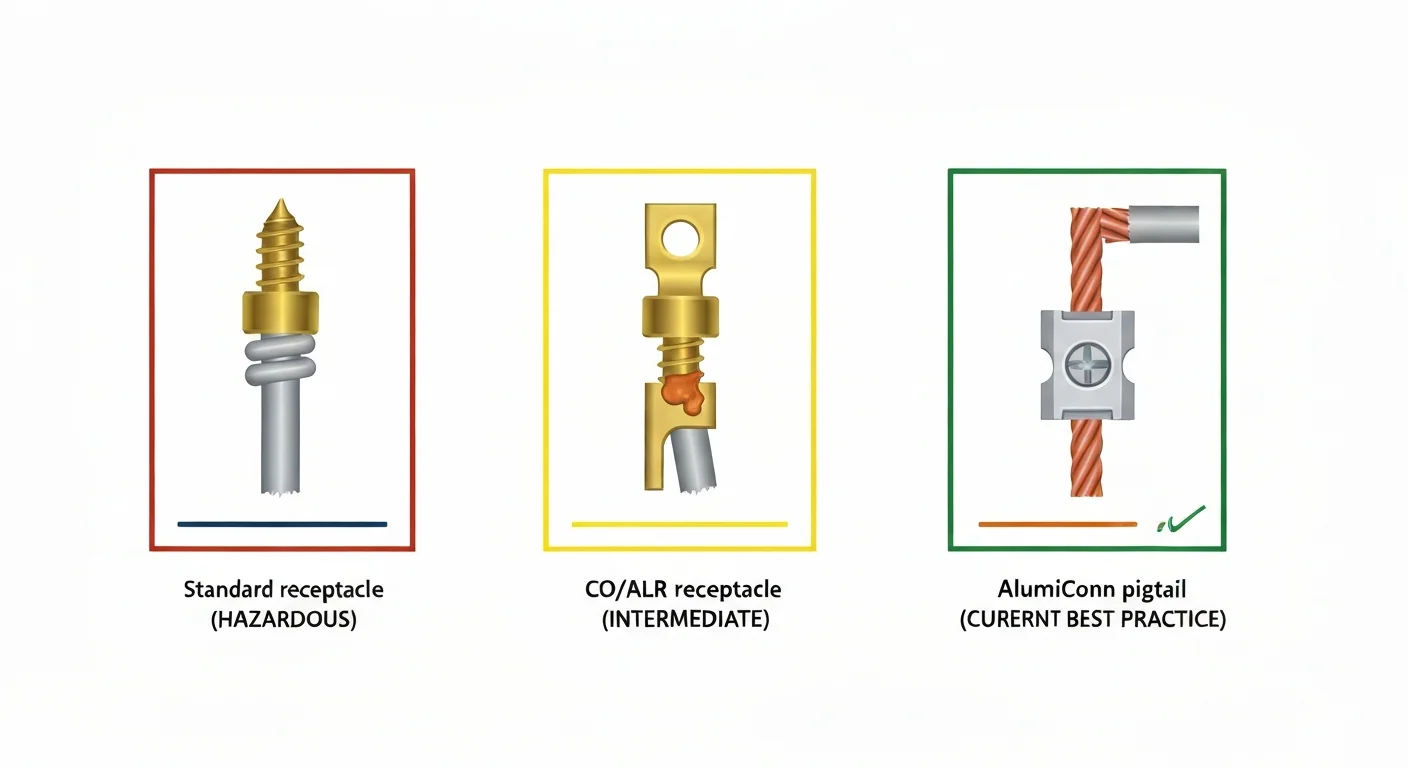
CO/ALR (Copper-Aluminum Revised) is a receptacle rating specifically engineered for aluminum branch wiring. The receptacle's terminal screws are made from a specific brass alloy with mechanical and thermal properties matched to aluminum's behavior. This is the baseline remediation option.
What CO/ALR receptacles do:
Improved screw alloy: The terminal screws are engineered to handle aluminum's cold-flow and thermal expansion characteristics. The connection stays tighter over thermal cycling than standard brass screws.
Anti-oxidation compound application: CO/ALR installations typically include a small amount of antioxidant compound (like Noalox) applied to the aluminum wire before insertion. The compound reduces oxide formation at the contact surface.
Specific torque specifications: CO/ALR installations require specific torque on terminal screws (typically 12-14 in-lb). Electricians use torque screwdrivers for proper installation.
What CO/ALR receptacles DON'T do:
Eliminate the aluminum-copper junction: The aluminum wire still terminates at brass, so galvanic corrosion potential remains.
Address splice connections: Most aluminum-wired homes have splices inside junction boxes. CO/ALR receptacles only address the receptacle terminals; splices need separate treatment.
Provide permanent resolution: CO/ALR is "much safer than nothing" but not "permanently resolved." Periodic inspection and re-torque is recommended every 10-15 years for sustained safety.
Cost for CO/ALR remediation: $25-$45 per receptacle replaced. A typical kitchen has 6-10 receptacles plus switches and the dedicated-circuit outlets for appliances. Total kitchen-only CO/ALR remediation: $200-$500 for materials, $400-$1,200 for labor. Whole-house CO/ALR remediation: $1,500-$4,500.
When CO/ALR is the right choice: kitchens being remodeled where the homeowner wants improved safety but doesn't want full rewire cost. Homes where full rewire is impractical due to lath-and-plaster walls or finished living spaces that would require destruction. Older homeowners staying in place who want safety improvement without major construction.
When CO/ALR is NOT enough: homes where the homeowner wants permanent elimination of the hazard. Homes being prepared for resale. Homes where insurance companies require copper-only.
Kitchens being remodeled in homes where the homeowner is staying long-term and full rewire isn't justified by budget.
Doesn't address splices; requires periodic re-inspection; doesn't satisfy stricter insurance underwriting.
Fix the wiring before you build the dream kitchen
Aluminum branch wiring assessment and remediation is standard scope on our 1965-1975 era Boise kitchen remodels. Schedule a consultation and we'll coordinate the electrical scope with the remodel design, and any unforeseen conditions are documented and approved before additional work proceeds.
AlumiConn is a specific connector product recognized by the Consumer Product Safety Commission as an acceptable alternative to COPALUM for aluminum-to-copper splice connections. It addresses the connection problem more completely than CO/ALR receptacles and has become the current best practice for aluminum branch wiring remediation when full rewire isn't done.
How AlumiConn works:
Three-port splice connector: Each AlumiConn connector has three ports — one accepts the aluminum branch wire, another accepts a copper "pigtail" (a short copper wire), and the third is unused. The connection is made with a specific torque-driven set-screw that includes an internal antioxidant pad.
Copper pigtail conversion: The copper pigtail extends from the AlumiConn into the receptacle, switch, or splice point. From the AlumiConn forward, the wiring is effectively copper. Receptacles and switches see only copper terminals — no aluminum.
Permanent connection: Unlike CO/ALR receptacles which need periodic re-inspection, AlumiConn connections are designed to last the life of the installation (typically rated for 50+ years).
Where AlumiConn gets installed:
At every receptacle: AlumiConn connector inside the receptacle box, with copper pigtail to the receptacle terminals. Approximately 6-10 connections per kitchen.
At every switch: Similar configuration — AlumiConn in the switch box, copper pigtail to switch terminals.
At every existing splice: The most-overlooked location. Splices inside junction boxes need AlumiConn replacement of the original splice.
At the panel: Connections where aluminum branch circuits attach to breakers. Most modern breakers are CO/ALR rated and don't strictly require AlumiConn at the breaker, but some installations include them for full conversion.
Cost for AlumiConn remediation: $50-$90 per device location. A typical kitchen has 10-15 device locations. Total kitchen-only AlumiConn remediation: $500-$1,200 for materials, $1,200-$3,500 for labor. Whole-house AlumiConn: $4,000-$12,000.
Insurance and resale benefits: AlumiConn-remediated homes typically satisfy strict insurance underwriting that CO/ALR doesn't. For Boise homes being prepared for resale or insurance renewal in a strict carrier market, AlumiConn often justifies the cost premium over CO/ALR.
When AlumiConn is the right choice: most aluminum-wired Boise homes where the homeowner can afford modest investment and wants permanent elimination of the connection-point hazard without the disruption of full rewire.
Mid-budget remediation that addresses the hazard permanently without requiring drywall and finish destruction for full rewire.
Higher cost than CO/ALR. Still requires breaker-panel access for confirmation that breaker connections are properly rated.
Full rewire — physically removing aluminum branch wiring and replacing it with copper — is the most thorough remediation. It's also the most disruptive and expensive. The decision involves trade-offs specific to the kitchen remodel scope and the home's overall electrical situation.
Full kitchen rewire scope:
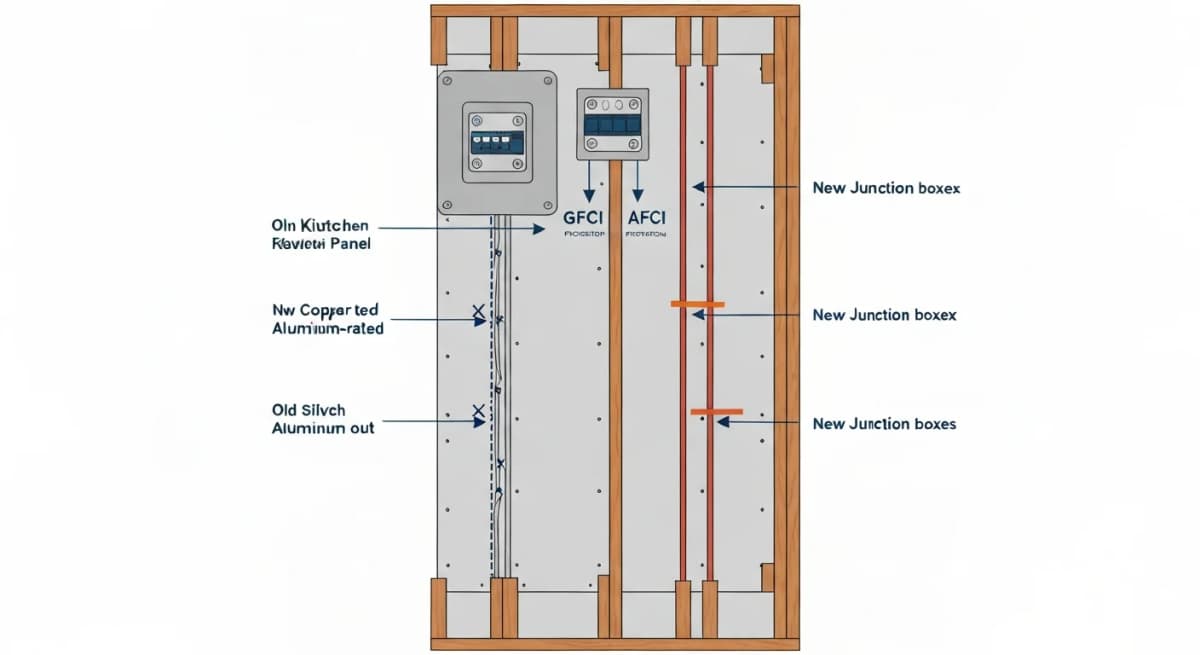
Remove existing aluminum branch circuits: Cut and pull existing aluminum cable from each receptacle, switch, and appliance circuit back to a tie-in point (typically the breaker panel or a major junction box).
Pull new 12-gauge copper: Run new copper Romex-style cable through existing stud bays or fish through finished walls. For kitchen remodels with full demo, this is straightforward; for kitchen remodels with selective demo, this is harder.
Install new GFCI and AFCI protection: Modern code (2023 NEC, adopted in Idaho) requires GFCI on all kitchen countertop receptacles; AFCI applies per Idaho's amended rules (bedroom circuits only). New copper-wired circuits get this protection at the breaker panel.
Tie new copper to existing copper or junction: The new copper circuits terminate at the panel where they replace the aluminum breakers with copper-rated standard breakers.
Cost: $4,500-$12,500 for a typical Boise kitchen rewire. Specific cost drivers:
Wall access: If the kitchen has open framing during a full demo, the cost is at the lower end. If wires need to be fished through finished walls, cost is higher.
Circuit count: Modern kitchens require multiple dedicated circuits — typically 6-8 circuits. More circuits = more wire = more labor.
Panel work: If the existing panel can accept the new copper circuits, the panel work is modest. If the panel needs upgrade to handle modern kitchen circuit count, panel-upgrade cost adds $1,500-$4,500.
When full kitchen rewire is the right choice:
Full kitchen demo anyway: If the kitchen is being gutted for the remodel, the marginal cost of rewiring while access is available is much less than rewiring later as a separate project. This is the most common rewire scenario.
Modern kitchen circuit requirements: If the existing kitchen's aluminum circuits don't support modern code (typically yes), the rewire is essentially mandatory regardless of aluminum-vs-copper considerations.
Homeowner wants permanent elimination: Full rewire produces a kitchen that's permanently copper-wired with no future remediation concerns.
Insurance or resale requirements: Some insurance carriers will only insure aluminum-wired homes if remediated to copper. Some pre-purchase home inspections trigger buyer requests for copper-only.
For the broader scope of full home rewire, see our electrical remodel guide for Boise. Whole-home rewire is a separate decision tree — $15,000-$45,000 typical for a 1960s Boise home with aluminum branch wiring.
Kitchens being remodeled with full demo, where the marginal cost of rewire is low compared to rewiring later.
Highest cost option. Requires kitchen unavailable for the rewire portion of the project (typically 1-2 weeks).
Aluminum branch wiring isn't a typical contractor issue — it's specific enough that even some licensed Boise electricians don't have extensive experience with it. Before scoping a kitchen remodel in an aluminum-wired home, several coordination items matter.
Coordination checklist:
Confirm aluminum wiring presence and scope BEFORE design phase: The remediation decision affects budget, timeline, and inspection scope. Knowing this at design phase avoids mid-project changes. Cost: $200-$400 for a comprehensive electrical inspection.
Verify the electrician's aluminum-wiring experience: Ask specifically: "Have you remediated aluminum branch wiring before?" and "What's your standard approach — CO/ALR receptacles or AlumiConn pigtails?" An electrician who hesitates or says "we'll just use regular receptacles" isn't the right choice for this work.
Confirm permit and inspection scope: City of Boise requires permits for electrical work in kitchen remodels. The permit application should explicitly note aluminum branch wiring presence and the planned remediation approach. Inspections happen at rough-in (before drywall) and final.
Insurance pre-coordination: Some insurance carriers want to be informed about aluminum branch wiring presence and remediation plan during the remodel. Contact your homeowner's insurance before the project starts.
Resale disclosure: Idaho's disclosure laws require sellers to disclose known material defects. Aluminum branch wiring counts. If you're selling the home within a few years of the remodel, the remediation approach affects what disclosure is required. Document everything.
Whole-home perspective: The kitchen remediation might address the kitchen-specific hazard but leave the bedroom, bathroom, and other circuits still aluminum. Discuss the whole-home plan with the electrician — a phased approach is workable, but the plan should exist upfront.
Boise-specific code considerations: Idaho adopted the 2023 NEC effective 2024. The 2023 NEC has specific requirements for kitchen circuits. New copper installations must meet these requirements. If your electrician suggests reusing existing aluminum circuits "as-is" rather than full rewire, verify they're applying code-compliant remediation.
Iron Crest works regularly with Boise electricians experienced in aluminum branch wiring remediation. We coordinate scope with the electrician during the design phase.
Homeowners scoping kitchen remodels in 1965-1975 Boise homes who want to avoid project-stage surprises.
Adds 1-2 weeks of pre-construction coordination time. Saves significantly more time and cost mid-project.
Iron Crest's standard pre-construction checklist for any 1965-1975 era Boise home explicitly includes aluminum branch wiring assessment in the first design meeting. Aluminum-wiring remediation is standard scope on our 1965–1975-era kitchen remodels across Boise Bench, Garden City, West Boise, and Northwest Boise. The remediation approach depends on the homeowner's budget, the remodel scope, the home's overall electrical system age, and the homeowner's resale or insurance considerations.
For most active kitchen remodels we recommend full rewire of the kitchen circuits to copper while walls are open — the marginal cost is small compared to the lifecycle benefit, and it produces a permanently safe installation. For kitchens not being fully gutted, AlumiConn pigtailing is our standard approach. CO/ALR-only remediation is acceptable for budget-constrained projects but we explicitly document the trade-offs. For broader electrical scope, see our Boise electrical remodel guide and kitchen remodeling page.
How can I tell when my Boise home was built and whether it falls in the aluminum-wiring era?
Three quick sources. (1) Ada County Assessor's Office property records — searchable online via the parcel ID, shows year built and construction era. (2) Your property's title or closing documents from when you purchased — typically include year built. (3) For homes near the 1965-1975 era boundary, check the actual breaker panel and any visible cable jackets for the aluminum identifiers covered in item 2 of this article. The wiring itself, not the year built, is the definitive indicator.
Will my homeowner's insurance be affected if I have aluminum branch wiring?
Variable by carrier. Underwriting varies: some carriers will write policies on aluminum-wired homes with full disclosure and remediation documentation. Others will not insure aluminum-wired homes at all, or will require full rewire to copper. Specific to Boise market: most mainstream carriers accept AlumiConn-remediated homes; CO/ALR-only remediation is sometimes acceptable depending on carrier. Recommendation: contact your insurance agent before starting the kitchen remodel.
Does fixing aluminum wiring in just the kitchen leave the rest of the house unsafe?
The kitchen remediation addresses the kitchen-specific hazard but doesn't change the rest of the home's aluminum circuits. The kitchen tends to be the highest-risk location because of heavy appliance loads, so kitchen remediation produces the biggest safety improvement per dollar. But the other circuits remain at the same statistical risk as before. Long-term plan: phase the rest of the home's remediation as other rooms are remodeled, or address the entire home in a coordinated electrical scope.
What's the timeline for full kitchen rewire as part of a remodel?
Typically 5-10 working days for the electrical work portion specifically. The full kitchen remodel timeline doesn't extend by 5-10 days though — the rewire happens during the rough-in phase when other trades are also working. The electrical scope adds maybe 2-4 days to the overall kitchen remodel timeline beyond a non-rewire kitchen remodel. For most homeowners this is acceptable given the safety benefit.
Can I do CO/ALR receptacle replacement myself, or does it require a licensed electrician?
Code requires licensed electrician for kitchen circuit work in permitted remodels. For owner-occupied homes doing receptacle-by-receptacle replacement outside a permitted remodel scope, Idaho law allows owner DIY electrical work — but several practical considerations argue against it for aluminum branch wiring. Torque specifications matter; antioxidant compound application matters; inspection isn't typically done for one-off receptacle replacement. For kitchens being remodeled, the work is in scope of the permit anyway. For non-permitted remediation projects, hiring a licensed electrician is still the right call.
Fix the wiring before you build the dream kitchen
Aluminum branch wiring assessment and remediation is standard scope on our 1965-1975 era Boise kitchen remodels. Schedule a consultation and we'll coordinate the electrical scope with the remodel design, and any unforeseen conditions are documented and approved before additional work proceeds.
These pages go deeper on the topics linked from this article. Read them before your consultation and you'll come in with sharper questions and a clearer scope.
The following government agencies, industry organizations, and official resources provide additional information relevant to your remodeling project.