
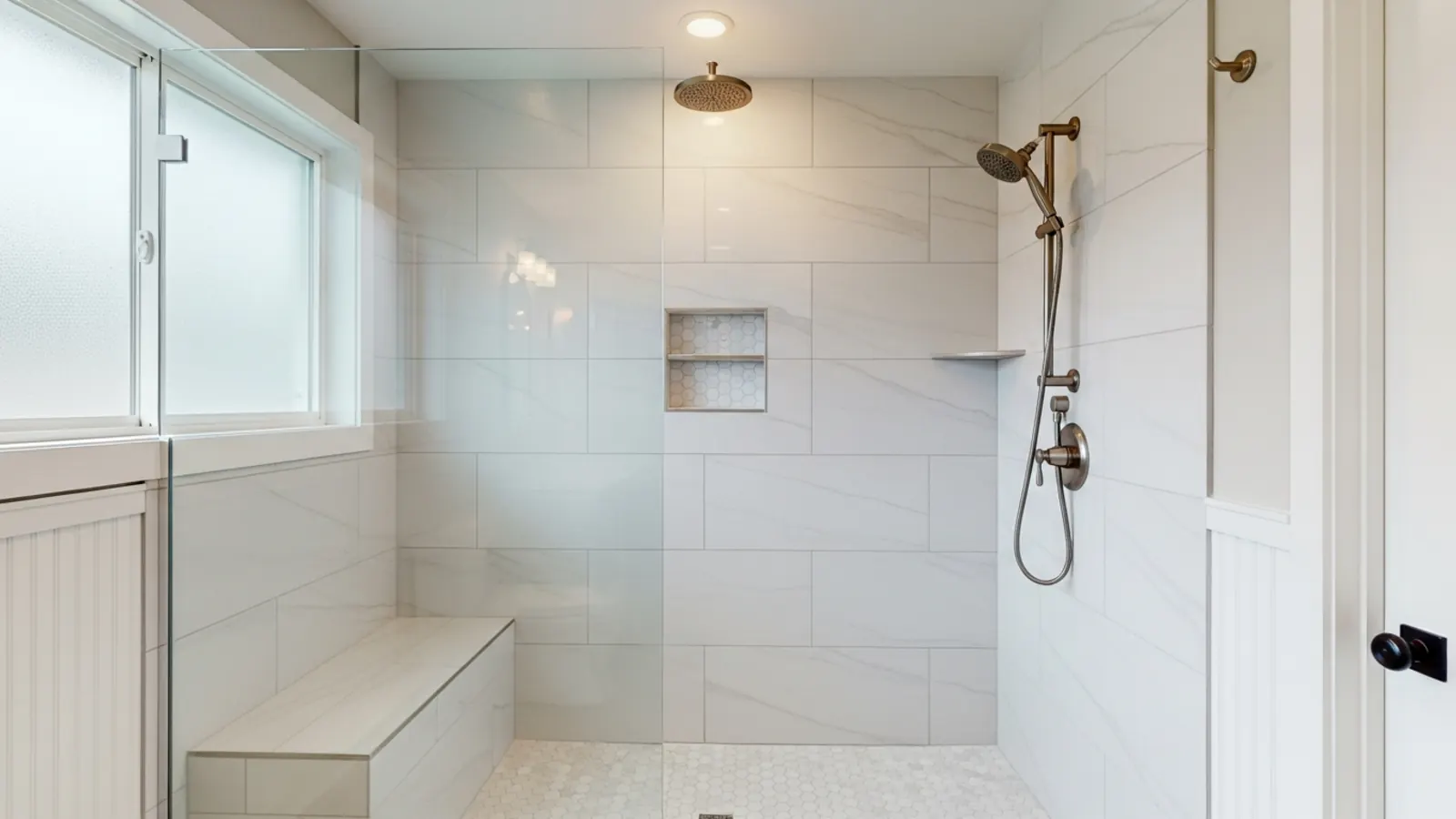
Shower Remodeling on Vista, Curtis / Targee, the Eastern Bench & the Lower Bench
Tub-to-shower conversions out of the original 5-foot steel and cast iron alcove tubs that came in every 1948–1965 Bench bathroom, curbless walk-ins for aging in place, and Schluter-Kerdi-waterproofed builds with the asbestos and lead protocols pre-1980 stock requires.
Quick answer
5–7 weeks from contract signing to final walkthrough for standard tub-to-shower conversion on a Vista or Curtis / Targee ranch. Breakdown: 1 week design and material selection, 2 weeks permit + environmental testing + material ordering (concurrent), 1 week demolition + plumbing rough-in, 1 week waterproofing + substrate, 2 weeks tile install (including grout cure), 1 week glass enclosure templating and install plus final inspections.
Shower remodeling on the Boise Bench is shaped by three things specific to this housing stock: the universal mid-century 5-foot alcove tub that came in every 1948–1965 Bench bathroom (steel on the later ranches, cast iron on the earlier minimal traditionals around Roosevelt Market), the cramped 35-to-50-square-foot original bathroom footprint that makes the tub the bath's dominant feature even though the homeowner usually doesn't use it, and the universal pre-1980 asbestos pattern under or behind the original tile (vinyl asbestos in the substrate, asbestos in the mortar bed, sometimes asbestos in the cement-board backing) that triggers DEQ-mandated abatement before any tile removal. The dominant project on Vista, Curtis / Targee, and Eastern Bench / Overland is the tub-to-shower conversion: remove the 5-foot steel or cast iron tub, rebuild the substrate to Schluter Kerdi waterproofing standards, install a walk-in shower (sometimes curbless, increasingly with aging-in-place blocking for grab bars), tile in modern subway or large-format porcelain, frameless glass enclosure. The Bench has none of the Historic Preservation overlay that North End shower projects carry — permits run at standard City of Boise speed (confirm current turnaround with Boise PDS), making Bench bathroom turnaround meaningfully faster than the same scope in the Hyde Park or Camel's Back blocks. Iron Crest's Bench shower work is anchored on Schluter Kerdi waterproofing on every build, EPA RRP lead-safe practices throughout (universal in pre-1978 stock), pre-1980 asbestos pre-screen on every mortar-bed and substrate disturbance, and the structural assessment that curbless designs require on older Bench joist depths.
Bench shower strategy varies by era because original tub type, bathroom dimensions, and what's behind the tile all change across the post-war housing waves.
1940–1955 early post-war minimal traditional (Roosevelt Market area, parts of Western Bench)
Small original bathrooms with cast iron alcove tubs (250–350 lbs, often impossible to walk out of an original 26-inch doorway), hex mosaic floor tile that sometimes survives original, beadboard wainscoting on the homes that have it. Original galvanized supply and cast iron drain. Pre-1978 trim universally lead-painted — EPA RRP applies. Modern scope: break-out cast iron tub demolition in place where access is tight, full waterproofing rebuild on Schluter Kerdi, period-correct hex floor mosaic if owner wants the era-appropriate vocabulary or modern porcelain otherwise. Original mortar beds frequently contain asbestos.
1955–1965 classic post-war ranch (Vista, Curtis / Targee, Eastern Bench)
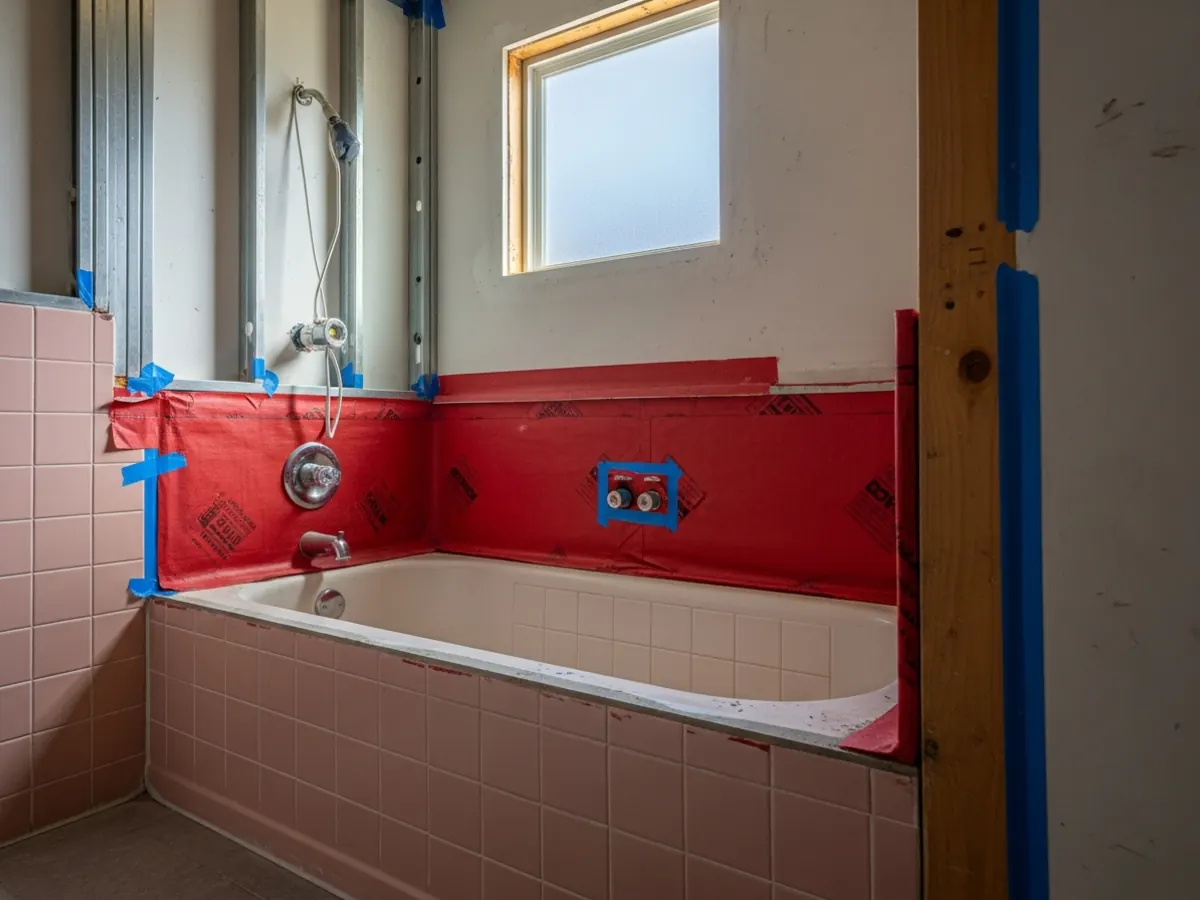
5-foot steel alcove tubs (lighter at 60–80 lbs than the cast iron predecessor), original bathrooms with pink, blue, mint-green, or sea-foam wall tile that's frequently still intact and original. Copper supply almost universal by this era; cast iron drains still standard. Pre-1978 lead applies. Wall framing is modern stud spacing. Original vinyl asbestos sheet flooring (9-inch tiles) almost universal under whatever the prior owner installed. Modern scope: standard tub-to-shower conversion with full demolition, asbestos abatement of mortar bed and substrate, Schluter Kerdi rebuild, modern build-back.
1965–1975 expanded ranch and split-level (Eastern Bench / Overland, parts of Lower Bench)
Slightly larger bathrooms with original 5-foot tubs, sometimes tub-shower combinations rather than tub-only, earthier 1970s tile palettes (avocado green, harvest gold, brown). Modern mechanical baseline — copper supply, cast iron or ABS drains, drywall with plaster-skim wall framing. Shower projects more flexible due to larger footprints; curbless designs more often viable here than on the older Vista and Curtis / Targee stock.
1985+ updated and infill Bench
Modern construction or substantially renovated stock. Standard walk-in shower builds with current materials and methods, no asbestos concerns, no lead, no original-tub heritage to manage.
Five recurring shower-remodel shapes account for nearly every Bench project. Era of the original house and accessibility brief drive which one fits.
1. The Standard Vista / Curtis-Targee Tub-to-Shower Conversion
Remove the original 1955-era 5-foot steel alcove tub, abate the asbestos-mortar substrate, rebuild with Schluter Kerdi membrane waterproofing on cement-board substrate, install a walk-in shower in the same alcove footprint with modern porcelain or subway tile walls, hex or penny-round mosaic floor, frameless 3/8" tempered glass enclosure, new anti-scald thermostatic shower valve. Most common Bench shower scope by volume.
Target homes: Vista, Curtis / Targee, and Eastern Bench ranches with the original 1955-era 5-foot tub that's no longer being used. Permit: plumbing permit; building permit if any structural change to drain location or framing.
2. The Bench Curbless Walk-In (Modern Look Plus Mobility-Ready Entry)
Walk-in shower with no threshold between bathroom floor and shower floor — floor slopes continuously to a Schluter Kerdi-Line linear drain. Requires careful waterproofing detail and structural assessment of joist depth (Bench homes vary; some 1955-era joists don't have enough depth for the required subfloor depression to create slope). Floor must drop into shower area to create slope, requiring subfloor and joist work on most pre-1965 stock.
Target homes: Bench bathrooms with floor structure that supports the slight drop; owners prioritizing aging-in-place readiness or modern aesthetic. Eastern Bench / Overland splits and 1965+ stock have the joist depth more often than Vista / Curtis-Targee 1955-era ranches. Permit: building and plumbing permits.
3. Walk-In Built Inside a Full Vista / Curtis-Targee Bath Gut (Incremental Cost)
Building a walk-in shower as part of a broader bathroom gutting where the bathroom is being taken to studs anyway. Lower marginal cost than standalone shower remodel because demolition and substrate work is already in the broader bath budget. The right path when both the tub and the rest of the original 1955 bath (vanity, toilet, flooring, lighting) are being replaced concurrently.
Target homes: Bench homes doing comprehensive bathroom remodels. Permit: full bath permit suite.
4. The Bench Aging-in-Place Shower (Forever-Home Universal Design)
Walk-in shower designed for full mobility-impaired access on a Bench ranch where owners plan to age in place: curbless entry with continuous floor slope, 60-inch width minimum (larger than the original alcove footprint typically requires absorbing a small adjacent closet or hallway corner), wall-mounted teak bench at chair-transfer height, plywood blocking installed in the walls for current or future grab bars, hand-shower on slide bar, anti-scald thermostatic valve with paddle handle for arthritic dexterity, slip-resistant 2-inch hex floor tile. Common request on the Lower Bench / I-84 frontage stock where owners are turning their value-priced ranch into a forever home.
Target homes: Bench owners 55+ planning to age in place, particularly common on Vista and Curtis / Targee stock with strong family/community ties. Rental properties optimizing for older-adult tenant durability. Permit: building and plumbing permits.
5. The Wet-Room Conversion (Eastern Bench / Overland Larger Footprints)
European-style design where the entire bathroom is treated as a single wet area — tile floor and walls throughout, comprehensive Schluter waterproofing across all surfaces, heated floor recommended, careful high-CFM ventilation with humidity-sensing fan. Less common on the smaller Vista / Curtis-Targee footprints; more often viable on the larger 1970s Eastern Bench bathrooms.
Target homes: Larger Bench bathrooms (70+ sq ft) where design vision supports wet-room approach — primarily Eastern Bench / Overland splits and some Cole Road / Lower Bench stock. Permit: building and plumbing permits.
The Boise Bench is made up of distinct sub-neighborhoods, each with its own remodeling personality.
Vista
One of the most recognized sub-neighborhoods on the Boise Bench, centered around Vista Avenue between the Boise River and Overland Road. Post-war homes on uniform lots with mature street trees and good walkability to local commercial corridors. A heavy concentration of small ranch and minimal-traditional homes that respond well to galley-kitchen open-ups, primary-suite additions, and aesthetic modernization.
Central Bench (Curtis & Targee corridor)
The geographic core of the Bench, running along Curtis Road and Targee Street between I-84 and Overland. The City of Boise's Central Bench Neighborhood Plan records that the neighbourhood changed significantly during and after World War II, when agricultural land was subdivided into residential lots, and that new homes were built west of Orchard Street from the mid-1950s through the 1970s. Blueprint Boise designates the Central Bench primarily for compact-neighbourhood form — small lots, typically between 5,000 and 7,000 square feet, predominantly single-family, on an interconnected network of sidewalks and streets. Galley kitchen conversions are the dominant remodeling project type here.
Eastern Bench / Overland
The eastern edge of the Bench around Overland Road, with a mix of ranch and split-level homes. Lots tend to be slightly larger. Closer to mall-adjacent commercial corridors and major transit routes.
Western Bench / Roosevelt Market area
The western edge of the Bench near the Roosevelt Market and Capitol corridor. Some of the older Bench housing stock sits here, with steeper roof pitches and smaller footprints than the post-war ranches further east. Closer to downtown amenities and walkable.
Greenbelt-adjacent Bench
Bench properties along the elevated edges of the Boise River bluff with views down to the Greenbelt and the river. Frequently subject to view-preserving design considerations during exterior work — though without formal Historic District constraints.
Lower Bench (I-84 frontage)
The southern edge of the Bench close to I-84, on smaller lots and often with more traffic noise from the freeway. Common to combine kitchen, bathroom, and primary-suite remodels into a single comprehensive scope.
Most Boise shower remodel projects run $8,500 to $35,000 — the band published on our Boise shower remodel page. The ranges below run higher than that band because of the Bench's pre-1980 housing stock, where asbestos testing, lead-safe work practices and original-systems discovery are part of the base scope rather than an add-on. Pricing reflects three Bench realities: waterproofing rigor (Schluter Kerdi on every shower), demolition complexity in older stock (asbestos abatement universal on pre-1980 mortar beds, cast iron tub break-out on pre-1955 alcoves), and the labor of modern tile patterns in tight original footprints.
Boise Bench shower remodeling ranges
New shower in comprehensive bathroom remodel (incremental) (Marginal cost above bathroom-remodel base scope): $14,000–$24,000 / Aligned with bath remodel end to end
Standard tub-to-shower conversion (Tub removal, traditional curbed walk-in with Schluter Kerdi, modern tile, frameless glass): $22,000–$32,000 / 5–7 weeks end to end
Curbless walk-in conversion (Tub removal, joist depression for slope, curbless entry, linear drain, frameless glass): $26,000–$38,000 / 6–8 weeks end to end
Accessible aging-in-place shower (Curbless entry, in-wall grab-bar blocking, transfer-height teak bench, ADA-spec fixtures, slip-rated 2-inch hex floor): $28,000–$42,000 / 6–9 weeks end to end
Wet-room conversion (Entire bathroom treated as wet area, heated floor, fully tiled walls, comprehensive ventilation): $32,000–$42,000 / 7–10 weeks end to end
Pricing assumes Iron Crest's standard Bench scope: City of Boise plumbing and building permits (no Historic Preservation review because the Bench isn't within a designated Historic District, which removes the Certificate of Appropriateness step that comparable North End scope carries), pre-1980 asbestos pre-screen on mortar beds and substrates, licensed asbestos abatement when triggered, EPA RRP lead-safe work practices on every pre-1978 home (universal in the pre-1980 Bench stock), Schluter Kerdi waterproofing membrane on every shower, premium porcelain or ceramic tile install, frameless tempered glass enclosure with hardware in matched finish family, anti-scald thermostatic shower valve, and our 3-year workmanship warranty. Contingency budget of 12–15% above contract value for older-home discovery on pre-1965 stock.
The City of Boise designates ten historic districts, and the Boise Bench is not one of them and does not sit inside one. There is no Historic Preservation Commission review for exterior modifications, so siding changes, window replacements, additions, and exterior colour changes don't trigger the Certificate of Appropriateness process that constrains North End and East End projects. That removes a review step from the pre-construction schedule on any Bench exterior scope; confirm current review timelines with Boise PDS for your specific project.
City of Boise standard permits still apply for any work involving electrical, plumbing, structural changes, or mechanical systems. A scope that includes new circuit additions, moving a gas line, or removing a load-bearing wall requires a building permit from City of Boise Planning and Development Services. Permit processing for Bench projects takes about two weeks for online plan review per Boise PDS, longer with structural drawings — without the historic-review overlay that North End projects carry. Building Division: (208) 608-7070. Planning & Zoning: (208) 608-7100.
Asbestos and lead paint remain serious considerations on the Bench, despite the absence of Historic District review. Pre-1980 Bench homes (which is most of the housing stock) commonly contain asbestos in floor tiles, joint compound, and sometimes pipe insulation. We test suspect pre-1980 materials and arrange AHERA-accredited abatement when asbestos is confirmed. Pre-1978 Bench homes contain lead paint. The EPA RRP rule requires lead-safe work practices for any renovation in lead-paint homes — including containment, specialized HEPA vacuuming, and proper disposal. Iron Crest follows EPA RRP lead-safe work practices and incorporates them into the standard scope on every pre-1980 Bench project.
Bench-specific permit consideration: setbacks. Blueprint Boise designates the Central Bench primarily for compact-neighbourhood form, with small lots typically between 5,000 and 7,000 square feet, so additions or detached structures must navigate side and rear setbacks carefully. Boise's residential zoning code sets no maximum lot coverage, so the binding constraint on a Bench addition is almost always the setback envelope rather than a coverage percentage. Zoning verification during initial design is critical to avoid late-stage redesigns.
Shower material selection for Bench bathrooms favors clean modern lines that complement mid-century post-war architecture without imposing a North End Craftsman-revival vocabulary that doesn't belong on a 1955 Vista ranch.
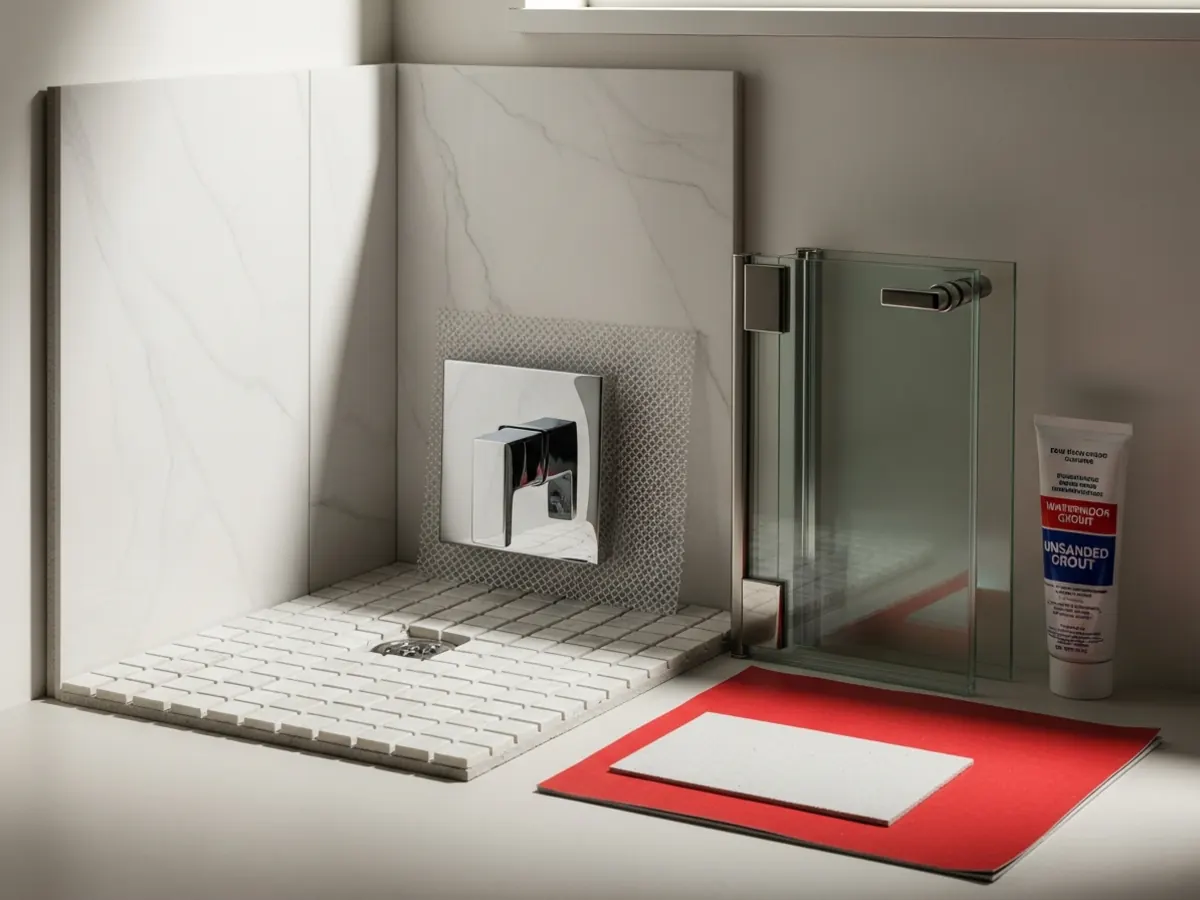
Waterproofing — Schluter Kerdi membrane on every shower
Schluter Kerdi (orange polyethylene fabric bonded to substrate with thin-set mortar) is the standard on every Bench shower we build. Lifetime Schluter manufacturer warranty when installed to Schluter's published specifications. Avoid: cement-board-only construction without a separate membrane (the 1990s standard that fails 10–15 years later and is the cause of most of the hidden-mold remediation work we do on Bench bathrooms that were 'remodeled' in 2005).
Wall tile — modern vocabulary, not period revival
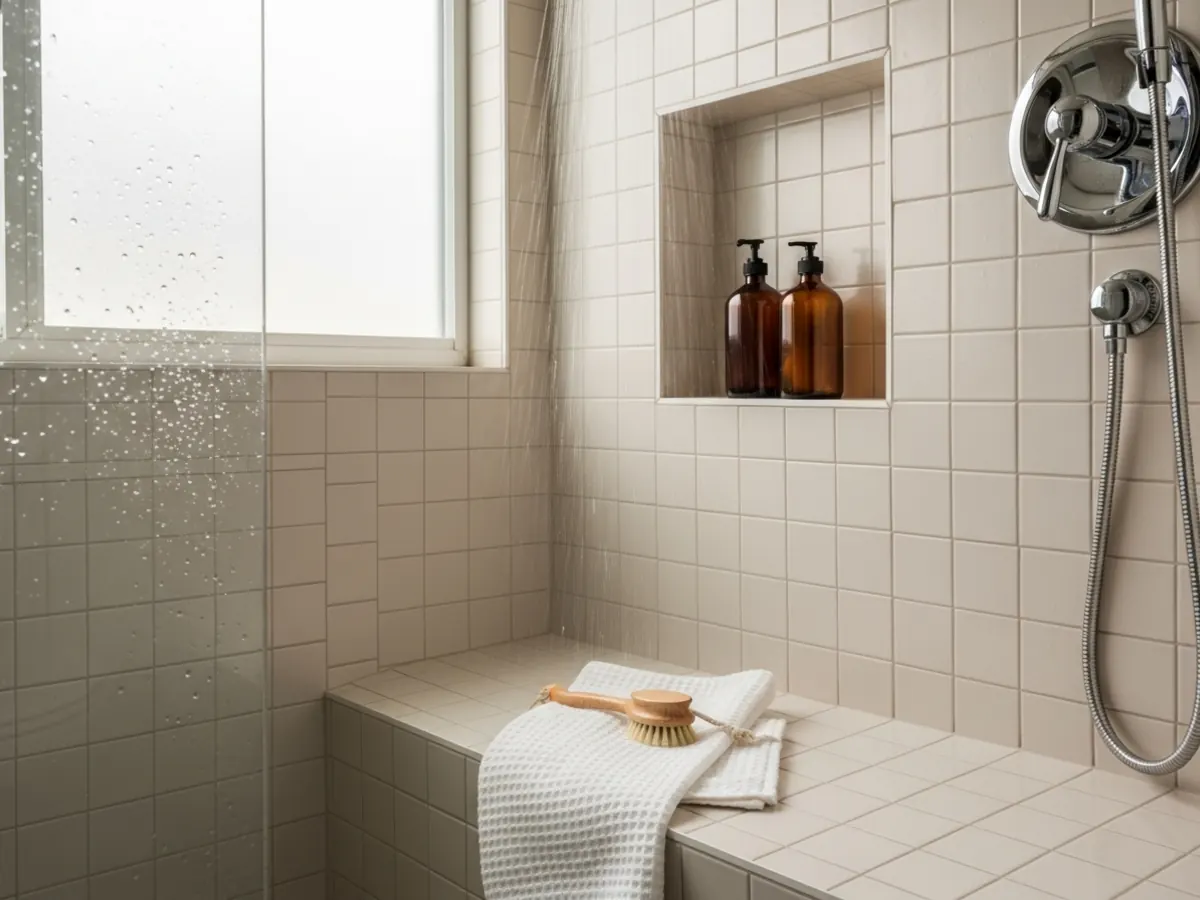
3×6 or 4×12 subway tile in matte finish with thin sanded grout joints reads more contemporary than glossy or large-format alternatives and complements mid-century post-war architecture without imposing Craftsman-revival looks that don't belong on a 1955 ranch. Stack pattern for the most modern read. Large-format porcelain (12×24 or 24×24 in stone-look or solid color) provides a quieter modern aesthetic where owner brief is design-statement minimalism. Avoid: small-format colored tile (pink, mint, sea-foam) that recreates the era you're escaping; ornate handmade tiles that read North End rather than Bench.
Floor tile and slope — small-format mosaic for grip
Mosaic tile (1-inch to 2-inch) is required for shower floor — small grout joints provide slip resistance. White hex mosaic or penny round mosaic in white, matte grey, or warm sand. Floor slope minimum 1/4 inch per foot to drain location. Curbless designs require the slope to be achieved within the bathroom floor itself, which means subfloor depression or joist work on most pre-1965 Bench stock.
Drain selection — center round for curbed, Schluter Kerdi-Line linear for curbless
Standard center drain (round, 4-inch) for traditional curbed showers — lowest cost, simplest detailing. Schluter Kerdi-Line or Infinity Drain linear drain for curbless designs, typically positioned along the wall opposite the shower head to keep the drain visually subordinate. Linear drain costs $400–$1,200 above standard but is non-negotiable on curbless work.
Glass enclosure — frameless 3/8" tempered
Frameless 3/8-inch tempered glass is the modern Bench standard — minimal hardware, clean aesthetic, durable. Configuration options: single fixed panel (for walk-in alcoves), single fixed plus pivot door, or full enclosure depending on layout. Brushed nickel, polished chrome, or matte black hinges and clips chosen to match the rest of the bathroom finish family. Low-iron Starphire glass available as upgrade for the cleanest read; standard tempered is appropriate for most scope.
Fixtures — thermostatic anti-scald valve, modern brand specification
Thermostatic shower valve (vs pressure-balance) is the higher-quality choice and is required for accessibility scope. Rain shower head (8-inch to 12-inch ceiling-mount or wall-mount) plus hand-shower on slide bar is the modern Bench standard. Brand specifications: Kohler Memoirs, Moen Genta, Brizo Litze for typical scope; Hansgrohe Talis for premium tier. Finish: brushed nickel, polished chrome, or matte black depending on bathroom finish family.
Shower demolition in older Bench bathrooms surfaces a recurring set of conditions related to original tub installation, plumbing condition, floor structure, and substrate composition. We pre-screen at the consultation walkthrough so the budget is honest up front.
- •Asbestos in pre-1980 mortar bed and tile-substrate materials Pre-1980 ceramic-tile mortar beds and cement-board backing materials frequently contain asbestos. Idaho DEQ requires licensed abatement before disturbance. Pre-screen testing $300–$700; abatement when triggered $1,200–$3,500.
- •Steel tub removal (1955–1965 stock) — easier than cast iron but disposal-controlled Original steel alcove tubs weigh 60–80 pounds. Removal is straightforward; tub disposal requires proper waste handling per Idaho regulations. $100–$300 above standard scope.
- •Cast iron tub heavier than expected — break-out demolition in tight original doorways Original cast iron alcove tubs in early 1940s–1955 Bench homes weigh 250–350 pounds. Removal requires careful lifting with multiple workers or break-out demolition in place with a chipping hammer when the tub can't be carried through an original 26-inch doorway. $200–$500 above standard scope.
- •Galvanized supply lines that fail when disturbed Existing galvanized supply lines feeding the original tub valve are 60–80 years old (on pre-1955 stock; copper became standard from 1955+) and often fail at fittings during demolition. Replacement of nearby supply runs to PEX or copper: $400–$1,500.
- •Drain location requiring subfloor adjustment The original Bench 5-foot alcove tub drains at the end wall, while the new shower drain typically lands centered or linear along the back wall. Cutting through 1955-era subfloor and rerouting through cast iron joist bays adds structural work. $400–$1,500.
- •Failed waterproofing under existing tub or shower causing subfloor and joist damage Universal on pre-1990 showers because original construction used felt-paper-only construction (modern membranes weren't standard until later). Patch repair of localized water damage: $400–$1,500. Joist sister or replacement: $800–$2,500.
- •Pre-1990 Bench valve assembly missing modern anti-scald protection Pre-1990s shower valves often lack anti-scald protection and aren't compliant with current Idaho plumbing code. The existing valve must be replaced as part of any shower remodel. $400–$1,200 above standard.
- •Lead paint on bathroom walls disturbed during shower wall demolition Universal in pre-1978 Bench homes. EPA RRP lead-safe work practices including HEPA-only sanding, wet-paste paint scraping, and lead-safe disposal. Built into our pricing rather than added as discovery.
- •Floor structure inadequate for curbless slope requirement on pre-1965 Bench joist depths Achieving curbless slope sometimes requires subfloor depression that older Bench framing can't accommodate without joist reinforcement. Engineering review and joist sister/reinforcement: $1,500–$4,000. Detected during the consultation walkthrough by depth measurement.
Consultation and assessment (Week 1)
In-home walkthrough. Measurement of original bathroom and existing tub. Identification of mechanical concerns (galvanized supply, original 60A or 100A service, knob-and-tube if pre-1955). Discussion of shower shape, curbed vs. curbless preference, and aging-in-place priorities. Joist depth measurement on curbless scope.
Environmental testing (Weeks 1–2)
Asbestos pre-screen on suspect tile mortar beds, vinyl substrate, and sheet flooring. Lead testing assumed universal on pre-1978 trim. Results in 5–7 business days.
Design and material selection (Week 2)
Tile selections (subway vs. large-format, mosaic floor pattern), glass enclosure layout, fixture and valve selections, drain placement (center vs. linear for curbless), accessibility scope decisions. Detailed line-item estimate.
Permitting and material ordering (Weeks 2–3)
City of Boise plumbing permit (and building permit when structural work is in scope). Tile, fixtures, valve, and Schluter Kerdi waterproofing materials ordered. No Historic Preservation review because the Bench isn't within a designated Boise Historic District.
Demolition (Week 3–4)
Tub or existing shower removal. Asbestos abatement when pre-screen returned positive (by licensed contractor under DEQ containment). Tile and substrate removal. EPA RRP lead-safe containment throughout. Subfloor inspection and repair when needed.
Plumbing and structural rough-in (Week 4)
Drain location adjustment, supply line modifications, new anti-scald thermostatic shower valve set. Joist depression and reinforcement on curbless scope. City of Boise plumbing rough-in inspection.
Waterproofing and substrate (Weeks 4–5)
Cement board on shower walls. Schluter Kerdi membrane install across all wet areas (walls, floor, niche, bench if applicable). Pre-slope mortar bed. Curb construction if curbed design. Curbless slope verification with water test before tile.
Tile install (Weeks 5–7)
Wall tile install with thin grout joints. Floor tile install on properly sloped substrate. Mosaic shower-floor work where applicable. Grout install per Schluter spec. Sealer application after grout cure.
Glass enclosure, fixtures, final inspection (Weeks 7–9)
Glass enclosure templated and installed (5–10 business day fabrication, longer for low-iron Starphire upgrade). Shower head, hand-shower on slide bar, valve trim. Final City of Boise plumbing and building inspections. Owner walkthrough. Punch resolution. 3-year Iron Crest workmanship warranty begins.
Shower waterproofing is the highest-stakes detail in any bathroom — failure means hidden water damage, joist rot, mold, and tens of thousands of dollars of repair work years later. On the Bench, you also need a contractor fluent in the asbestos protocols universal on pre-1980 mortar beds and the cast iron tub break-out techniques specific to pre-1955 alcove geometry.
- City of Boise Planning & Development Services — Building, electrical, plumbing, and mechanical permits. Online portal and in-person plan check.
- Idaho DEQ Air Quality (Asbestos) — Testing and abatement guidance for pre-1980 homes via the Idaho Department of Environmental Quality.
- EPA Lead Renovation, Repair and Painting (RRP) Program — Required certification and work practices for renovation in pre-1978 lead-paint homes.
- Idaho Power — Rebates & Offers — Idaho Power's residential incentives: the Heating and Cooling Efficiency Program (heat pumps, central air conditioners, duct sealing, smart thermostats, heat pump water heaters, whole-house fans and similar equipment), the A/C Cool Credit, and the Shade Tree Project. Windows and insulation are not covered.
- Idaho DOPL — Contractor Search — Verify any contractor's RCE registration through the official Idaho DOPL license search.
How long does a Bench tub-to-shower conversion take?
5–7 weeks from contract signing to final walkthrough for standard tub-to-shower conversion on a Vista or Curtis / Targee ranch. Breakdown: 1 week design and material selection, 2 weeks permit + environmental testing + material ordering (concurrent), 1 week demolition + plumbing rough-in, 1 week waterproofing + substrate, 2 weeks tile install (including grout cure), 1 week glass enclosure templating and install plus final inspections. The Bench isn't within a Historic District, so there's no Historic Preservation review adding the Certificate of Appropriateness step that comparable North End projects carry.
What waterproofing system do you use?
Schluter Kerdi membrane on every shower — orange polyethylene fabric bonded to cement-board substrate with thin-set mortar that creates a fully waterproof barrier behind the tile. We install Schluter systems to the manufacturer's published specifications (required for the lifetime manufacturer warranty). The Kerdi system far outperforms older vinyl-and-felt or cement-board-only methods that were standard before the late 1990s and that are the root cause of most of the hidden-mold remediation work we do on Bench bathrooms 'remodeled' in 2005. For curbless designs, we use Schluter Kerdi-Line linear drains.
Can you do a curbless walk-in shower in my Bench bathroom?
Usually, but it requires structural assessment. Curbless showers need the bathroom floor itself to slope toward the drain — typically requires depressing the subfloor in the shower area. Older Bench homes have variable joist depths and sometimes inadequate clearance, especially on pre-1965 Vista and Curtis / Targee 1955-era stock. Eastern Bench / Overland splits and 1965+ stock have the joist depth more often. We measure joist depth during the consultation walkthrough and tell you whether your specific floor structure supports curbless before quoting that scope.
What does a Bench tub-to-shower conversion cost?
$22,000–$36,000 typical range. Lower end: tub removal, traditional curbed walk-in shower with subway tile and frameless glass enclosure on a 1955 Vista ranch. Higher end: curbless walk-in with custom tile pattern, premium fixtures, larger glass enclosure, structural work for older-home discovery (joist reinforcement, supply repipe). Accessibility scope with blocking, bench, and ADA-compliant fixtures: $28,000–$42,000.
How do you handle the 60-year-old plumbing in a Bench shower remodel?
We assume galvanized supply lines on any pre-1955 Bench bathroom and copper supply on the 1955+ stock. Original cast iron drain stacks are typical across the pre-1965 era. We budget for replacement of supply runs feeding the shower valve from main shutoff or branch tap to PEX or copper. New drain: PVC from new shower drain back to existing main drain stack. Standard scope on our Bench shower work, not a surprise change order mid-project.
How do you handle asbestos in a 1955-era Bench tile mortar bed?
Pre-1980 ceramic tile mortar beds in Bench bathrooms frequently contain asbestos. Required pre-screen testing identifies — visible 9-inch vinyl tile under the existing flooring is a strong indicator. If positive, licensed abatement before tile removal: $800–$2,500 incremental. Built into our Bench shower pricing as a probable rather than a surprise discovery.
Can you preserve any of the original Bench bathroom?
Sometimes. Original hex mosaic floor tile in earlier 1940s–early 1950s Bench bathrooms can occasionally be preserved when the shower work is contained to the tub alcove and the floor tile is intact and structurally sound. Original colored wall tile (pink, blue, mint green, sea-foam) from the 1955–1965 wave is almost always fully replaced rather than preserved — the era-signature pastel palette is what owners are escaping, not embracing. We discuss preservation goals during consultation.
What's the maintenance story for frameless glass given Bench hard-water deposits?
Boise's hard water (up to ~13 grains per gallon; ~6 average) leaves visible mineral deposits on glass enclosures over time. Application of a hydrophobic glass coating (EnduroShield or ShowerGuard) at install time substantially reduces deposit accumulation. Adds $200–$400 to install cost. Without coating, weekly squeegee after each use plus a monthly deep clean with white vinegar or a CLR-type product is the maintenance routine that keeps the glass clear.
Ready to start your Boise Bench shower remodeling project?
Free in-home consultation, honest contingency-based budgeting, and the experience Boise homes require. Iron Crest Remodel — Idaho RCE #6681702, EPA RRP lead-safe work practices, $2M general liability, 3-year workmanship warranty.
Get Your Free Estimate