
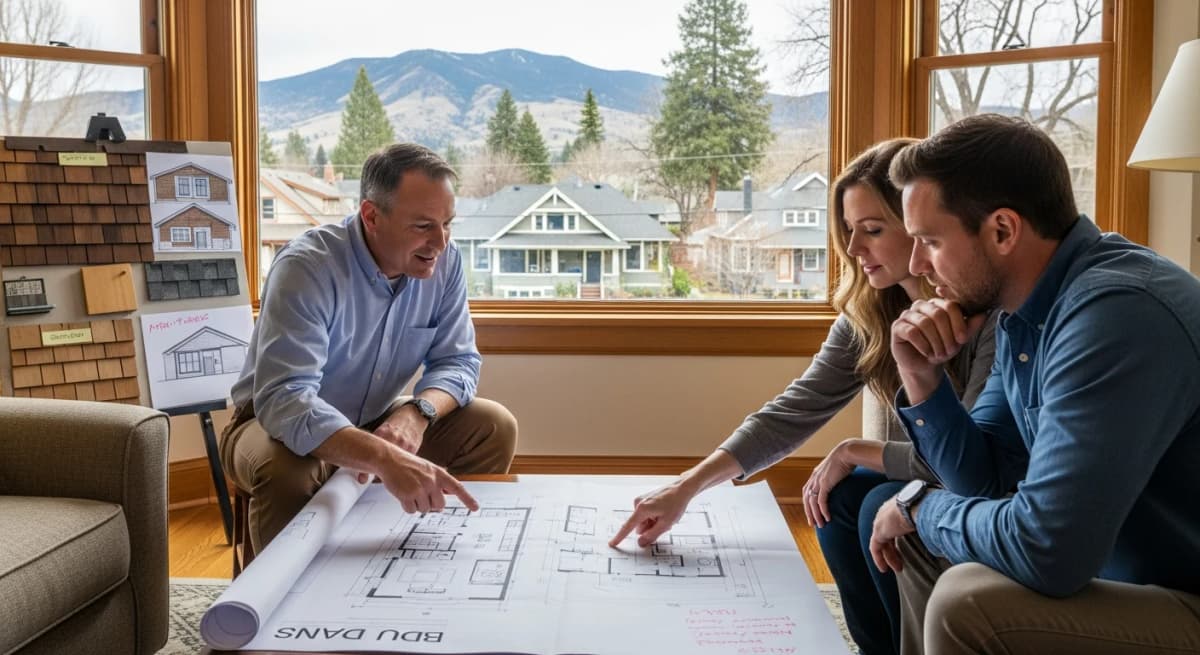
ADU Design Ideas for Boise Homes
Explore floor plans, exterior styles, and interior design strategies for accessory dwelling units in Boise and the Treasure Valley. From studio layouts to two-bedroom plans, find the ADU design that fits your property, budget, and goals.
Quick answer
Under Boise's current ADU regulations, accessory dwelling units can be up to 900 square feet or 70% of the primary structure's total floor area, whichever is smaller, with no more than two bedrooms.
The right floor plan depends on your ADU's purpose — rental income, multi-generational housing, home office, or guest quarters. Boise's 900-square-foot maximum and typical lot sizes in established neighborhoods create specific constraints that shape every layout decision. Here are the three core ADU floor plan categories and optimal configurations for each.
Studio ADU (400-500 sq ft)
The most efficient and affordable ADU layout. A single open living space combines the kitchen, dining, living, and sleeping areas with only the bathroom fully enclosed. Ideal for single occupants, short-term rentals, or home offices that double as guest quarters.
Key design features:
- Open floor plan with kitchen along one wall and living/sleeping in the remaining area
- Murphy bed or sleeping alcove to separate daytime and nighttime use of the space
- Single full bathroom positioned near the entry to serve as a powder room for guests
- Compact galley or single-wall kitchen with full-height cabinetry to maximize vertical storage
- Built-in storage throughout: window seats with hidden storage, wall niches, closet systems
- Large windows on at least two walls to prevent the space from feeling cramped
- Minimum 9-foot ceilings recommended to create a sense of volume in the open plan
Boise-specific: Studio ADUs work exceptionally well on Boise's smaller North End and Bench area lots where setback requirements limit the buildable footprint. A 400-square-foot studio can fit on lots as narrow as 40 feet wide while maintaining required 5-foot side setbacks and 20-foot rear setback.
1-Bedroom ADU (500-700 sq ft)
The most popular ADU layout in Boise and the sweet spot for rental income. A dedicated bedroom provides privacy and functionality that studios cannot match, while keeping the overall footprint manageable for most lots.
Key design features:
- Separate bedroom (minimum 100 sq ft, ideally 120-140 sq ft) with closet and window
- Open-concept kitchen and living area as the primary shared space
- Full bathroom accessible from the hallway (not through the bedroom) for guest convenience
- L-shaped or galley kitchen with space for full-size appliances
- Stackable or side-by-side washer/dryer in a dedicated closet or hallway niche
- Entry mudroom or coat closet for Boise's four-season gear storage needs
- Optional: second half-bath near the living area for longer-term tenants or multi-generational use
Boise-specific: One-bedroom ADUs are the highest-demand rental unit type in Boise's 2026 market. A well-designed 600-square-foot one-bedroom with modern finishes, in-unit laundry, and a private patio commands $1,200-$1,600 per month in most Boise neighborhoods, making it the strongest ROI layout for rental-focused ADU projects.
2-Bedroom ADU (700-1,000 sq ft)
The maximum-capacity ADU layout, ideal for families, long-term aging-in-place use, or premium rental income. Approaches Boise's current 900-square-foot cap (rising to the 1,000-square-foot / 75% state floor by October 1, 2026), so every inch must be purposefully designed to avoid wasted space.
Key design features:
- Two bedrooms (primary at 120-150 sq ft, secondary at 100-120 sq ft) each with closets
- Full bathroom shared between bedrooms, positioned in a central hallway
- Open kitchen and living area (250-350 sq ft) as the social center of the unit
- Full-size kitchen with L-shaped or U-shaped layout and standard-depth appliances
- Dedicated laundry area (closet or small room) rather than stacked units in a hallway
- Separate entry with small foyer or landing area for shoes, coats, and keys
- Optional: second bathroom (3/4 bath) for units at the 900-square-foot maximum
Boise-specific: Two-bedroom ADUs require lots with at least 50 feet of width and 100 feet of depth to meet Boise's setback and lot coverage requirements comfortably. Most lots in the Bench, Vista, and Southeast Boise neighborhoods accommodate this size. Two-bedroom units rent for $1,500-$2,100 per month in Boise's 2026 market.
Open vs. Divided Floor Plans
Open floor plans maximize perceived space and natural light — critical in sub-900-square-foot units. However, fully open plans offer zero acoustic privacy, which matters for rental units and multi-generational living.
The best ADU designs use a semi-open approach: the kitchen and living area share one open space, while bedrooms and bathrooms are fully enclosed with solid-core doors. Pocket doors between the living area and bedroom hallway allow the option to open up or close off spaces as needed.
Boise Lot Size Constraints
Typical residential lots in established Boise neighborhoods measure 50×125 feet (6,250 sq ft) to 60×150 feet (9,000 sq ft). After applying required setbacks (20-foot rear, 5-foot side, and the primary home footprint), buildable area for a detached ADU is typically 500 to 1,200 square feet of lot.
This means your ADU footprint is often limited to 400-700 square feet on the ground floor. For larger ADUs, a second story or loft design can double usable space within the same footprint — though Boise's height restrictions (typically 25 feet for accessory structures) and neighbor privacy concerns must be addressed.
The three fundamental ADU types each offer distinct advantages and trade-offs. Your lot size, budget, privacy needs, and long-term goals determine which approach makes the most sense for your Boise property.
Detached ADU
A standalone structure built as a separate building on your lot, typically in the backyard. The premium option offering maximum design freedom and the highest return on investment.
Advantages
- Complete design freedom — any floor plan, style, or size up to the 900 sq ft limit
- Maximum privacy for both the ADU occupant and the primary home residents
- Highest rental income potential due to the standalone, apartment-like experience
- No structural impact on the primary home — no shared walls, roof, or foundation
- Strongest resale value addition — detached ADUs add 20-30% to property value in Boise
- Separate utility connections possible for independent metering
Limitations
- Highest construction cost: $150,000-$250,000+ in the Boise market
- Requires adequate lot size to meet setback and lot coverage requirements
- Longer construction timeline: 4-8 months from permit to completion
- Site work costs (foundation, utility trenching, landscaping restoration) add up quickly
- May require removal of existing landscaping, sheds, or other backyard structures
Boise insight: Detached ADUs are most popular in Boise's established neighborhoods — the North End, East End, Bench, and Vista areas — where lot sizes are adequate and property values support the investment. In Southeast Boise's newer subdivisions, tighter lot spacing can make detached ADUs challenging.
Attached ADU
An addition built onto the existing home, sharing at least one wall with the primary structure. A middle-ground option that balances cost savings with design flexibility.
Advantages
- Shared wall reduces construction cost by 15-25% compared to fully detached
- Shared utility connections (sewer, water, electrical) reduce infrastructure costs
- Seamless connection to the main home — ideal for aging parents who want proximity
- No separate foundation required if building on the existing home's foundation or slab
- Can be designed as a convertible space that reintegrates into the main home later
Limitations
- Less privacy — shared walls transmit sound even with insulation
- Design constrained by the existing home's structure, roofline, and foundation
- Construction disrupts the primary home during the build process
- Lower rental income potential compared to detached units (shared-wall perception)
- May trigger upgrades to existing home systems (electrical panel, plumbing, HVAC)
Boise insight: Attached ADUs work well for multi-generational families in Boise where an aging parent or adult child wants close proximity to the main household. The shared-wall design keeps utility costs lower during Boise's cold winters, and the connection allows easy check-ins without going outside in January.
Garage Conversion
Converting an existing attached or detached garage into livable space. The most affordable ADU option because the shell — walls, roof, and foundation — already exists.
Advantages
- Lowest cost: $80,000-$130,000 for a full garage conversion in Boise
- Fastest timeline: 2-4 months from permit to completion
- No change to lot coverage calculations (structure already exists)
- Existing utility proximity reduces connection costs
- Minimal impact on yard space and landscaping
Limitations
- Floor plan constrained by existing garage dimensions (typically 12x20 or 20x20 feet)
- Ceiling height may be limited — garages often have 8-foot or lower ceilings after floor buildup
- Concrete slab requires moisture barrier, insulation, and floor buildup (raises the floor 2-4 inches)
- Garage doors must be replaced with insulated walls, windows, and a proper entry door
- You lose your garage — parking and storage must be relocated
- Foundation may need reinforcement if not designed for habitable-space loads
Boise insight: Garage conversions are especially popular in Boise's Bench neighborhood and older South Boise areas where two-car garages on alley-accessed lots provide a natural conversion opportunity. Many of these garages are detached structures with their own utility access, making the conversion smoother. Boise does not require replacement off-street parking when converting a garage to an ADU.
Your ADU's exterior must complement the primary home without looking like a miniature replica. The goal is visual cohesion across the property — a consistent material language that reads as an intentional design, not an afterthought. Boise's diverse architectural styles, from craftsman bungalows to modern farmhouse, each require a different approach.
Matching the Main House
The three elements that create visual unity between an ADU and the primary home are siding material, roof pitch, and trim style. If these three match, the buildings will read as part of the same property even if the ADU has a distinctly different footprint and window configuration.
- Siding: Use the same material (lap siding, board-and-batten, stucco) and a complementary color — either identical or one shade lighter/darker
- Roofing: Match the roof material (architectural shingle, metal standing seam) and pitch angle. A shed roof on the ADU with a gable roof on the main house creates visual conflict
- Trim: Window trim, fascia, and corner board profiles should match or closely echo the main home. This is the most overlooked detail and one of the most visible
- Windows: Match the window style (single-hung, casement, picture) and grid pattern. Window sizing can differ, but the style should be consistent
Boise Style Guide
Craftsman Homes (North End, Bench)
ADU should feature tapered columns or simplified column details at the entry, exposed rafter tails or a similar eave detail, and lap siding with wide trim boards. Use earth-tone colors and natural wood accents. Avoid ultra-modern flat roofs.
Ranch/Mid-Century (Vista, Morris Hill)
Low-slope or flat roof profiles work well. Horizontal siding, wide overhangs, and clean geometric lines. Board-and-batten or smooth panel siding. Muted, nature-inspired color palettes. Large windows facing private outdoor spaces.
Modern Farmhouse (Eagle, Meridian, New Builds)
Board-and-batten siding with metal roof accents. Black-frame windows against light siding. Gabled roofline with simple trim. The ADU can lean slightly more modern than the main house — this style accommodates a contemporary ADU interpretation easily.
Contemporary (Harris Ranch, Southeast Boise)
Flat or single-slope roofs, mixed materials (metal panels, wood cladding, fiber cement), large window walls, and a minimalist trim approach. These homes allow the most design freedom for ADUs — a modern, compact structure complements the aesthetic naturally.
HOA considerations: Approximately 30% of Boise-area residential properties are in HOA-governed communities. Even when city zoning allows ADUs, HOA CC&Rs may restrict exterior materials, colors, roof styles, or ADU placement. We review your HOA documents during the design phase to prevent conflicts after construction begins.
The kitchen is the most design-intensive room in any ADU. In 400 to 900 square feet, you need to deliver full cooking functionality in a fraction of the space a standard home kitchen occupies. Layout choice, appliance sizing, and storage strategy determine whether the kitchen feels like a real cooking space or a cramped afterthought.
Single-Wall Kitchen
Best for: Studios and ADUs under 500 sq ft
All appliances and cabinetry along one wall, typically 8-12 feet long. The most space-efficient layout because it dedicates zero floor space to the kitchen — everything faces one direction.
Design tips:
- Full-height upper cabinets (42 inches) to maximize vertical storage
- Under-cabinet lighting is essential — the single wall creates shadows
- 24-inch appliances save 6 inches per unit without sacrificing functionality
- Open shelving on one end prevents the wall from feeling like a closed box
Galley Kitchen
Best for: 1-bedroom ADUs (500-700 sq ft)
Two parallel counter runs facing each other, typically with 36-42 inches of aisle space between them. Highly efficient for cooking because everything is within arm's reach.
Design tips:
- Minimum 36-inch aisle width (42 inches preferred for two people passing)
- Place the sink and cooktop on opposite walls to create a natural work triangle
- Light colors and reflective surfaces counteract the corridor feel
- One end open to the living area maintains visual connection to the larger space
L-Shaped Kitchen
Best for: Larger ADUs (700-900 sq ft) and 2-bedrooms
Counters and cabinets along two perpendicular walls, with the open corner facing the living area. Provides the most counter space of any compact kitchen layout and accommodates an eat-in counter.
Design tips:
- Place the sink at the corner junction for maximum counter on both sides
- Use a lazy Susan or pull-out in the corner cabinet to avoid dead space
- The open side can include a breakfast bar for casual dining
- Full-size appliances fit comfortably in L-shaped ADU kitchens over 10 feet per leg
Full-Size vs. Apartment-Size Appliances
Full-size appliances (30-inch range, 24-inch dishwasher, standard refrigerator) are strongly preferred for rental ADUs — tenants perceive apartment-size appliances as a downgrade and will pay less rent accordingly. For owner-occupied or guest ADUs, compact European-style appliances from Bosch, Miele, or Fisher & Paykel offer professional-grade performance in 24-inch widths.
- 24-inch range: saves 6 inches, cooks identically to 30-inch models for 1-2 people
- Counter-depth refrigerator: aligns with cabinetry for a built-in look
- 18-inch dishwasher: sufficient for 1-2 people and fits in tight layouts
- Combination microwave/convection oven: eliminates the need for a separate microwave
Counter Space & Storage Solutions
Counter space is the number one complaint in small kitchens. Every inch of counter must serve a purpose, and storage must be vertical, hidden, or multi-functional.
- Over-the-sink cutting boards and colanders create temporary prep space
- Magnetic knife strips and wall-mounted utensil rails free counter and drawer space
- Pull-out pantry towers (6-9 inches wide) use otherwise dead space beside appliances
- Fold-down tables or breakfast bars provide dining surfaces that disappear when not in use
- Deep drawer base cabinets hold pots, pans, and dishes more efficiently than shelved cabinets
ADU bathrooms must deliver full functionality in significantly less space than a standard home bathroom. The two most common ADU bathroom sizes — 5×8 feet (full bath) and 3×5 feet (half bath) — require careful fixture selection, creative storage, and smart layout decisions to feel comfortable rather than cramped.
Efficient Bathroom Layouts
5×8 Full Bathroom
The standard minimum for a full bathroom with a shower or tub. Place the toilet and vanity on the same wall (8-foot wall) with the shower or tub on the opposite short wall. This keeps plumbing on two walls maximum, reducing cost. A 32×60 shower or a standard 60-inch tub fits against the 5-foot wall. The 36-inch minimum clearance in front of the toilet and vanity is achievable with this layout.
3×5 Half Bathroom
A toilet and small vanity (18-20 inches wide) in the tightest possible configuration. Place the toilet on the 3-foot wall and the vanity on the 5-foot wall beside the door. A pocket door saves the 30 inches of swing space that a standard door requires — in a 15-square-foot room, this is a significant gain.
Walk-In Shower vs. Tub
For ADUs designed for aging-in-place or ADA accessibility, a curbless walk-in shower with a fold-down bench is the clear choice. For rental ADUs, a tub/shower combo appeals to the broadest tenant pool (families with children need tubs). For studio and one-bedroom rentals targeting single professionals, a walk-in shower with frameless glass is the modern, space-efficient option.
Design Details That Matter
Floating Vanities
Wall-mounted vanities expose the floor beneath, making small bathrooms feel larger by allowing the eye to see the full floor area. The open space below also allows for baskets or a small step stool. Choose 24-30 inch vanities for ADU bathrooms — 36-inch models are possible in 5×8 layouts.
Pocket Doors
Standard swing doors consume 7-9 square feet of usable floor space. In a 40-square-foot bathroom, that is 20% of the room. Pocket doors slide into the wall, returning all of that space. We install pocket doors on every ADU bathroom unless wall framing prevents it.
Large-Format Tile
Larger tiles (12×24 or 24×24) with thin grout lines make small bathrooms feel bigger by reducing visual clutter. Fewer grout lines also mean less maintenance — important for rental ADUs where tenants may not maintain grout as diligently as homeowners.
Boise's Hard Water
Boise has moderately hard water (up to ~13 grains per gallon; ~6 average), which causes mineral buildup on fixtures and glass. For ADU bathrooms, choose brushed nickel or matte black fixtures over polished chrome (water spots are less visible), and treat glass shower doors with a protective coating. Consider a small point-of-use water softener for the ADU if the main home does not have a whole-house system.
Multi-generational ADUs are the fastest-growing segment of our Boise ADU projects. Aging parents moving closer to adult children, adult children returning to the family property, and grandparents providing childcare all drive demand for ADUs that balance togetherness with independence. The design challenge is creating real privacy within close proximity.
Separate Entrances
Every multi-generational ADU needs its own dedicated entrance — not a shared hallway or door through the main house. A separate entrance provides psychological independence and eliminates the feeling of living 'in someone else's home.' Covered entries are essential for Boise's winter weather.
ADA-Ready Design
Even if the current occupant doesn't need accessibility features, design for future needs: 36-inch doorways, curbless shower, lever-style door handles, reinforced bathroom walls for future grab bars, and zero-step entry. These features cost 5-10% more during construction but avoid a $15,000-$30,000 retrofit later.
Privacy Buffer Zones
Landscape screening, a small courtyard, or a garden path between the ADU entrance and the main home's windows creates a psychological buffer. Even 10 feet of intentional separation — a small patio, a planting bed, a trellis — makes both households feel they have their own space.
Shared Outdoor Spaces
Design one shared outdoor area (a patio, fire pit, or garden) as an intentional gathering space where both households come together by choice. This prevents the entire yard from feeling like contested territory and gives multi-generational families a natural meeting point.
Aging-in-Place Design Features
- Zero-step entry: No threshold or step at the main entrance. The ADU floor level should match the exterior grade for wheelchair and walker access.
- 36-inch minimum doorways: Standard 32-inch doors do not accommodate most wheelchairs. All interior doors should be 36 inches, and the front door 36-42 inches.
- Curbless shower: A roll-in shower with a linear drain, fold-down teak bench, and handheld showerhead on a slide bar. No glass door — use a weighted shower curtain for easy access.
- Kitchen at counter height: Adjustable-height or standard 34-inch counter height (rather than 36-inch bar height) for seated use. Pull-out shelves in base cabinets eliminate reaching and bending.
Communication & Separation Balance
The most successful multi-generational ADU designs in our Boise projects share a common principle: connection by choice, privacy by default.
- Separate HVAC controls so each household sets their own temperature
- Separate Wi-Fi networks (or at minimum, separate SSIDs on the same network)
- Separate mailboxes and package delivery areas to maintain personal space
- A shared garden, patio, or outdoor kitchen as the designated together-space
- Video doorbell on the ADU so the occupant controls who visits and when
If rental income is your primary ADU goal, every design decision should be filtered through tenant appeal, durability, and operating cost. The difference between a well-designed rental ADU and a poorly designed one in Boise is $200-$400 per month in rent and significantly lower vacancy rates. Here is what drives rental value.
What Boise Renters Want in 2026
In-Unit Washer/Dryer
The single most requested amenity among Boise renters. Units with in-unit laundry command $100-$150 more per month than units with shared or no laundry. Stackable units fit in a 27-inch wide closet.
Private Outdoor Space
A dedicated patio, deck, or yard area — even 80-100 square feet — differentiates your ADU from apartment living. Boise renters value outdoor space for grilling, pets, and the region's 200+ days of usable outdoor weather.
Full-Size Kitchen Appliances
Renters perceive apartment-size appliances as a compromise. A full 30-inch range, standard refrigerator, and 24-inch dishwasher signal that the unit is a real home, not a converted space.
Dedicated Parking
One off-street parking spot is expected. A covered spot or small carport adds perceived value. In neighborhoods without abundant street parking (North End, downtown-adjacent), parking is a dealmaker.
Reliable High-Speed Internet
Pre-wire for fiber internet (Lumen/CenturyLink fiber or Sparklight) and include at least two ethernet drops. Remote workers — a large segment of Boise renters — prioritize internet reliability above nearly everything else.
Durable Finishes & Smart Investments
Rental ADU finishes must survive tenant turnover without requiring replacement every few years. Choose materials that look good, resist wear, and are easy to repair or touch up between tenants.
- LVP flooring: Luxury vinyl plank is waterproof, scratch-resistant, and can be replaced plank-by-plank. The best rental flooring available. Budget $3-$5/sq ft installed.
- Quartz countertops: Non-porous, stain-resistant, no sealing required. More durable than granite for rental use. Budget $50-$75/sq ft installed.
- Semi-gloss paint: Washable and touch-up friendly. Use eggshell on ceilings and semi-gloss on walls, trim, and doors. Neutral warm gray or greige maximizes tenant appeal across demographics.
- Porcelain tile in wet areas: Porcelain in the bathroom (floor and shower) outlasts any other material. Large-format tiles reduce grout maintenance.
Separate Utility Metering
Separate metering for electricity, gas, and water allows you to bill tenants for their own usage — a significant long-term savings. In Boise, separate electrical service requires a second meter panel and Idaho Power account. Separate water metering requires a second meter from Suez (Boise's water utility) and a dedicated service line.
Sound insulation: For attached ADUs and garage conversions, invest in STC 50+ wall assemblies between the ADU and the main home. Double drywall with Green Glue, insulated staggered studs, and resilient channel achieve this rating. Sound complaints are the number one source of conflict between ADU tenants and primary home residents in Boise.
Boise ADU Rental Income Projections by Design Tier (2026)
Basic
$900-$1,200/mo
Garage conversion or basic studio. Apartment-size appliances, shared laundry, no private outdoor space. Minimal finishes.
ROI: 6-8% annual return on $80,000-$110,000 investment
Standard
$1,200-$1,600/mo
1-bedroom detached or well-finished conversion. Full-size appliances, in-unit laundry, private patio, quality finishes.
ROI: 7-9% annual return on $150,000-$200,000 investment
Premium
$1,600-$2,200/mo
2-bedroom detached with high-end finishes, covered outdoor living, separate metering, premium appliances, fiber internet.
ROI: 8-10% annual return on $200,000-$260,000 investment
Boise's climate is one of the best in the Pacific Northwest for outdoor living. With comfortable outdoor temperatures from May through October and over 200 sunny days per year, integrating outdoor living space into your ADU design extends the functional square footage far beyond the building's walls.
Private Patios & Decks
Every ADU benefits from a dedicated outdoor space, even if it is modest. A 10×12 foot patio provides enough room for a small dining table, two chairs, and a grill. For rental ADUs, a private patio is a top differentiator from apartment living.
- Covered patios: A roof extension or pergola provides shade in Boise's hot July-August sun (90-100°F) and shelter during spring rain. Budget $3,000-$8,000 for a basic covered patio addition.
- Decks: Composite decking (Trex, TimberTech) is the low-maintenance choice for Boise's dry climate. A 12×12 composite deck costs $4,000-$8,000 installed. Wood decks are cheaper upfront but require annual sealing in Boise's UV-intense environment.
- Concrete patios: Stamped or stained concrete is the most durable and affordable patio surface. Budget $8-$15/sq ft installed. Pairs well with modern and contemporary ADU designs.
Fire Pit & BBQ Integration
Outdoor cooking and fire features transform a basic patio into an outdoor living room. For shared outdoor spaces between the ADU and main home, a fire pit or outdoor kitchen becomes the natural gathering point.
- Built-in gas fire pits ($2,000-$5,000) provide ambiance without the smoke and ash of wood-burning — important when the ADU is close to the main home
- Natural gas hookup for a built-in grill eliminates propane tank management and provides reliable fuel year-round
- Boise fire code requires fire features to be at least 10 feet from any structure — plan placement during the design phase, not after construction
Landscaping as Privacy Screening
Strategic landscaping creates natural privacy barriers between the ADU, the main home, and neighboring properties without the harsh visual of a solid fence. In Boise's climate, these plants thrive with minimal irrigation once established.
Fast-Growing Evergreen Screens
Arborvitae (Green Giant or Emerald varieties) grow 3-5 feet per year and provide year-round privacy. Plant 5-6 feet apart for a solid screen within 2-3 years. Austrian pines and Colorado blue spruce also work well in Boise's climate for larger properties.
Ornamental Grasses & Shrubs
Karl Foerster feather reed grass (6-7 feet tall), purple fountain grass, and dwarf burning bush create seasonal screening with movement and texture. These soften the visual boundary between the ADU and main home better than a solid hedge.
Trellises & Climbing Plants
Vertical trellises with climbing plants (clematis, hops, Virginia creeper) provide screening in minimal ground space — as little as 12 inches wide. Ideal for tight side yards between the ADU and property lines.
Shared vs. Separate Outdoor Areas
The outdoor space plan should be defined during the ADU design phase, not left to evolve organically. Undefined shared space leads to conflict and resentment between households.
Our recommendation: Design three zones — a private outdoor area for the ADU (patio, small yard), a private outdoor area for the main home (existing patio, deck), and one shared space (fire pit area, garden, BBQ station). Mark these zones on the site plan and discuss them with both households before construction. This clarity prevents 90% of the outdoor space conflicts we see in multi-unit properties.
Common questions about ADU design for Boise homeowners.
What is the maximum ADU size allowed in Boise?
Under Boise's current ADU regulations, accessory dwelling units can be up to 900 square feet or 70% of the primary structure's total floor area, whichever is smaller, with no more than two bedrooms. Idaho's 2026 ADU law (Senate Bill 1354) raises the floor to 1,000 square feet or 75% of the primary home by October 1, 2026 — confirm the limit in effect with Planning & Development Services. Detached ADUs must also comply with setback requirements — typically 5 feet from side and rear property lines. Lot coverage maximums (usually 40% in residential zones) also apply, so your available buildable area depends on how much of the lot your existing home and other structures already occupy. We handle all zoning verification and permit coordination as part of our ADU design process.
Can I build an ADU in any Boise neighborhood?
Most residential zones in Boise now allow ADUs following the 2023 zoning updates. R-1A, R-1B, R-1C, and R-2 zones all permit accessory dwelling units. However, some HOAs in planned communities — particularly in newer subdivisions in Southeast Boise, Meridian, and Eagle — have CC&Rs that restrict or prohibit ADUs regardless of city zoning. Before investing in design, we verify both zoning compliance and HOA restrictions for your specific property.
Should I build a detached ADU or convert my garage?
The best choice depends on your budget, lot size, and goals. Garage conversions cost 30-50% less than detached new construction ($80,000-$130,000 vs. $150,000-$250,000+) because the shell already exists. However, you lose your garage, the ceiling height may be limited (minimum 7.5 feet required), and the floor plan is constrained by existing dimensions. A detached ADU offers complete design freedom, better privacy, higher rental income potential, and a stronger ROI at resale. If your lot can accommodate it and the budget allows, detached ADUs deliver the most value long-term.
What ADU design style works best with Boise's existing homes?
The most successful ADU designs in Boise use a complementary approach — matching the general material palette and roofline of the main house without being an exact replica. For example, a craftsman-style primary home pairs well with an ADU that uses the same lap siding and similar trim profiles but with a simpler, more modern interpretation. Matching the roof pitch and siding material creates visual cohesion, while allowing the ADU to have its own character as a distinct structure. Trying to make a small ADU look identical to a large primary home often feels awkward and forced.
How do I design an ADU for maximum rental income in Boise?
Rental-optimized ADUs in Boise focus on three priorities: a functional kitchen with full-size appliances (renters avoid units with apartment-size appliances), in-unit washer/dryer hookups (a top demand from Boise renters), and a private outdoor space even if it is just a small patio. One-bedroom ADUs with these features command $1,200-$1,600 per month in most Boise neighborhoods as of 2026. Adding separate utility metering, a dedicated parking spot, and quality sound insulation between the ADU and main house further increases tenant satisfaction and retention.
Do I need an architect to design my ADU in Boise?
For structures under 200 square feet, Boise does not require architect-stamped plans. However, for the typical 400-900 square foot ADU, you will need construction drawings that meet IRC building code and Boise's specific requirements. You can use a licensed architect, a structural engineer with design capabilities, or a design-build firm like Iron Crest that handles design, engineering, permitting, and construction as a single team. The design-build approach is generally the most efficient and cost-effective path because it eliminates the coordination gap between separate design and construction teams.
Explore our complete library of ADU construction guides for Boise homeowners.
ADU Construction Service
Our full ADU construction service overview
ADU Cost Guide
Detailed pricing from $80k to $260k+
ADU Construction Timeline
Phase-by-phase scheduling breakdown
ADU Materials Guide
Siding, roofing, insulation, finishes & more
ADU Floor Plan Planning
How to choose the right floor plan for your lot
Rental-Ready ADU Finishes
Durable materials that maximize rental income
Let's Design Your Boise ADU
From floor plan selection to exterior design and interior finishes, our team handles every detail of your ADU project. Schedule a free consultation to discuss your property, goals, and budget.