
Tankless Water Heater Scale Maintenance in Boise: 5 Specifications for Bathroom Remodel Plumbing
Tankless water heater adoption is rising in Boise. The maintenance math is different here than in soft-water markets — annual descaling vs. biannual elsewhere. Five specifications and maintenance considerations when incorporating tankless into a bathroom remodel scope.
Quick answer
Idaho code requires a licensed plumber for permitted water heater installations, including tankless. Beyond code, tankless installation involves gas line connections, venting, and electrical work that benefit from professional installation.
Tankless (on-demand) water heaters are increasingly specified in Boise bathroom remodels — they deliver endless hot water, free up floor space, and, on the gas side, a .91 UEF unit earns a $325 Intermountain Gas rebate in an existing home for customers who water-heat exclusively with Intermountain Gas. The catch: Boise's hard water (about 6 grains per gallon on average, up to ~13 gpg in well-fed zones) accelerates internal scale buildup in tankless units. Standard manufacturer recommendations of biannual descaling are inadequate; Boise installations need annual descaling at minimum.
This article covers the five specifications and maintenance considerations that determine whether your tankless installation delivers 15-20 years of reliable service or fails at year 7 from accumulated scale damage.
For the broader plumbing remodel context, see our plumbing remodel guide for Boise. For the broader hard-water fixture decisions across the bathroom, see our Boise hard water plumbing fixtures guide.
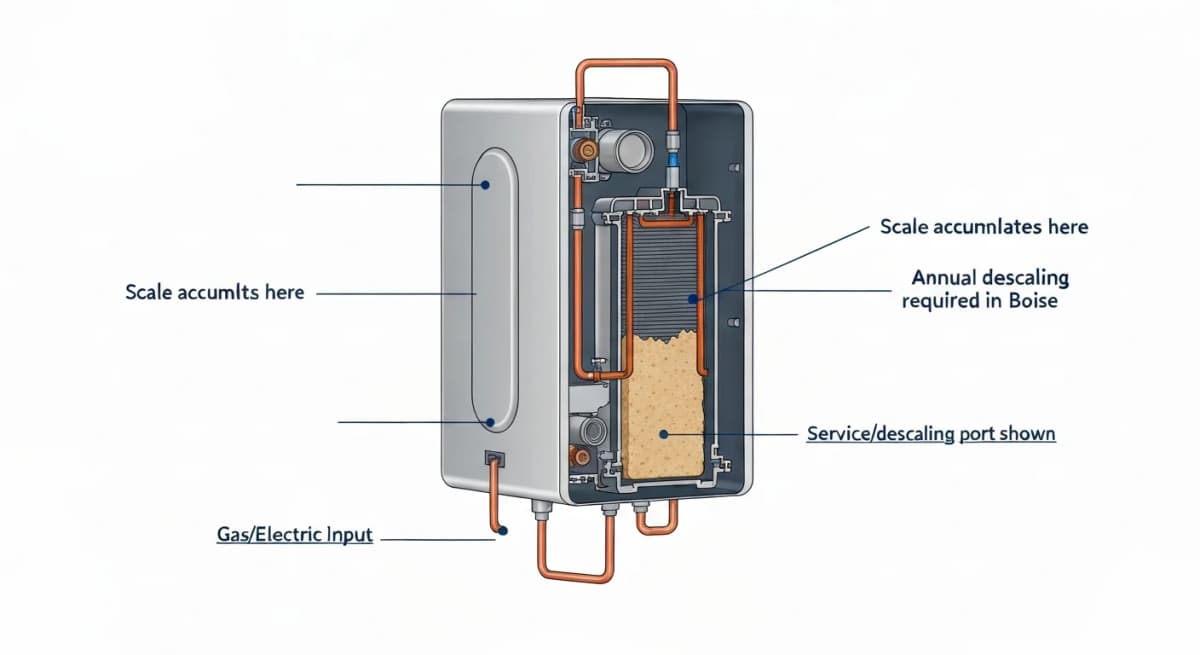
Tankless water heaters scale at a rate proportional to water hardness and water flow volume. Boise's hardness is roughly 2x the U.S. average, so scale accumulation is roughly 2x faster than national norms.
Specific scale-accumulation math:
Boise water hardness: about 6 grains per gallon on average (roughly 108 mg/L calcium carbonate), up to ~13 gpg in well-fed zones — figures that vary by source well, so check the current Consumer Confidence Report for your own service area. USGS classifies water above roughly 7 gpg (120 mg/L) as hard.
Scale deposit rate: Approximately 1 gram of scale per 100 gallons of heated water at Boise hardness levels.
Typical residential hot water use: 60-90 gallons per day for a 2-3 person household, 120-180 for a 4-5 person household.
Annual scale deposit: 220-650 grams per year for typical Boise households. Most of this deposits inside the tankless unit's heat exchanger.
Manufacturer guidance vs. Boise reality:
Standard manufacturer descaling recommendation: Annually for hardness above 11 gpg; biannually below. Boise's well-fed zones fall into the annual zone, and annual descaling is cheap insurance everywhere else in the valley.
Some Boise installers say "every 18 months": Marginal. By 18 months, visible flow reduction and burner-modulation issues often appear. Annual is the right cadence.
Untreated installations: Tankless units that never get descaled in Boise typically fail at 5-8 years (heat exchanger damage). Manufacturers will deny warranty claims for scale-related failures, so the cost falls on the homeowner.
Calibrating maintenance expectations before specifying tankless in a Boise bathroom remodel.
Annual descaling is a recurring service cost. Reasonable for the benefits but not zero-maintenance.
Whole-house water softener installation upstream of the tankless changes the maintenance math significantly. Whether to add one depends on overall household water use and other priorities.
Softener cost and impact:
Whole-house softener installation: $1,500-$4,500 installed for a typical Boise home. Plus $200-$500 annual salt cost.
Impact on tankless maintenance: Reduces descaling frequency from annual to every 5-7 years. Significantly extends heat exchanger life. Total tankless lifespan extends from 12-15 years to 18-25+ years.
Other benefits: Better appliance lifespan (dishwasher, washing machine), softer skin and hair, less soap and detergent needed, easier shower glass cleaning.
Cost-effectiveness analysis:
Just the tankless: Annual descaling cost $200-$400/year for 12-15 years = $2,400-$6,000 over tankless lifespan.
Softener + tankless: Softener $1,500-$4,500 install + $200-$500/year salt for 15+ years = $4,500-$12,000. Less descaling needed but softener itself has maintenance cost.
The softener is rarely cost-effective for tankless protection alone. But for households where softer water is valued for other reasons (skin, hair, appliances, cleaning effort), the tankless protection becomes a bonus benefit. The decision is "do we want softer water broadly?" rather than "does the tankless need a softener?"
Households evaluating broader water-treatment decisions where tankless is one part of the consideration.
Softener adds significant capital and operating cost. Only justified by broader benefits beyond tankless protection.
Annual descaling requires specific plumbing configuration that must be installed at the time of tankless installation. Retrofitting later is expensive.
Required components:
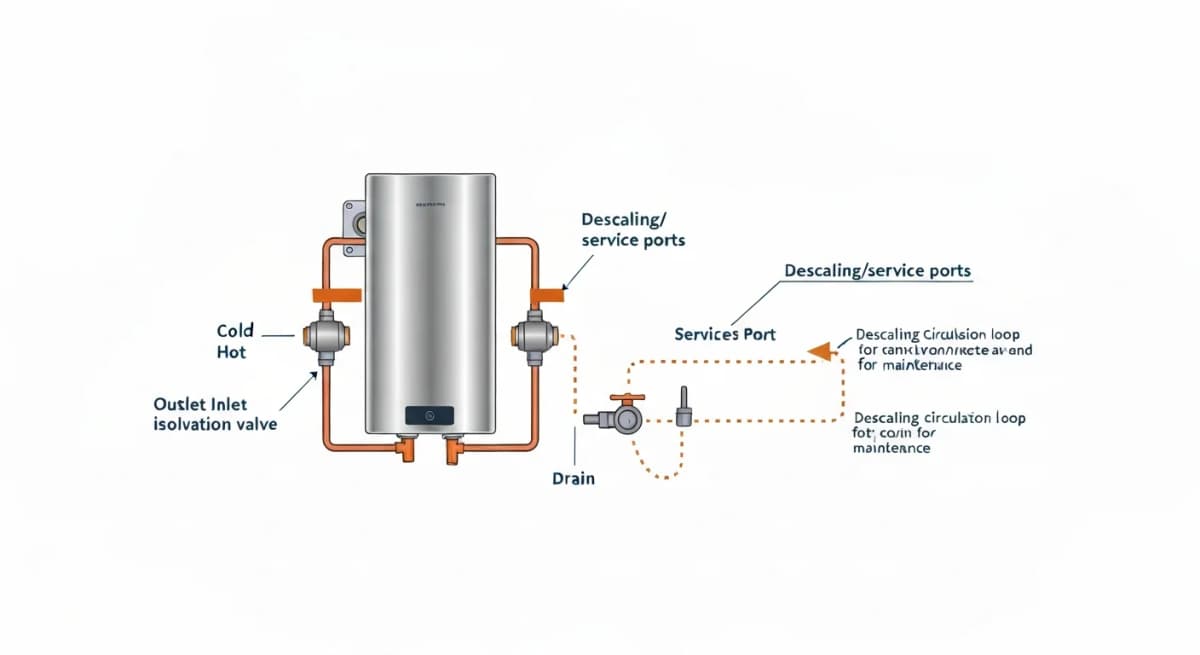
Isolation valves on inlet and outlet: Two ball valves (Watts FBV-3 or equivalent) installed on the cold inlet and hot outlet lines immediately adjacent to the tankless unit. Allow the tankless to be isolated from the rest of the plumbing during descaling.
Service/descaling ports: 3/4-inch threaded ports between the isolation valves and the tankless unit. Allow connection of a descaling pump and reservoir to circulate descaling solution through the heat exchanger.
Drain valves: Built into the isolation valve assembly, allow flushing the system after descaling.
Combined service kit: Many manufacturers (Rinnai, Navien, Rheem) sell complete service valve kits ($150-$300) that include all of the above in a single pre-assembled unit. Specify these.
Installation cost:
With service valves included: $200-$500 additional plumbing labor over standard tankless install.
Without service valves (retrofit later): $400-$900 for retrofit installation. Plus 2-4 hours of plumber time vs. 30-45 minutes for installation at original install.
The 5-minute conversation with your plumber: confirm explicitly that "Boise water hardness requires annual descaling. We need isolation valves and service ports for descaling access. Use the manufacturer's service valve kit." Avoid plumbers who skip these or charge extra after installation discovery.
All Boise tankless installations.
Modest upfront cost premium. Significant savings in long-term maintenance accessibility.
Install tankless with maintenance built in
Tankless water heaters in Boise need specific isolation valves and annual descaling. We specify both as standard on bathroom-remodel tankless installations. Schedule a consultation for your scope.
Annual descaling can be done by a plumber ($150-$300 per visit) or DIY by homeowners with the right equipment ($30-$50 in materials + 2-3 hours of homeowner time).
Standard descaling procedure:
Tools needed: Descaling pump (small submersible pump, $40-$80 retail), 5-gallon bucket, two 3-foot drain hoses with 3/4-inch threaded fittings, food-grade descaling solution (white vinegar OR commercial descaler like CLR or Mag-Erad), gloves and eye protection.
Procedure: Close inlet and outlet isolation valves to isolate the tankless. Connect hoses to service ports — one from pump output to tankless inlet, one from tankless outlet back to the bucket. Fill bucket with 3-4 gallons of descaling solution. Start pump to circulate solution through tankless for 45-60 minutes. Disconnect, drain, flush with clean water through both ports for 5-10 minutes.
Frequency: Annual for Boise installations without softener. Every 5-7 years for softened-water installations.
Signs descaling is overdue: Reduced hot water flow rate, hot water that takes longer to reach desired temperature, burner modulation issues, error codes related to scale buildup.
DIY vs professional:
DIY: One-time equipment investment ($60-$120), then $5-$15 per descaling event for vinegar or descaling solution. Total over 15-year tankless life: ~$200-$300. Plus 2-3 hours of homeowner time annually.
Professional: $150-$300 per descaling event × 15 = $2,250-$4,500 over tankless life.
Most Boise homeowners with basic mechanical comfort can handle DIY descaling. The procedure is straightforward and the savings are significant. For homeowners who prefer not to deal with chemicals or pump equipment, professional service is reasonable but adds $2,000-$4,000 over the tankless lifespan.
Both DIY and professional service decisions for ongoing tankless maintenance.
DIY requires comfort with chemicals and pump operation. Professional service is straightforward but expensive over time.
Tankless isn't right for every Boise bathroom remodel. Several scenarios favor traditional tank water heaters or hybrid heat-pump units.
Scenarios where tank is the better choice:
Small bathroom remodel only, existing tank still has lifespan: Don't replace a 5-year-old tank with a tankless just because you're remodeling the bathroom. Wait for the natural tank replacement cycle (10-15 year lifespan).
Limited gas line capacity: Tankless units need 150,000-200,000 BTU gas input. Older Boise homes may have 3/4-inch gas lines that can't deliver this volume. Upgrade cost: $1,500-$5,000 for gas line modifications.
Electric-only homes without 240V capacity: Electric tankless units need 240V high-amperage circuits (90-120 amps). Many older Boise homes can't support this without panel upgrade. Hybrid heat-pump water heater is often better in this scenario.
Households with simultaneous high-demand use: Tankless flow rate is limited by the unit's BTU capacity. Households with multiple simultaneous hot-water demands (two showers at once, dishwasher plus shower) may not get adequate flow from standard tankless units.
Scenarios where hybrid heat-pump is the better choice:
Houses on the electric side: Hybrid heat pump water heaters are covered by Idaho Power's Heating and Cooling Efficiency Program; Idaho Power does not publish the incentive amount, so confirm it before buying. See our heat pump water heater sequencing article.
Households where indoor air-quality matters: Heat-pump units pull heat from surrounding air; tankless gas units exhaust combustion gases (vented to exterior but sometimes problematic for indoor air quality during transition).
All-electric homes: Electric tankless is energy-intensive and expensive to operate. Hybrid heat-pump is much more efficient (300-400% efficiency vs. 100% for electric resistance).
There is no useful percentage to put on this, because the answer is determined by the house rather than by the market. Tankless is the stronger choice where the home has adequate gas capacity, no simultaneous-use conflict, and a tank already near end-of-life. Tank or hybrid heat pump wins where gas capacity is marginal, where several fixtures run at once, or where the electrical service makes the heat-pump path the cheaper one to feed. Work the list above against your own house rather than against an average.
Cost comparison summary:
Standard tank water heater: $800-$1,500 installed. Lifespan: 10-12 years. Operating cost moderate. Maintenance minimal.
Tankless (gas): $2,500-$5,000 installed. Lifespan: 15-20 years. Operating cost low. Maintenance: annual descaling required in Boise.
Hybrid heat-pump: $2,800-$4,500 installed (before any utility incentive). Lifespan: 12-15 years. Operating cost lowest. Maintenance moderate.
Honest evaluation of whether tankless fits your specific situation rather than defaulting to it.
Decision matrix is more complex than 'always tankless.' Worth doing properly.
Iron Crest's bathroom remodel design includes explicit water heater conversation if the existing unit is approaching end-of-life or if homeowner preferences (endless hot water, freed floor space, indoor air quality, utility rebates) favor reconsideration. We specify isolation valves and descaling ports as standard on all tankless installations and coordinate with Boise plumbers experienced in hard-water tankless service. For broader plumbing context, see our plumbing remodel guide and bathroom remodeling page.
Can I install a tankless myself or does it need a licensed plumber?
Idaho code requires a licensed plumber for permitted water heater installations, including tankless. Beyond code, tankless installation involves gas line connections, venting, and electrical work that benefit from professional installation. DIY descaling after installation is fine; DIY installation is not recommended.
Will my homeowner's insurance care about tankless installation?
Insurance is generally neutral on tankless vs. tank, as long as the installation is permitted and code-compliant. Properly installed tankless units carry less water-damage risk than tanks (smaller water capacity, less flood potential if the unit fails). Document permit and inspection records for your insurance file.
Does tankless qualify for any utility rebates in the Boise area?
On the gas side, yes: Intermountain Gas pays $325 for a .91 UEF tankless water heater in an existing home, provided the household water-heats exclusively with Intermountain Gas natural gas. Idaho Power does not rebate tankless units of any kind — it is an electric utility, and its Heating and Cooling Efficiency Program covers the hybrid heat pump water heater instead. Confirm both before specifying, since program terms change.
Can I add a tankless to my existing tank setup as a booster?
Technically possible but rarely cost-effective. The 'tankless booster' approach uses a small tankless unit downstream of an existing tank to handle high-demand periods. Adds $1,500-$3,500 to cost. Generally simpler to replace the tank entirely with tankless or hybrid heat-pump.
How do I know when my tankless heat exchanger is failing from scale damage?
Warning signs: reduced hot water flow rate even with descaling, water that doesn't reach set temperature, frequent error codes, visible scale exiting the hot water line. By the time these appear, replacement is often the right call rather than further descaling. Tankless heat exchanger replacement (if available for your model) costs $400-$1,200; full unit replacement runs $2,500-$5,000.
Install tankless with maintenance built in
Tankless water heaters in Boise need specific isolation valves and annual descaling. We specify both as standard on bathroom-remodel tankless installations. Schedule a consultation for your scope.
These pages go deeper on the topics linked from this article. Read them before your consultation and you'll come in with sharper questions and a clearer scope.
The following government agencies, industry organizations, and official resources provide additional information relevant to your remodeling project.