
Boise Skylight Pairing for Dark Kitchens: 5 Design Decisions for Winter Light Without Summer Heat
Dark kitchens — north-facing, interior, or single-window — benefit substantially from skylight additions, but Boise's seasonal extremes require specific design decisions to capture winter daylight without summer heat gain.
Quick answer
Modern skylights from reputable manufacturers (Velux, Fakro, Sun-Tek) have warranty-backed weatherproofing and rarely leak when properly installed. Common leak causes: improper flashing during installation, deferred maintenance of seal areas, or damage from severe weather events.
Boise winter daylight is short (9 hours, mid-December) and often filtered through overcast. Kitchens that don't capture natural light during this period rely entirely on artificial illumination — and many Boise kitchens (especially north-facing, interior, or single-window layouts) suffer from chronic dimness. Skylights solve the winter daylight problem effectively.
But Boise summers reach 95-103°F regularly, with peak July afternoons sometimes hotter. South-facing skylights without proper shading create greenhouse-effect kitchens during the most intense summer heat. The design must address both seasonal extremes.
This article covers five decisions for installing skylights in Boise kitchens — orientation, glass specification, shading, sizing, and ventilation — that produce a year-round daylight solution rather than a winter benefit and summer problem.
For broader window replacement and glazing context, see our window replacement guide for Boise. For broader kitchen lighting strategy, see our UV fade mapping in Boise kitchens article for the cabinet finish considerations.
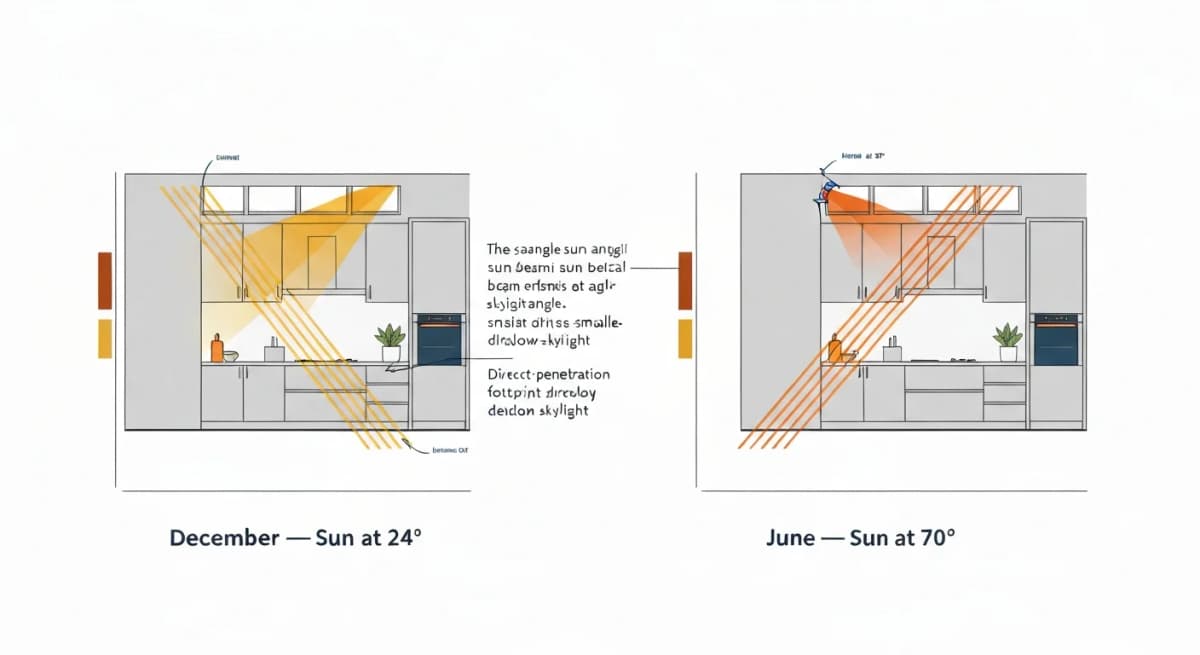
Boise's latitude (43.6°N) means sun angles vary substantially between winter and summer. Skylight orientation determines how much light enters and how much heat comes with it.
Boise sun-angle data:
December solstice (winter low): Solar noon sun is 24° above horizon. The sun is low; it enters skylights at oblique angles and penetrates deep into the room.
June solstice (summer high): Solar noon sun is 70° above horizon. Nearly overhead; light enters skylights almost vertically and penetrates a small area directly below.
Equinox (spring/fall): Solar noon sun is approximately 46° above horizon. Mid-range penetration.
Skylight orientation options:
North-facing skylight: Receives no direct sun. All light is diffuse/indirect (from cloud reflection, atmospheric scattering). Light intensity is steady throughout the day and across seasons. Best for kitchens where consistent daylight matters more than maximum light volume. Lower heat gain.
South-facing skylight: Receives direct sun for most daylight hours. Maximum light volume but maximum heat gain. The decision pivot for Boise: south-facing skylights deliver excellent winter daylight (when heat gain is welcome) but require aggressive shading to manage summer heat (when heat gain is undesirable).
East-facing skylight: Receives direct sun only in morning. Good morning light; cooler afternoons. Reasonable balance for many kitchens.
West-facing skylight: Receives direct sun only in afternoon. Late-day brightness; coordinates with late-afternoon cooking activity. Higher afternoon heat gain than east-facing.
For most Boise kitchens, north-facing or east-facing skylights are the right choice. South and west require more aggressive design (shading, glass spec) to manage heat gain.
The decision is fundamentally about how the kitchen is used:
For dim winter kitchens primarily: South-facing or east-facing maximizes the winter daylight capture. Cabinet finish UV resistance becomes important — see our UV fade article.
For year-round consistent light: North-facing provides steady diffuse light without strong direct sun. Cabinet finishes unrestricted.
Choosing skylight orientation based on actual kitchen use patterns and seasonal priorities.
Each orientation has different daily and seasonal performance.
Modern skylight glass can dramatically reduce summer heat gain while preserving winter daylight transmission. The specific coating system matters significantly.
Glass specifications to compare:
Single-pane skylights (pre-1990 standard, occasionally seen in older Boise homes): No insulation, no coatings. Massive heat gain in summer, heat loss in winter. Never install new; replace existing if found.
Double-pane uncoated: Better than single-pane but still allows substantial UV and infrared (heat) transmission. Acceptable for north-facing skylights with low heat-gain concern.
Double-pane low-E: A thin metallic coating reflects infrared (heat) wavelengths while allowing visible light through. Cuts solar heat gain substantially against uncoated glass; the unit's NFRC label gives the actual solar heat gain coefficient, which is the number to compare. Standard recommendation for most kitchen skylights.
Double-pane low-E + spectrally-selective coating: Premium coating system that allows visible light through but blocks much more infrared. Lower solar heat gain coefficient again than a standard Low-E unit, at similar visible light transmittance — compare the two figures side by side on the NFRC labels. The right specification for south-facing or west-facing skylights in Boise.
Triple-pane low-E with argon fill: Maximum thermal performance. Reduces heat gain and heat loss. Premium cost, premium performance. Worth specifying for premium kitchens or for kitchens in Boise's foothills with substantial elevation.
Solar Heat Gain Coefficient (SHGC) ratings:
SHGC explained: Decimal between 0 and 1 representing fraction of solar energy transmitted through the glass. Lower SHGC = less heat gain. Higher SHGC = more heat gain.
Recommendations by orientation:
South or west-facing skylights: SHGC 0.25 or lower. Significant heat gain reduction.
North or east-facing: SHGC 0.30-0.40. Less critical because direct sun is limited or only morning.
Foothills homes with extreme summer heat: SHGC 0.20 or lower. Aggressive heat-gain protection.
Visible Transmittance (VT):
VT explained: Decimal between 0 and 1 representing fraction of visible light transmitted. Higher VT = more daylight. SHGC and VT can be optimized separately with good coating systems.
Recommendation: VT 0.50 or higher. Maintains substantial daylight transmission while keeping SHGC low.
Cost ranges:
Standard low-E double-pane skylight: $400-$1,200 for the unit, $600-$1,200 install. Total: $1,000-$2,400.
Premium low-E + spectrally-selective: $800-$2,000 for the unit, $600-$1,500 install. Total: $1,400-$3,500.
Triple-pane premium: $1,400-$3,500 for the unit, $800-$1,800 install. Total: $2,200-$5,300.
All Boise skylight installations. The glass spec is the highest-impact design decision.
Premium glass adds cost but reduces summer-cooling burden substantially.
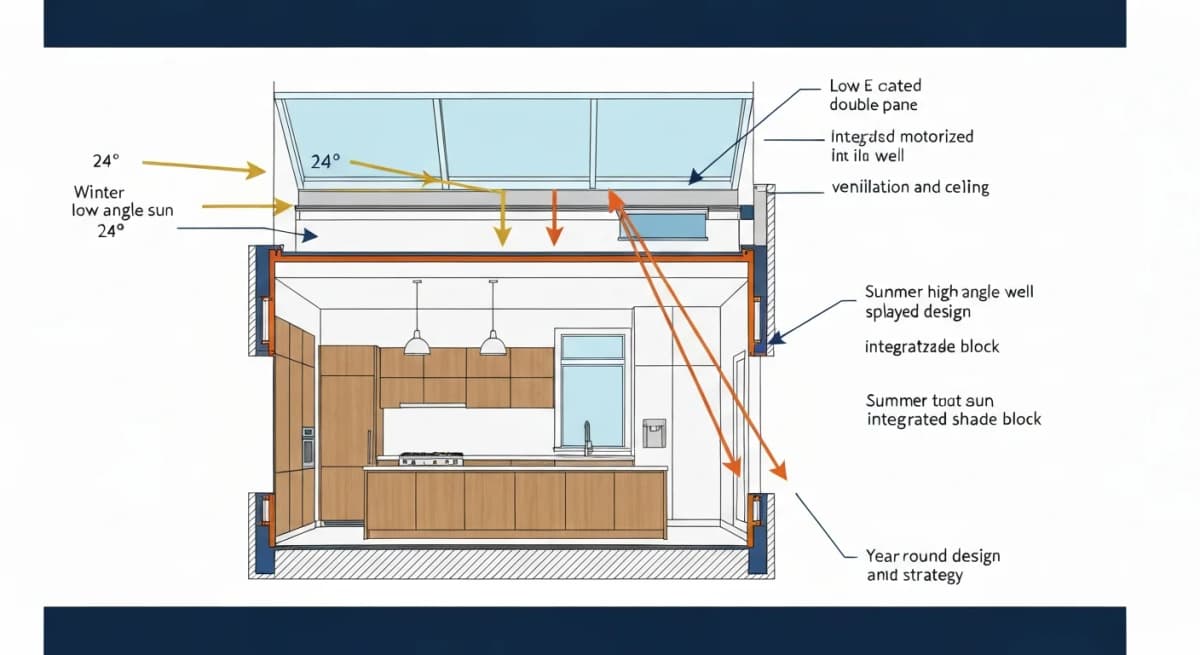
Beyond the glass itself, the architectural skylight well (the recessed opening between roof and ceiling) and any integrated shading affect performance.
Skylight well design:
Straight well (vertical sides): Direct passage from roof to ceiling. Maximum light penetration. Minimum architectural design control over sun angle.
Splayed well (angled sides): Sides angle outward from the roof opening to the ceiling. Creates wider opening at ceiling than at roof. Improves diffuse light penetration. Common in residential applications.
Tunnel well (deeper than wider): A longer pathway from roof to ceiling, used in two-story or deeply-recessed installations. Reduces direct sun penetration; provides indirect diffuse light only.
The architectural well affects sun angle:
Winter low-angle sun (24°): Penetrates wells of all geometries reasonably well. Architectural design doesn't significantly block winter daylight.
Summer high-angle sun (70°): A deeper well or splayed well design partially blocks the highest-angle summer sun. The well's geometry can be designed to selectively pass winter light while reducing summer direct penetration.
Integrated shading:
Internal shades (motorized): Pleated cellular shades, blackout shades, or sheer shades integrated into the skylight well. Manual or motorized control. Effective summer shading.
External shades: Mounted on the exterior over the skylight. Most effective for heat-gain reduction because they stop the sun before it reaches the glass. Architecturally less attractive; more weather-exposed.
Tinted retractable shades: Roll-up shades that retract during winter (allowing maximum daylight) and deploy during summer (blocking heat). Best of both worlds.
Automatic shading (smart-home integrated): Shades that deploy based on temperature, time of day, or sun-angle sensors. Premium but effective, and can be scheduled to deploy during peak-demand cooling periods on Idaho Power's Time-of-Day plan.
Cost ranges:
Standard manual internal shade: $200-$600.
Motorized internal shade: $500-$1,500.
External shade system: $1,200-$3,500.
Smart-home integrated automatic shading: $1,500-$4,500.
Year-round skylight performance optimization beyond just glass selection.
Shading adds cost and may require operating attention. Worth it for south or west-facing installations.
Daylight in the kitchen, year-round
Skylight specification is part of our kitchen remodel design for dim Boise kitchens. We evaluate orientation, glass spec, shading, and ventilation to maximize winter benefit while managing summer heat. Schedule a consultation.
Skylight sizing affects light volume, heat gain, structural impact, and cost. The decision involves trade-offs.
Size options:
Standard residential skylight: 22x46 inches (about 7 square feet of glass). Common, manufactured by major brands (Velux, Fakro). Cost: $400-$1,200 for the unit.
Smaller dome skylight: 16x32 inches (about 3.5 square feet). Less light volume but easier structural installation.
Larger custom skylight: 4 feet by 6 feet or larger. Up to 24 square feet of glass. Premium product, premium price. Substantially more light volume.
Quantity strategies:
Single large skylight: One generous skylight in the center of the kitchen or above the main work area. Concentrated light. Simpler installation.
Two medium skylights: Spaced 4-8 feet apart, providing distributed light across the kitchen. More even illumination, less hot spot from sun. More expensive total install but better visual outcome.
Three or more small skylights: Distributed throughout the kitchen ceiling. Premium aesthetic. Maximum light distribution. Highest install complexity.
Decision factors:
Kitchen size: Small kitchens (under 100 sq ft) often work best with single skylight. Larger kitchens (150+ sq ft) benefit from multiple.
Structural constraints: Roof framing may limit skylight options. Single skylight in an accessible framing bay is sometimes easier than multiple skylights requiring framing modifications.
Budget: Single skylight: $1,000-$3,500 total install. Multiple skylights: $2,500-$8,000+ total.
Aesthetic preference: Some homeowners prefer the bold statement of single large skylight; others prefer distributed light from multiple smaller units.
Boise-specific consideration:
Solar load: Larger skylights = more solar heat gain. For south-facing installations, smaller multiple skylights with aggressive shading sometimes deliver better summer performance than single large skylights.
Insurance/structural: Skylights are weight-bearing structures. Larger skylights require more substantial structural design. Get a structural assessment before specifying very large units.
Right-sizing skylight installation for your specific kitchen and structural constraints.
Larger skylights provide more light but more heat gain and structural complexity.
Operable skylights (skylights that can open) provide ventilation in addition to daylight. They're more expensive than fixed skylights but deliver functional value, especially in kitchens where steam, smoke, and cooking odors need removal.
Operable skylight options:
Manual operable: Hand-cranked or pole-operated. Cheapest. Functional for users who can physically reach and operate.
Electric operable: Motorized open/close. Operated by wall switch or remote. Cost premium: $300-$800 over manual. Convenient for high or hard-to-reach skylights.
Solar-powered operable: Self-contained solar panel powers the motor. No electrical wiring required. Cost premium: $200-$500 over electric.
Automatic rain sensor: Skylight automatically closes when rain is detected. Important for any operable skylight; standard on premium units. Cost: typically included with electric/solar-powered units.
Kitchen-specific ventilation benefits:
Cooking steam removal: Boiling water, simmering pots, and other moisture-generating cooking produces substantial humidity. Operable skylight provides high-point ventilation that effectively removes humidity.
Smoke removal: Searing, grilling, or other high-heat cooking produces smoke. Operable skylight removes smoke directly. Critical for cooking-intensive households.
Stack effect ventilation: In summer, opening the skylight at night creates an upward draft that pulls cooler outside air into the kitchen through other openings. Effective cooling strategy without AC.
Coordination with range hood: A range hood vented through the skylight area can deliver enhanced ventilation. Discuss with HVAC contractor.
Operable vs fixed cost comparison:
Fixed skylight installation: $400-$1,500 for unit, $600-$1,200 install.
Manual operable: $600-$1,800 for unit, $800-$1,500 install.
Electric operable: $900-$2,500 for unit, $1,000-$2,000 install (includes electrical).
Solar-powered operable: $1,100-$2,800 for unit, $800-$1,500 install (no electrical).
For kitchen-focused skylights with active cooking, operable is typically worth the premium. For purely daylight-focused skylights in less-cooking-intensive kitchens, fixed is acceptable and cheaper.
Kitchens where cooking-related ventilation and ambient cooling matter.
Operable skylights cost more but provide functional ventilation that fixed skylights can't match.
Iron Crest's kitchen design includes skylight assessment for any kitchen where daylight inadequacy is a concern. We evaluate the existing kitchen's solar exposure profile, structural framing, and budget constraints, then specify skylight orientation, glass spec, sizing, and operable vs fixed accordingly. Typical Boise kitchen skylight scope runs $2,500-$8,500 depending on configuration. For broader window context including the interaction between window glazing and cabinet finishes, see our window replacement guide.
Do skylights leak over time in Boise?
Modern skylights from reputable manufacturers (Velux, Fakro, Sun-Tek) have warranty-backed weatherproofing and rarely leak when properly installed. Common leak causes: improper flashing during installation, deferred maintenance of seal areas, or damage from severe weather events. Lifespan of well-installed modern skylights: 25-40 years before any service typically needed. Annual visual inspection (look for water stains, check sealant condition) catches issues early.
Will a skylight increase my heating costs in winter?
Modest increase. Double-pane low-E skylights have U-factors around 0.50-0.60 (vs about 0.30 for good windows and roughly 0.05 for insulated walls). Heat loss through skylight is higher per square foot than walls. For a typical 22x46 inch skylight in Boise winter: $30-$80 in additional annual heating costs. Offset by reduced winter daytime lighting electricity ($20-$50) and improved mental-health benefits of natural light during dark winter months. Net economic impact: roughly neutral; quality-of-life benefit significant.
What's the difference between a skylight and a sun tunnel?
Skylights are flat glazed openings in the roof that allow direct daylight. Sun tunnels (also called solar tubes) are smaller diameter tubes with reflective interiors that pipe sunlight from roof to ceiling. Sun tunnels are cheaper ($300-$800 vs $1,000-$3,500 for skylights), require less structural modification, and have minimal heat-gain or heat-loss concerns. Trade-off: significantly less light volume than skylights. For kitchens needing meaningful daylight improvement, skylights are typically the right call.
Can I install a skylight in a two-story Boise home where the kitchen is downstairs?
Difficult and rare. The skylight would need to pierce the second floor in addition to the roof, with a tunnel well connecting the two floors. Structural complexity and cost (typically $5,000-$15,000+) usually make this impractical. Alternative for downstairs kitchens in two-story homes: emphasize wall windows, increase artificial lighting, consider light-tube alternatives. Or add a skylight to a single-story portion of the home (mudroom, attached garage area) if applicable.
Will my homeowner's insurance change with a skylight?
Generally no impact on rates. Skylights are standard residential features that don't significantly affect underwriting. Some insurers may want skylight installation disclosed as a building modification; check with your agent. The roof leak risk slightly increases with any roof penetration, but well-installed modern skylights have minimal impact on overall roof leak risk.
Daylight in the kitchen, year-round
Skylight specification is part of our kitchen remodel design for dim Boise kitchens. We evaluate orientation, glass spec, shading, and ventilation to maximize winter benefit while managing summer heat. Schedule a consultation.
These pages go deeper on the topics linked from this article. Read them before your consultation and you'll come in with sharper questions and a clearer scope.
The following government agencies, industry organizations, and official resources provide additional information relevant to your remodeling project.