
Recent-Buyer Bathroom Sequence for Boise Homes: 5 Fix-First Decisions in Year One
Recent Boise homebuyers face decisions about bathroom investments in the first year of ownership. Five priorities for what to fix immediately vs cosmetic upgrades that should wait until you understand the home better.
Quick answer
Mostly no. Standard pre-purchase home inspections are general assessments — they identify obvious issues but don't deep-dive into bathroom-specific concerns. They typically don't include moisture meter testing of wall framing, GFCI compliance audits, exhaust performance testing, or plumbing pressure checks.
The first year in a newly purchased home is when many homeowners make their biggest mistakes — and biggest correct calls. Pre-purchase inspections cover surface conditions; living in the home reveals problems that no inspection catches. For bathroom-specific decisions, the right sequencing is to address hidden problems before cosmetic upgrades that would mask the warning signs.
This article covers five priorities for recent Boise homebuyers in the first year of ownership, distinguishing fix-immediately items from items that should wait until you've lived with the home long enough to understand it.
For broader pre-remodel home assessment, see our pre-remodel home inspection checklist. For the broader first-time remodel context, see our first-time home remodel guide.
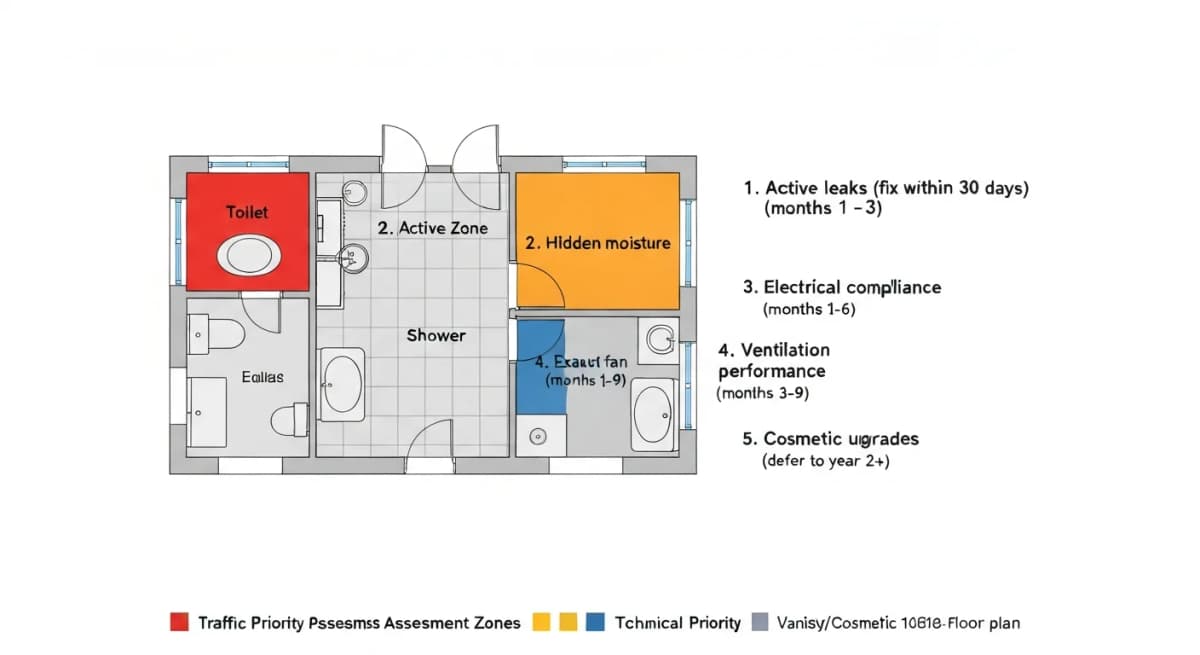
Active water leaks waste money and cause progressive damage. They should be the first priority regardless of remodel plans.
Common leak sources in newly-purchased Boise homes:
Running toilets: Flapper valve failures, fill valve failures, or chain misalignment. Symptoms: water heard running between flushes, visible water moving in the bowl. Cost to fix: $15-$60 in parts, 30-60 minutes DIY or $100-$200 plumber service call.
Faucet drips: Worn washers or cartridge failures. Symptoms: visible dripping, water marks in the sink. Cost to fix: $20-$100 for parts, DIY or $100-$200 plumber.
Supply line leaks: Cracked or corroded supply lines under sinks. Symptoms: water under sink, moisture stains in cabinet floor. Cost to fix: $20-$50 for parts, DIY or $150-$300 plumber.
Toilet tank leaks: Tank-to-bowl gasket failures, tank cracks (rare). Symptoms: water on floor behind toilet, hairline cracks visible in porcelain. Cost to fix: $30-$100 for parts, $200-$500 plumber if tank replacement needed.
Boise water cost considerations:
Typical Boise water rates: $5-$12 per 1,000 gallons depending on use volume. A running toilet wastes 200-300 gallons per day = $30-$90 per month. Over a year of unfixed running, $360-$1,080 wasted plus the carbon impact.
Detection methods: Listen for running water after toilets stop flushing. Look for water moving in toilet bowls when not in use. Check water meter — if it's moving with no water use in the home, there's a leak.
Fix-in-month-one priority. Don't defer.
Every new Boise homeowner. Active leaks should be addressed regardless of remodel timing.
None significant — leak fixes are essentially always net-positive.
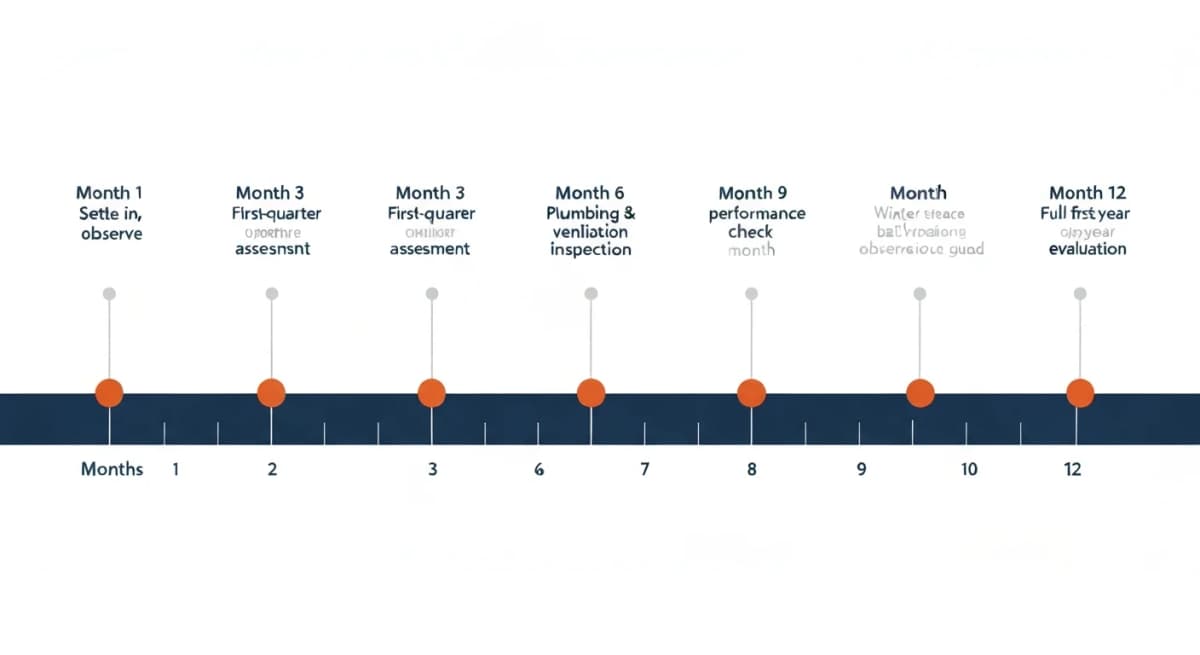
The home inspection covered visible moisture. Living in the home reveals hidden moisture issues — leaks behind walls, slow plumbing failures, vapor barrier issues. The first 1-3 months of ownership is when these become observable.
Investigation methods:
Visual inspection after each shower use: Walk through the home checking for moisture penetration. Look at the wall on the opposite side of the shower (often a hallway), the ceiling below an upstairs shower, the baseboards near the bathroom.
Smell test: Mold and active moisture have distinctive smells. Walk through the bathroom and adjacent rooms after a shower — note any musty or earthy smells that don't dissipate.
Cabinet base inspection: Open all bathroom cabinets and inspect the cabinet floors and walls for water staining, soft spots, or visible mold.
Floor inspection: Walk the floor in front of the toilet, around the tub, and in front of the shower. Look for soft spots indicating subfloor damage.
Common Boise-area issues:
Pre-2005 shower vapor barrier failures: See our 1990s vapor barrier article. If the home is 1990-2005 era and the shower hasn't been remodeled since, vapor barrier failure is likely.
Galvanized supply line corrosion: See our galvanized supply line article. Pre-1965 homes commonly have this issue.
Tile grout failure: Older tile installations have failed grout that allows moisture penetration. Visible signs: discolored grout, missing grout sections, soft tile areas.
When investigation reveals issues:
Address before cosmetic remodel. If you redecorate over a leaking shower, you waste the redecorating investment when the leak forces tear-out. Investigation cost: $200-$500 for professional assessment. Worth it before any bathroom remodel scope.
Recent Boise homebuyers in homes built before 2005, or any home where the bathroom hasn't been remodeled recently.
Some homes are clean — investigation reveals nothing. The cost is modest but not zero.
Modern electrical code requires GFCI (ground fault circuit interrupter) protection for bathroom receptacles. Many pre-2020 Boise bathrooms don't have full GFCI compliance. Fix during the first year — both for safety and to avoid surprises during future remodel scope.
GFCI requirements (current 2023 NEC):
All bathroom receptacles: Must be GFCI-protected. Either GFCI-type outlets at each receptacle or GFCI-breaker protection at the panel.
Outlets within 6 feet of any sink: Must be GFCI.
Common pre-2020 Boise homes:
1990s homes: Bathroom receptacles often had GFCI but not always at the locations modern code requires. Verify with circuit tester.
1980s and earlier: GFCI was less consistent. Some receptacles had it, some didn't.
1970s and earlier: Often no GFCI at all in bathrooms. Receptacles also may be ungrounded (2-prong outlets).
How to test:
Plug-in circuit tester ($10-$30): Inserts into receptacle, lights indicate ground continuity and GFCI presence. Cheap and reliable.
Plumber/electrician inspection: Have an electrician verify GFCI compliance during any service call. Typical cost: $0 added (typically included in any service visit) to $100-$200 for a dedicated inspection.
Remediation:
Add GFCI outlet at each non-compliant location: $30-$60 per outlet for materials, $100-$200 per outlet for electrician install. Total bathroom GFCI compliance: $200-$600.
GFCI breaker at the panel: $40-$100 for the breaker, $100-$200 install. Single-point GFCI protection for an entire circuit.
Why fix during first year: GFCI protection prevents electrical injuries. It's also required by most insurance policies for full coverage. And it must be in place before any remodel scope inspections.
Pre-2020 Boise bathrooms that may not have full current-code GFCI compliance.
Modest cost for electrical work. Some homeowners delay until remodel scope, but that's exposure.
First year in your Boise home — assessed, prioritized
Iron Crest offers first-year homeowner bathroom assessments to identify priority issues and plan future remodel scope. Schedule a consultation for your home.
Bathroom exhaust ventilation that's inadequate or non-functional causes long-term mold and moisture problems. Most homeowners don't realize their fans are underperforming until the issues develop.
Symptoms of inadequate exhaust:
Persistent moisture on bathroom surfaces: Walls or ceiling still feel damp 30 minutes after shower. Mirror remains foggy.
Mold growth around shower: Visible mold spots on grout, caulk, or upper bathroom surfaces. Often appears within a few months in inadequately-vented bathrooms.
Paint or wallpaper degradation: Peeling, bubbling, or staining near the shower.
Adjacent room moisture damage: If exhaust ducts to attic instead of exterior, attic moisture damage above the bathroom.
Testing exhaust performance:
Toilet paper test: Hold a piece of toilet paper to the running exhaust fan grille. If it sticks securely, the fan has adequate suction. If it falls or sticks weakly, the fan is underperforming or the duct is blocked.
Tissue or smoke pencil test: Same principle as toilet paper but with finer indicator. Smoke pencils ($10-$20) provide clearer indication of airflow.
Common Boise issues:
Fan ducting to attic instead of exterior: Common in pre-2000 construction. Code violation but rarely fixed during ownership transfers. Moisture accumulates in attic, causing rot.
Inadequate fan CFM: Older bathrooms often have 50 CFM fans which are inadequate for modern moisture loads. Modern code is 80-110 CFM for typical residential.
Fan motor failure: Fans run but don't move adequate air. Common in fans 10+ years old.
Remediation options:
Fan replacement with quiet premium unit: $300-$800 for fan plus install. Solves the noise problem and the CFM problem simultaneously.
Re-routing duct to exterior: If ducting goes to attic, re-routing to exterior wall or roof typically $300-$800. Eliminates attic moisture problem.
Add humidity-sensing automatic control: Replaces simple on-off switch with humidity sensor that activates fan when shower-generated humidity rises. Cost: $80-$150 for the control plus $80-$150 install.
The combined ventilation upgrade ($400-$1,500) is one of the highest-ROI bathroom investments. Prevents mold remediation costs ($1,000-$5,000) that compound annually.
Any Boise bathroom showing moisture-related issues.
Modest cost relative to mold remediation it prevents.
The most common new-homeowner mistake: jumping into cosmetic upgrades before understanding the home's actual condition. Five reasons to defer cosmetic upgrades to year 2 or later:
1. Underlying problems become visible during the first year of use. Vapor barrier failures, plumbing issues, electrical inadequacies — all become observable over time. Cosmetic upgrades made in month 6 may need to be torn out in month 18 when underlying problems emerge.
2. Use patterns reveal what you actually need. Living in the home for 6-12 months shows you which fixtures are inadequate, which storage is insufficient, which layout doesn't work. Cosmetic upgrades made before this reveal lock in suboptimal decisions.
3. Personal preferences clarify with experience. The aesthetic you wanted at move-in may not be the aesthetic you want at year 2. Most homeowners' bathroom taste evolves as they spend time in the space.
4. Boise housing market timing. If you're in a Boise neighborhood where you might sell within 3-5 years, the bathroom investment timing matters. Some upgrades pay back better when made closer to listing date.
5. Budget priorities clarify with ownership experience. Year 1 reveals the home's actual maintenance needs — HVAC issues, foundation concerns, exterior repairs. Budget priorities shift. The "amazing bathroom" plan may yield to "fix the failing roof" reality.
What cosmetic upgrades to defer:
New tile installation: Wait until you know the underlying conditions are good and the layout is optimal.
Vanity replacement (if functional): Wait until you've used the vanity for 6-12 months to understand storage and ergonomic needs.
Paint color and decor: Easy to do quickly but premature. Wait until the bathroom layout is finalized through any structural upgrades.
Fixture replacements (faucets, lighting): Unless the existing fixtures are non-functional, defer until you have a full bathroom remodel plan to coordinate the scope.
Exceptions where cosmetic upgrades make sense early:
Cleaning and maintenance that improves function: Re-caulk shower joints, regrout failing grout, clean mineral scale from fixtures. These are maintenance, not cosmetic upgrades.
Simple paint: If the bathroom has visible damage from previous owners' paint, repainting is easy and improves daily experience without locking in larger decisions.
Plumbing fixture replacements with functional benefit: Replacing a low-flow showerhead with a higher-flow one (or vice versa) for the household's preference. Or upgrading to WaterSense-certified fixtures for water cost savings.
The first-year mantra: investigate and fix structural and mechanical issues; defer cosmetic decisions until you understand the home better.
Recent Boise homebuyers tempted by quick cosmetic wins before fully understanding their new home.
Delayed gratification. Some homeowners prefer immediate aesthetic improvement.
Iron Crest's consultation process for recent Boise homebuyers includes an explicit "what to fix first" discussion. We do a 1-2 hour home walk-through assessing the structural, mechanical, and electrical priorities before any cosmetic remodel scope conversation. The assessment is typically $200-$400 and produces a documented priority list for the homeowner's first-year budget planning. For broader first-time remodel context, see our first-time home remodel guide.
Did my pre-purchase inspection cover all the bathroom issues?
Mostly no. Standard pre-purchase home inspections are general assessments — they identify obvious issues but don't deep-dive into bathroom-specific concerns. They typically don't include moisture meter testing of wall framing, GFCI compliance audits, exhaust performance testing, or plumbing pressure checks. Plan on a more thorough bathroom-specific assessment in the first 90 days.
Should I budget for major bathroom work in the first year?
Maybe. Budget for $1,500-$5,000 in priority repairs (items 1-4 from this article) for typical Boise homes built before 2010. Major bathroom remodels ($25-$45k+) should wait until year 2-3 unless specific scope-driving issues are discovered. Track first-year discovery findings before committing to remodel scope.
Can I do bathroom work during my first month while still moving in?
Possible but stressful. Priority 1 (leaks) and parts of Priority 3 (GFCI) can happen during move-in without significant disruption. Full bathroom remodels during move-in are bad coordination — you don't yet know the home well enough to make good design decisions, and the construction adds to the already-disruptive move period.
What if I plan to sell within 2-3 years of buying?
Different priority framework. For short-ownership periods, focus on items that maintain home value (priority 1-4 from this article) and be cautious about cosmetic upgrades chosen purely to taste, since you won't have long to enjoy them and you can't count on recovering them at sale. We deliberately don't quote a return percentage for a bathroom remodel — there's no sourced Ada County figure for it — but the general shape holds: the longer you'll live with the room, the easier the spend is to justify.
How do I know when to stop investigating and start planning the remodel?
Three signals. (1) First-year observation has revealed all issues you'd notice through normal use. (2) Repair work for priorities 1-4 is complete. (3) Your understanding of the home's layout, storage needs, and use patterns is clear. For most Boise homebuyers, this point arrives at 12-18 months of ownership.
First year in your Boise home — assessed, prioritized
Iron Crest offers first-year homeowner bathroom assessments to identify priority issues and plan future remodel scope. Schedule a consultation for your home.
These pages go deeper on the topics linked from this article. Read them before your consultation and you'll come in with sharper questions and a clearer scope.
The following government agencies, industry organizations, and official resources provide additional information relevant to your remodeling project.