
Boise Kitchen Refrigerator Recess Depth: 4 Cabinet Decisions When 'Counter-Depth' Isn't Actually Flush
Counter-depth refrigerators don't actually sit flush with counters. The 1.5-2 inch overhang affects cabinet design, side panel selection, and kitchen aesthetics. Four cabinet decisions for accommodating refrigerators in Boise kitchen remodels.
Quick answer
Yes, easily. Counter-depth refrigerator fits in any standard refrigerator alcove — there's just more space behind it. Some homeowners use the extra space for a small shelf or storage. Visual impact: the refrigerator looks recessed rather than overhanging.
Counter-depth refrigerators are marketed as sitting flush with kitchen counters. The marketing is misleading: most counter-depth refrigerators overhang the standard 25.5-inch base cabinet depth by 1.5-2 inches, including doors and handles. The result is a refrigerator that protrudes visibly from the cabinet line — minor on its own but problematic when paired with traditional cabinet face-frame construction or when the fridge is at the end of a cabinet run.
This article covers four cabinet design decisions for accommodating modern counter-depth refrigerators in Boise kitchen remodels, with the dimensional reality and design responses for each.
For broader cabinet specification context, see our cabinet options guide. For kitchen layout planning generally, see our kitchen layout planning guide.
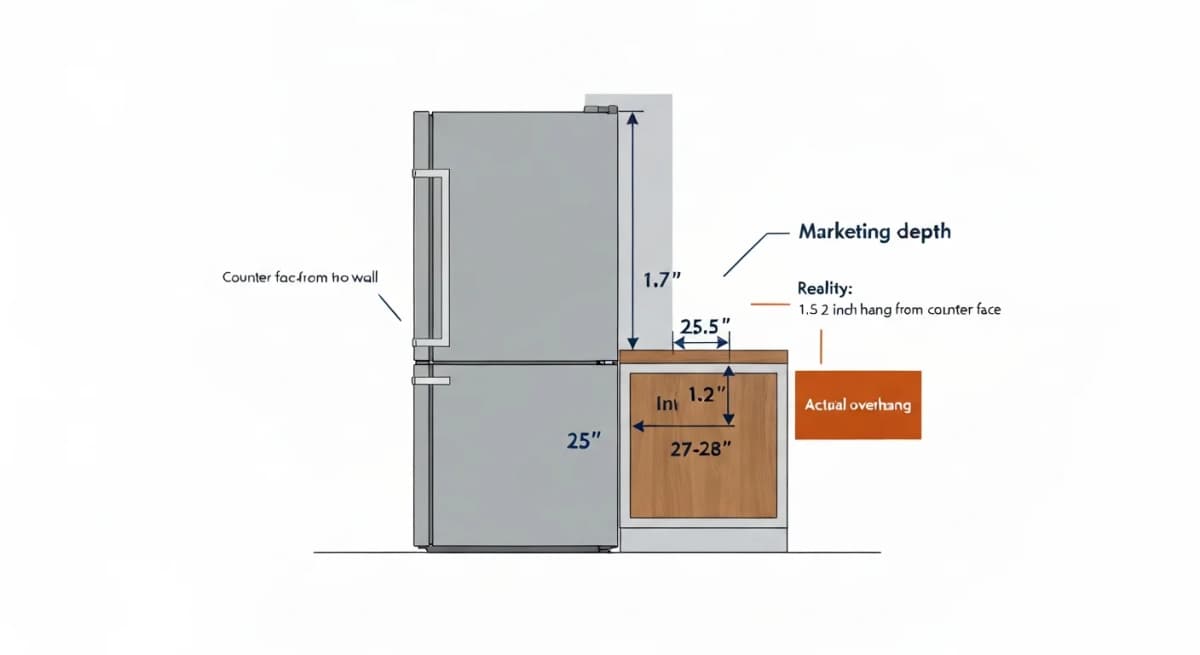
'Counter-depth' is a marketing term, not a strict dimensional specification. Different manufacturers define it differently, and even within a single manufacturer's line, the actual dimensions vary by model.
What 'counter-depth' typically means:
Refrigerator body depth (excluding doors): 24-25 inches. Designed to fit within standard 25.5-inch base cabinet depth.
With doors closed: 27-28 inches total. The doors themselves are 1-2 inches deep, plus 0.5-1 inch for door hinges and offset from the body.
With handles: 28-30 inches total. External handles add 1-2 inches.
Standard full-depth refrigerator (for comparison): 30-34 inches total depth. The 'counter-depth' designation is meaningful — it's significantly shallower than full-depth — just not actually counter-depth.
The visual effect:
Counter-depth refrigerator door and handles project 1.5-2 inches beyond the counter face. When the fridge is between cabinets, this overhang is visually obvious. When the fridge is at the end of a cabinet run, the projection is even more pronounced because there's no adjacent cabinet to provide visual reference.
Brand-by-brand variation:
Sub-Zero, Thermador, Miele (premium European brands): 24-inch body depth, 27-inch total. The cleanest 'counter-depth' performance.
Bosch, Liebherr, Fisher Paykel (premium upper-mid): 24-25 inch body, 28-inch total. Slight overhang.
KitchenAid, GE Cafe, Whirlpool (mid-tier counter-depth): 25-inch body, 29-30 inch total. Noticeable overhang.
Budget counter-depth (mass-market): 26-inch body, 30-32 inch total. Significant overhang. Borderline misuse of the 'counter-depth' marketing.
Understanding the actual depth of your chosen refrigerator before designing the cabinet around it.
Premium brands have less overhang but cost significantly more.
If the refrigerator is between two cabinets or at the end of a run, the side panel design determines how visible the overhang is.
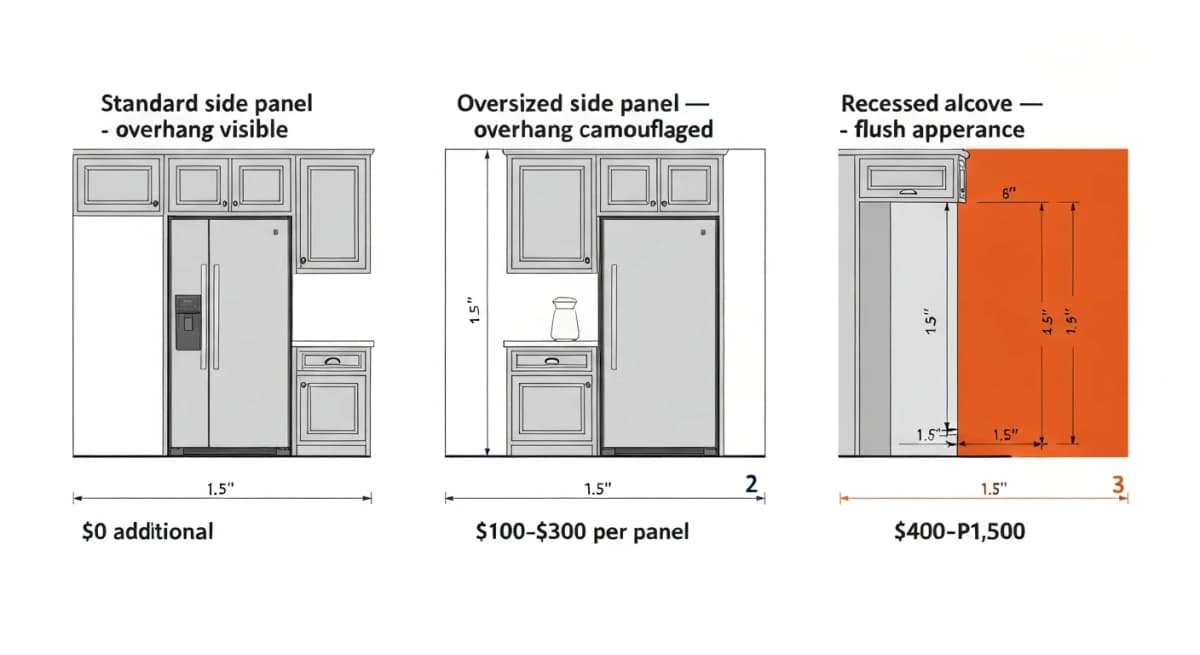
Three side panel approaches:
Standard side panel (overhang accepted): Cabinet side panel matches standard cabinet depth. Refrigerator overhang is visible — typically 1.5-2 inches beyond the cabinet side. Cost: $0 additional (standard cabinet construction).
Oversized side panel: Cabinet side panel built to match refrigerator depth. Side panel extends 1.5-2 inches beyond standard cabinet depth, hiding the refrigerator overhang behind it. Cost: $100-$300 per side panel for custom cabinet construction.
Recessed alcove: The cabinet enclosure recesses into the wall by 1.5-2 inches. Refrigerator sits flush with the cabinet face. Cost: $400-$1,500 depending on wall complexity. Most expensive but achieves true flush appearance.
Which approach is right:
For premium counter-depth refrigerators (Sub-Zero, Thermador): Overhang is minimal. Standard side panels are fine. The 1.5-inch overhang reads as intentional rather than awkward.
For mid-tier counter-depth refrigerators: Overhang is moderate. Oversized side panels typically the right choice. Modest cost premium for substantial aesthetic improvement.
For premium kitchens regardless of refrigerator tier: Recessed alcove if budget supports and wall structure permits. The flush appearance reads as premium.
For budget counter-depth refrigerators: Often the overhang is bad enough that recessed alcove is worth the cost. Or consider switching to a different refrigerator with better counter-depth specifications.
Cabinet design decisions when the refrigerator is between cabinets or at the end of a run.
Oversized side panels and recessed alcoves cost more than standard.
Kitchen design that accommodates your actual refrigerator
Refrigerator dimensional planning is part of our kitchen design phase. We confirm specific model dimensions before cabinet order to prevent overhang surprises. Schedule a consultation for your kitchen scope.
Modern refrigerators require water line and electrical connections that aren't immediately obvious. Cabinet design must accommodate these without compromising flush installation.
Water line considerations:
Standard residential water line: 1/4-inch copper or plastic supply line. Connects to a dedicated in-line shut-off valve (not a saddle valve, which Idaho's plumbing code prohibits).
Cabinet clearance required: Water line needs vertical clearance behind the refrigerator (typically 3-4 inches between refrigerator back and wall) to make the connection without kinking.
For recessed alcove designs: The recessed wall space must accommodate the water line connection point and any shutoff valves. Plan ahead during framing.
Electrical considerations:
Standard residential outlet: Dedicated 120V outlet for refrigerator. Some smart refrigerators require additional outlets (filtered ice maker, water dispenser controls).
Cabinet clearance required: Outlet must be reachable when refrigerator is in place. Typical placement: 2-3 feet above floor on the wall behind the refrigerator.
Recessed alcove placement: Outlet often placed in the recess back wall, allowing flush refrigerator placement without sacrificing access.
Ventilation considerations:
Compressor heat rejection: Refrigerator compressor produces 200-400 watts of heat that must dissipate from the back of the unit. Inadequate ventilation reduces compressor lifespan.
Manufacturer ventilation specs: Most counter-depth refrigerators need 1-2 inches of clearance on the sides, 1 inch at the top, and 0.5-1 inch at the back for adequate ventilation.
Boise climate consideration: Boise's dry climate is helpful — high humidity environments stress refrigerators more. But hot summer kitchen temperatures (which can reach 85°F in some Boise kitchens without adequate AC) increase compressor load. Plan for ventilation accordingly.
Coordination requirements:
The water, electrical, and ventilation specifications all interact with cabinet design. Discuss with your contractor and electrician during the design phase, before cabinets are ordered. Last-minute discovery of inadequate clearance triggers expensive cabinet modification or rework.
Design-phase coordination with the cabinet, electrical, and plumbing scopes.
Adds complexity to the design coordination but prevents post-install discoveries.
For homeowners wanting true flush refrigerator integration with custom-panel doors that match the cabinetry, the choice expands beyond just counter-depth to fully integrated refrigerators.
Integrated refrigerator characteristics:
Body depth: 24 inches, designed for true flush installation with standard 25.5-inch base cabinets.
Cabinet-style doors: No exterior visible refrigerator door. Cabinet panels match the surrounding cabinetry, with handles or recessed pulls matching the cabinet style.
Heat rejection: Top-mounted or front-mounted heat exhaust (vs back-mounted on standard refrigerators) accommodates the flush installation.
Cost: $4,500-$15,000 for the refrigerator. $400-$1,500 for the cabinet panel fabrication. Significantly more expensive than counter-depth.
Counter-depth characteristics:
Body depth: 24-25 inches with 1.5-2 inch door overhang.
Visible refrigerator design: Standard stainless steel, black, or smart-fridge doors visible.
Cost: $1,800-$4,500 for counter-depth refrigerators across tiers.
When integrated is worth the premium:
Premium kitchens with consistent cabinet aesthetic priority: Visible refrigerator disrupts the cabinet pattern. Integrated refrigerator becomes invisible. Right choice for upscale Boise kitchens with $90k+ total scope.
Compact kitchens where the refrigerator is visually prominent: Open-concept kitchens with the refrigerator visible from the living area. Integrated refrigerator removes the visual interruption.
European-style kitchens: Integrated refrigerators are common in European cabinet design. If you're going for European aesthetic, integrated is essentially mandatory.
When counter-depth is sufficient:
Mid-budget kitchens ($50-$80k total scope): Counter-depth with thoughtful side panel design achieves clean appearance. Integrated premium isn't justified.
Galley or U-shaped kitchens: Refrigerator is at one end of the run rather than visually prominent. Counter-depth with standard side panel is fine.
Households with strong preference for visible refrigerator design: Some homeowners like the stainless steel refrigerator aesthetic. Counter-depth preserves this option.
The premium math for integrated:
$4,500-$15,000 integrated refrigerator + $400-$1,500 panel fabrication = $4,900-$16,500 total. Vs $2,500-$4,500 for premium counter-depth refrigerator. Premium for integrated: $2,400-$12,000.
For most Boise kitchens, the integrated premium isn't justified. In the upper tier of scopes — where the cabinetry is custom and every reveal is being drawn rather than assembled from stock — the integrated option is the right choice.
Making the integrated-vs-counter-depth decision during refrigerator selection.
Significant cost premium for integrated. Some users prefer the visible refrigerator aesthetic regardless.
Iron Crest's kitchen design includes explicit refrigerator-dimension discussion early in the design phase. We confirm specific model dimensions before finalizing cabinet drawings to avoid the 'standard counter-depth assumption' that leads to overhang surprises. For broader cabinet specification, see our cabinet options guide; for kitchen layout integration, see our kitchen layout planning guide.
Can I retrofit a counter-depth refrigerator into a kitchen designed for full-depth?
Yes, easily. Counter-depth refrigerator fits in any standard refrigerator alcove — there's just more space behind it. Some homeowners use the extra space for a small shelf or storage. Visual impact: the refrigerator looks recessed rather than overhanging.
What if my refrigerator alcove is non-standard depth?
Older Boise kitchens often have non-standard alcove depths from previous renovations. Measure your existing alcove and match the refrigerator specifications. Custom cabinet work may be needed for very non-standard dimensions.
Do French-door and counter-depth refrigerators have the same overhang?
Similar overhang. French-door configurations don't significantly affect total depth — the door split is left-right rather than front-back. Some French-door models have slightly thinner doors due to the smaller door size, reducing overhang by 0.25-0.5 inches.
Will the side panel approach affect refrigerator ventilation?
Possibly. Oversized side panels and recessed alcoves can restrict ventilation if not designed correctly. Manufacturer specs require 1-2 inch side clearance for compressor cooling. Discuss with your cabinet maker and refer to your specific refrigerator's installation specifications.
How long does typical refrigerator dimensional planning take during a remodel?
Specific refrigerator selection should happen during design phase (4-6 weeks before construction). Cabinet drawings reflect actual refrigerator dimensions. If selection happens late (after cabinet order), refrigerator dimensional surprises trigger cabinet modification at $400-$1,500 cost.
Kitchen design that accommodates your actual refrigerator
Refrigerator dimensional planning is part of our kitchen design phase. We confirm specific model dimensions before cabinet order to prevent overhang surprises. Schedule a consultation for your kitchen scope.
These pages go deeper on the topics linked from this article. Read them before your consultation and you'll come in with sharper questions and a clearer scope.
The following government agencies, industry organizations, and official resources provide additional information relevant to your remodeling project.