
Boise Airbnb Shower Glass: 5 Specifications That Survive 200+ Cleanings a Year
Standard residential shower glass specifications assume household cleaning cycles, not 200+ wipe-downs per year with industrial-grade cleaners. Five specifications that determine whether your Boise STR shower glass survives 5 years or needs replacement at 18 months.
Quick answer
Wipe-down at every turnover (60-110 times per year). Deep-clean (mineral descaling, hardware inspection, sealant condition check) quarterly. The quarterly deep-clean takes 30-45 minutes and includes: applying mineral descaler to glass surfaces, soft-brush cleaning of frame crevices (if framed), inspecting all hardware for corrosion or loose connections, checking all sealant joints for separation or mold, and replacing the shower-floor mat or other accessories.
A typical residential shower glass enclosure sees maybe 50-80 wipe-down cleanings per year. A Boise short-term rental shower sees 200-400+ cleanings annually — every turnover cleaning at 60-110 turnovers per year, often supplemented by mid-stay glass touch-ups. Add Boise's hard water (up to ~13 gpg in well-fed zones) and the typical STR cleaner toolkit (bleach-based products, ammonia cleaners, abrasive sponges used for speed), and you get glass failure modes that don't appear in residential installations.
The result for STR operators: shower glass that looks acceptable at 6 months, visibly degraded at 18 months, and effectively scrap at 36 months. Replacement cost is $1,800-$4,500 per shower — and the listing has to be off-market during replacement.
This article covers five specifications that meaningfully extend shower glass life in Boise STR installations. The specifications add modest upfront cost ($300-$1,200 above standard residential spec) and produce 4-7+ year glass lifespan with the cleaning frequency STR units actually see.
For broader STR remodel framework — long-term vs short-term rental design priorities, capital budget allocation, and material durability — see our rental property remodel guide for Boise. For STR kitchen design specifically, see our Airbnb kitchen speed layout article. For shower glass scope including doors and enclosures, see our shower glass doors page.
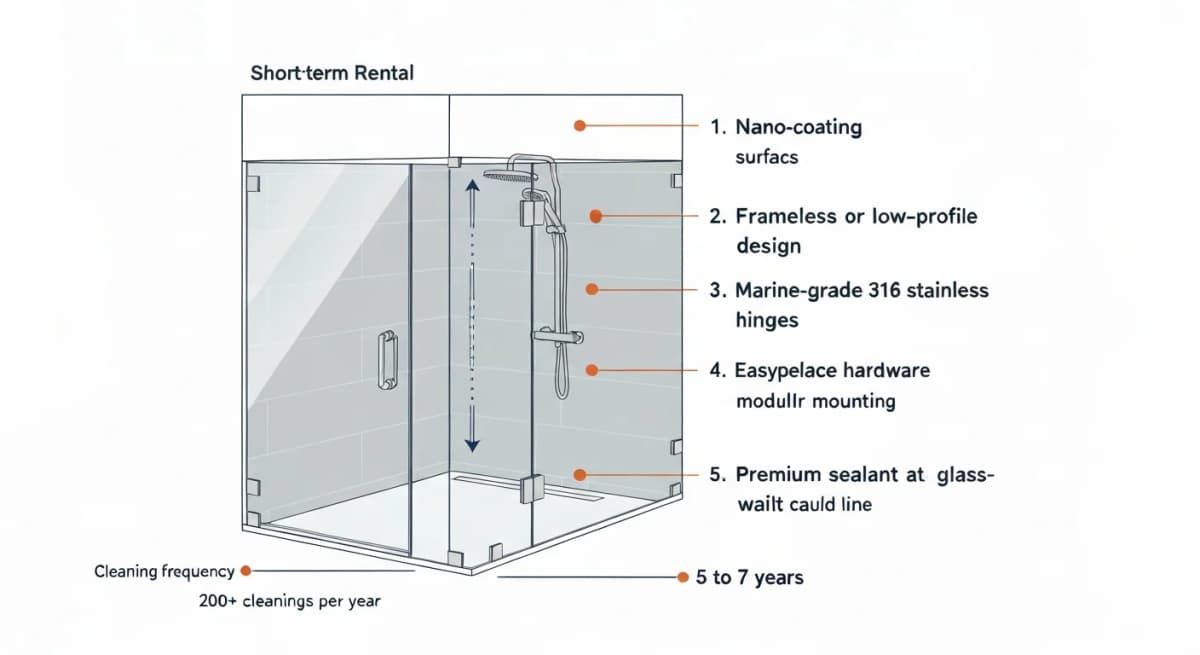
Understanding the actual cleaning load helps justify the specification premiums in subsequent items.
Typical Boise STR cleaning math:
Annual turnovers per unit: 60-110 depending on occupancy and average stay length.
Shower cleanings per turnover: 1 full cleaning per turnover, plus typically 1 mid-stay touch-up. Effective: 2 cleanings per turnover average.
Annual shower cleanings: 120-220 per unit. Some high-occupancy units exceed 250 cleanings annually.
Cleaning chemistry typically used:
Bleach-based products (e.g., Clorox Bathroom Cleaner): Effective for mold and mildew but corrosive to many metal finishes over time. STR cleaners use these because they sanitize quickly.
Ammonia cleaners (e.g., Windex): Common for glass cleaning. Corrosive to some metal finishes and can damage nano-coatings.
Abrasive sponges/pads: Used for speed even when not appropriate. Scratches some coated surfaces, etches some glass surfaces.
Citrus-based descalers (e.g., CLR): Used for hard-water mineral removal. Strong acidic action; can damage some sealants and trim if applied broadly.
Cumulative wear pattern:
Standard residential shower glass under STR cleaning load: Visible mineral etching at 6-12 months; visible coating degradation at 12-18 months; hardware corrosion at 18-24 months; visible "tired" appearance at 24-36 months. Replacement typically needed at 36-48 months.
STR-optimized shower glass: Same conditions — visible signs at 36-48 months, replacement at 60-84 months.
Economics of the spec premium:
Standard residential spec: $1,800-$3,200 installed for a typical Boise STR shower enclosure. Replacement at 36 months. Lifetime cost: $1,800-$3,200 per 36 months.
STR-optimized spec: $2,500-$4,500 installed. Replacement at 72 months. Lifetime cost: $2,500-$4,500 per 72 months = roughly half the per-month cost.
For STR operators, the upgrade pays for itself in the second cycle. The first installation costs more; the next replacement is delayed long enough that the total ownership cost drops substantially.
STR operators making capital decisions about shower glass spec at remodel or replacement time.
Higher upfront cost. Some operators prefer to defer the premium and replace standard glass more frequently.
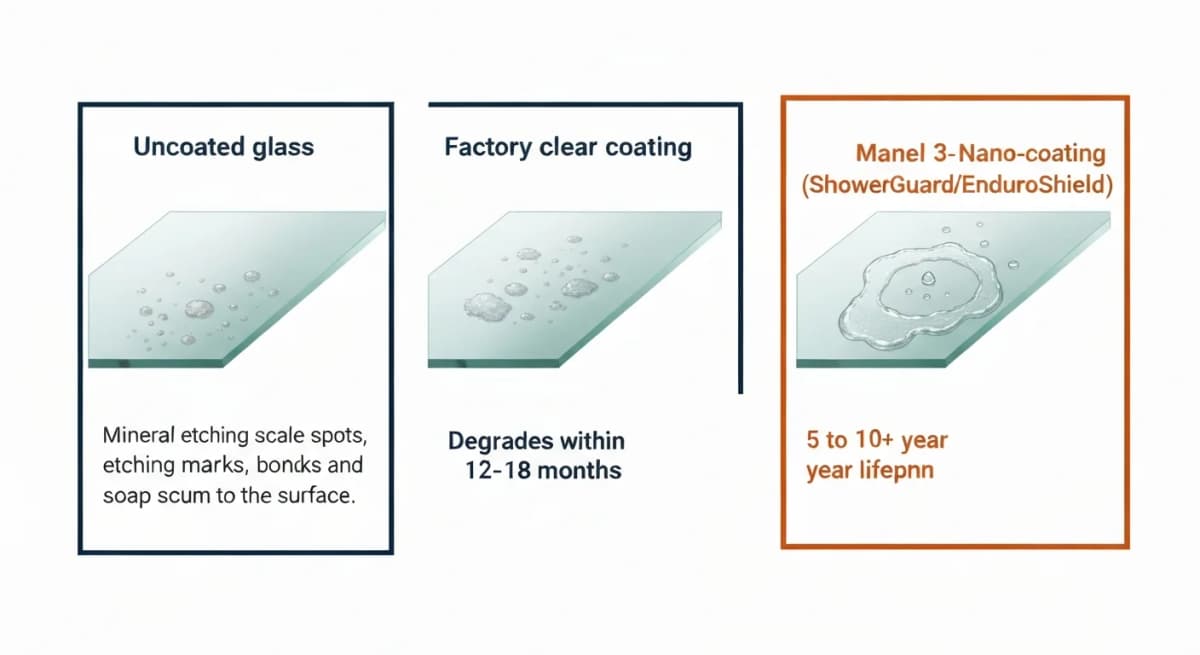
Glass coating is the single highest-impact specification for STR shower glass longevity. Standard uncoated glass develops visible mineral etching from hard water within months in STR-cleaning-frequency installations.
Coating options:
Uncoated glass (standard): Bare tempered glass. Susceptible to mineral etching, soap scum bonding, and progressive cleaning damage. Inappropriate for STR applications.
Factory clear coating (some manufacturers): A thin polymer coating applied at manufacture. Provides some protection but degrades quickly under STR cleaning load.
ShowerGuard (Guardian Glass): Permanent factory-applied glass treatment. Creates a hydrophobic surface that resists mineral binding and reduces soap-scum adhesion. Lifespan: 5-10+ years in STR applications. Cost premium: $150-$400 per glass panel.
EnduroShield: Post-installation glass treatment. Similar performance to ShowerGuard but applied after manufacture. Reapplication required every 5-8 years. Cost: $80-$250 per glass panel for application; lifetime cost similar to ShowerGuard over 10+ years.
Diamon-Fusion or similar professional treatments: Premium nano-coating systems applied during fabrication. Highest performance tier. Cost premium: $200-$500 per glass panel.
Why coating matters specifically for STR:
Cleaning-product compatibility: Nano-coatings are compatible with the bleach and ammonia cleaners STR housekeepers use. Standard cleaning routines don't damage the coating.
Hard-water resistance: The hydrophobic surface causes water to bead and roll off rather than evaporating and leaving mineral deposits. Mineral scale doesn't bind to the surface, so the post-cleaning appearance is consistently good.
Quick-cleaning compatibility: Even when housekeepers don't follow ideal cleaning protocols (incomplete rinse, wrong product, abrasive sponge), nano-coated glass shows better results than uncoated. The coating's forgiving nature is valuable in STR-cleaner-pool contexts.
Visual consistency: The shower glass looks consistently clean across hundreds of cleaning cycles. Important for STR listing photos and guest perception of cleanliness.
Specification approach:
Factory ShowerGuard or equivalent: The recommended spec for new STR shower glass. Specify at fabrication.
Post-install EnduroShield application: If the glass is already installed without factory coating, EnduroShield can be applied retroactively. Modest cost, significant lifespan extension.
DIY products (water-repellent sprays): Available at hardware stores. Provide marginal benefit but degrade within months. Inadequate for STR applications. Don't substitute for professional coating.
All Boise STR shower glass installations. The coating premium pays back in extended lifespan and consistently better appearance.
Adds $80-$500 per glass panel depending on coating system. ROI is favorable but upfront cost is real.
Glass enclosure framing style affects both cleaning efficiency and long-term durability. Heavy-framed enclosures create cleaning friction; frameless or low-profile framed enclosures support faster turnover.
Enclosure styles:
Frameless glass: No vertical or horizontal frames around the glass panels. Hardware (hinges, handles) directly attached to glass. Visual: modern, premium, clean lines. STR appeal: best — no frame crevices to clean, fewer surfaces to wipe down. Cost: $2,500-$6,500 per enclosure.
Semi-frameless (single horizontal track at top): Glass panels supported by a top track and hinged door. Less heavy than fully-framed but still has framing. STR appeal: good — modest improvement over fully-framed. Cost: $1,800-$3,800 per enclosure.
Low-profile framed (thin aluminum framing around door only): Door has thin frame; fixed panels are frameless. Compromise between full frameless and fully framed. STR appeal: good — fewer crevices than fully framed. Cost: $1,500-$3,000 per enclosure.
Fully framed (aluminum frame around all glass): Traditional approach. Aluminum framing around the perimeter of every glass panel. STR appeal: poor — multiple horizontal and vertical frame surfaces with crevices that accumulate soap scum and mold. Cost: $800-$1,800 per enclosure.
Why frameless or low-profile is better for STR:
Cleaning time reduction: No frame crevices to clean. Cleaner can wipe the glass in single passes. Saves 3-5 minutes per turnover cleaning. Over 80 turnovers, that's 4-7 hours of recovered cleaner time per year.
Mold prevention: Frame crevices retain moisture and accumulate soap scum, creating mold-growth substrate. Frameless enclosures don't have these moisture-retention points.
Aesthetic appeal: Frameless enclosures photograph better for listings. The "open" feel is consistent with premium STR positioning.
Durability: Aluminum frames in framed enclosures corrode under bleach-based cleaning over time. Frameless enclosures don't have this failure point.
The recommendation for STR-optimized spec:
For premium STR units ($200+ ADR): Frameless glass. The aesthetic premium supports the listing pricing and the cleaning-efficiency benefits compound over operating life.
For mid-tier STR units ($120-$200 ADR): Semi-frameless or low-profile framed. Good balance of cost and cleaning efficiency.
For budget STR units (under $120 ADR): Low-profile framed minimum. Avoid fully-framed enclosures even at the budget tier — the cleaning-time cost outweighs the upfront savings.
STR operators choosing between frame styles at the design phase.
Frameless costs significantly more than fully-framed. Mid-tier framed options balance cost and cleaning efficiency.
STR shower glass that survives the cleaning cycle
STR-optimized shower glass specification adds $400-$1,200 upfront and produces 4-7+ years of consistent appearance vs 18-36 months for standard residential spec. Schedule a consultation for your Boise STR shower scope.
Shower glass hardware (hinges, handles, clamps, brackets) corrodes faster in STR applications than in residential ones. The specific stainless steel grade matters more than most STR operators realize.
Stainless steel grades:
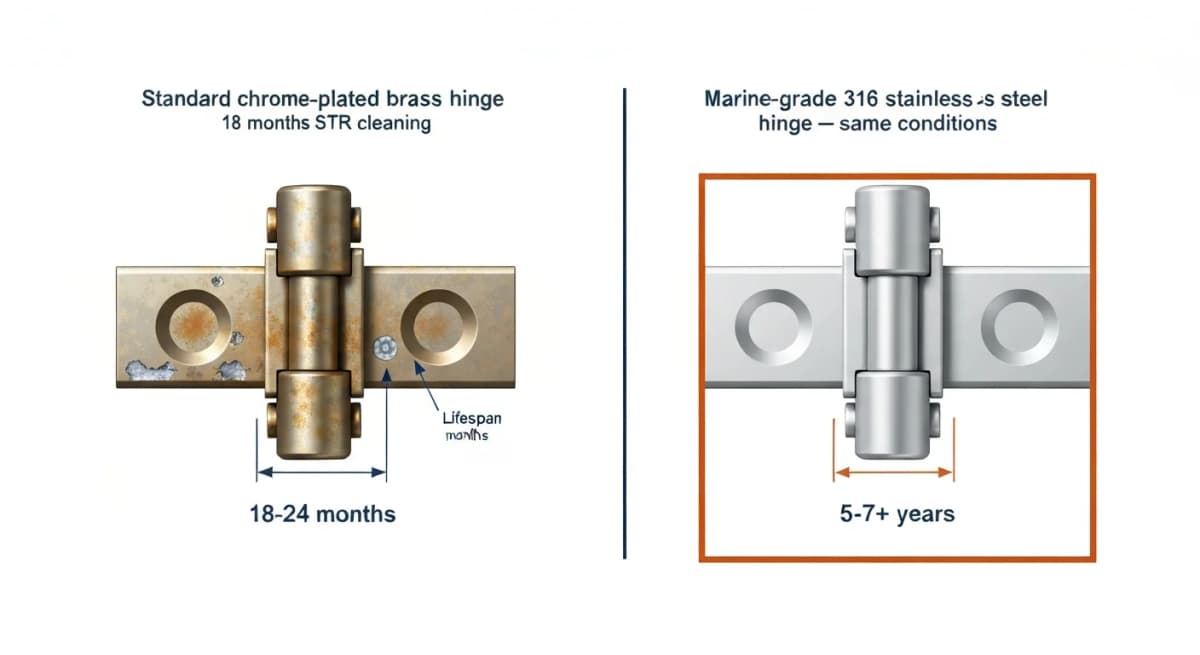
304 Stainless Steel: Standard residential grade. 18% chromium, 8% nickel. Corrosion resistant in normal household conditions. Lifespan in STR applications: 18-30 months before visible corrosion.
316 Stainless Steel (marine grade): Includes 2% molybdenum in addition to chromium and nickel. Significantly more corrosion-resistant in chloride environments (bleach, salt water, marine air). Lifespan in STR applications: 5-7+ years with same cleaning load.
Brass with chrome plating: Traditional residential. Chrome plating wears off under aggressive cleaning, exposing brass to corrosion. Lifespan in STR applications: 12-24 months.
PVD (Physical Vapor Deposition) coated finishes: A premium finish technology applied over stainless steel base. Resistant to scratching and corrosion. Used by premium glass-hardware manufacturers (CRL, Aquatica, Brizo). Lifespan extension over standard stainless: 1.5-2x.
Why 316 stainless matters for STR:
Bleach exposure: Bleach contains chloride compounds that attack standard stainless steel. 316 stainless's molybdenum content resists chloride attack significantly better.
Hard-water mineral exposure: Hard-water minerals can accelerate corrosion at hardware-glass interfaces. 316 stainless tolerates this better than 304.
Cleaning-product variability: STR cleaners may not use the right product on the right surface. 316 stainless is forgiving of cleaning-product mistakes.
Specification approach:
Premium STR units: Specify 316 marine-grade stainless steel hardware throughout. Cost premium: $200-$600 per shower enclosure above standard 304 stainless.
Mid-tier STR units: 304 stainless with PVD coating. Better than 304 alone, less expensive than 316.
Avoid: Chrome-plated brass and budget no-name hardware. Lifespan is too short for the STR application even at lower upfront cost.
Specific brands to consider:
CR Laurence (CRL): Industry leader for premium shower glass hardware. Marine-grade options available across product lines.
Hansgrohe: Premium European glass hardware. Excellent quality, premium pricing.
Brizo: US-based premium glass hardware brand. Strong PVD finish options.
Avoid: Budget no-name brands found in DIY retail. Lifespan is short, replacement parts difficult to source.
STR installations where the hardware is exposed to aggressive cleaning over many years.
Premium hardware adds $200-$600 to enclosure cost. ROI from extended lifespan and reduced replacement burden.
Even with premium specifications, shower glass hardware eventually needs service or replacement. STR operators benefit substantially from systems that support easy field replacement of individual components.
Easy-replace considerations:
Modular hinge systems: Some hinge brands (CRL Pinnacle, Cardinal Shower Enclosures) use modular hinge designs where individual pivots can be replaced without removing the entire glass panel. STR field maintenance is much faster.
Standard mounting hole patterns: Hardware that uses industry-standard mounting hole patterns can be replaced by other manufacturers' hardware if specific parts are unavailable. Avoid proprietary mounting patterns that lock you to one brand.
Replacement parts availability: Some glass hardware manufacturers maintain parts inventory for 20+ years; others discontinue products and leave installations without replacement options. Verify before specifying.
Documented hardware specifications: Keep records of every hardware specification in the installation — hinge model numbers, handle styles, clamp types, finishes. Saves significant time when service is needed years later.
STR-specific maintenance program:
Annual hardware inspection: Visual inspection of all hinges, handles, clamps. Look for corrosion, loose pivots, water-spot accumulation. Annual inspection catches issues before they require full replacement.
Quarterly cleaning audit: Verify housekeepers are using appropriate cleaning products. STR housekeeper turnover is high; new housekeepers may not know the specific cleaning protocols.
Maintenance schedule: Replace seals/gaskets every 3-4 years (cost: $50-$150). Replace hinge pins every 5-7 years (cost: $40-$120). Re-apply nano-coating every 5-7 years if non-permanent coating is used (cost: $80-$250).
Insurance and liability considerations:
Glass breakage coverage: Tempered shower glass is designed to break into small fragments rather than large shards. Breakage is rare but should be covered by STR property insurance. Verify your policy.
Guest injury liability: Door hinges failing under guest weight, or glass falling from improper installation, create liability exposure. Premium installation with proper hardware specification reduces this risk.
Vendor documentation: Save all installation paperwork, hardware specifications, and contractor warranties. Useful for insurance claims if breakage or failure occurs.
The lifecycle math for STR shower glass:
Standard residential spec: $1,800-$3,200 installed. Average lifespan in STR: 36 months. Service over lifespan: minor; replacement is the dominant cost.
STR-optimized spec: $2,500-$4,500 installed. Average lifespan in STR: 60-84 months. Service over lifespan: $150-$400 in seals/hinge replacements. Total cost roughly half of standard-spec lifetime cost.
The premium spec is rarely the right choice for owner-occupied homes. For STR units, it's almost always the right choice.
Long-term STR operators planning capital improvements over 10+ year ownership horizons.
Maintenance program requires ongoing operator attention. Field maintenance still requires occasional vendor visits.
Iron Crest's STR shower glass scope includes the five specifications covered in this article as standard for any STR installation we design. We coordinate with Boise glass fabricators (CRL distributors locally) to specify ShowerGuard-coated tempered glass, 316 marine-grade stainless hardware, frameless or low-profile framed configurations, and easy-replace hinge systems. The cost premium above residential-standard glass typically runs $400-$1,200 per shower enclosure — significant but worth it for STR operators serving multiple units over decade-plus horizons.
For broader STR-specific design including kitchen, durability finishes, and capital budget planning, see our Airbnb kitchen speed layout article and rental property remodel guide.
How often should an STR shower glass be deep-cleaned vs. just wiped down?
Wipe-down at every turnover (60-110 times per year). Deep-clean (mineral descaling, hardware inspection, sealant condition check) quarterly. The quarterly deep-clean takes 30-45 minutes and includes: applying mineral descaler to glass surfaces, soft-brush cleaning of frame crevices (if framed), inspecting all hardware for corrosion or loose connections, checking all sealant joints for separation or mold, and replacing the shower-floor mat or other accessories. Quarterly schedule keeps glass looking new-condition and catches issues early.
Can I retrofit a nano-coating to existing STR shower glass?
Yes. EnduroShield is the most common retrofit-applicable product. Application process: clean glass thoroughly (remove all soap scum and mineral deposits), apply EnduroShield with provided applicator, allow to cure for 24-48 hours. Cost: $80-$250 per glass panel for DIY application; $200-$500 if professionally applied. Lifespan after retrofit: 5-8 years. The retrofit extends glass life significantly compared to uncoated continued use. Worth doing if existing glass is in otherwise-acceptable condition but suffering from cleaning load.
What's the right balance between cleaning frequency and cleaner instruction for STR shower glass?
Document cleaning protocols and train cleaners explicitly. STR cleaning crews vary in skill and consistency. The right approach: laminated cleaning protocol card in the supply closet showing approved products (ShowerGuard-compatible cleaners), prohibited products (abrasive sponges, certain acidic cleaners), and the proper cleaning sequence. Periodic spot-checks during turnovers verify protocol adherence. Premium STR operators typically replace housekeepers who don't follow protocols rather than tolerating ongoing damage to capital improvements. The math: a non-compliant housekeeper might cost you 2-3 years of glass life. Replace the housekeeper before replacing the glass.
Should STR operators expect to replace shower glass over the ownership period?
Yes, eventually. Even premium-spec STR shower glass has a useful lifespan of 5-7 years before mineral scale, coating degradation, or hardware wear requires renewal. Plan capital reserves accordingly: a typical 8-unit STR portfolio should budget $4,500-$8,000 per shower for replacement every 5-7 years. The annual reserve: roughly $400-$1,200 per unit per year. Smaller than HVAC or appliance reserves but real. Some operators pre-buy glass replacements in batches for cost savings — fabricators often discount 10-15% on multi-unit orders.
Does premium shower glass affect listing photos and guest reviews?
Yes, both. Listing photos: frameless and well-maintained glass photographs significantly better than framed enclosures with visible soap scum or hardware corrosion. Premium spec supports premium listing positioning. Guest reviews: glass condition is a frequent specific mention in reviews. Reviews mentioning 'looked old' or 'soap scum on the shower' directly cite glass condition. Reviews of premium-spec STR units rarely mention glass quality (which is what you want — glass should disappear into the overall impression of cleanliness). For operators tracking review-driven booking impact, glass quality contributes measurably to the cumulative review trend.
STR shower glass that survives the cleaning cycle
STR-optimized shower glass specification adds $400-$1,200 upfront and produces 4-7+ years of consistent appearance vs 18-36 months for standard residential spec. Schedule a consultation for your Boise STR shower scope.
These pages go deeper on the topics linked from this article. Read them before your consultation and you'll come in with sharper questions and a clearer scope.
The following government agencies, industry organizations, and official resources provide additional information relevant to your remodeling project.