
Boise Airbnb Bathrooms: 9 Materials and Design Choices That Survive 200 Guests a Year
Short-term rental bathrooms see 100-200+ guest cycles per year — five to ten times the wear of a long-term rental. Standard residential materials don't keep up. Here are the 9 spec choices that produce a Boise STR bathroom photographing well at year 5.
Quick answer
Typical premium runs 15-30% above equivalent residential spec, depending on which specific upgrades are included. The largest cost drivers: epoxy grout vs cementitious ($150-$300 premium), PEI 4-5 porcelain floor tile vs PEI 2-3 ($400-$1,200 premium for a 60 sq ft floor), quartz vanity top vs cultured marble ($500-$1,200 premium), factory-coated shower glass vs uncoated ($200-$400 premium), and skirted one-piece toilet vs basic two-piece ($300-$500 premium).
The Treasure Valley short-term rental market — Bogus Basin ski-season weekends, downtown Boise game-day rentals, summer river-trip stays, fall Idaho-wine tours — drives a specific bathroom-remodel demand that isn't well-served by standard residential design. Long-term rental properties (annual leases) see 1-2 tenant turnovers per year. Short-term rentals see 100-200+ guest cycles per year. The wear math is dramatically different, and the materials that work in long-term rentals fail visibly in short-term properties within a few years.
STR bathrooms across Boise — North End rental conversions, foothills vacation homes, downtown game-day units — follow a consistent pattern: spec the materials for guest-cycle durability rather than long-term-residence ergonomics, and the bathroom photographs well at year 5 and serves the rental income through year 10. Spec it the way you'd spec a personal home and the bathroom needs cosmetic refresh by year 3 and major refresh by year 6. Below are the 9 spec decisions that consistently produce the longer-lifespan result for Boise STR operators.
For broader rental property remodeling context (long-term landlord scope, ROI calculations across the home), see our rental property remodel guide which targets long-term-lease landlords. This page is specifically about short-term rentals — Airbnb, Vrbo, vacation rental properties — where the guest-cycle frequency creates fundamentally different durability requirements.
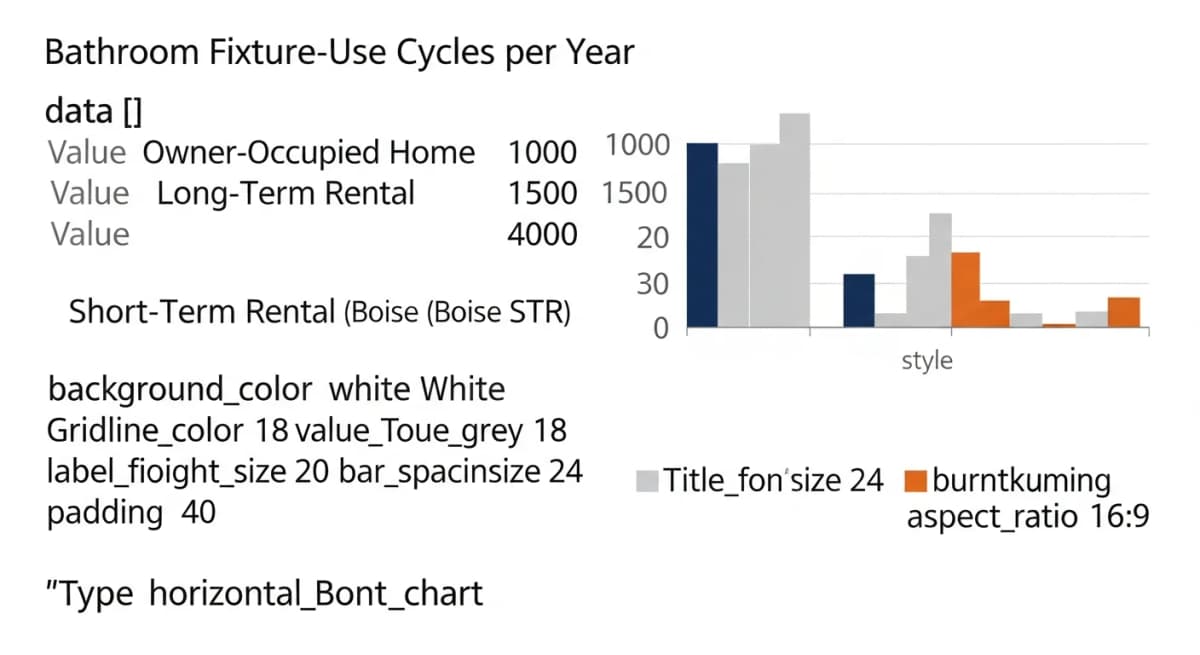
An owner-occupied Boise master bathroom typically sees 1,000-1,500 fixture-use cycles per year (1-3 people × 2-4 uses per fixture per day × 365 days). A long-term rental property has similar numbers — slightly higher if the household is larger but in the same order of magnitude. A short-term rental bathroom sees fundamentally different numbers because of the guest density.
Run the arithmetic on your own booking calendar rather than on a market average — we have no sourced Treasure Valley occupancy figure and won't invent one. The shape of it: take your booked nights for the year, divide by your average stay length to get guest groups, multiply by party size, and multiply again by the number of times a person uses a toilet, faucet, or shower valve in a day. Even a conservative pass through that math lands in the thousands of fixture cycles a year. A family home puts one or two adults through the same fixture on a predictable schedule; a short-term rental puts strangers through it at a rate no residential fixture was specified for, and prime-location units in the downtown and Bogus Basin corridors run harder still.
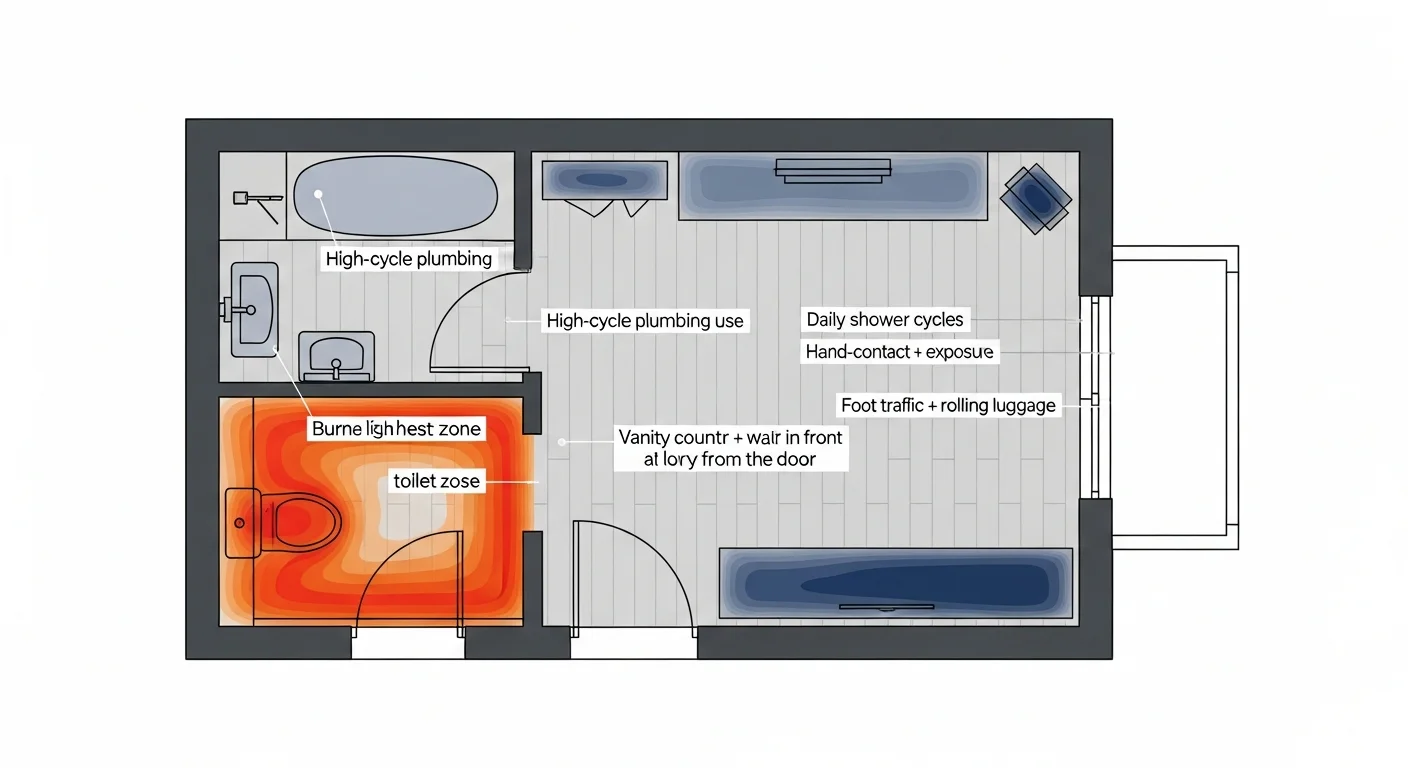
The wear concentrates in five high-use components: the shower (every guest, every day), the toilet (every guest, multiple times daily), the vanity faucet (high-frequency use), the floor (every entry/exit), and the door hardware (every entry/exit). These five components see most of the cycle count and most of the visible wear. Spec dollars should concentrate there. Components that see lower-frequency use (towel bars, hooks, light fixtures, ceiling, back walls) can be specced at standard residential level without affecting the bathroom's long-term durability.
The toilet is the highest-cycle-use component in an STR bathroom. Standard residential two-piece toilets ($150-$300) have a 3-5 year cosmetic lifespan in STR use because the tank-bowl junction develops a stained line that no cleaning reverses, and the porcelain glaze around the rim shows progressive wear from sanitizing chemicals.
The right STR spec: a mid-tier one-piece skirted toilet ($400-$700 with installation). Key features that drive STR durability: (1) skirted design (smooth exterior with no exposed plumbing trap) — cleaner appearance, easier to clean, no junction line; (2) one-piece construction — no tank-to-bowl seam to develop stains; (3) elongated bowl — accommodates larger guests, doesn't read as 'budget'; (4) higher-grade glaze (Toto's Cefiontect or American Standard's EverClean) — resists staining and bacterial buildup.
What to avoid: bargain two-piece toilets ($120-$200), which look fine on day one but show visible wear within 18-24 months in STR use. Also avoid premium high-tech toilets ($1,200+) with electronic features — bidets, heated seats, automatic flushers — which add failure modes that cost guest reviews when they malfunction.
Every STR bathroom upgrade. The toilet is the single highest-visibility component to guests and the highest cycle frequency.
Mid-tier toilets cost 2-3x what bargain toilets do. The math works because the replacement cycle is 8-12 years vs 3-5 for bargain spec.
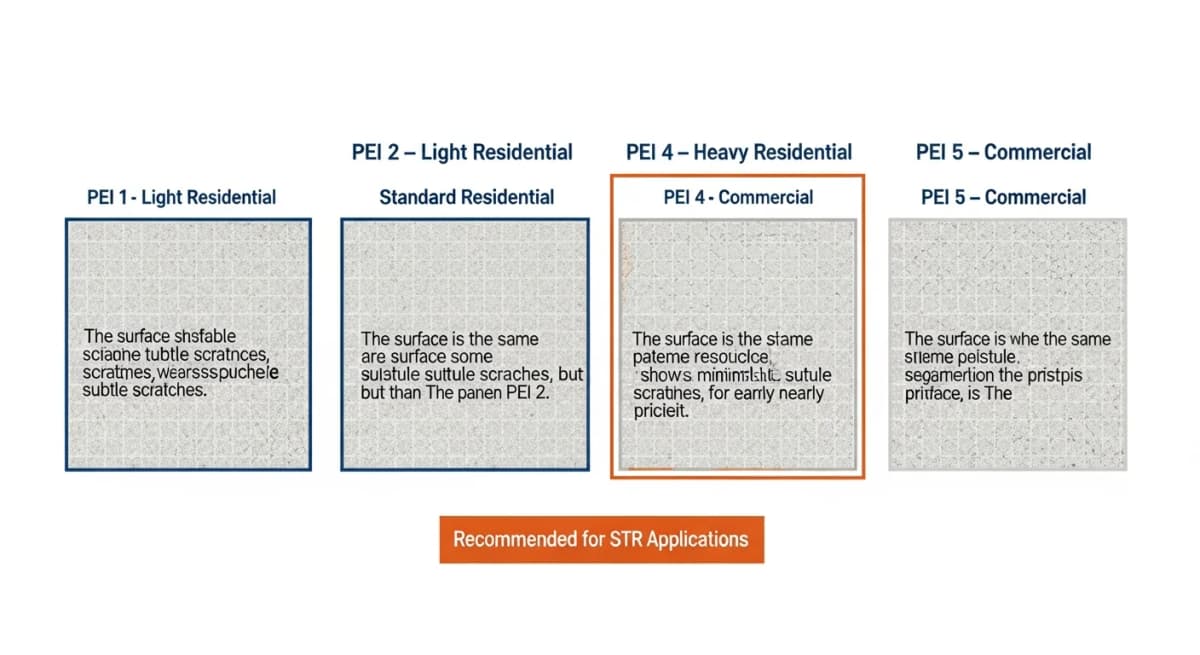
Tile durability under foot traffic is measured by the Porcelain Enamel Institute (PEI) rating scale, which ranges from PEI 1 (no foot traffic, walls only) to PEI 5 (heavy commercial use). For STR bathroom floors, PEI 4 (heavy residential) is the minimum acceptable rating; PEI 5 (commercial-grade) is preferred. Most home-center tile is PEI 2 or 3 — adequate for residential master baths but underperforming in STR cycle counts.
The right STR floor spec: porcelain tile rated PEI 4 or 5, in 12x24 or 18x24 format (medium-to-large), with rectified edges for tight grout lines (1/8 inch grout joints). Why these specs: (1) porcelain has lower water absorption (under 0.5%) than ceramic, which matters in wet bathroom environments; (2) PEI 4-5 glazes resist surface scratching from rolling luggage and shoes; (3) medium-to-large format reduces total grout line linear footage by 60-70% compared to small tile, which reduces the staining/cleaning surface area; (4) rectified edges with tight grout lines further reduce grout exposure.
Cost: PEI 4-5 porcelain in 12x24 format runs $4-$10 per square foot for stock products from Treasure Valley distributors, $10-$20 for designer lines. A typical 60 sq ft bathroom floor: $250-$1,200 for tile material. Installation labor is similar to standard tile spec, sometimes slightly higher because rectified edge work is more precise.
Shower wall tile in STR applications faces different wear than floor tile — less foot traffic, more chemical exposure (cleaning products, soaps, shampoos), more water exposure, more direct contact with guests' bodies. The right shower wall spec optimizes for cleanability and chemical resistance, not foot-traffic durability.
Recommended spec: large-format porcelain (24x48 or 12x36 panels) on the back wall and at minimum one full side wall, with smaller-format tile (3x12 or 4x12) for accent bands or curated accent walls. The large-format choice reduces grout exposure (the cleaning-burden hotspot) and produces a clean modern aesthetic that photographs well. The smaller-format accent provides visual interest without the cleaning burden of a fully small-tile shower.
Niche design matters specifically: STR guests need at least one large niche (12x18 minimum) for their shampoo bottles, body wash, conditioner, razor, and other supplies. Two niches at different heights work better — one at chest height for adults, one lower for kids or shorter guests. Skip the small 8x10 or 10x12 niches that look proportional in residential design photos but don't fit modern STR guest supply volumes.
Cost: large-format porcelain wall tile $6-$15 per square foot installed; niche fabrication adds $200-$500 per niche for the structural and waterproofing scope.
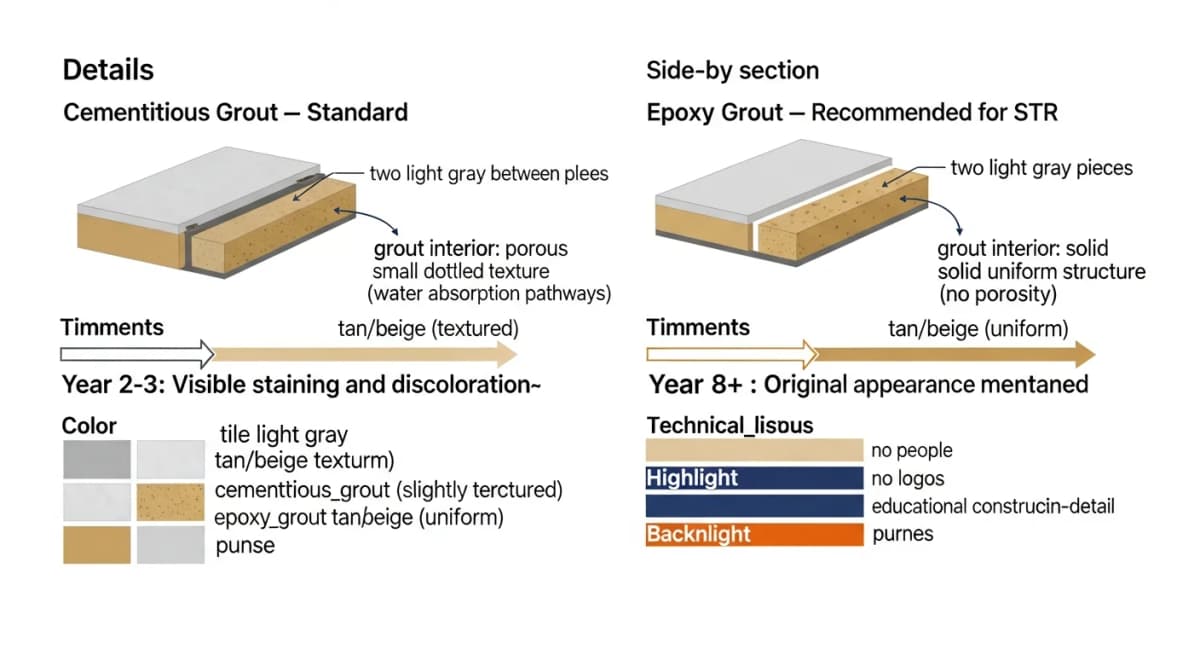
Grout choice is the single largest difference between an STR bathroom that looks new at year 5 and one that needs regrouting. Standard cementitious grout is porous; it absorbs water, soap, body oils, and cleaning chemicals over time. In STR use with 100-200+ guest cycles per year, cementitious grout develops visible stains and discoloration within 18-24 months no matter how well it's installed. Aggressive cleaning (which guest turnovers require) accelerates the discoloration further.
Epoxy grout — the resin-based grout systems from Mapei, Laticrete, and similar manufacturers — is non-porous. It doesn't absorb stains. It resists chemical attack from cleaning products. It maintains its original color through the bathroom's full lifespan. The trade-offs are real: epoxy grout costs 3-5x more than cementitious ($150-$350 per typical bathroom vs $40-$80), requires more skilled installation (faster cure time, less forgiving of mistakes), and produces a slightly different look (subtly more uniform than cementitious).
For STR applications, the math overwhelmingly favors epoxy. The grout looks the same at year 5 as at year 1. The cleaning labor per turnover is meaningfully lower because grout doesn't need scrubbing. The regrouting service that cementitious grout eventually requires ($600-$1,500) is avoided entirely.
One caveat: epoxy grout requires installer experience. Some Treasure Valley tile setters don't routinely work with it. Confirm during contractor selection that the actual installer has installed epoxy grout in 5+ projects.
Every STR bathroom remodel. The cost difference is small relative to the project; the durability difference is large.
Requires experienced tile setter. Confirm during contractor selection.
Spec your Boise STR bathroom for guest-cycle durability
Short-term rental bathrooms wear 5-10x faster than owner-occupied baths. Schedule a consultation and we'll model the right materials, durability spec, and timeline for your property's booking pattern — and price the work transparently against expected rental income.
Vanity countertops in STR bathrooms see daily chemical exposure (cleaning products), accidental damage (dropped items from guests), heat exposure (hot styling tools), and water pooling around the faucet base. Cultured marble — common in budget residential vanities — commonly fails on all four of these dimensions within a few years of STR use. The thin gel coat scratches, dulls, and develops permanent damage from hot tools and cleaning chemicals.
The right STR vanity top: quartz ($45-$85 per sq ft installed) or solid-surface materials like Corian ($50-$90 per sq ft) for the budget tier, or natural stone (granite, soapstone) for the higher tier. Quartz is the standard recommendation for most STRs because of its combination of durability, low maintenance, and consistent appearance. The non-porous surface resists staining; the harder surface resists scratching; the chemical resistance handles standard bathroom cleaning products.
Specific quartz advantages for STR use: doesn't require sealing, doesn't show water spots like polished granite, resists heat damage from styling tools (up to 300°F), and photographs well in listing photos. Color choice should be slightly cooler whites or grays — they read as 'modern and clean' in marketing photos and don't show light staining as much as warm whites would.
Shower doors in STRs face high cycle frequency (every guest opens and closes them multiple times per day) and hard-water exposure that produces the etching described in our shower glass etching article. The right spec combines mechanical durability with surface protection.
Mechanically: frameless glass doors with quality hinges (Italian or German manufacture preferred — typically $400-$700 in hinge cost vs $80-$150 for bargain hinges) survive STR cycling better. Semi-frameless designs ($200-$400 in hinges vs full frameless's higher cost) are an acceptable middle option. Avoid full-framed shower doors — the frame collects mineral deposits and cleaning chemicals over time and looks dated faster.
Surface protection: factory-applied glass coating (ShowerGuard or EnduroShield) is essentially mandatory for STR applications in Boise's hard water. The $200-$400 upcharge prevents the etching that develops within 12-18 months on uncoated glass — etching that's both visible in listing photos and a guest-review complaint. Combined with consistent post-cleaning squeegee discipline (cleaners can squeegee the door during turnover), factory-coated glass survives 5-8 years in STR use without visible etching.
Faucet, showerhead, towel bar, and door hardware finishes in STR bathrooms experience accelerated wear from cleaning chemicals and frequent hand contact. The standard finishes that work in residential applications fail visibly faster in STR use, particularly polished chrome and polished nickel (water-spot magnets in Boise hard water).
Three finishes survive STR use well: brushed nickel (low cost, hides water spots, broadly compatible with design schemes — typical $100-$200 per fixture); matte black (modern look, hides water spots and fingerprints, popular in 2024-2026 design trends — typical $150-$250 per fixture); and PVD-coated brass (Brizo Luxe, Kohler Vibrant Brushed Brass — premium tier at $250-$450 per fixture, longest finish lifespan in hard water and most resistant to chemical wear).
The critical design discipline: pick ONE finish and apply it consistently across every hardware piece in the bathroom. Mixing finishes — chrome faucet, brushed nickel handles, brass hooks, oil-rubbed bronze toilet flush — reads as 'piecemeal' in listing photos and produces a less professional look than coordinated finish across cheaper-tier hardware. The finish discipline matters more than the price per fixture.
STR bathroom lighting serves two functions that residential bathroom lighting doesn't: it has to photograph well for listing images (which often determine booking decisions), and it has to support quick guest turnovers where the cleaner needs to see surface conditions clearly. Standard residential lighting (2700K-3000K Kelvin, CRI 80) doesn't optimize for either function.
The right STR lighting spec: 3500K-4000K Kelvin (slightly cooler than residential default — reads as 'modern and clean' in photos), CRI 90+ (accurate color rendering), and adequate lumen output (40-60 lumens per square foot ambient + dedicated task lighting at the vanity). A typical 60 sq ft STR bathroom needs 2,400-3,600 ambient lumens plus 1,500-2,000 task lumens at the vanity. Layered with proper dimmer controls so guests can adjust for relaxation versus active use.
For the vanity specifically, sconces flanking the mirror (rather than a top-mounted fixture) provide the shadow-free face lighting that listing photos benefit from. Sconces with frosted glass diffusers ($75-$200 each) produce flattering even light for photography. LED-edge-lit mirrors ($400-$900) are also strong STR specs because they double as task lighting and read as 'modern' in listings.
The single highest-wear floor zone in an STR bathroom is the 18-24 inch strip immediately inside the bathroom door, where guests transfer rolling luggage, transition from carpet/hallway to tile, and shed water from feet exiting the shower. Standard residential floor tile installed continuously through this zone shows wear here first — scratches, scuffs, and progressive surface dulling.
Two design responses work for high-traffic STR baths:
Larger-format tile in entry zone: Continuing the 12x24 or 18x24 floor tile through the entry zone (rather than transitioning to smaller-format accent tile near the door) creates a continuous high-durability surface. The larger format also reads as 'spacious' in listing photos.
Reinforced threshold: A solid-surface or natural-stone threshold (Saddle threshold at $30-$80) at the bathroom doorway creates a designated transition zone that absorbs the wear that would otherwise concentrate on the tile edge. Easier to replace if it eventually does wear than replacing tile.
For showers specifically, a curbless design with a slight slope toward the linear drain (per our curbless shower article if you're working with slab-on-grade) reduces the wet-feet transition zone outside the shower. Standard curbed showers transfer more water onto the bathroom floor through the curb-to-floor transition, accelerating wear on that floor section.
Iron Crest's STR bathroom remodel process starts with the rental's booking pattern. We ask how many bookings per year the property currently does (or projects for new conversions), the average group size, the seasonal pattern, and the cleaning service model. Those numbers drive the material spec — a 40-booking-per-year Bogus Basin ski rental needs different durability than a 150-booking-per-year downtown Boise unit. We adjust the spec accordingly rather than applying a single 'STR bathroom' template across every project.
The single most common mistake STR operators make on their own: applying residential design choices to a property that will see 5-10x the cycle frequency. The bathroom looks great in opening photos and slowly degrades through years 2-4 to where it underperforms in listing photos and starts affecting booking velocity. The premium STR spec costs 15-25% more than equivalent residential spec — but it's the difference between a bathroom that earns rental income through year 8-10 and one that needs major refresh by year 5. For broader STR property planning context, see our rental property remodel guide and bathroom remodeling service overview.
What's the cost premium for STR-grade bathroom finishes versus standard residential?
Typical premium runs 15-30% above equivalent residential spec, depending on which specific upgrades are included. The largest cost drivers: epoxy grout vs cementitious ($150-$300 premium), PEI 4-5 porcelain floor tile vs PEI 2-3 ($400-$1,200 premium for a 60 sq ft floor), quartz vanity top vs cultured marble ($500-$1,200 premium), factory-coated shower glass vs uncoated ($200-$400 premium), and skirted one-piece toilet vs basic two-piece ($300-$500 premium). For a typical $25,000-$35,000 STR bathroom remodel, the durability premium adds $4,000-$8,000 to the project. That premium typically pays back through reduced refresh cycles, lower maintenance labor per turnover, and sustained listing-photo quality.
How often do typical STR bathrooms in Boise need cosmetic refresh?
It depends entirely on initial spec quality and cleaning practices. STR bathrooms specced at standard residential quality typically need cosmetic refresh (regrouting, repainting, hardware replacement) at year 3-4 and major refresh (vanity, lighting, fixtures) at year 6-8. STR bathrooms specced to the durability standards in this article typically don't need cosmetic refresh until year 6-8 and stretch major refresh to year 10-12. The 2-4 year delay is meaningful when paired with maintained listing-photo quality through the extended window — the bathroom doesn't visibly age out of the photo set during peak booking years.
Should I include a tub in a Boise STR bathroom?
Generally one tub somewhere in the property is helpful for family-with-young-children bookings, but the primary bath shower-only is acceptable and increasingly common in modern STR designs. For multi-bathroom STR properties, having one tub (often in a secondary bath) covers the family booking segment while letting the primary bath be a high-end walk-in shower for design impact in listing photos. For single-bathroom STR units, the trade-off is real — tub adds family appeal but reduces the modern-spa-bath listing aesthetic. We typically recommend shower-only for primary baths in 1-2 bedroom STR units and at least one tub for 3+ bedroom STR units.
Are heated floors worth installing in a Boise STR bathroom?
Sometimes yes, particularly for higher-end STR properties (typically $300+ per night) and for properties operated primarily during winter months (Bogus Basin ski rentals, winter foothills cabin rentals). The features that drive STR booking premium include heated bathroom floors, particularly when included in the listing description. Cost: $1,500-$3,500 installed for typical 50-70 sq ft bathroom. The premium is meaningful enough to justify the install in upmarket STR positioning; less meaningful for budget or mid-tier STR pricing where the feature isn't a search-decision factor. We help work through the booking-pattern math during STR remodel planning.
How important is professional photography for STR bathroom remodel marketing?
Critical. The cost difference between professional STR listing photography ($300-$800 for a full property shoot) and amateur photos is the single highest-leverage variable in STR booking velocity. After investing $25k-$40k in a quality bathroom remodel, skimping on photography is poor sequencing. We coordinate with our STR clients on the photography schedule (typically scheduled 5-10 days after remodel completion to allow for staging and final detail work), and several Treasure Valley STR photographers we work with consistently produce listing images that drive measurable booking-velocity increases.
Are there Boise zoning or permit considerations for STR bathroom remodels?
Standard bathroom remodel permits apply (plumbing, electrical, mechanical depending on scope). What's different for STRs in Boise: short-term rental operating permits are required as of 2023 for properties offering rentals under 30 days. STR registration is separate from the construction permit. The bathroom remodel work itself follows standard residential code; the STR operating status is the separate regulatory layer. We help clients navigate both during STR property remodels. For broader Boise STR regulatory context, refer to the City of Boise's short-term rental ordinance pages.
Spec your Boise STR bathroom for guest-cycle durability
Short-term rental bathrooms wear 5-10x faster than owner-occupied baths. Schedule a consultation and we'll model the right materials, durability spec, and timeline for your property's booking pattern — and price the work transparently against expected rental income.
These pages go deeper on the topics linked from this article. Read them before your consultation and you'll come in with sharper questions and a clearer scope.
The following government agencies, industry organizations, and official resources provide additional information relevant to your remodeling project.