
Flooring Installation Across Vista, Curtis / Targee, Roosevelt Market & the Lower Bench
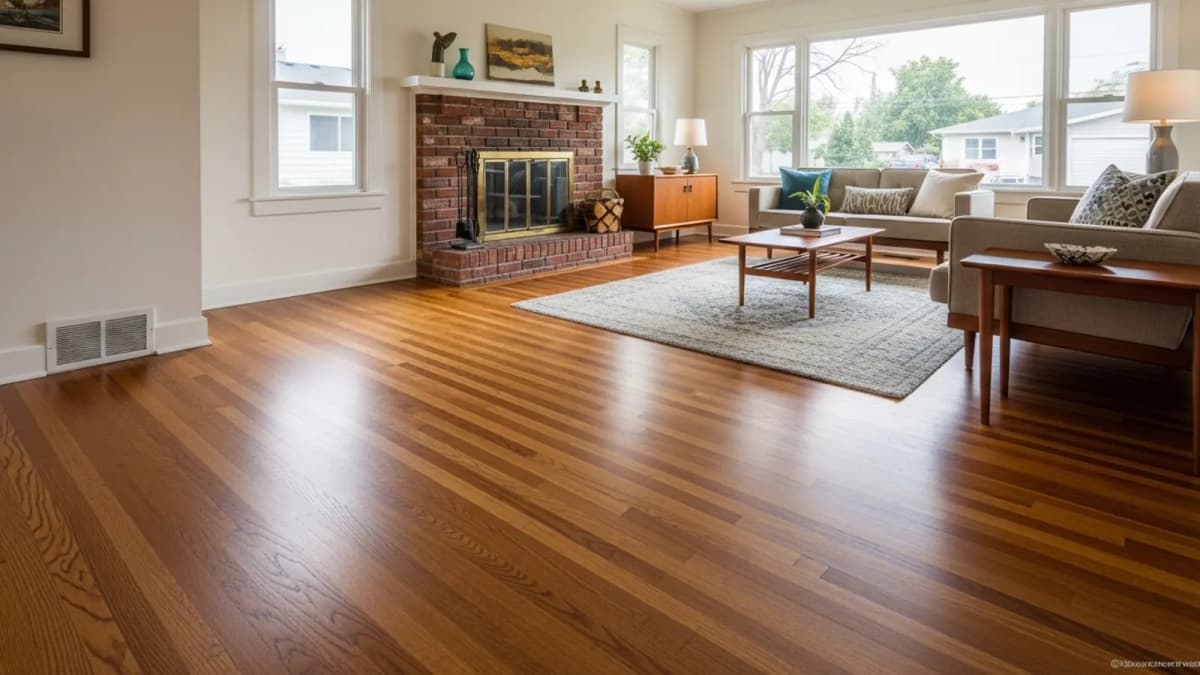
Original red oak strip refinishing on 1940s–1960s post-war ranches, asbestos-vinyl removal where prior owners covered originals with sheet vinyl in the 1970s, engineered hardwood and large-format porcelain on whole-home Bench remodels — done with the prep and finish discipline 60-to-85-year-old originals deserve.
Quick answer
Refinish, almost always. Original red oak in a pre-1965 Bench home is irreplaceable old-growth wood — denser grain than modern milled oak, with patina no new product replicates. Refinishing removes 1/16-inch to 1/8-inch of surface wood through sanding, and most original Bench floors can be refinished 4–6 times over their lifetime.
Flooring decisions on the Boise Bench are a strong driver of overall remodel quality, and the dominant decision is whether the original 2¼-inch red oak strip flooring under the carpet, vinyl, or laminate that a previous owner installed is recoverable. On a 1948 Vista ranch or a 1955 Curtis / Targee minimal traditional, the original old-growth red oak strip is almost always still there under wall-to-wall carpet that went down in the 1980s — and almost always recoverable through proper refinish. That floor has grain density and patina that can't be replicated with any modern product on the market, and pulling the carpet to expose it is among the most rewarding scope items in a Bench remodel. Where the original is missing or beyond rescue (decades of pet damage, severe water damage from a kitchen leak, or already sanded too thin in a previous refinish wave), engineered red oak in matched tone and width fills in cleanly. The Bench-specific complexity is the universal pre-1980 asbestos-vinyl scenario: kitchen and bathroom floors on pre-1980 Bench homes almost universally have either 9-inch vinyl asbestos tile or asbestos-mastic sheet vinyl somewhere in the substrate stack, and removal triggers Idaho DEQ-mandated abatement by a licensed contractor before disturbance. EPA RRP applies to every pre-1978 Bench address for any sanding work because original baseboards are lead-painted. Iron Crest's Bench flooring work is anchored on three reliability moves: depth-measure original wood before sanding (some originals were sanded too thin in a 1980s refinish wave and can't accept another sand), pre-screen for asbestos in any vinyl substrate before disturbance, and run HEPA-filtered dust containment from day one of any sanding scope.
Flooring strategy on the Boise Bench varies sharply by era because original flooring type, layout, and what previous owners did to it are entirely different across the housing waves.
1940–1955 early post-war minimal traditional (Roosevelt Market area, parts of Western Bench)
Original 2¼-inch red oak strip flooring on heavy fir joists, sometimes original 4-inch fir flooring instead. Floors run continuously through living-dining-bedroom areas; original linoleum in kitchens and baths. Almost always covered with carpet at some point during the 1970s or 1980s. Pre-1978 trim universally lead-painted — EPA RRP applies. Often the original wood is in better condition than the carpet would suggest because it's been protected for 40+ years.
1955–1965 classic post-war ranch (Vista, Curtis / Targee, Eastern Bench)
Original 2¼-inch red oak strip flooring in living rooms, dining rooms, hallways, and sometimes kitchens. Original linoleum or 9-inch vinyl asbestos tile in kitchens and bathrooms (the 9-inch tile is the visual giveaway — modern vinyl tile is 12-inch). Wall-to-wall carpet over plywood subfloor in bedrooms increasingly standard from original construction in this wave. Many homes had a 1980s refinish that took meaningful wood off — depth measurement is non-negotiable before another sand.
1965–1975 expanded ranch and split-level (Eastern Bench / Overland, parts of Lower Bench)
Wall-to-wall carpet became dominant in living spaces during this era; less original hardwood than 1940s–1950s homes. Some homes have original cork or rubber tile in basements (cork is salvageable; rubber tile usually contains asbestos). Sheet vinyl or 12-inch ceramic tile in kitchens and baths, with the 12-inch tile less likely than 9-inch to be asbestos-bearing.
1985+ infill and renovated homes
Modern flooring from original construction or recent updates — engineered hardwood, LVP, modern tile, sometimes wall-to-wall carpet still. Standard flooring practices apply with no asbestos, no lead, no original-floor-preservation considerations.
Five recurring flooring shapes account for nearly every Bench project. Whether original wood is being preserved or new flooring is being installed drives most of the cost and timeline.
1. The Original Red Oak Refinish (Preserve and Restore)
Sand existing original red oak or fir floor to bare wood (Bona Atomic or DCS edger system), repair damaged areas with matched salvaged old-growth boards, apply selected stain (Bona DriFast or oil-based), finish with three coats of premium polyurethane (Bona Traffic HD or Pallmann). Restores original 60–85-year-old floor to near-new appearance while preserving irreplaceable old-growth wood. Most rewarding scope item in a Bench remodel by visual-impact-per-dollar.
Target homes: Pre-1965 Vista, Curtis / Targee, Roosevelt Market area, and Western Bench homes with intact original wood. Permit: no permit required.
2. The Carpet-Pull and Refinish (Exposing Hidden Originals)
Removing wall-to-wall carpet that was installed over original wood in the 1970s or 1980s, assessing condition (depth-measuring the wear layer, checking for water-damaged or pet-damaged sections), repairing as needed with matched salvaged old-growth boards, then refinishing. Often a dramatic and welcome surprise — original wood discovered under decades of carpet that the owner didn't know was there. Most common Bench scope on Vista and Curtis / Targee ranches.
Target homes: Bench homes where prior owners installed carpet over original wood. Permit: none required.
3. The Engineered Hardwood Install (New Flooring Matching Originals)
Install engineered red oak hardwood in rooms where no original wood survives — bedrooms that always had carpet, kitchens whose original linoleum is being replaced, additions or rooms where the original wood was destroyed by water damage. Specified in matched tone (typically Bona Walnut, Golden Oak, or English Chestnut to match adjacent original) and matched width (2¼-inch or 3¼-inch to match Bench-era proportions). Pre-finished or site-finished both viable; site-finished allows custom stain color matching to existing original wood.
Target homes: Bench homes where original flooring is missing in some rooms but the visual continuity goal is to match adjacent original. Permit: none required.
4. The Modern Tile Install (Kitchen, Bathroom, Mudroom)
Large-format porcelain (12×24 or 24×24) in stone-look or solid color for kitchens and baths, white hex mosaic for bathroom floors, penny round mosaic for accent areas. Properly prepped subfloor — cement board over the original 1×6 fir subfloor, sometimes Schluter Ditra uncoupling membrane on top of cement board for older Bench homes with bouncy framing. Tile install, grout, and sealing.
Target homes: Kitchens, bathrooms, and mudrooms in Bench homes — particularly when the existing flooring is asbestos-bearing 9-inch vinyl tile that's being abated as part of scope. Permit: usually none required.
5. The Whole-Home Flooring Refresh
Comprehensive flooring across the entire home — original red oak refinishing where wood survives (Vista, Curtis / Targee, Roosevelt Market typical), engineered hardwood install where wood is missing (bedrooms that always had carpet), tile in kitchens and baths, sometimes LVP in basements or laundry. Coordinated stain and finish selections so the refinished originals and the new engineered installs read as one continuous floor.
Target homes: Whole-home Bench remodels or owners doing comprehensive refresh on a Vista, Curtis / Targee, or Eastern Bench ranch. Permit: usually none required.
The Boise Bench is made up of distinct sub-neighborhoods, each with its own remodeling personality.
Vista
One of the most recognized sub-neighborhoods on the Boise Bench, centered around Vista Avenue between the Boise River and Overland Road. Post-war homes on uniform lots with mature street trees and good walkability to local commercial corridors. A heavy concentration of small ranch and minimal-traditional homes that respond well to galley-kitchen open-ups, primary-suite additions, and aesthetic modernization.
Central Bench (Curtis & Targee corridor)
The geographic core of the Bench, running along Curtis Road and Targee Street between I-84 and Overland. The City of Boise's Central Bench Neighborhood Plan records that the neighbourhood changed significantly during and after World War II, when agricultural land was subdivided into residential lots, and that new homes were built west of Orchard Street from the mid-1950s through the 1970s. Blueprint Boise designates the Central Bench primarily for compact-neighbourhood form — small lots, typically between 5,000 and 7,000 square feet, predominantly single-family, on an interconnected network of sidewalks and streets. Galley kitchen conversions are the dominant remodeling project type here.
Eastern Bench / Overland
The eastern edge of the Bench around Overland Road, with a mix of ranch and split-level homes. Lots tend to be slightly larger. Closer to mall-adjacent commercial corridors and major transit routes.
Western Bench / Roosevelt Market area
The western edge of the Bench near the Roosevelt Market and Capitol corridor. Some of the older Bench housing stock sits here, with steeper roof pitches and smaller footprints than the post-war ranches further east. Closer to downtown amenities and walkable.
Greenbelt-adjacent Bench
Bench properties along the elevated edges of the Boise River bluff with views down to the Greenbelt and the river. Frequently subject to view-preserving design considerations during exterior work — though without formal Historic District constraints.
Lower Bench (I-84 frontage)
The southern edge of the Bench close to I-84, on smaller lots and often with more traffic noise from the freeway. Common to combine kitchen, bathroom, and primary-suite remodels into a single comprehensive scope.
Most Boise flooring projects run $3,500 to $32,000 — the band published on our Boise flooring page. Pre-1978 Bench flooring sits toward the upper part of that band because of the EPA RRP lead-safe labor practices required on every sanding scope and the universal pre-1980 asbestos-vinyl pre-screen.
Boise Bench flooring installation ranges
Single-room original floor refinish (Sand to bare wood, stain, three coats premium polyurethane): $3,200–$5,000 (typical 12×14 living room) / 1 week end to end
Whole-floor original refinish (Main-level comprehensive refinish — living, dining, hallway): $7,500–$13,000 / 1–2 weeks end to end
Engineered hardwood install (single room) (Remove existing flooring, install engineered hardwood matched to adjacent original): $3,200–$7,500 (typical 12×14 bedroom) / 1–2 weeks end to end
Tile install (kitchen or bathroom) (Large-format porcelain or hex mosaic on properly prepped subfloor): $4,000–$12,000 / 1–3 weeks end to end
Whole-home flooring refresh (Comprehensive flooring throughout 1,200–1,800 sq ft Bench home): $14,000–$28,000 / 3–5 weeks end to end
Pricing assumes Iron Crest's standard Bench scope: EPA RRP lead-safe work practices on every pre-1978 home (universal in the pre-1980 Bench housing stock), pre-1980 asbestos pre-screen on any vinyl or sheet flooring being disturbed, licensed asbestos abatement when triggered, proper substrate preparation with cement board for tile and self-leveling underlayment for engineered installs where required, premium-grade Bona Traffic HD or Pallmann finish, HEPA-filtered dust containment with negative-pressure scrubbers running continuously through sanding, complete cleanup, and our 3-year workmanship warranty. The Boise Bench is not within any City of Boise Historic District — no Historic Preservation Commission review, no Certificate of Appropriateness — which means flooring scope moves at standard City of Boise speed.
The City of Boise designates ten historic districts, and the Boise Bench is not one of them and does not sit inside one. There is no Historic Preservation Commission review for exterior modifications, so siding changes, window replacements, additions, and exterior colour changes don't trigger the Certificate of Appropriateness process that constrains North End and East End projects. That removes a review step from the pre-construction schedule on any Bench exterior scope; confirm current review timelines with Boise PDS for your specific project.
City of Boise standard permits still apply for any work involving electrical, plumbing, structural changes, or mechanical systems. A scope that includes new circuit additions, moving a gas line, or removing a load-bearing wall requires a building permit from City of Boise Planning and Development Services. Permit processing for Bench projects takes about two weeks for online plan review per Boise PDS, longer with structural drawings — without the historic-review overlay that North End projects carry. Building Division: (208) 608-7070. Planning & Zoning: (208) 608-7100.
Asbestos and lead paint remain serious considerations on the Bench, despite the absence of Historic District review. Pre-1980 Bench homes (which is most of the housing stock) commonly contain asbestos in floor tiles, joint compound, and sometimes pipe insulation. We test suspect pre-1980 materials and arrange AHERA-accredited abatement when asbestos is confirmed. Pre-1978 Bench homes contain lead paint. The EPA RRP rule requires lead-safe work practices for any renovation in lead-paint homes — including containment, specialized HEPA vacuuming, and proper disposal. Iron Crest follows EPA RRP lead-safe work practices and incorporates them into the standard scope on every pre-1980 Bench project.
Bench-specific permit consideration: setbacks. Blueprint Boise designates the Central Bench primarily for compact-neighbourhood form, with small lots typically between 5,000 and 7,000 square feet, so additions or detached structures must navigate side and rear setbacks carefully. Boise's residential zoning code sets no maximum lot coverage, so the binding constraint on a Bench addition is almost always the setback envelope rather than a coverage percentage. Zoning verification during initial design is critical to avoid late-stage redesigns.
Flooring material strategy on the Bench balances preservation of irreplaceable original red oak, modern durability needs in working family homes, and the modern aesthetic that's selling Vista and Curtis / Targee comparable sales in 2026.
Original wood floor preservation — refinish unless structurally compromised
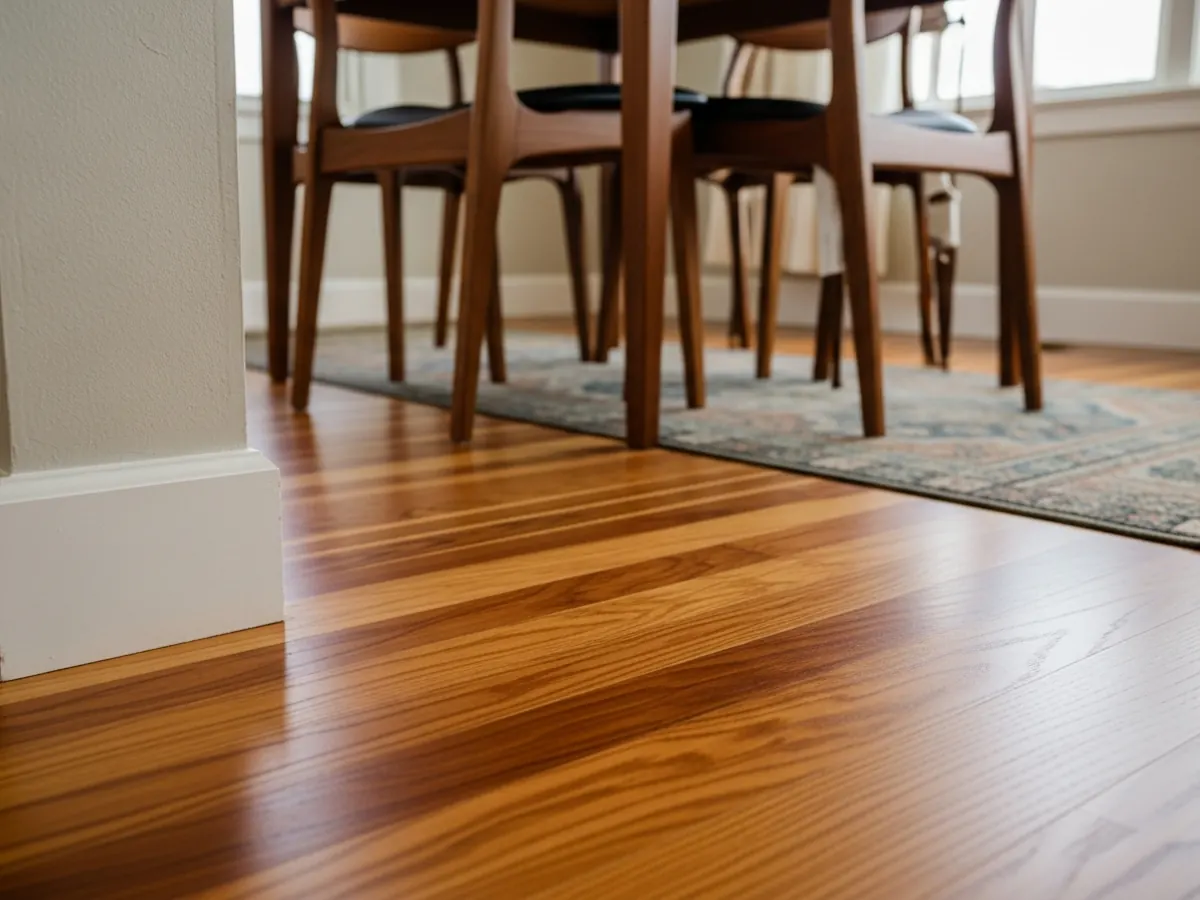
If original red oak strip flooring exists and is structurally sound, preserve it. Original mid-century oak in pre-1965 Bench homes is irreplaceable old-growth wood — denser grain than modern milled oak, with patina that no new product replicates. Refinishing removes 1/16-inch to 1/8-inch of surface wood through sanding — most original Bench floors can be refinished 4–6 times over their lifetime. Depth measurement before commit-to-sand is non-negotiable on 1955–1965 Bench stock that may have been refinished in the 1980s and is approaching the wear-layer minimum.
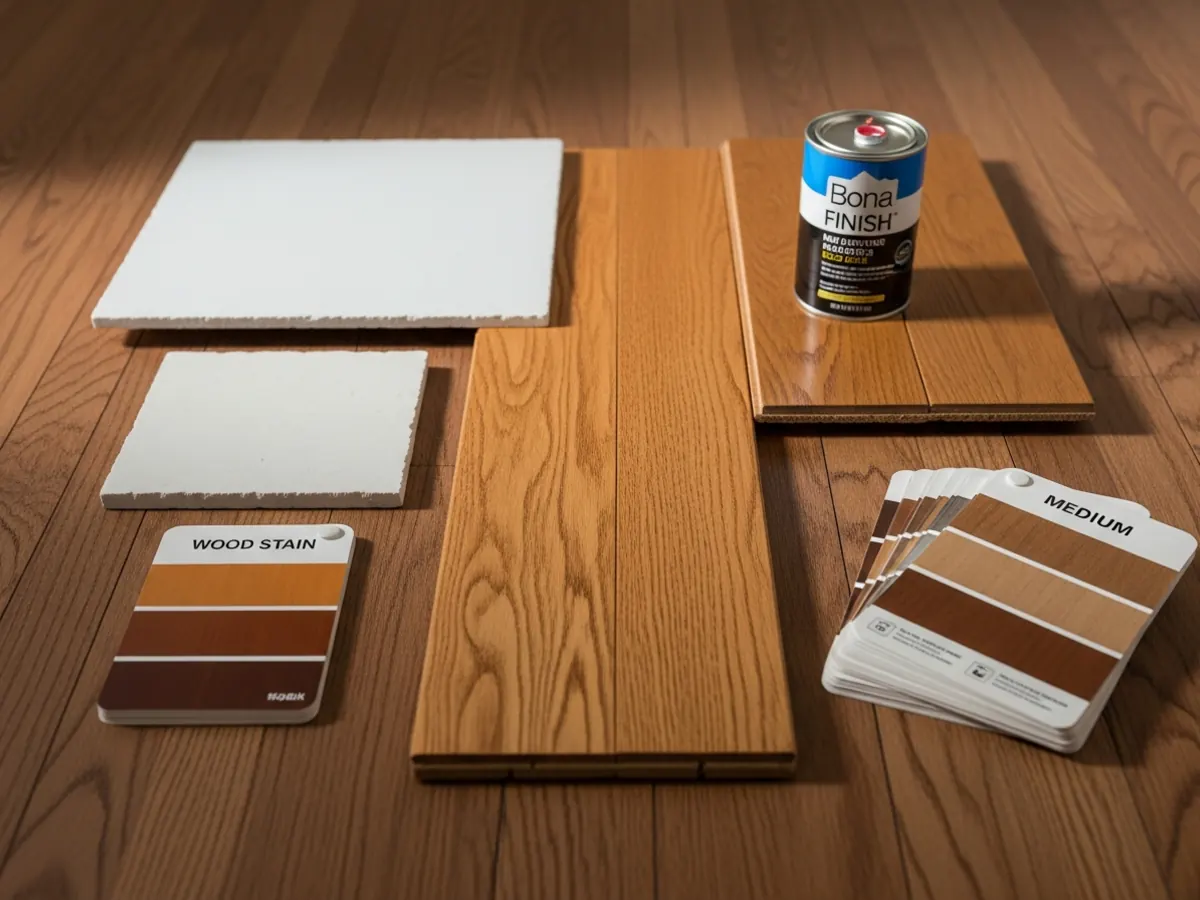
Stain selection — modern Bench-appropriate medium tones
Modern Bench-appropriate stains: Bona DriFast Walnut, Golden Oak, English Chestnut, or oil-based Minwax in matching tones. These complement mid-century post-war architecture without recreating dated 1970s wood-look paneling aesthetics. Avoid: ultra-dark stains (espresso, ebony) that read as 2010s contemporary and date quickly; ultra-light bleached looks that read as Scandinavian modern transplants. Stain test on actual original floor in inconspicuous area before commit — old red oak grain density variations affect stain absorption unpredictably.
Engineered hardwood for new install — matched to existing original
Engineered red oak with 3/8-inch to 1/2-inch wear layer, in 2¼-inch to 4-inch plank width to match Bench-era proportions on Vista and Curtis / Targee ranches. Pre-finished or site-finished both viable. Site-finished allows custom stain matching to existing original wood — usually the right answer when existing original is being refinished concurrently in adjacent rooms. Premium products: Mirage, Bona, Hallmark — all available in matched red oak.
Tile for kitchens, bathrooms, mudrooms
Large-format porcelain (12×24 or 24×24) in stone-look or solid color is the modern Bench default. Whites, warm greys, and Calacatta-look porcelain dominant. White hex mosaic for bathroom floors. Penny round mosaic for shower floors and accent areas. Subway tile (3×6) for backsplashes. Subfloor prep is non-negotiable on older Bench homes: cement board over plywood subfloor at minimum; Schluter Ditra uncoupling membrane on top of cement board where original framing has any flex.
LVP for basements, laundry, and utility areas
Luxury vinyl plank in mid-tone wood look — durable, water-resistant, dimensionally stable through Boise's freeze-thaw and humidity swings. Excellent for basements (where moisture from below makes hardwood inappropriate) and for laundry rooms and mudrooms where water spills are predictable. Premium LVP (Coretec Plus, Karndean LooseLay, Shaw Floorté) reads as wood from a few feet away. Cost: $4–$8 per square foot installed.
Subfloor preparation — original 1×6 fir is usually still excellent
Original 1×6 fir subfloors in pre-1965 Bench homes are usually still excellent — old-growth Douglas fir is dimensionally stable and the original construction was over-built by modern standards. For new engineered hardwood or LVP install over existing original subfloor, the subfloor sometimes needs overlay with 1/4-inch luan or new 3/4-inch tongue-and-groove plywood for flat substrate. For tile install, cement board over the original is required regardless of original subfloor condition.
Bench flooring work surfaces a recurring set of conditions across the pre-1980 housing stock. Pre-screen during the consultation walkthrough so the budget reflects them honestly up front.
- •Asbestos in original linoleum or 9-inch vinyl tile (universal in pre-1980 Bench kitchens and baths) Pre-1980 sheet linoleum, 9-inch vinyl floor tiles, and many sheet vinyl flooring products contain asbestos in the tile body, in the mastic, or in both. Idaho DEQ requires abatement by a licensed contractor before any disturbance. Pre-screen testing $300–$700; licensed abatement $1,200–$4,000 typical for a kitchen or bathroom; higher for whole-house scope.
- •Lead paint on baseboards and trim near floor (universal in pre-1978 Bench stock) Universal in pre-1978 homes. Sanding floors generates dust that can disturb baseboard paint. EPA RRP lead-safe containment and HEPA-only sanding required. Built into Iron Crest's Bench pricing rather than added as discovery.
- •Subfloor damage from undetected leaks Removing existing flooring sometimes reveals subfloor damage from old kitchen sink, dishwasher, refrigerator-line, or toilet leaks. Localized patch repair: $400–$1,200. Larger areas requiring sheet replacement: $1,500–$3,000.
- •Original wood floor sanded too thin in a previous 1980s refinish Some 1955–1965 Bench red oak was aggressively sanded in a 1980s refinish wave and is approaching the wear-layer minimum. Detected through depth measurement during consultation walkthrough. Forces conversion to engineered hardwood install when sand isn't viable. $4,000–$7,500 incremental cost vs. refinish.
- •Squeaks and movement requiring subfloor screw-down Older subfloors sometimes need additional fastening to joists. Screwing through subfloor to joists at 12-inch spacing eliminates most squeaks: $0.40–$0.80 per square foot.
- •Floor leveling required for new install Original framing on pre-1965 Bench homes has settled differentially over 60–85 years. New engineered hardwood or LVP install requires level substrate. Self-leveling underlayment: $200–$1,500 depending on extent.
- •Original wood staining challenges from grain density variations Old-growth red oak sometimes accepts stain unevenly because grain density varies more than modern milled oak. Multiple stain test samples on actual floor recommended before commit — what looks correct on a sample piece can read mottled across a whole room.
- •Threshold and transition complications between rooms When refinishing original wood in some rooms while installing new flooring in others, threshold transitions between materials need custom millwork. Custom-milled threshold matching: $80–$200 per transition.
- •Pet damage requiring board replacement Pet stains and scratches sometimes require board replacement during refinish — discoloration that doesn't sand out, deep gouges across the wear layer. Sourcing matched salvaged old-growth red oak from a Bench-stock supply is part of our standard process: $400–$1,500 per damaged area depending on size.
Consultation and floor assessment (Week 1)
Walkthrough of all flooring areas. Condition assessment under any existing carpet or vinyl. Depth measurement of original wood (non-negotiable on 1955–1965 stock that may have been refinished previously). Discussion of preservation vs. replace strategy. Stain and finish selection with sample boards.
Environmental testing (Week 1)
Asbestos pre-screen testing on suspect linoleum, 9-inch vinyl tile, sheet vinyl, or vinyl mastic. Results in 5–7 business days. Lead paint testing already assumed universal on pre-1978 baseboards.
Estimate and material ordering (Weeks 1–2)
Detailed line-item estimate. Stain and finish products ordered. Engineered hardwood ordered if applicable (1–3 week lead). Asbestos abatement scheduled with licensed contractor when pre-screen returns positive.
Furniture removal and protection (Day 1 of work)
Furniture moved out of work area or carefully sequestered to one side of the room. Adjacent rooms protected with poly sheeting and HEPA-filtered air scrubbers.
Existing floor removal and asbestos abatement if applicable (Days 1–3)
Carpet, vinyl, or laminate removal. Asbestos abatement by licensed contractor under DEQ-compliant containment when pre-screen returned positive. Tack strip removal. Substrate inspection.
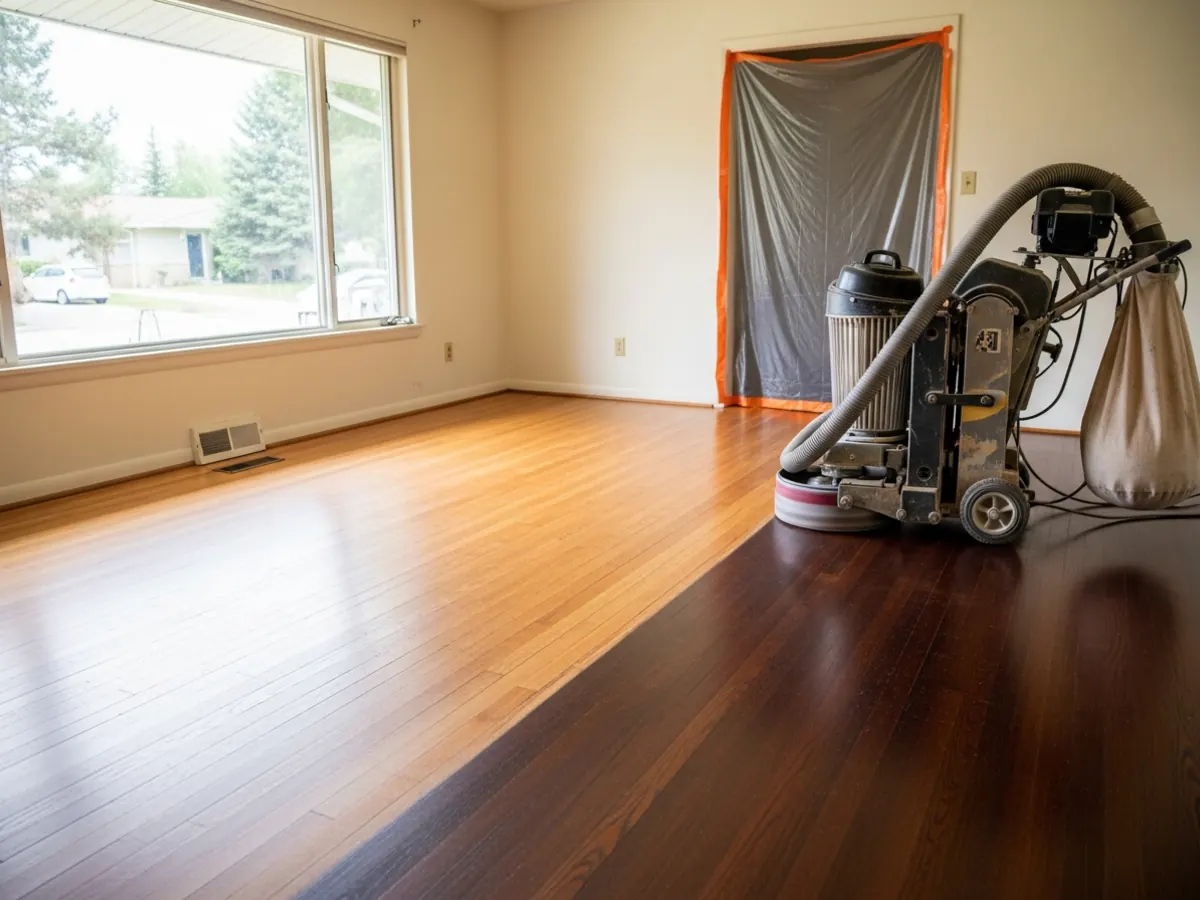
Sanding (Days 2–4 for refinish scope)
Drum sanding with progressively finer grits (typically 36, 60, 80, 100, then 120 for the final pass). Edge sanding at perimeter with Bona Atomic or DCS edger. Hand sanding in corners. HEPA-filtered dust collection running continuously.
Stain and finish (Days 4–6)
Stain application with brush or rag (24-hour drying time). First coat polyurethane (Bona Traffic HD or Pallmann) — 4–8 hour dry depending on temperature and humidity. Light sanding between coats to break the surface tension. Second coat. Third coat — final cure begins.
Cure time (Days 6–8)
Walk-on (sock-feet) typically 24 hours after final coat. Furniture replacement typically 72 hours. Full traffic and rugs typically 7 days. Bona Traffic HD has a faster cure than oil-modified polyurethane.
Walkthrough and final (Day 8+)
Walkthrough with owner. Cleanup verification. Touch-ups if needed. 3-year Iron Crest workmanship warranty begins.
Flooring work in older Bench homes — especially original floor refinishing — is a craft that doesn't translate from suburban work. Sanding too aggressively, sanding unevenly, choosing the wrong stain, applying finish poorly, or cutting corners on dust containment all produce results you'll see daily for years.
- City of Boise Planning & Development Services — Building, electrical, plumbing, and mechanical permits. Online portal and in-person plan check.
- Idaho DEQ Air Quality (Asbestos) — Testing and abatement guidance for pre-1980 homes via the Idaho Department of Environmental Quality.
- EPA Lead Renovation, Repair and Painting (RRP) Program — Required certification and work practices for renovation in pre-1978 lead-paint homes.
- Idaho Power — Rebates & Offers — Idaho Power's residential incentives: the Heating and Cooling Efficiency Program (heat pumps, central air conditioners, duct sealing, smart thermostats, heat pump water heaters, whole-house fans and similar equipment), the A/C Cool Credit, and the Shade Tree Project. Windows and insulation are not covered.
- Idaho DOPL — Contractor Search — Verify any contractor's RCE registration through the official Idaho DOPL license search.
Should I refinish my original red oak floor or replace it?
Refinish, almost always. Original red oak in a pre-1965 Bench home is irreplaceable old-growth wood — denser grain than modern milled oak, with patina no new product replicates. Refinishing removes 1/16-inch to 1/8-inch of surface wood through sanding, and most original Bench floors can be refinished 4–6 times over their lifetime. Replacement is warranted only when severe water damage or excessive prior sanding has compromised the floor structurally — depth measurement during consultation tells us which side of that line your floor is on.
What stain color is right for a Bench mid-century ranch?
Medium-tone modern stains — Bona DriFast Walnut, Golden Oak, English Chestnut, or oil-based Minwax in matching tones. These complement mid-century Vista and Curtis / Targee architecture without recreating dated 1970s wood-look paneling aesthetics. Avoid ultra-dark stains (espresso, ebony) that read as 2010s contemporary and will date quickly. Avoid ultra-light bleached looks that read as Scandinavian modern and don't match the ranch context. We test stain samples on your actual floor before commit because old-growth red oak grain density variations can read differently than sample boards predict.
Can you refinish my floors while I live in the home?
Yes, with planning. Sanding generates fine dust even with HEPA collection — we use containment plastic to seal off work areas and HEPA-filtered air scrubbers running continuously. Cure time means refinished floor is non-walkable for 24 hours, furniture-replaceable at 72 hours, full-traffic at 1 week. We discuss your routine and stage work to minimize disruption. Most Bench refinish scopes can be sequenced so the home remains livable in non-work zones throughout.
How long does a Bench floor refinish take?
1 week for a single room, 1–2 weeks for whole-floor refinish (living + dining + hallway), 2–3 weeks for whole-home original floor refinish on a 1,200–1,800 sq ft Bench home. Schedule: 1–2 days sanding, 1 day stain (24-hour dry), 3 days finish coats with sanding between, 2–3 days cure before furniture replacement.
What about asbestos in my original linoleum or 9-inch vinyl tile?
Pre-1980 sheet linoleum and 9-inch vinyl tile frequently contain asbestos in the tile body, in the mastic, or in both. Almost universal on pre-1980 Bench kitchens and bathrooms. Idaho DEQ requires asbestos abatement by a licensed contractor before any disturbance. We coordinate testing as part of pre-construction; the 9-inch tile size is a visual giveaway that pre-screen testing is mandatory. Abatement: $1,200–$4,000 typical for a kitchen or bath scope, higher for whole-house.
Should I use solid hardwood or engineered hardwood for new install?
Engineered hardwood for almost all Bench installations. Boise's high-desert climate causes solid hardwood to expand and contract significantly across seasons (humidity in summer, dry forced-air heat in winter), leading to cupping in summer and gapping in winter. Engineered hardwood (real wood wear layer over plywood core) is dramatically more dimensionally stable and reads identical to solid wood once installed. Solid hardwood is appropriate only on homes with carefully controlled humidity year-round.
Do you do tile installation in older Bench bathrooms and kitchens?
Yes — and we're particularly experienced with large-format porcelain in modern Bench kitchens and hex mosaic in bathrooms. Subfloor preparation is critical in older Bench homes because original 1×6 fir subfloors sometimes have flex that's invisible until tile starts cracking. We use Schluter Ditra uncoupling membrane on cement-board subfloor for any tile install in pre-1965 Bench homes to prevent crack telegraphing through the tile and grout.
What about LVP for the kitchen?
LVP (luxury vinyl plank) is an appropriate choice for Bench kitchens — durable, water-resistant, dimensionally stable through Boise's high-desert humidity swings. Premium LVP (Coretec Plus, Karndean LooseLay, Shaw Floorté) reads as wood from a few feet away. Recommended for kitchens where original wood doesn't extend, where original wood is too damaged to refinish, or where the owner wants water-spill durability that solid wood and even engineered hardwood don't deliver. Cost: $4–$8 per square foot installed.
Ready to start your Boise Bench flooring installation project?
Free in-home consultation, honest contingency-based budgeting, and the experience Boise homes require. Iron Crest Remodel — Idaho RCE #6681702, EPA RRP lead-safe work practices, $2M general liability, 3-year workmanship warranty.
Get Your Free Estimate