
Kitchen Remodeling on the Boise Bench
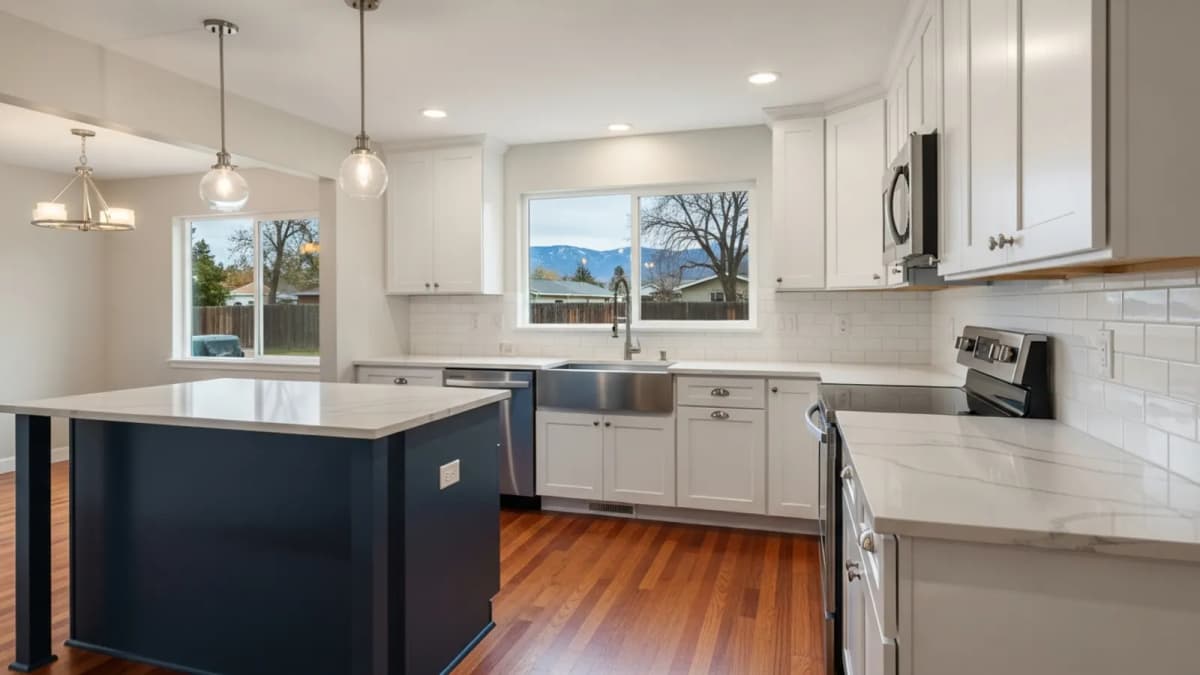
Galley conversions, post-war ranch open-ups, modern aesthetics on 1950s and 1960s housing stock — kitchen design that respects original mid-century bones while delivering today's livability.
Quick answer
Three main differences. First: the Bench is not in a Historic District, so there's no Historic Preservation Commission review. The Certificate of Appropriateness step drops out of the schedule entirely.
The Boise Bench is one of the fastest-changing kitchen-remodel markets in the entire Treasure Valley right now — and for one specific reason. The mid-century housing stock that defines the Bench (1940s minimal traditionals, 1950s post-war ranches, 1960s split-levels, 1970s expanded ranches) was built around galley kitchens and closed-off floor plans that worked for the era but feel impossibly cramped to modern households. The Bench was traditionally a working-class neighbourhood priced below the North End and Hyde Park, and buyers priced out of those neighbourhoods have been moving into it. We do not publish figures for what a renovated Bench house is worth — that is a question for your agent, with local comparable sales behind it. The result we do see: kitchen remodeling demand on the Bench has grown sharply since 2020. Unlike the North End, there's no Historic District review to slow things down, so the Certificate of Appropriateness step drops out of the schedule entirely.
The Bench's mid-century housing stock divides into four overlapping eras. Each has its own kitchen layout conventions, original materials, and remodel sensibilities.
1940–1950: Minimal traditional and early post-war
The earliest Bench housing wave — small one-and-a-half story homes with steep roof pitches, simple massing, and original kitchens tucked into back corners. Original cabinets are typically painted wood with single-knob hardware; counters are honestly-aged Formica or post-form laminate; floors are linoleum (often containing asbestos in pre-1980 installations). Kitchens were closed off from dining rooms by partition walls. Galvanized steel supply lines and cast-iron drains throughout.
1950–1965: Classic post-war ranch
The defining Bench housing type. Single-story ranches on uniform lots. Original kitchens configured as galleys (two-wall configuration with 36–42″ between facing counters) or small L-shapes. Steel slab cabinets, Formica counters, drop-ceiling fluorescent lighting in 2x2 grid panels, original linoleum tile flooring (asbestos-bearing), single overhead globe fixture for general lighting. Mechanical baseline: copper supply (replacing earlier galvanized in many homes), cast-iron drains, 100-amp electrical service typical.
1965–1975: Expanded ranch and early split-level
Larger ranches and split-level homes with somewhat more generous kitchens. Original cabinets shifted from steel slab to oak or maple stained wood with raised-panel doors; counters from Formica to early-generation tile or laminate; flooring from linoleum to early vinyl sheet or 12-inch ceramic tile. Drop ceilings still common; first-generation wall ovens and cooktops increasingly seen. Many of these homes have aluminum siding from later 1970s–1980s updates.
1985–present: Infill and modernized rebuilds
Modern homes built on Bench lots where original homes were demolished, plus original homes that were comprehensively renovated in the 1990s–2010s. Modern kitchens with current mechanical systems and no environmental complications — though 1990s renovations often have their own dated aesthetic (oak cabinets, beige tile, fluorescent troffer lighting) that warrants its own update.
Bench kitchen projects fall into recognizable shapes shaped by the mid-century housing stock and the absence of Historic District constraints.
1. The Galley Open-Up — wall removal between kitchen and living/dining
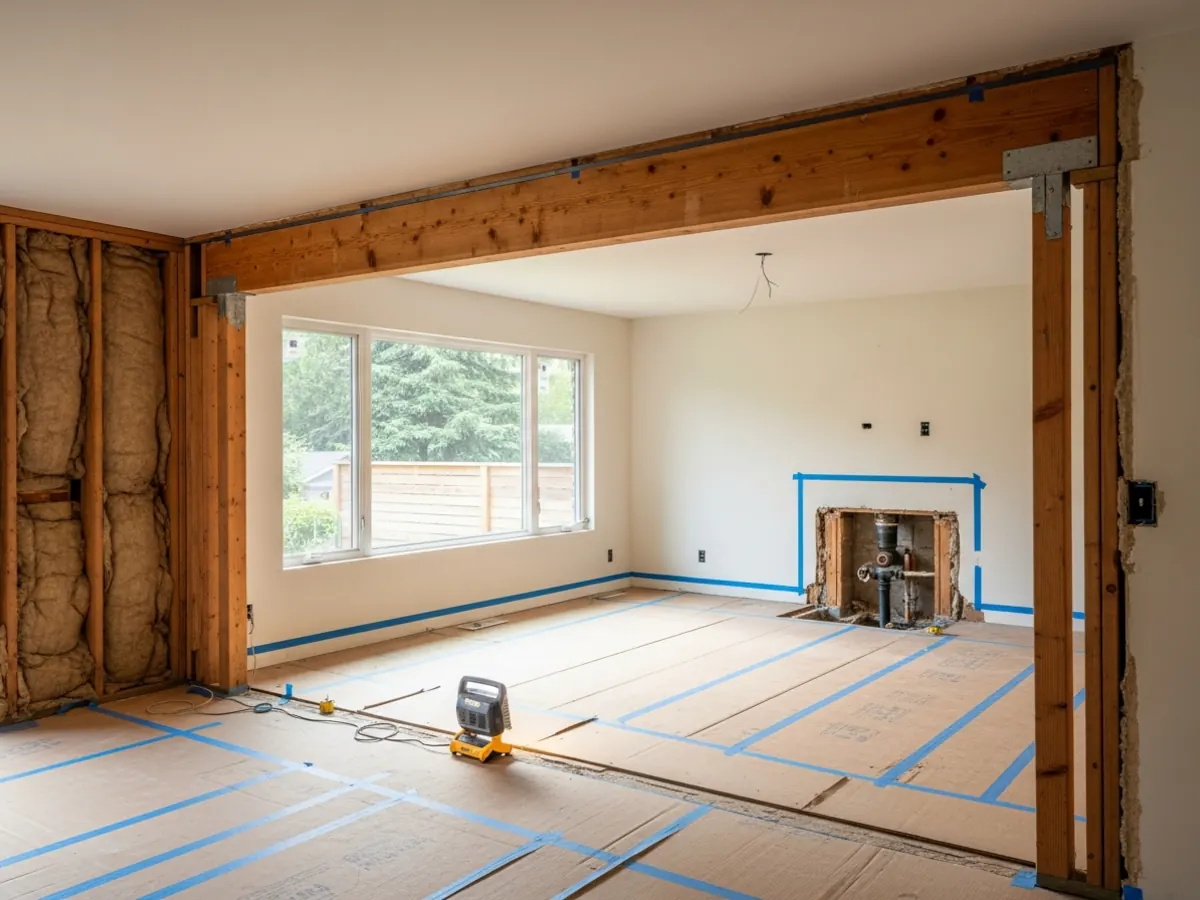
The dominant Bench kitchen project. Remove the wall between the original galley kitchen and the adjacent living or dining room (almost always load-bearing — requires structural engineer's stamp and an LVL or PSL beam), reconfigure the resulting space as an L-shape with a peninsula or island providing seating. The transformation is dramatic — a 100-square-foot dark galley becomes a 200+ square-foot connected cooking-and-gathering space flooded with light from the picture windows that define mid-century ranch architecture. Combined with cabinet replacement, quartz counters, and LVP or refinished oak flooring, all-in cost typically lands at $62,000–$85,000.
Target homes: 1950–1975 Bench ranches and split-levels. Permit: building permit with structural drawings required.
2. The Cosmetic Modernization — cabinet replacement, no structural
For Bench kitchens with sound layouts that just need aesthetic and surface modernization. Standard scope: replace cabinets with semi-custom shaker in painted finish (white, navy, or two-tone), replace counters with quartz, replace flooring with LVP or refinished original oak, update appliances, replace the dropped fluorescent ceiling with recessed cans and pendants. No wall removal, no structural work, no major plumbing or gas relocation. The fastest Bench kitchen scope by timeline.
Target homes: Bench homes where the existing footprint and layout work. Permit: electrical and plumbing permits typical; no building permit required if no structural change.
3. The Full Reconfigure — moving sink, range, and adding island
More aggressive than cosmetic modernization but less than the galley open-up. Moves major appliance locations, adds a true island (where the original layout had no island), and reroutes plumbing and gas. Often combined with relocating the kitchen entry point, swapping a window for a slider to the back yard, or capturing space from an adjacent pantry or closet. Doesn't require wall removal but does require permit-level plumbing and mechanical work.
Target homes: Bench homes where the layout itself is the constraint, not just the surfaces. Permit: building, plumbing, and electrical permits.
4. The Kitchen + Dining Combine — absorbing a formal dining room
Some Bench homes (especially 1965–1975 expanded ranches and splits) have a formal dining room adjacent to the kitchen that's never used for formal dining. The combine: remove the partition wall, extend kitchen cabinets and flooring into the unified space, add a large island with seating that anchors the new combined room. Footprint can grow from 130 sq ft to 300+ sq ft, dramatically improving the home's entertaining capacity without an addition.
Target homes: Bench homes with adjacent kitchen and formal dining rooms. Permit: building permit (structural assessment of the partition wall required).
5. The Mechanical Modernization Bundle — new electrical, supply, drains
Bundled with any other kitchen scope: full mechanical update of the kitchen-supporting infrastructure. New 200-amp electrical service replacing original 100-amp, dedicated kitchen circuits, replace any remaining galvanized supply with PEX or copper, replace cast-iron drains where deterioration warrants, add code-compliant range hood with proper exterior venting, add or replace dishwasher water/drain with code-compliant air-gap fitting. Almost every pre-1975 Bench kitchen needs some version of this bundle.
Target homes: Any pre-1975 Bench home where mechanical baseline is original. Permit: electrical, plumbing, and mechanical permits.
The Boise Bench is made up of distinct sub-neighborhoods, each with its own remodeling personality.
Vista
One of the most recognized sub-neighborhoods on the Boise Bench, centered around Vista Avenue between the Boise River and Overland Road. Post-war homes on uniform lots with mature street trees and good walkability to local commercial corridors. A heavy concentration of small ranch and minimal-traditional homes that respond well to galley-kitchen open-ups, primary-suite additions, and aesthetic modernization.
Central Bench (Curtis & Targee corridor)
The geographic core of the Bench, running along Curtis Road and Targee Street between I-84 and Overland. The City of Boise's Central Bench Neighborhood Plan records that the neighbourhood changed significantly during and after World War II, when agricultural land was subdivided into residential lots, and that new homes were built west of Orchard Street from the mid-1950s through the 1970s. Blueprint Boise designates the Central Bench primarily for compact-neighbourhood form — small lots, typically between 5,000 and 7,000 square feet, predominantly single-family, on an interconnected network of sidewalks and streets. Galley kitchen conversions are the dominant remodeling project type here.
Eastern Bench / Overland
The eastern edge of the Bench around Overland Road, with a mix of ranch and split-level homes. Lots tend to be slightly larger. Closer to mall-adjacent commercial corridors and major transit routes.
Western Bench / Roosevelt Market area
The western edge of the Bench near the Roosevelt Market and Capitol corridor. Some of the older Bench housing stock sits here, with steeper roof pitches and smaller footprints than the post-war ranches further east. Closer to downtown amenities and walkable.
Greenbelt-adjacent Bench
Bench properties along the elevated edges of the Boise River bluff with views down to the Greenbelt and the river. Frequently subject to view-preserving design considerations during exterior work — though without formal Historic District constraints.
Lower Bench (I-84 frontage)
The southern edge of the Bench close to I-84, on smaller lots and often with more traffic noise from the freeway. Common to combine kitchen, bathroom, and primary-suite remodels into a single comprehensive scope.
Most Boise kitchen remodel projects run $22,000 to $145,000 — the band published on our Boise kitchen remodel page. Bench pricing sits inside that band: the absence of Historic District review and the more straightforward post-war framing pull it down, while environmental remediation on pre-1980 stock pulls it back up.
Boise Bench kitchen remodeling ranges
Cosmetic refresh (cabinet repainting, new counters, new flooring, no structural or major mechanical changes): $22,000–$38,000 / 4–6 weeks end to end
Standard remodel (new cabinets, quartz, LVP, lighting, backsplash, appliance package, no wall removal): $45,000–$65,000 / 5–7 weeks end to end
Full reconfigure (moving sink/range, adding island, plumbing and gas relocation, no wall removal): $55,000–$70,000 / 7–10 weeks end to end
Galley open-up (load-bearing wall removal, beam install, full kitchen replacement): $62,000–$85,000 / 8–12 weeks end to end
Kitchen + dining combine (absorb adjacent formal dining room into expanded kitchen, structural work): $85,000–$145,000 / 9–13 weeks end to end
All ranges assume Iron Crest's standard scope: full City of Boise permitting, asbestos and lead environmental testing and required abatement on any pre-1980 home, EPA RRP lead-safe work practices for pre-1978 homes, structural engineering when required, semi-custom cabinetry, quartz countertops, LVP or engineered hardwood flooring, all new fixtures and lighting, and a 3-year workmanship warranty. Contingency budget of 12–15% above contract value should be held for older-home discovery work.
The City of Boise designates ten historic districts, and the Boise Bench is not one of them and does not sit inside one. There is no Historic Preservation Commission review for exterior modifications, so siding changes, window replacements, additions, and exterior colour changes don't trigger the Certificate of Appropriateness process that constrains North End and East End projects. That removes a review step from the pre-construction schedule on any Bench exterior scope; confirm current review timelines with Boise PDS for your specific project.
City of Boise standard permits still apply for any work involving electrical, plumbing, structural changes, or mechanical systems. A scope that includes new circuit additions, moving a gas line, or removing a load-bearing wall requires a building permit from City of Boise Planning and Development Services. Permit processing for Bench projects takes about two weeks for online plan review per Boise PDS, longer with structural drawings — without the historic-review overlay that North End projects carry. Building Division: (208) 608-7070. Planning & Zoning: (208) 608-7100.
Asbestos and lead paint remain serious considerations on the Bench, despite the absence of Historic District review. Pre-1980 Bench homes (which is most of the housing stock) commonly contain asbestos in floor tiles, joint compound, and sometimes pipe insulation. We test suspect pre-1980 materials and arrange AHERA-accredited abatement when asbestos is confirmed. Pre-1978 Bench homes contain lead paint. The EPA RRP rule requires lead-safe work practices for any renovation in lead-paint homes — including containment, specialized HEPA vacuuming, and proper disposal. Iron Crest follows EPA RRP lead-safe work practices and incorporates them into the standard scope on every pre-1980 Bench project.
Bench-specific permit consideration: setbacks. Blueprint Boise designates the Central Bench primarily for compact-neighbourhood form, with small lots typically between 5,000 and 7,000 square feet, so additions or detached structures must navigate side and rear setbacks carefully. Boise's residential zoning code sets no maximum lot coverage, so the binding constraint on a Bench addition is almost always the setback envelope rather than a coverage percentage. Zoning verification during initial design is critical to avoid late-stage redesigns.
Material strategy for Bench kitchens differs from North End — these are mid-century homes, not pre-1940 Craftsman or Tudor. Period-correct here means clean modern lines, not period-restoration aesthetics. The right material decisions read as a deliberate update of mid-century bones rather than a Craftsman costume change.
Cabinetry
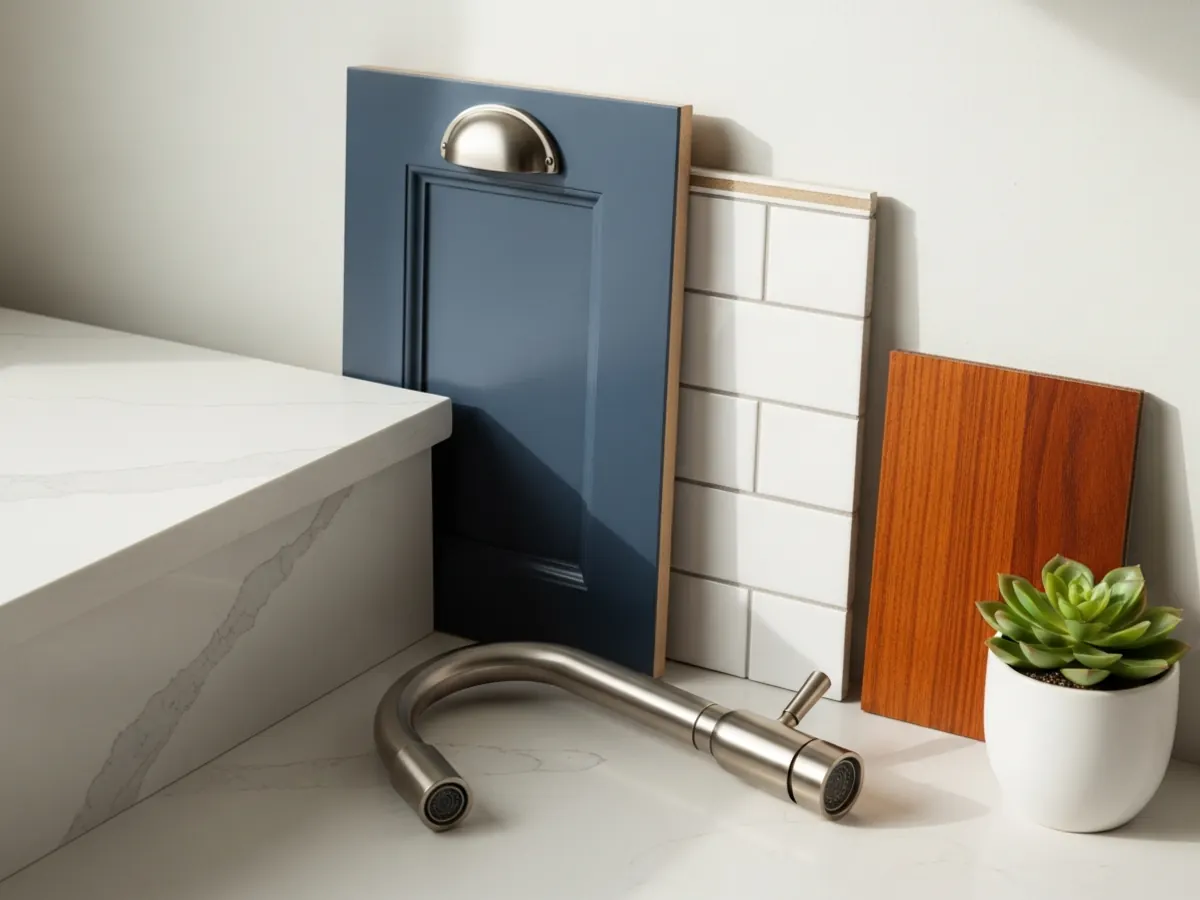
Full-overlay shaker or flat-panel doors in painted finish are the modern Bench default. Two-tone configurations (white perimeter + navy island, or warm white perimeter + sage green island) read as deliberate and contemporary. Color palette: Benjamin Moore Simply White, Sherwin Williams Pure White (perimeter); Hale Navy, Black Forest Green, Naval, or Iron Mountain (island or accent). Inset cabinet construction is overkill for mid-century context; full-overlay reads cleaner and costs less. Avoid: ornate raised-panel doors (too traditional for mid-century context), oak stained finishes (read as 1980s).
Countertops
Quartz is the dominant choice and the right one for Bench kitchens. White quartz with subtle gray veining (Caesarstone Statuario Maximus, Silestone Calacatta Gold, Cambria Brittanicca) is the most-requested and most broadly compatible. For accent islands or two-tone schemes, darker quartz (charcoal, leathered slate) provides contrast. Waterfall edge on island is a contemporary feature that fits mid-century aesthetic. Granite is acceptable in budget-conscious projects but feels dated next to quartz in 2026 listings. Marble is rarely the right call for mid-century kitchens — too period-traditional.
Flooring
LVP (luxury vinyl plank) in mid-tone wood look is the most-installed Bench kitchen flooring — durable, water-resistant, dimensionally stable through Boise's humidity swings, low-maintenance, and reads visually as wood without solid wood's seasonal movement. For homes where original red oak strip flooring extends into the kitchen and is in good condition, refinishing is the strongest single decision — original mid-century oak is irreplaceable and ties the kitchen to the rest of the home. Engineered oak hardwood is appropriate when matching adjacent original wood. Avoid: 12-inch ceramic tile floors (the 1990s Bench default; reads dated), large-format porcelain that's overly contemporary for the home's bones.
Backsplash
Subway tile in 3x6 or 4x12 with thin sanded grout joint is the safe Bench default. Matte or honed finish reads more contemporary than glossy. Stack pattern (rather than offset) is the modern choice. For more design statement, large-format porcelain slab behind the range (one piece up to 5×5 feet, no grout joints) is a clean modern feature. Tile patterns from the 1980s–2000s (sage green diamonds, terracotta tumbled stone) are exactly what's being torn out — avoid recreating that look.
Lighting
Layered modern lighting: recessed cans for general illumination, pendants over the island in mid-century-style profiles (smoked glass, brushed brass, or matte black), under-cabinet LED strips for counter task lighting, an accent fixture (sconce or chandelier) over the eat-in area if applicable. The dropped fluorescent ceiling that's standard in pre-1985 Bench kitchens should be removed entirely; the gained ceiling height (typically 6–10 inches) is one of the highest-impact changes. Color temperature: 2700K–3000K reads warm and current.
Hardware & fixtures
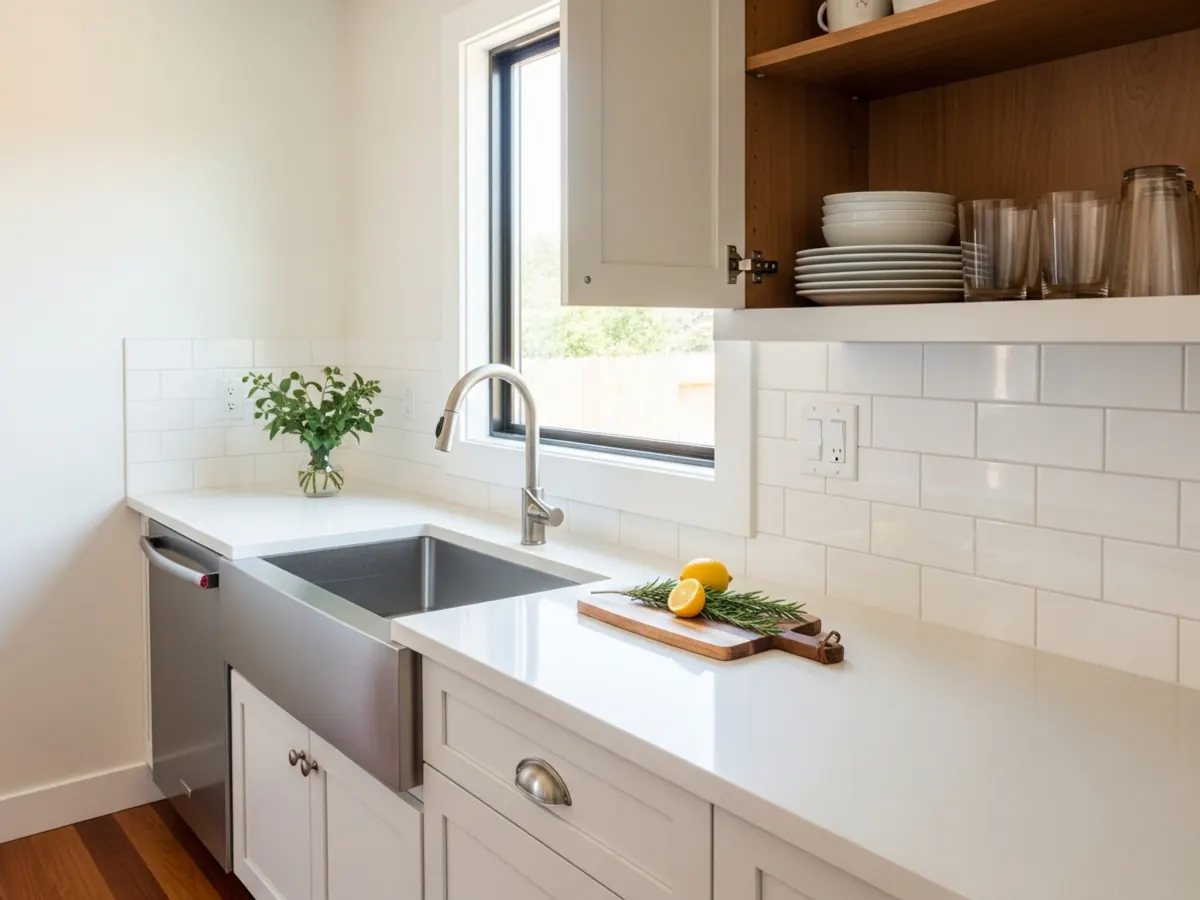
Brushed nickel, polished chrome, or matte black are the three contemporary finish families that work in Bench mid-century kitchens. Brushed nickel is the most broadly compatible. Avoid: polished gold, brushed gold, polished brass — these read as 1990s revival. Cabinet hardware: simple bar pulls (4″, 6″, 8″ depending on cabinet width) in matching finish. Faucet: single-handle gooseneck pull-down is the modern standard; bridge faucets are too period-traditional for mid-century context. Apron-front sink in stainless or white fireclay is broadly compatible. Single-bowl 30″–33″ sink fits mid-century proportions.
Bench kitchen demolition routinely uncovers conditions specific to mid-century construction. These items are predictable based on the home's age — build them into your contingency budget.
- •Galvanized steel supply lines. Common in pre-1965 Bench homes that haven't had whole-house repipe. Internal corrosion reduces flow capacity, often severely. Replacement from main shutoff to fixtures with PEX or copper. $1,200–$3,500 typical.
- •Cast iron drain stack deterioration. Original cast iron drains 60–80 years old sometimes show advanced corrosion. Replacement of kitchen drain back to main stack: $1,500–$3,500.
- •Asbestos in original linoleum and joint compound. Pre-1980 Bench homes very commonly contain asbestos in 9-inch and 12-inch vinyl floor tiles, sheet linoleum, and in joint compound at drywall seams. Testing suspect materials identifies extent; AHERA-accredited abatement handles confirmed asbestos before disturbance: $1,500–$5,000 typical for a Bench kitchen.
- •Lead paint on cabinets, walls, and trim. Universal in pre-1978 Bench homes. EPA RRP lead-safe work practices required for any disturbance. Built into Iron Crest's labor pricing for pre-1978 homes.
- •Undersized 100-amp electrical panel. Original 100-amp service is common in pre-1975 Bench homes. Modern kitchen loads (induction range, dishwasher, microwave, refrigerator with ice maker, garbage disposal, lighting) need 200-amp service. Panel upgrade with new meter base coordination through Idaho Power: $3,500–$5,500.
- •Drop ceiling concealing dated soffits or duct runs. The dropped fluorescent ceiling that's standard in pre-1985 Bench kitchens often conceals plumbing reroutes, HVAC duct runs, or original dated soffits. Removing the drop ceiling for higher modern ceiling height sometimes reveals work that needs cleanup or reconfiguration. $400–$2,500.
- •Subfloor damage from undetected leaks. Original subfloors 60–80 years old sometimes have localized water damage under sinks, dishwashers, or refrigerators. Patch repair: $400–$1,200. Larger damaged area: $1,500–$3,500.
- •Range hood venting routing through interior chases. Many original Bench kitchens have no exterior wall on the cooking elevation, requiring creative duct routing through ceiling soffits or interior chases to reach the exterior. Custom ducting: $800–$2,500 above standard install.
- •Foundation issues affecting cabinet level. Some Bench homes have minor foundation settlement that creates floor unlevel issues. Cabinet installation requires shimming, scribing, and sometimes filler panels. Standard scope addresses minor cases; major level adjustments: $500–$1,500.
Consultation and home assessment (Week 1)
In-home walkthrough at no cost. We measure the kitchen, photograph existing conditions, identify mechanical concerns (panel age, supply line type, asbestos likelihood, drop ceiling status), discuss your goals.
Environmental testing and structural assessment (Weeks 1–2)
Asbestos and lead testing on suspect materials. Structural engineer's assessment for any wall proposed for removal — typically a 60-minute site visit followed by stamped drawings within 1–2 weeks.
Design finalization and detailed estimate (Weeks 2–3)
Cabinet layout, material selections, fixture and appliance specifications, and a line-item estimate with the contingency budget called out separately.
Permitting and material ordering (Weeks 3–6)
We submit building, electrical, and plumbing permit applications to City of Boise Planning & Development Services. Online plan review takes about two weeks per Boise PDS, longer with structural drawings (and no historic review overlay, unlike the North End). Cabinet order placed simultaneously (typical 4–8 week lead).
Asbestos/lead abatement and demolition
AHERA-accredited abatement handles any confirmed asbestos. Once cleared, containment and demolition begin. ZipWall barriers and HEPA air scrubbers protect the rest of your home.
Structural and mechanical rough-ins
Wall removal, beam installation if applicable, framing modifications, plumbing rough-in, electrical rough-in (panel upgrade and dedicated kitchen circuits), HVAC and range hood ducting. City of Boise inspections at each rough-in milestone.
Insulation, drywall, and finish prep
Open exterior walls insulated to current energy code (existing 2×4 cavities filled). Drywall installation. Drop ceiling removal and proper ceiling drywall install at higher height if scope. Prep for paint and finish work.
Cabinet, countertop, and finish installation
Cabinet delivery and installation. Countertop template and install. Backsplash, flooring, lighting, fixtures, appliances. Final paint.
Final inspections and walkthrough
City of Boise final inspections (electrical, plumbing, building). Punch-list walk with you. Items addressed within 1 week. Final walkthrough and sign-off. 3-year workmanship warranty begins.
Bench kitchen remodels are a different specialty from North End or Harris Ranch work. Mid-century housing stock has its own rhythms — galley conversions, drop-ceiling removal, asbestos abatement, undersized electrical service, original aluminum windows that may need replacing during the same project. The contractor who excels in 2010 Meridian subdivisions is often surprised by what a 1962 Bench ranch delivers.
- City of Boise Planning & Development Services — Building, electrical, plumbing, and mechanical permits. Online portal and in-person plan check.
- Idaho DEQ Air Quality (Asbestos) — Testing and abatement guidance for pre-1980 homes via the Idaho Department of Environmental Quality.
- EPA Lead Renovation, Repair and Painting (RRP) Program — Required certification and work practices for renovation in pre-1978 lead-paint homes.
- Idaho Power — Rebates & Offers — Idaho Power's residential incentives: the Heating and Cooling Efficiency Program (heat pumps, central air conditioners, duct sealing, smart thermostats, heat pump water heaters, whole-house fans and similar equipment), the A/C Cool Credit, and the Shade Tree Project. Windows and insulation are not covered.
- Idaho DOPL — Contractor Search — Verify any contractor's RCE registration through the official Idaho DOPL license search.
How is a Boise Bench kitchen remodel different from a North End kitchen remodel?
Three main differences. First: the Bench is not in a Historic District, so there's no Historic Preservation Commission review. The Certificate of Appropriateness step drops out of the schedule entirely. Second: the housing stock is mid-century (1940s–1970s) rather than Craftsman or Tudor (pre-1940). Aesthetic expectation is clean modern lines rather than period restoration. Third: environmental remediation costs (asbestos, lead) are the same as in any pre-1980 Boise home, so the saving comes from the permit path and the framing rather than from the remediation.
What's the most common Bench kitchen project?
The galley open-up. Original mid-century Bench kitchens are almost universally configured as galleys — narrow two-wall configurations between front of house and back yard. Removing one wall (almost always load-bearing — requires structural engineer and an LVL or PSL beam), reconfiguring the resulting space as L-shape with peninsula or island. Result: a 100-square-foot dark galley becomes 200+ square feet connected and light-filled. Cost typically $62,000–$85,000 all-in, timeline 8–12 weeks end to end (1–2 weeks on site).
Should I worry about asbestos and lead paint in my Bench home?
Yes — both are essentially universal in pre-1980 Bench homes and both must be addressed before demolition. Pre-1980 vinyl floor tiles, sheet flooring, and joint compound frequently contain asbestos; pre-1978 paint layers are likely lead-based. We test suspect pre-1980 materials and arrange AHERA-accredited abatement when asbestos is confirmed. The EPA RRP rule requires lead-safe work practices, which Iron Crest follows, and we coordinate environmental testing as standard pre-construction. Budget $300–$600 for testing and $1,800–$5,000 for abatement.
How much does a Bench kitchen remodel cost?
$22,000–$145,000 depending on scope. Cosmetic refresh (cabinet repainting, new counters, new flooring, no structural): $22,000–$38,000. Standard remodel (new cabinets, quartz, LVP, no wall removal): $45,000–$65,000. Galley open-up with wall removal: $62,000–$85,000. Full kitchen + dining combine with structural work: $85,000–$145,000. Each estimate is line-item with contingency called out separately.
Do I need to remove my drop ceiling?
Almost always yes. The dropped fluorescent ceiling that's standard in pre-1985 Bench kitchens conceals 6–10 inches of ceiling height that dramatically improves the room's sense of space when removed. The original ceiling drywall behind the drop ceiling is often dated or damaged and warrants replacement. New recessed can lighting and pendants installed at the higher ceiling height read as completely modern. The ceiling height gain is one of the highest-impact changes in any Bench kitchen remodel.
What about my 100-amp electrical service?
Most Bench kitchen remodels include a panel upgrade to 200-amp service. Modern kitchen loads (induction range, dishwasher, microwave, refrigerator, garbage disposal, lighting circuits, plus dedicated circuits for any island appliances) regularly exceed 100-amp capacity. Upgrade includes panel replacement, new meter base coordination through Idaho Power (typically a same-day reconnection), and dedicated circuits for kitchen appliances. Cost: $3,500–$5,500 with City of Boise electrical permit.
Can you preserve my original oak strip floors during a Bench kitchen remodel?
Often yes, and we strongly recommend it. Original 2 1/4-inch red oak strip flooring in 1950s–1970s Bench homes is irreplaceable old-growth wood. If the floor extends into the kitchen and is structurally sound (no severe water damage), refinishing rather than replacement is the best decision — saves the original wood, preserves visual continuity with the rest of the home, costs less than new flooring install. Where original wood is missing or beyond rescue (water damage, severe wear), engineered red oak in matching tone and width is the right replacement.
Will I get my investment back if I sell?
We will not quote you a recovery percentage. The national remodeling surveys are not Ada County appraisal data, and we have no resale study of our own to cite — anyone who gives you a number for a Bench kitchen is guessing or repeating a national average. What we can say honestly: for owners staying long-term, the daily return on a kitchen that works is immediate, and for owners selling, your agent can pull comparables on Vista or Curtis / Targee and tell you what renovated kitchens are doing on those streets.
Ready to start your Boise Bench kitchen remodeling project?
Free in-home consultation, honest contingency-based budgeting, and the experience Boise homes require. Iron Crest Remodel — Idaho RCE #6681702, EPA RRP lead-safe work practices, $2M general liability, 3-year workmanship warranty.
Get Your Free Estimate