
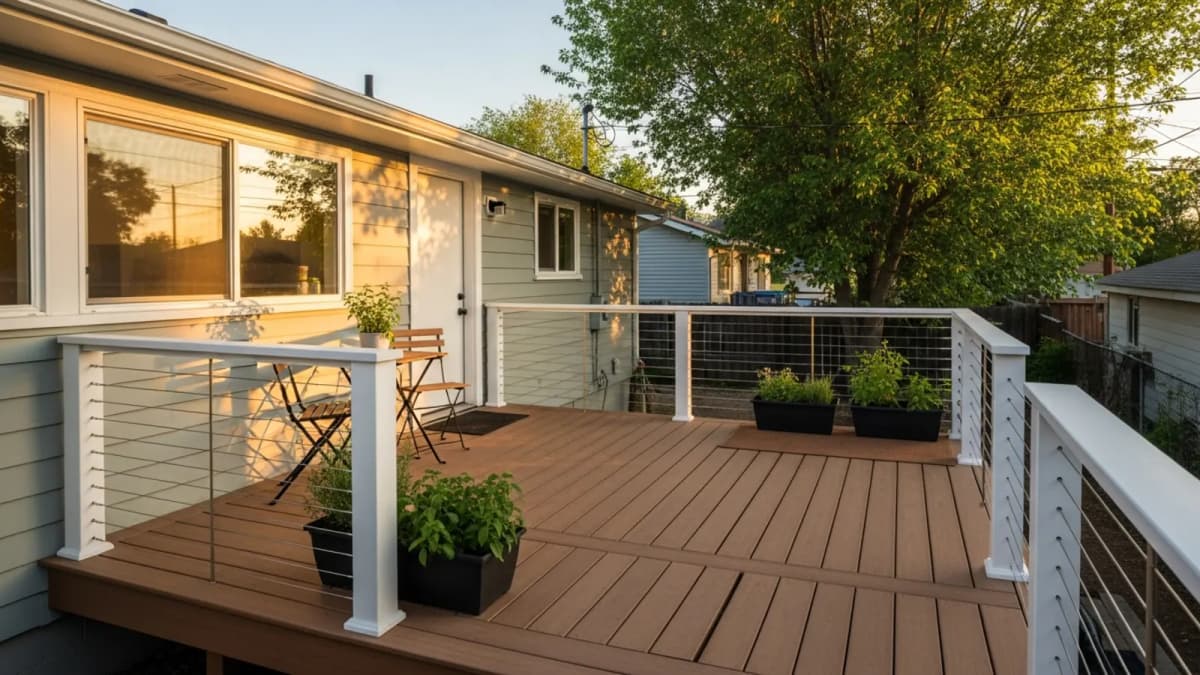
Deck Construction on the Boise Bench
Composite, cedar, and wood decks for Bench mid-century ranches — modern design that complements ranch architecture, with the structural rigor Boise's freeze-thaw climate demands.
Quick answer
No. The Boise Bench is not within a Historic District. Standard City of Boise building permit only — processing time varies by season.
Building a deck on a Bench home is straightforward in some ways and exacting in others. The lots are uniform (typically compact alley-access lots), the back-yard access is good (most Bench blocks have alley access), and there's no Historic District review to slow things down. The exacting parts: Boise's 24-inch frost depth requires properly engineered concrete footings, and the architectural language of mid-century ranch homes calls for clean modern deck designs that complement rather than compete with the home's character — composite decking in warm wood tones, simple modern railing, painted railing posts matching house trim. Iron Crest brings the structural engineering, design sense, and operational experience these projects require.
Deck strategy varies by era because the home's architectural character and original outdoor-living conventions set what a sympathetic deck looks like.
1940–1955: Early post-war minimal traditional
Original homes typically had simple covered front porches and minimal back-yard outdoor structures. Deck additions are essentially new construction — designed in modern vocabulary that respects the home's simple character.
1955–1965: Classic post-war ranch
Most original homes had a concrete patio rather than a deck. Modern deck additions can either complement or replace the existing concrete patio. Single-story massing makes deck connection straightforward.
1965–1975: Expanded ranch and split-level
Larger homes occasionally had original wood decks (now usually beyond service life). Replacement decks designed in modern vocabulary. Split-levels sometimes benefit from multi-level deck designs that step down to grade.
1985–present: Infill and renovated homes
Modern construction. Deck additions follow standard practice.
Bench deck projects fall into recognizable shapes based on home era, lot configuration, and intended use.
1. The Modest Rear Deck — outdoor dining for 4–6
12' × 16' to 14' × 20' rear deck with composite decking, painted wood railing posts matching house trim color, simple cable or wood balusters, two stairs down to grade. Sized for a small dining table with 4–6 chairs and a grill.
Target homes: Bench homes wanting basic outdoor dining and entertaining space. Permit: building permit required for any deck more than 12″ above grade.
2. The Generous Rear Deck — outdoor living + dining
16' × 24' to 18' × 28' rear deck with multiple zones — outdoor dining, lounge seating, sometimes a covered area with pergola. Composite decking, more elaborate railing, integrated lighting.
Target homes: Bench homes with rear yard depth supporting larger structure. Permit: building permit.
3. The Multi-Level Deck — terraced outdoor living
Two or three levels with stair transitions between, often used to address grade changes in the back yard or to create distinct functional zones.
Target homes: Bench homes with sloped or multi-grade back yards (less common than North End but present on some lots). Permit: building permit with structural drawings.
4. The Covered Deck — pergola or solid roof
Standard rear deck with a pergola, louvered roof, or solid covered roof structure providing shade and weather protection. Roof design must complement the home's existing roof line and material.
Target homes: Bench homes wanting outdoor space usable in more weather conditions. Permit: building permit.
5. The Patio Replacement — concrete to deck conversion
Remove existing concrete patio (or build over it) and replace with composite deck. Often raises the deck slightly above grade for better drainage and for connection to the home at floor level.
Target homes: Bench homes with original concrete patios that owners want to upgrade to deck.
The Boise Bench is made up of distinct sub-neighborhoods, each with its own remodeling personality.
Vista
One of the most recognized sub-neighborhoods on the Boise Bench, centered around Vista Avenue between the Boise River and Overland Road. Post-war homes on uniform lots with mature street trees and good walkability to local commercial corridors. A heavy concentration of small ranch and minimal-traditional homes that respond well to galley-kitchen open-ups, primary-suite additions, and aesthetic modernization.
Central Bench (Curtis & Targee corridor)
The geographic core of the Bench, running along Curtis Road and Targee Street between I-84 and Overland. The City of Boise's Central Bench Neighborhood Plan records that the neighbourhood changed significantly during and after World War II, when agricultural land was subdivided into residential lots, and that new homes were built west of Orchard Street from the mid-1950s through the 1970s. Blueprint Boise designates the Central Bench primarily for compact-neighbourhood form — small lots, typically between 5,000 and 7,000 square feet, predominantly single-family, on an interconnected network of sidewalks and streets. Galley kitchen conversions are the dominant remodeling project type here.
Eastern Bench / Overland
The eastern edge of the Bench around Overland Road, with a mix of ranch and split-level homes. Lots tend to be slightly larger. Closer to mall-adjacent commercial corridors and major transit routes.
Western Bench / Roosevelt Market area
The western edge of the Bench near the Roosevelt Market and Capitol corridor. Some of the older Bench housing stock sits here, with steeper roof pitches and smaller footprints than the post-war ranches further east. Closer to downtown amenities and walkable.
Greenbelt-adjacent Bench
Bench properties along the elevated edges of the Boise River bluff with views down to the Greenbelt and the river. Frequently subject to view-preserving design considerations during exterior work — though without formal Historic District constraints.
Lower Bench (I-84 frontage)
The southern edge of the Bench close to I-84, on smaller lots and often with more traffic noise from the freeway. Common to combine kitchen, bathroom, and primary-suite remodels into a single comprehensive scope.
Most Boise deck projects run $18,000 to $95,000 and up — the band published on our Boise deck page. Bench pricing sits at the lower part of that band, reflecting mid-tier or premium composite decking material cost, properly engineered footings for Boise's 24-inch frost depth, and the operational efficiency of working on uniform Bench lots with good alley access.
Boise Bench deck construction ranges
Modest rear deck (12x16 to 14x20) (composite decking, simple railing, basic stairs): $11,000–$22,000 / 3–5 weeks end to end
Patio-to-deck conversion (remove or build over concrete, install composite deck): $14,000–$28,000 / 4–7 weeks end to end
Generous rear deck (16x24 to 18x28) (composite decking, decorative railing, multiple zones, integrated lighting): $24,000–$36,000 / 5–8 weeks end to end
Multi-level deck (terraced design with multiple framing levels): $28,000–$48,000 / 6–9 weeks end to end
Covered deck add-on (pergola, louvered roof, or solid roof above base deck): $18,000–$38,000 incremental / +2–4 weeks end to end
Pricing assumes Iron Crest's standard scope: full City of Boise building permit, properly engineered concrete footings to 24-inch frost depth, pressure-treated joists and beams, premium composite decking (Trex, TimberTech, or equivalent), painted-finish railing posts matching house color, code-compliant guard rail and stair detailing, and a 3-year workmanship warranty + manufacturer material warranty (terms vary by composite product line; confirm with the manufacturer).
The City of Boise designates ten historic districts, and the Boise Bench is not one of them and does not sit inside one. There is no Historic Preservation Commission review for exterior modifications, so siding changes, window replacements, additions, and exterior colour changes don't trigger the Certificate of Appropriateness process that constrains North End and East End projects. That removes a review step from the pre-construction schedule on any Bench exterior scope; confirm current review timelines with Boise PDS for your specific project.
City of Boise standard permits still apply for any work involving electrical, plumbing, structural changes, or mechanical systems. A scope that includes new circuit additions, moving a gas line, or removing a load-bearing wall requires a building permit from City of Boise Planning and Development Services. Permit processing for Bench projects takes about two weeks for online plan review per Boise PDS, longer with structural drawings — without the historic-review overlay that North End projects carry. Building Division: (208) 608-7070. Planning & Zoning: (208) 608-7100.
Asbestos and lead paint remain serious considerations on the Bench, despite the absence of Historic District review. Pre-1980 Bench homes (which is most of the housing stock) commonly contain asbestos in floor tiles, joint compound, and sometimes pipe insulation. We test suspect pre-1980 materials and arrange AHERA-accredited abatement when asbestos is confirmed. Pre-1978 Bench homes contain lead paint. The EPA RRP rule requires lead-safe work practices for any renovation in lead-paint homes — including containment, specialized HEPA vacuuming, and proper disposal. Iron Crest follows EPA RRP lead-safe work practices and incorporates them into the standard scope on every pre-1980 Bench project.
Bench-specific permit consideration: setbacks. Blueprint Boise designates the Central Bench primarily for compact-neighbourhood form, with small lots typically between 5,000 and 7,000 square feet, so additions or detached structures must navigate side and rear setbacks carefully. Boise's residential zoning code sets no maximum lot coverage, so the binding constraint on a Bench addition is almost always the setback envelope rather than a coverage percentage. Zoning verification during initial design is critical to avoid late-stage redesigns.
Deck material selection for Bench homes balances longevity in Boise's climate, modern aesthetic that complements mid-century ranch architecture, and budget.
Composite decking (Trex, TimberTech, Fiberon)
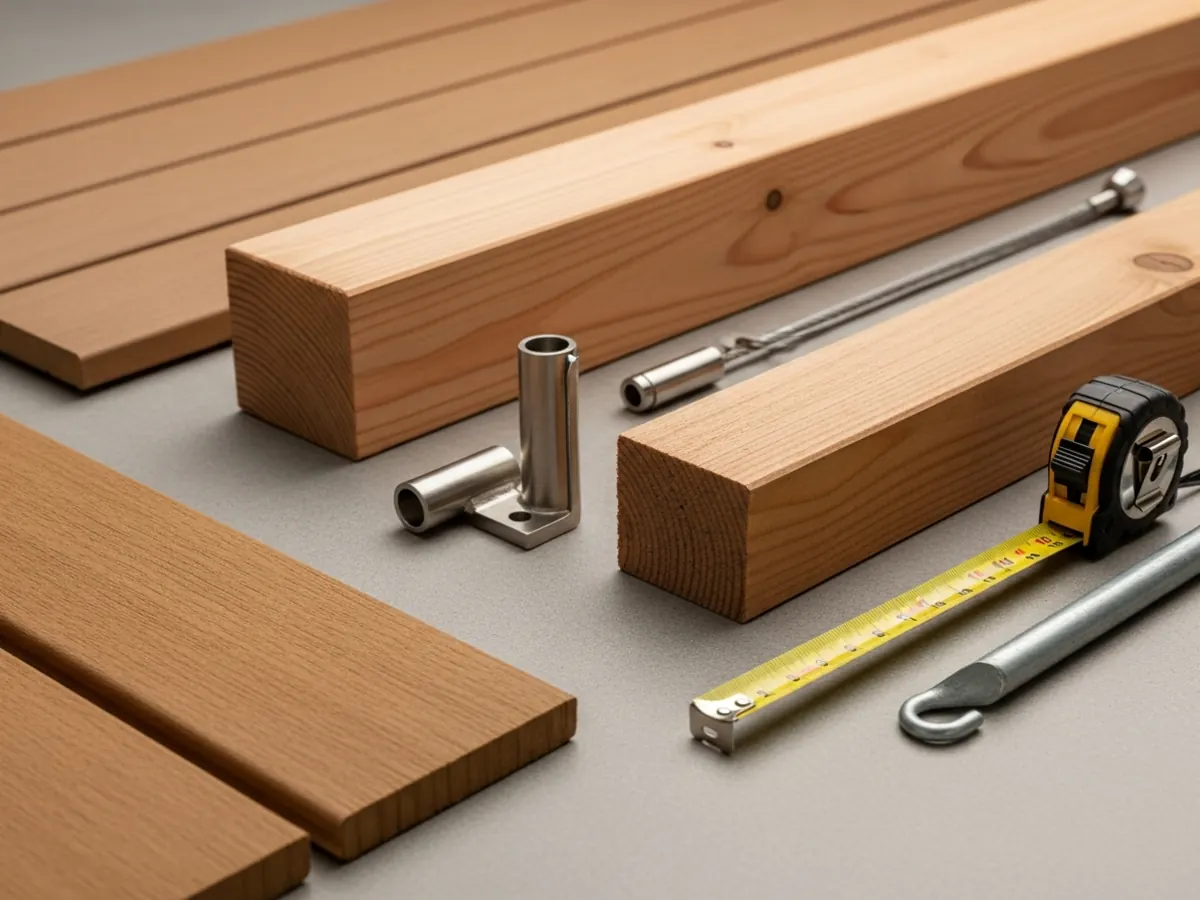
The dominant deck surface material in this market. Excellent dimensional stability in Boise's freeze-thaw and high-UV climate. No painting or staining required. warranty terms vary by product line — Trex Enhance 25 years, Select 35, Transcend 50; TimberTech's Advanced PVC lines carry a limited lifetime product warranty. Confirm current terms with the manufacturer. Cost: $4–$9 per square foot installed. Best choice for most Bench decks. Wood-tone colors that read as sympathetic to mid-century ranch architecture.
Cedar decking
Real cedar wood — provides warmth and natural texture. Requires staining/sealing every 2–3 years. 15–25 year life depending on maintenance. Cost: $3–$5 per square foot installed. Beautiful but maintenance-intensive.
Pressure-treated decking
Lowest-cost option ($2–$3 per square foot installed). Modern pressure-treated lumber lasts 10–15 years with proper maintenance. Acceptable for budget-constrained projects or rental properties.
Railing systems
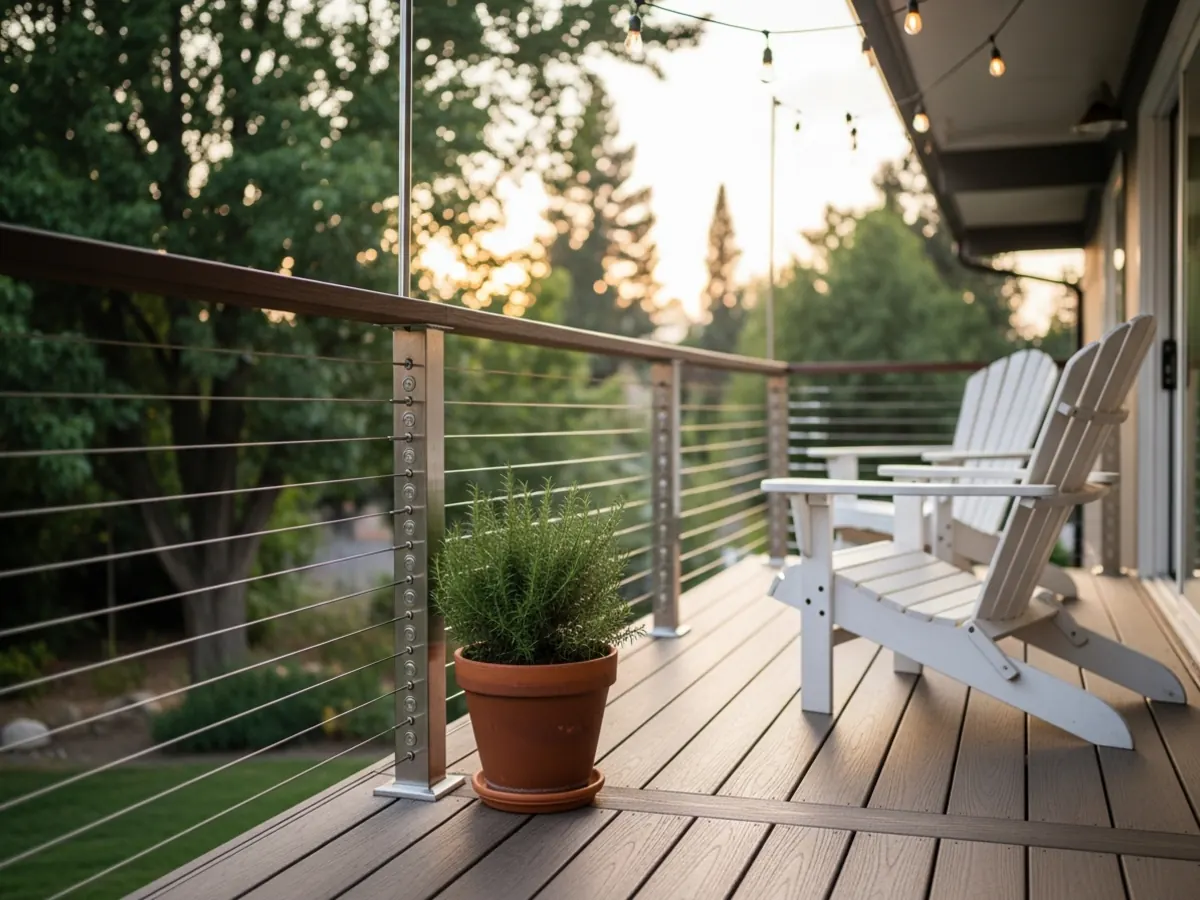
Painted wood railing posts (4×4 cedar or pressure-treated, painted to match house trim color) with cable railing infill is the most contemporary Bench deck choice — clean modern aesthetic that complements mid-century architecture. Aluminum balusters between painted posts is another good option.
Foundation and structural framing
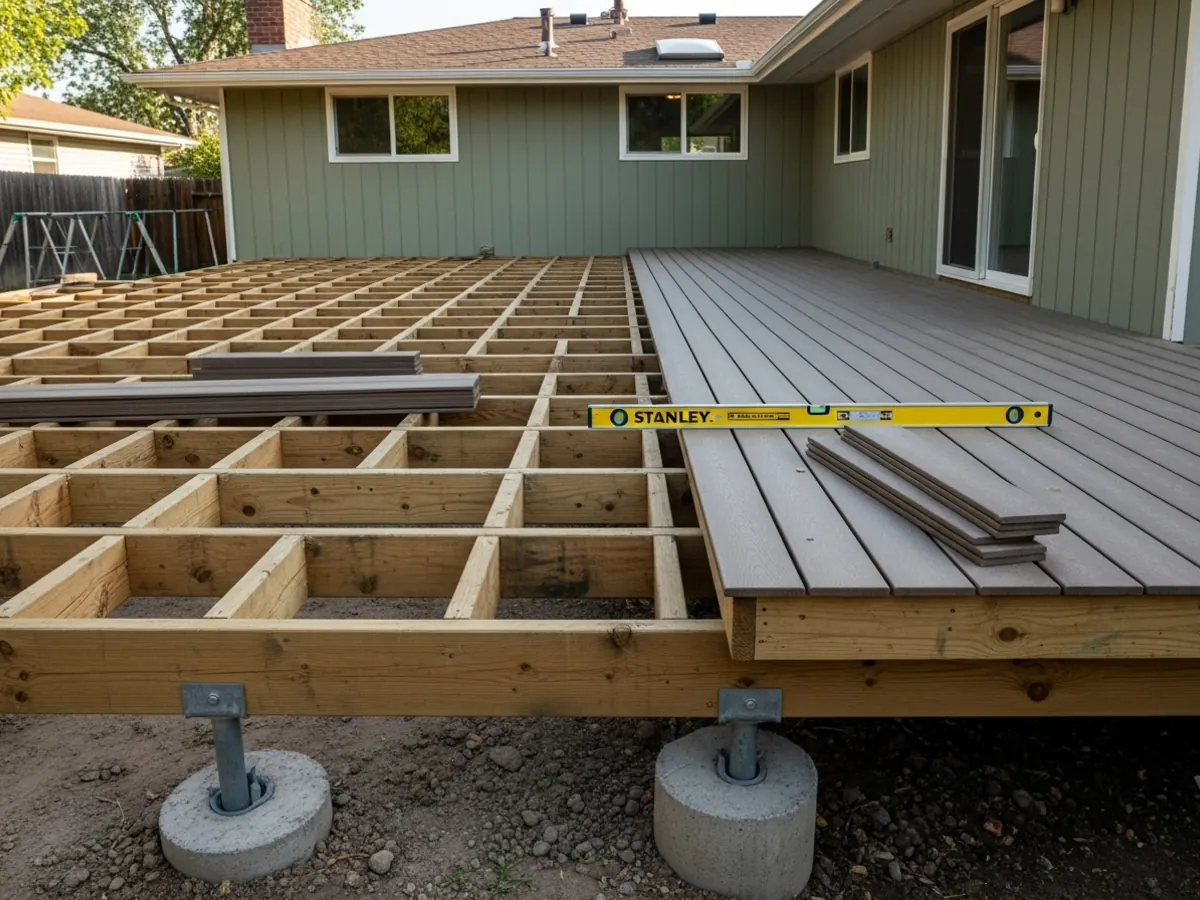
Tube-form concrete footings extending to 24-inch frost depth (Boise minimum) with concrete poured in-place around galvanized post anchors. Pressure-treated lumber for joists and beams. Engineered lumber (LVL or PSL) for long-span beams. Joist hangers throughout, properly fastened with stainless or hot-dipped galvanized screws.
Lighting and integration
Low-voltage LED deck lighting integrated into railing posts, stair risers, and post caps adds usability after dark. Dimmer-controlled, warm color temperature (2700K–3000K). Outdoor receptacles for grills and other use.
Deck construction in Bench back yards occasionally surfaces conditions that affect cost and timeline.
- •Existing deck demolition and disposal. If replacing an existing deteriorating deck: $1.50–$3.00 per square foot of existing deck. Pre-1978 deck with lead-paint contamination: $1,200–$3,000 incremental for EPA RRP-compliant disposal.
- •Existing concrete patio removal. If removing concrete patio for deck install (vs building over): $4–$7 per square foot of concrete demolition and removal.
- •Soil bearing conditions requiring engineered solutions. Some Bench back yards have poor soil bearing. Geotechnical investigation: $1,500–$3,500. Engineered footing solutions: $3,500–$11,000 above standard.
- •Underground utilities in deck footing area. Old utility lines sometimes run through back yards in unexpected paths. Idaho 811 mark-out before excavation is required. $0 if caught in mark-out; $1,500–$5,000 if relocation needed.
- •Tree root impact on footing locations. Mature trees in Bench yards have extensive root systems. Footing locations may need to shift. Standard scope addresses minor adjustments; major redesign for tree preservation: $1,500–$4,000.
- •Existing house ledger connection requiring repair or reinforcement. Connecting deck to existing house framing requires careful inspection of the rim joist. Older homes sometimes have rim joist damage requiring reinforcement. $400–$1,500.
- •Yard grading or drainage issues. Some Bench back yards have grading issues affecting deck design. Yard re-grading or French drain install: $1,200–$4,500.
- •Existing alley fence requiring temporary removal. Material delivery and waste disposal often require alley access. Existing alley fences sometimes need temporary panel removal. $300–$1,000.
- •Setback or zoning restrictions identified during permit review. City of Boise zoning sometimes flags issues. $0 if caught early; $1,500–$5,000 if requires redesign.
Consultation and lot assessment (Week 1)
On-site walkthrough, lot dimension verification, setback analysis, alley access assessment, discussion of deck shape and intended use.
Design and material selection (Weeks 1–2)
Deck plan with dimensions, height, railing detail, stair location. Material selections (composite color, railing system, lighting). Color and finish coordination with house trim.
Estimate and permitting (Weeks 2–4)
Detailed line-item estimate with structural specifications. Building permit application to City of Boise. Permit processing time varies by season. Right-of-way permits if alley dumpster placement requires.
Site setup and excavation (Day 1 of work)
Plant and lawn protection. Footing locations marked. Idaho 811 utility mark-out completed. Footing holes excavated.
Foundation (Days 2–4)
Tube-form footings poured to 24-inch frost depth. Cure 24–48 hours. Post anchors set. Inspection of footings by City of Boise.
Framing (Days 4–10)
Posts, beams, joists install. Ledger attached to house with proper flashing. Framing inspection by City of Boise.
Decking and railing (Days 10–18)
Composite decking install with proper expansion gaps and hidden fastener system. Railing posts install. Cable railing or balusters install. Stair construction. Painting of railing posts.
Lighting, finish, walkthrough (Days 18–25)
Low-voltage lighting install. Outdoor receptacles. Final cleanup. Lawn restoration around work area. Final building inspection. Walkthrough. 3-year workmanship warranty begins.
Deck construction on Bench lots requires the combined skills of a structural carpenter familiar with Boise's frost-depth requirements, a designer who can integrate the deck with mid-century ranch character, and a contractor with operational experience.
- City of Boise Planning & Development Services — Building, electrical, plumbing, and mechanical permits. Online portal and in-person plan check.
- Idaho DEQ Air Quality (Asbestos) — Testing and abatement guidance for pre-1980 homes via the Idaho Department of Environmental Quality.
- EPA Lead Renovation, Repair and Painting (RRP) Program — Required certification and work practices for renovation in pre-1978 lead-paint homes.
- Idaho Power — Rebates & Offers — Idaho Power's residential incentives: the Heating and Cooling Efficiency Program (heat pumps, central air conditioners, duct sealing, smart thermostats, heat pump water heaters, whole-house fans and similar equipment), the A/C Cool Credit, and the Shade Tree Project. Windows and insulation are not covered.
- Idaho DOPL — Contractor Search — Verify any contractor's RCE registration through the official Idaho DOPL license search.
Will my Bench deck need Historic Preservation Commission approval?
No. The Boise Bench is not within a Historic District. Standard City of Boise building permit only — processing time varies by season.
What's the right decking material for a Bench mid-century ranch?
Composite decking (Trex Transcend, TimberTech Terrain, or Fiberon Concordia) in a warm wood-tone color (cedar, mahogany, walnut). Excellent dimensional stability in Boise's freeze-thaw climate, no maintenance beyond occasional cleaning, warranty terms vary by product line — Trex Enhance 25 years, Select 35, Transcend 50; TimberTech's Advanced PVC lines carry a limited lifetime product warranty. Confirm current terms with the manufacturer. Cable railing in painted posts matching house trim provides clean modern aesthetic that complements mid-century architecture.
How deep do deck footings need to be in Boise?
24 inches minimum under the City of Boise design criteria (Ada County uses the same figure; other jurisdictions publish their own). Footings that stop above the frost line will heave during freeze-thaw cycles. Iron Crest pours every footing below the required frost depth using tube forms and properly designed concrete mix. Helical piles are an alternative for sites where excavation is difficult.
How long does a deck take to build?
3–5 weeks for a modest rear deck (12x16 to 14x20), 5–8 weeks for a generous deck (16x24 to 18x28), 6–9 weeks for a multi-level or covered deck. Permit processing (varies by season) and material lead time (1–2 weeks for composite delivery) run concurrent with design.
Can I have a deck attached to a 60-year-old Bench ranch?
Yes — this is the most common Bench deck. The connection (called a ledger) requires careful inspection of the existing rim joist. Bench rim joists 60–80 years old usually hold fasteners well. Where rim joist condition is questionable, we install structural blocking before ledger attachment. Proper flashing at the ledger-to-house junction is critical to prevent water intrusion.
Can I replace my concrete patio with a deck?
Yes — patio-to-deck conversion is a common Bench project. Two approaches: (1) demo and remove the concrete, then build a deck on engineered footings; (2) build a deck slightly raised over the existing concrete, using the concrete as a base for the deck framing. Approach 2 is faster and less expensive but requires existing concrete to be in good condition.
Can you build a covered deck or pergola?
Yes. Pergola provides partial shade and architectural detail at lower cost. Louvered roof systems provide adjustable shade and weather protection at higher cost. Solid roof structure makes the deck a usable outdoor room year-round. Each approach has different cost and architectural integration considerations.
What about deck footings near mature trees?
Mature Bench trees have extensive root systems. Iron Crest hand-excavates footing holes near significant tree roots and shifts footing locations as needed. Where footings can't be located optimally due to trees, we use beam configurations that span the obstacle.
Ready to start your Boise Bench deck construction project?
Free in-home consultation, honest contingency-based budgeting, and the experience Boise homes require. Iron Crest Remodel — Idaho RCE #6681702, EPA RRP lead-safe work practices, $2M general liability, 3-year workmanship warranty.
Get Your Free Estimate