

Deck Contractor in Boise, Idaho
Idaho registered deck builder specializing in composite and wood decks engineered for Boise's climate, frost depth, and sloped foothills lots
Quick answer
Idaho requires contractors performing work over $2,000 to hold a valid Registered Contractor Entity (RCE) license. You can verify any contractor's license through the Idaho Division of Occupational and Professional Licenses (DOPL).

Boise enjoys more than 200 sunny days a year — a climate that makes outdoor living not just pleasant, but practically a way of life. A well-built deck extends your usable living space dramatically, connects indoor living areas to your yard, and adds measurable value to your home in one of the nation's fastest-appreciating real estate markets.
But Boise's climate also creates engineering requirements that make deck construction more complex than many homeowners realize. The 24-inch minimum frost depth in the City of Boise design criteria — the depth footings must extend below grade to prevent frost heave — is a requirement that catches unlicensed contractors off guard. A deck built on improperly deep footings will shift, crack, and fail inspection. Getting it right requires a contractor who knows Boise's specific code requirements and builds every footing to that standard.
Idaho law requires contractors performing work over $2,000 to hold a valid Registered Contractor Entity (RCE) license. Deck construction involves structural engineering, concrete work, ledger attachment to your home's rim joist, and electrical rough-in for lighting and outlets — all of which must meet City of Boise building codes and pass inspection. An unlicensed contractor may skip permits, undersize beams, or fail to properly flash the ledger board — the single most common cause of deck rot and structural failure.
A licensed Boise deck contractor protects your investment, ensures the structure is safe for your family, and delivers a deck that adds genuine resale value rather than creating a disclosure liability when you sell.
Choosing between composite and natural wood decking is the most consequential material decision Boise homeowners face. Both are excellent options in the right context — but they perform very differently under Boise's 200-plus sunny days a year and temperature swings that can exceed 100°F in summer and drop below zero in winter.
Trex and TimberTech Composite Decking
Capped composite decking from brands like Trex and TimberTech is the premium choice for Boise homeowners who want a low-maintenance outdoor surface. The cap layer resists UV fading — critical in a city with more than 200 sunny days a year — prevents moisture absorption, and eliminates the annual sealing, staining, and splinter-removal routine that wood decks demand. Composite boards won't warp, crack, or rot, and they carry 25–30 year warranties. The upfront cost is 30–40% higher than pressure-treated wood, but the total lifetime cost often favors composite when you factor in zero maintenance spend over 25 years.
Pressure-Treated Lumber
Pressure-treated southern yellow pine remains the most affordable decking option. In Boise's lower-humidity climate, PT lumber performs reasonably well — drying cycles are less severe than in coastal areas. However, PT decking does require annual or biannual sealing and staining to prevent checking (surface cracking), and boards will eventually splinter if neglected. For budget-conscious projects or homeowners who enjoy the look of natural wood and don't mind the maintenance, PT lumber is a solid choice.
Cedar and Redwood
Western red cedar and redwood offer natural rot resistance and a beautiful aesthetic that composite cannot fully replicate. In Boise, cedar performs well and ages gracefully with proper maintenance. The primary drawback is cost — clear cedar decking is significantly more expensive than PT lumber — and the same maintenance requirements apply. Cedar is popular in North End and Foothills homes where the natural aesthetic complements the architecture.
Substructure: Always Pressure-Treated
Regardless of what decking surface material you choose, the framing, joists, beams, and posts should always be pressure-treated lumber rated for ground contact where appropriate. The substructure is the structural skeleton of your deck — it must resist moisture, ground contact, and seasonal movement. Iron Crest uses .40 CCA or ACQ treated lumber for all substructure framing.

Iron Crest Remodel is a fully registered and insured deck contractor serving Boise and the entire Treasure Valley. Here is exactly what backs every deck project we build:
We are not a referral network or a lead-generation company. Iron Crest Remodel pairs an in-house project manager with vetted, long-standing deck-building partners on every project in Boise. You know exactly who is building your deck from the first day of footing excavation to the final railing installation.
Boise is not a generic market. The city's geography, climate, and housing stock create specific requirements that a Boise deck contractor must understand — and that out-of-market contractors often underestimate.
The Bench and Foothills: Elevated Deck Specialists
Homes on the Boise Bench and in the foothills above Harrison Boulevard sit on sloped lots where a standard ground-level deck is impossible. These locations require elevated multi-level decks with taller post structures, engineered beam spans, and sometimes engineered stamped drawings required by the City of Boise for decks with post heights exceeding certain thresholds. Iron Crest regularly builds elevated decks in these neighborhoods — we understand the engineering, the permit requirements, and how to design a structure that maximizes your view while staying within code.
24-Inch Frost Depth: A Non-Negotiable Engineering Requirement
Boise's freeze-thaw cycles require deck footings to extend below the frost line, which the City of Boise design criteria set at a minimum of 24 inches (other jurisdictions publish their own criteria, which we confirm at permit time). This prevents the footing from sitting in soil that freezes and expands in winter — a phenomenon called frost heave that can lift and crack an improperly anchored deck within a few seasons. We drill all footings to the code-required depth, size our concrete piers appropriately for the deck load, and use code-approved post bases to keep posts out of standing water.
UV Exposure and Composite Deck Performance
Boise's 200-plus sunny days a year put decking surfaces under significantly more UV stress than Pacific Northwest markets. Uncapped composite decking — the first-generation products from the 1990s and early 2000s — fades dramatically under these conditions. Only capped composite products (Trex Transcend, TimberTech AZEK, or similar premium lines) carry meaningful fade warranties and perform well long-term in Boise's sunshine. We specify only capped composite products on every project where composite is chosen.
Ledger Board Flashing: The Critical Waterproofing Detail
Where an attached deck meets your home, the ledger board must be properly flashed and waterproofed to prevent water infiltration into your rim joist and floor framing. This is the most frequently missed detail on amateur and unlicensed deck builds — and the most common cause of hidden structural rot. Iron Crest uses Flashing Tape and proper Z-flashing at every ledger connection, installed correctly before decking goes on.

Iron Crest Remodel follows a structured, transparent process on every deck project in Boise. Here is exactly what to expect from consultation to final walkthrough:
In-Home Consultation and Site Assessment
We visit your Boise property to assess the site, evaluate topography, discuss your design goals, and identify any engineering requirements specific to your lot. For foothills and Bench properties, we evaluate elevation changes and determine the optimal substructure approach. This consultation is free and typically takes 60–90 minutes.
Design and Detailed Estimate
We develop a deck design concept based on your goals and site conditions, then prepare a line-item estimate covering materials, labor, permits, concrete, hardware, and contingency. Every cost is itemized — you know exactly where your money goes. We present composite and wood options with side-by-side cost comparisons so you can make an informed decision.
Permitting and Engineering
We submit permit applications to the City of Boise Building Department, including structural drawings and any required engineered calculations for elevated decks. We coordinate directly with the city throughout the review process to keep your project on schedule.
Footing Excavation and Concrete
We excavate footing holes to 24 inches below grade, set tube forms, and pour concrete piers sized for the deck load. Post bases are set in concrete while wet. Footings are inspected by the city before any framing begins — this is the most critical quality checkpoint in deck construction.
Framing, Decking, and Railing
We install the beam and joist system, attach and flash the ledger board, lay the decking surface, and install your chosen railing system — whether that's a classic wood baluster rail, cable railing for unobstructed views, or a glass panel system for premium foothills properties.
Final Inspection and Walkthrough
We schedule the final city inspection, address any punch-list items, and walk through the completed deck with you to confirm every detail meets your expectations. We do not call a deck complete until the city approves it and you are fully satisfied.

Deck construction pricing in Boise varies significantly based on size, material choice, deck height, and complexity. Here are realistic ranges based on typical Treasure Valley pricing:
Typical Boise deck construction: $18,000 – $65,000+
Ground-level pressure-treated deck (300–400 sq ft): $18,000–$28,000
Composite deck with railing (300–400 sq ft): $28,000–$42,000
Elevated foothills/Bench multi-level deck: $40,000–$65,000+
Labor accounts for approximately 40–50% of the total cost on most Boise deck projects, with the balance covering materials (decking, framing lumber, concrete, hardware, railing). Elevated decks carry higher labor costs because the taller substructure requires more material, more complex connections, and often engineering review.
Our estimates include permit fees, concrete, hardware, and a contingency allowance for any site-specific conditions discovered during footing excavation. Boise soil conditions in the foothills can vary, and we account for that variability upfront rather than hitting you with change orders mid-project.
We are happy to present composite and pressure-treated options side by side with a 20-year lifetime cost analysis — including estimated maintenance spend — so you can make a truly informed decision for your Boise home.
Boise's hot construction market means unlicensed or underprepared deck builders are actively soliciting work. Here are warning signs that should make you walk away:
Footings shallower than 24 inches
If a contractor proposes footings at 12 or 18 inches, they are either unfamiliar with Boise's frost depth requirements or planning to skip permits entirely. Shallow footings in Boise soil will heave within a few winters. Ask every bidder specifically: "What depth are you drilling the footings?" Correct answer: below the frost line on the approved plans, at least 24 inches in Boise.
Suggesting you skip the permit to save time or money
Unpermitted decks create serious problems — failed home inspections when you sell, potential insurance coverage gaps if someone is injured, and the cost of tearing down and rebuilding to code. The City of Boise actively enforces permit requirements. Any contractor who proposes skipping permits is not protecting your interests.
No ledger flashing mentioned in the scope
If a contractor's proposal does not specifically address ledger board waterproofing and flashing, that is a warning sign. Improper or missing ledger flashing is the number one cause of deck-related structural rot — and it is almost never visible until major damage has occurred behind the siding.
Large upfront cash deposits
A reasonable materials deposit (10–20%) is standard. Any contractor demanding 50% or more before work begins is a financial risk. Tie payment milestones to verifiable project phases — after footing inspection, after framing, after decking, at final walkthrough.
Boise's outdoor lifestyle is central to what makes this city exceptional. Warm, sunny summers draw people onto their decks from May through October — and a well-designed deck becomes the heart of outdoor life for a Boise family. Iron Crest Remodel builds decks that are engineered to last, designed to match the character of your neighborhood, and built by crews who take pride in craft.
We understand what makes Boise unique — the foothills topography, the frost depth requirements, the UV intensity, the mix of historic North End bungalows and modern Foothills custom homes. Whether you are building a simple ground-level deck behind a new construction home in Harris Ranch or an elevated multi-level entertainment deck cantilevered over a hillside lot in the Boise Bench, we have the experience to deliver it correctly.
Our Boise reputation is built on referrals. When we complete a deck in your neighborhood, your neighbors notice — and when they ask who built it, we want you to be proud to answer. That standard of accountability drives every project decision we make.
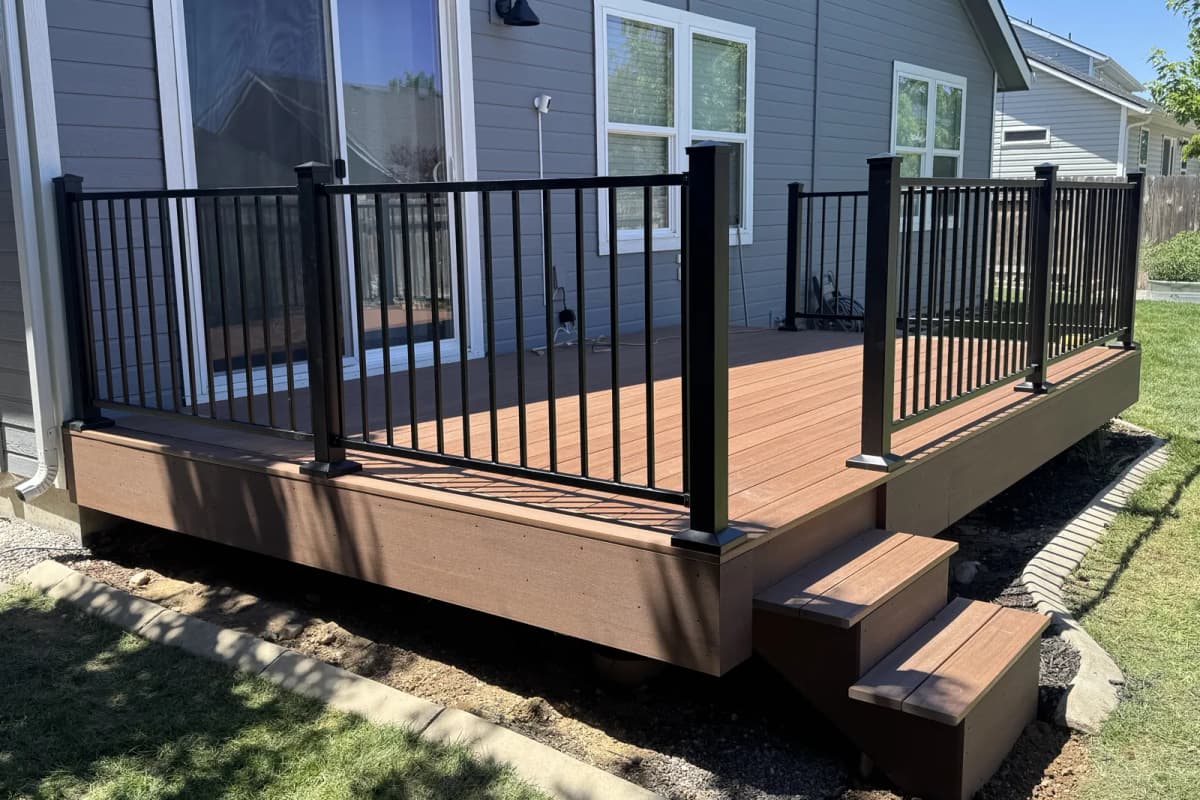
TimberTech AZEK deck replacement, Boise. We removed an aging painted wood deck, its built-in bench and its steps, and rebuilt from the footings up: six new concrete footings, 4×4 pressure-treated posts on galvanized post bases, a 2×8 pressure-treated frame, TimberTech AZEK composite decking with hidden fasteners, two step runs, and 36-inch black metal railing in place of the old bench. Build photos run June 17 to June 21, 2026 — the full 4–6 working day schedule in the contract.
- Size: 10′ × 16′ (160 sq ft)
- Decking: TimberTech AZEK
- Railing: 36 in black metal
- Footings: 6 new concrete piers
- Framing: 2×8 pressure-treated
- Fasteners: Hidden-fastener system
The following government agencies, industry organizations, and official resources provide additional information relevant to your remodeling project.

See Your Remodel Before You Build.
Upload a few photos of your kitchen, bathroom, flooring, or exterior and get AI-generated concept visuals tailored to your space, style, and materials — free, no obligation, in about five minutes. Then request a real estimate from our Idaho registered Boise team.
Free concept preview · No credit card · Licensed Idaho contractor
How do I find a licensed deck contractor in Boise?
Idaho requires contractors performing work over $2,000 to hold a valid Registered Contractor Entity (RCE) license. You can verify any contractor's license through the Idaho Division of Occupational and Professional Licenses (DOPL). Iron Crest Remodel is a fully registered RCE contractor serving Boise and the Treasure Valley — our RCE number is 6681702, verifiable online at any time.
How much does a deck cost in Boise, Idaho?
Deck construction in Boise typically ranges from $18,000 to $65,000+ depending on size, materials, and complexity. A standard 300–400 sq ft pressure-treated wood deck runs $18,000–$28,000. Composite decking with Trex or TimberTech adds roughly 30–40% to material costs but eliminates ongoing maintenance. Elevated decks in the Bench or foothills neighborhoods — where lot topography demands taller substructures — often cost $35,000–$55,000+. Iron Crest provides detailed, line-item estimates with a fixed-price scope and no surprise charges. Any owner-requested changes or unforeseen conditions requiring additional work are documented and approved before additional work proceeds.
What frost depth is required for deck footings in Boise?
Deck footings must extend below the frost line to prevent frost heave. The City of Boise design criteria set a minimum frost depth of 24 inches (Ada County uses the same figure; Canyon County and other cities publish their own, which we confirm at permit time). Deck contractors who pour footings at 12 or 18 inches — common in warmer climates — will fail inspection in Boise. Iron Crest Remodel drills all footings to code-required depth and sizes piers appropriately for the deck load above.
Do I need a permit to build a deck in Boise?
In most cases, yes. Permit thresholds vary by jurisdiction and project configuration, and we verify them during project planning; as a sourced example, the 2018 IRC adopted in Idaho (R105.2) exempts only a freestanding deck of 200 square feet or less that is no more than 30 inches above grade and not attached to the house, so attached decks, elevated decks, and larger decks generally need a City of Boise permit. Within Boise city limits the threshold is lower: the City of Boise requires a building permit for any deck more than 12 inches above grade. Structural, electrical (for outdoor lighting and outlets), and zoning setback requirements must all be addressed. Iron Crest handles every permit application, plan submission, and inspection on your behalf.
What is the best decking material for Boise's climate?
Boise's climate — with more than 200 sunny days a year, significant temperature swings, and occasional heavy snow — creates challenges for natural wood decking. Composite materials like Trex and TimberTech resist UV fading, won't splinter, and are unaffected by moisture cycles. For Boise homeowners who want the look of wood without annual sealing and staining, capped composite decking is the premium choice. Pressure-treated lumber remains the cost-effective alternative with proper maintenance.
How long does it take to build a deck in Boise?
A typical Boise deck project takes 2–4 weeks from permit approval to final walkthrough. Permit review time varies by jurisdiction and season. Complex multi-level decks, decks with integrated pergolas, or projects requiring engineered drawings take longer. Iron Crest provides a detailed schedule before work begins so you know exactly what to expect.
Can Iron Crest build decks in Boise's foothills neighborhoods?
Absolutely. We specialize in elevated and multi-level deck construction for the unique topography of the Bench, North End hillside homes, and Boise foothills neighborhoods. Sloped lots require deeper substructures, engineered footings, and sometimes engineered beam calculations — all of which our team handles routinely. These elevated decks unlock stunning views while adding significant value to your home.
What warranty does Iron Crest offer on Boise deck construction?
Iron Crest Remodel provides a 3-year workmanship warranty on all deck construction. Composite decking manufacturers (Trex, TimberTech) include their own product warranties — typically 25–30 years — which are passed through to you in full.
Costs and permit requirements differ by jurisdiction across the Treasure Valley. These guides cover Boise specifically.

Talk to a real project manager
Have Questions? Call Now for a Free In-Home Consultation.
Mon–Fri 7 AM–6 PM · Idaho registered & insured · No obligation
Russ Shloma — Project Manager
Russ Shloma — Project Manager
Hire a trusted deck contractor in Boise
Get a free, no-obligation estimate for your deck project in Boise, Idaho. Registered, insured, and backed by our 3-year workmanship warranty.
Get Your Free Estimate