
Steam Showers in Boise: When the Dry Climate Makes Them Brilliant — and 4 Cases When It Doesn't
Boise's dry air gives steam showers an efficiency advantage most contractors miss. It also raises the vapor-sealing bar in ways that humid-market install specs don't. Here's the physics, the four cases that make steam the wrong call, and the spec we use when it's right.
Quick answer
The all-in cost premium for adding steam to an otherwise-planned shower remodel runs $4,500–$9,500 in the Boise market, broken down approximately: steam generator and control ($1,800–$3,500), vapor-sealed ceiling and additional membrane work ($600–$1,200), dedicated 240V electrical circuit and outlet ($400–$900), exhaust fan upsizing ($150–$400), upgraded grout and sealing ($150–$400), and design and project-management overhead ($500–$1,200).
Steam showers are one of the few luxury bath features where Boise's climate is genuinely an advantage. Winter humidity in the Treasure Valley drops below 30% relative humidity for months at a time — well below the 50–70% baseline that coastal markets work with — and that difference changes the energy math of steam shower operation in the homeowner's favor. A 7.5 kW generator that struggles to saturate a humid Seattle bathroom puts out a thick, fully wrapped steam environment in a Boise master bath using meaningfully less wall-clock run time.
The catch is that the same dry climate raises the vapor-sealing bar of the install. When you stop using a steam shower in 60% RH ambient air, the vapor pressure differential between the wet interior and the dry exterior of the enclosure is moderate. When you stop using one in 20% RH Boise winter air, that differential is roughly three times higher, and it drives moisture into any building assembly that isn't properly sealed. Most steam shower failures we've inspected in Boise homes trace back to install specs borrowed from humid-market manufacturer documentation that didn't account for the dry-climate moisture-transport math. Below is the framework we use to decide whether a steam shower is the right call for a specific Boise home — including the four cases where the honest answer is no.
For broader luxury-shower planning (rain heads, body sprays, custom controls), our luxury shower features guide covers the design-and-cost basics, and the shower remodel cost page covers pricing across tiers. This page goes deep on one specific upgrade — steam shower viability — where Boise's climate physics matter most.
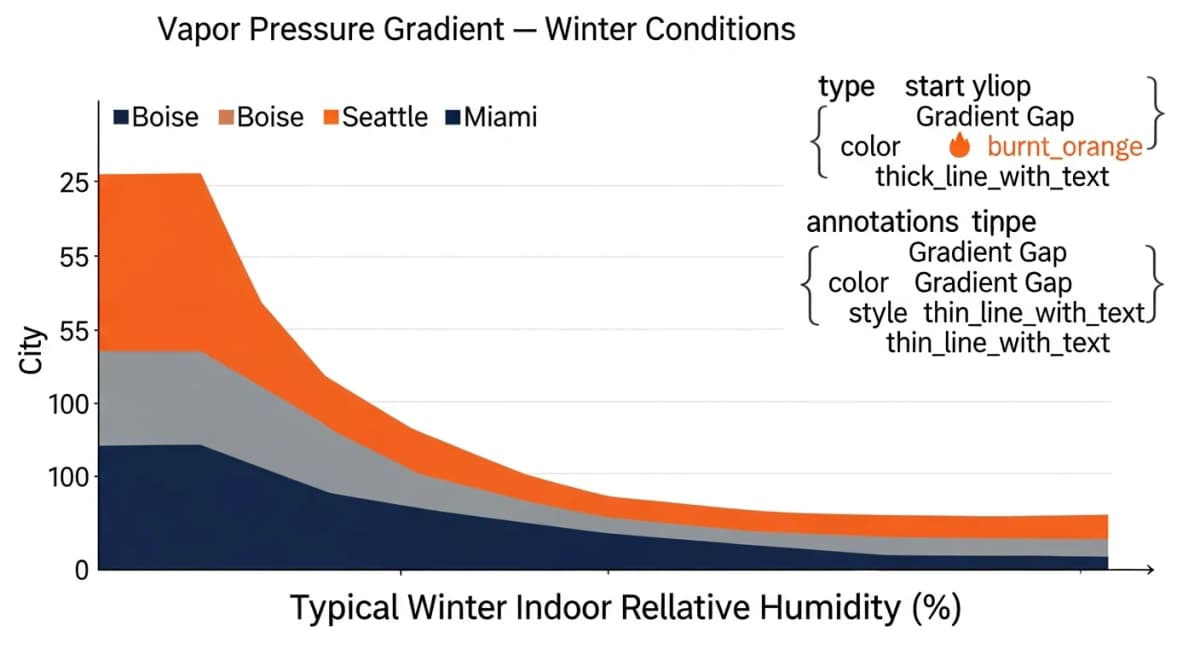
Steam shower generators are sized by enclosure volume — typically 1 kW per 50–60 cubic feet of enclosed space, with manufacturer adjustments for ceiling height, tile material, and door tightness. The manufacturer specs assume moderate ambient humidity (40–60% RH). In a dry-climate market like Boise, the same generator reaches operating saturation faster because the starting humidity gap is wider — there's more room for the released steam to occupy before the air saturates.
In practice, a 7.5 kW generator installed in a 250-cubic-foot Boise master bath enclosure reaches full steam saturation in 4–6 minutes, compared to 7–10 minutes for an equivalent install in Seattle or Portland. Over a typical 20-minute session the generator therefore spends less of its run time reaching saturation and more of it holding, which lowers consumption per session. We have no measured figure for the annual difference and won't invent one — it depends on session length, frequency, enclosure volume, and your own Idaho Power rate. The more meaningful benefit is the user experience — sessions ramp up faster, which makes the feature more usable for shorter morning routines.
Homeowners in upscale Boise master bath remodels ($40k+ shower scope) who are evaluating steam as an add-on. The climate genuinely favors it.
Steam still adds $4,500–$9,500 to the shower scope between generator, control, vapor-sealed enclosure, and electrical work. The climate efficiency doesn't change the upfront math much.
Boise's relative humidity profile is the defining climate factor for steam shower install specs. Winter months (December through February) routinely run 20–30% RH indoors, with outdoor RH dropping into the teens on cold dry days. Summer months are higher but still moderate — 30–45% RH typically. Compare this to coastal markets that run 50–70% RH year-round, or southern markets that run 60–80% RH in summer.
The relevance for steam shower installation is moisture transport. When a steam shower stops operating and the door opens, the warm humid air inside the enclosure (typically 110–120°F and near 100% RH at end-of-session) meets cooler drier ambient air in the surrounding bathroom and house. Water vapor moves down the gradient from the high-RH source to the low-RH surroundings. In a dry-climate home, that gradient is steeper, the moisture transport is faster, and the volume of moisture pushed into surrounding building materials per session is higher.
Practical implication: vapor sealing matters more in Boise than in coastal markets. A steam shower install that's "fine" in Seattle may slowly degrade insulation, drywall, and framing in Boise because the dry-climate gradient drives moisture deeper into assemblies that aren't sealed at the right points. The cost difference is small ($300–$800 for upgraded membrane and gaskets); the consequence of skipping it is structural over 10–15 years.
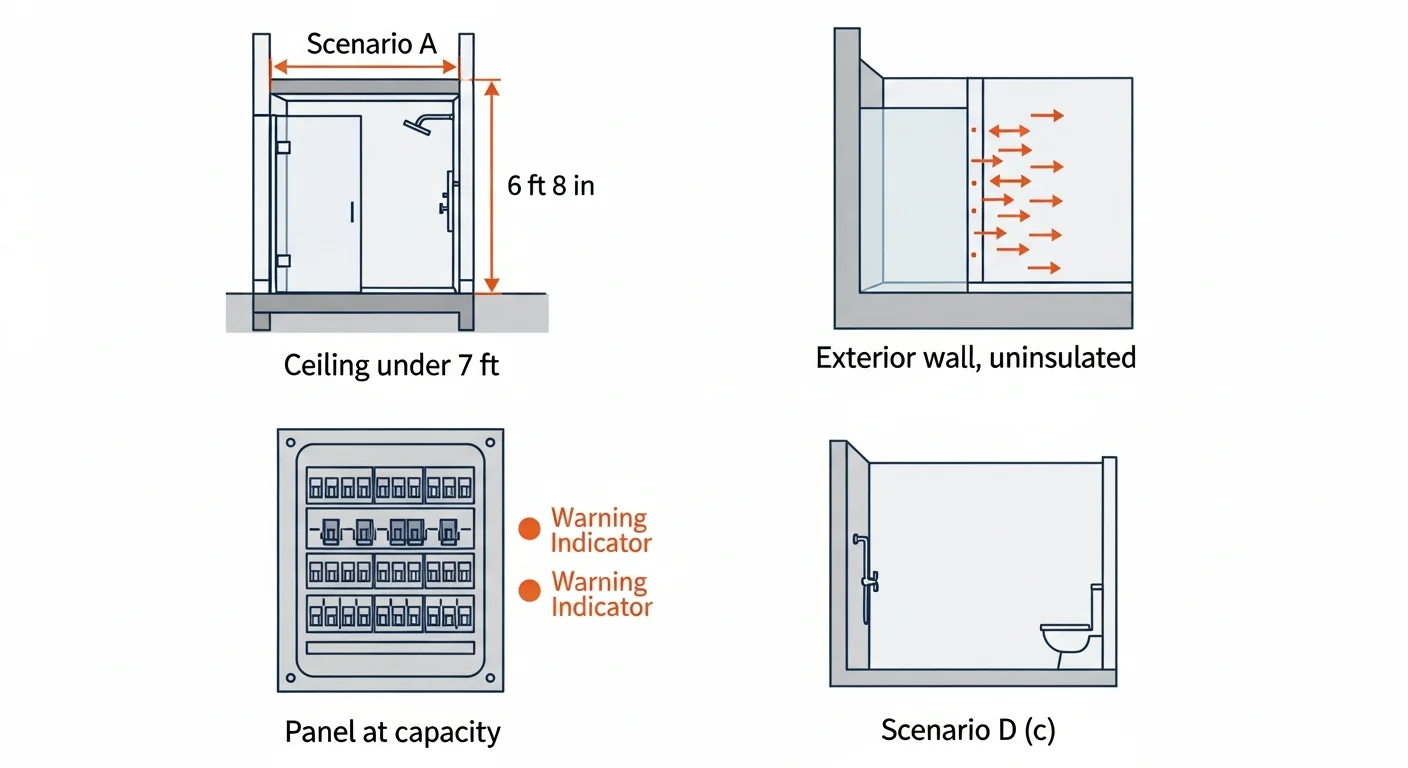
Steam shower enclosures need a minimum 7-foot ceiling height inside the enclosure. The reason is functional: steam rises, and at lower ceilings the steam concentration at face level (5'6" to 6'2" for typical users) is too dense to breathe comfortably and the head-clearance feel is oppressive. Manufacturer specs from Mr. Steam, ThermaSol, and Steamist all reference 7 feet as the floor.
This rules out steam in three specific Boise bathroom configurations. First, pre-1960 homes (North End, East End, Hyde Park bungalows) often have 7'0" to 7'4" ceilings throughout, which leaves no room for the additional ceiling-drop needed for vapor-tight membrane and the optional sloped ceiling that helps water drain back. Second, basement bathrooms in 1960s–70s Boise homes often have 7'2" to 7'6" finished ceilings, which is technically usable but leaves no margin for the membrane + tile + slope assembly. Third, attic-conversion bathrooms in 1.5-story homes (common in Hyde Park and North End) frequently have angled or low-clearance areas that disqualify the shower footprint.
The honest answer in these cases is to either skip steam entirely or do significant structural work to raise the ceiling — typically adding $4,000–$12,000 to the project, which is rarely justified by the steam feature alone. We don't pretend a 6'10" ceiling works for steam. It doesn't.
Identifying this constraint before design moves too far. Easy to spot with a tape measure on the first walkthrough.
Raising ceilings to enable steam is rarely cost-effective unless other constraints justify the structural work.
Steam showers built against an exterior wall in a pre-2010 Boise home routinely fail thermally and structurally because the wall assembly wasn't designed for the inside-surface temperature and vapor load of a steam shower. The interior surface of an exterior wall during a steam session reaches 110–115°F, which drives a strong thermal-vapor gradient toward the (cold, dry, unconditioned) exterior. Without continuous interior vapor sealing AND adequate insulation density, condensation forms inside the wall cavity itself — invisible from inside the house but slowly rotting the framing and degrading the insulation R-value.
Two solutions exist. First, build the steam enclosure against an interior wall — that's the standard fix when the bathroom layout allows it. Second, when the exterior wall must be used, upgrade the wall assembly: add 2 inches of closed-cell spray foam against the exterior sheathing (vapor barrier + R-13), tape and seal the interior face with 6-mil polyethylene under the membrane, and run a continuous vapor-tight assembly. This adds $1,500–$3,500 to the shower scope and is mandatory in this configuration.
What we don't recommend: building a steam shower against an uninsulated or fiberglass-batt exterior wall and trusting the manufacturer's shower-pan and membrane spec to handle the vapor load. We've inspected steam showers built that way in Boise homes that started showing exterior siding paint blistering within 5 years. The vapor was getting out.
Bathrooms where the layout forces an exterior wall and the homeowner accepts the additional envelope-upgrade cost.
Adds $1,500–$3,500 to the scope. Often makes more sense to redesign the bathroom layout to put the shower against an interior wall instead.
Spec a steam shower built for Boise's dry climate
Steam works in Boise homes when it's installed for the climate — properly sized generator, dry-climate vapor sealing, validated panel capacity, and the right enclosure geometry. Schedule a consultation and we'll assess feasibility, walk the four failure cases, and quote what the install actually costs.
Residential steam generators range from 5 kW (small enclosures, around 175 cubic feet) to 15 kW (very large enclosures, 500+ cubic feet). Each requires a dedicated 240V circuit sized for the generator's amperage — typically 30A, 40A, or 50A. The circuit needs a dedicated breaker pair in the panel and copper conductors sized appropriately (10 AWG for 30A, 8 AWG for 40A, 6 AWG for 50A).
In pre-1985 Boise homes with original 100-amp service panels, adding a 7.5 kW (37.5A at 240V) circuit may exceed available service capacity once existing loads are factored in. The load calculation has to account for AC, electric range, electric dryer, water heater, and the rest of the home — most pre-1985 100A panels can't accommodate steam without a 200A service upgrade. That upgrade adds $3,500–$6,500 (see our knob-and-tube and panel-capacity analysis for the broader pre-1980 electrical context).
The honest math: if the panel has to be upgraded for steam alone, the combined cost of steam ($4,500–$9,500) + panel upgrade ($3,500–$6,500) lands at $8,000–$16,000 for the feature. Some homeowners decide it's worth it as part of a broader pre-1980 home modernization (kitchen + bath + panel together); some decide steam isn't worth the bundle. Both are reasonable conclusions.
Homes with existing 200A service or where a panel upgrade is already part of the project scope.
Triggering a panel upgrade for steam alone is rarely cost-effective. Bundle it with other electrical work or skip steam.
When a steam shower bathroom is on the second floor over a finished living space — common in 1990s and 2000s Boise two-story builds in Eagle, Meridian, and Northwest Boise — the vapor-management calculus extends down through the floor assembly. Even with proper enclosure sealing, repeated steam sessions cycle the floor structure through moisture loading, and any imperfection in the bathroom floor waterproofing transmits straight to the ceiling below.
The risk specifically is at the floor penetrations: the drain, the toilet flange (if the toilet is in the same room), the shower valve rough-in, and any plumbing chase. Each is a path for water (in the worst case) or vapor (in the more subtle case) to reach the ceiling joist bay below. Standard waterproofing membranes handle water; they're less reliable for sustained vapor exposure if the assembly was specified for a non-steam shower.
The fix is a continuous full-floor vapor-and-water membrane in the steam bathroom, not just in the shower footprint, with sealed transitions at every penetration. Premium sheet membrane (Schluter KERDI extended across the full bathroom) plus proper sealing at fixtures adds $800–$1,800 to the scope. Skip it and the homeowner under the bathroom finds out about it within 5–8 years — usually when a ceiling stain shows up in the room below.
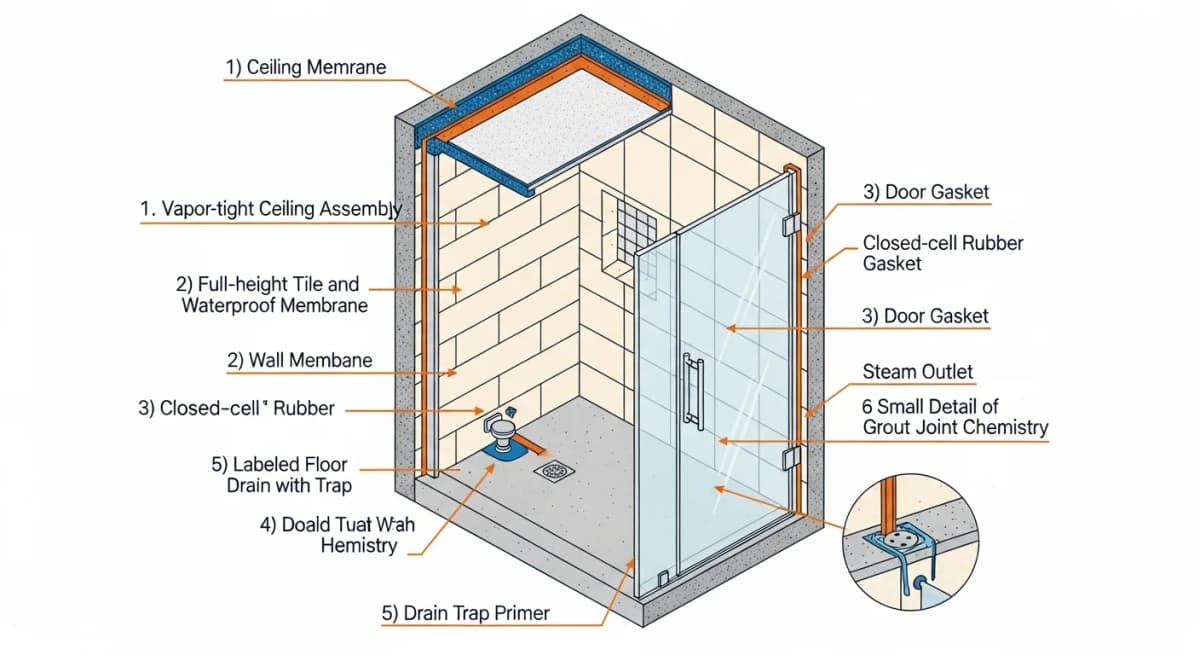
Manufacturer install instructions for Mr. Steam, ThermaSol, and Steamist generators specify minimum vapor-sealing requirements based on moderate-humidity climates. For Boise, we install above that minimum on five specific points:
Ceiling assembly: Continuous Schluter KERDI sheet membrane on the ceiling, lapped 4 inches down the wall membrane on all sides, sealed at all penetrations (steam outlet, lighting, exhaust). The manufacturer minimum is often a fluid-applied membrane; sheet is more reliable in dry-climate vapor differential.
Glass door perimeter: Closed-cell silicone gasket along the door jamb, header, and sill — not just the standard magnetic strip. Manufacturer minimum often allows magnetic-strip alone; that's adequate for humid climates and inadequate for Boise.
Steam head penetration: Plumbers' putty plus a stainless steel escutcheon with foam gasket behind the wall, sealed at both faces of the membrane. Manufacturer minimum often allows silicone alone; the foam-gasket assembly survives thermal cycling better.
Grout chemistry: Epoxy grout, not cementitious. Epoxy grout is non-porous and doesn't absorb the moisture that pushes through during dry-climate vapor transport. Cementitious grout is acceptable in humid climates because it doesn't have to do as much sealing work; in Boise it's the slow failure point.
Floor drain trap primer: Mandatory in steam showers regardless of climate, but we double-check this in dry climates because the higher evaporation rate during off-cycles can dry out the trap and let sewer gas through. Trap primer keeps water in the trap.
Steam showers don't require make-up air the way high-CFM range hoods do (steam shower ventilation is closed-system; you exhaust into the room through the door at end of session, then the room exhaust fan handles it from there). The exhaust fan in the bathroom does need to be sized for the steam session's vapor load — typically 110–150 CFM minimum for a master bath with steam, versus 50–80 CFM for a non-steam bath.
Operating cost in Boise: a 7.5 kW generator running 20 minutes per session uses 2.5 kWh per session. Multiply that by your own per-kWh rate — it's printed on your Idaho Power statement — and by how often the household actually uses it, and the annual figure comes out modest for typical use. Steam generators are not covered by any Idaho Power incentive — those are limited to heating, cooling, and water-heating equipment, and a steam shower adds load rather than reducing it.
One adjacent upgrade can qualify: if the steam install drives a water heater replacement to cover the added hot water load, a hybrid heat pump water heater falls under Idaho Power's Heating and Cooling Efficiency Program. Idaho Power does not publish the incentive amount, it is first-come first-served, and it is not paid retroactively — so confirm the current offer before the unit is ordered rather than after it is installed. We provide the invoice, model number, and installation documentation at closeout either way.
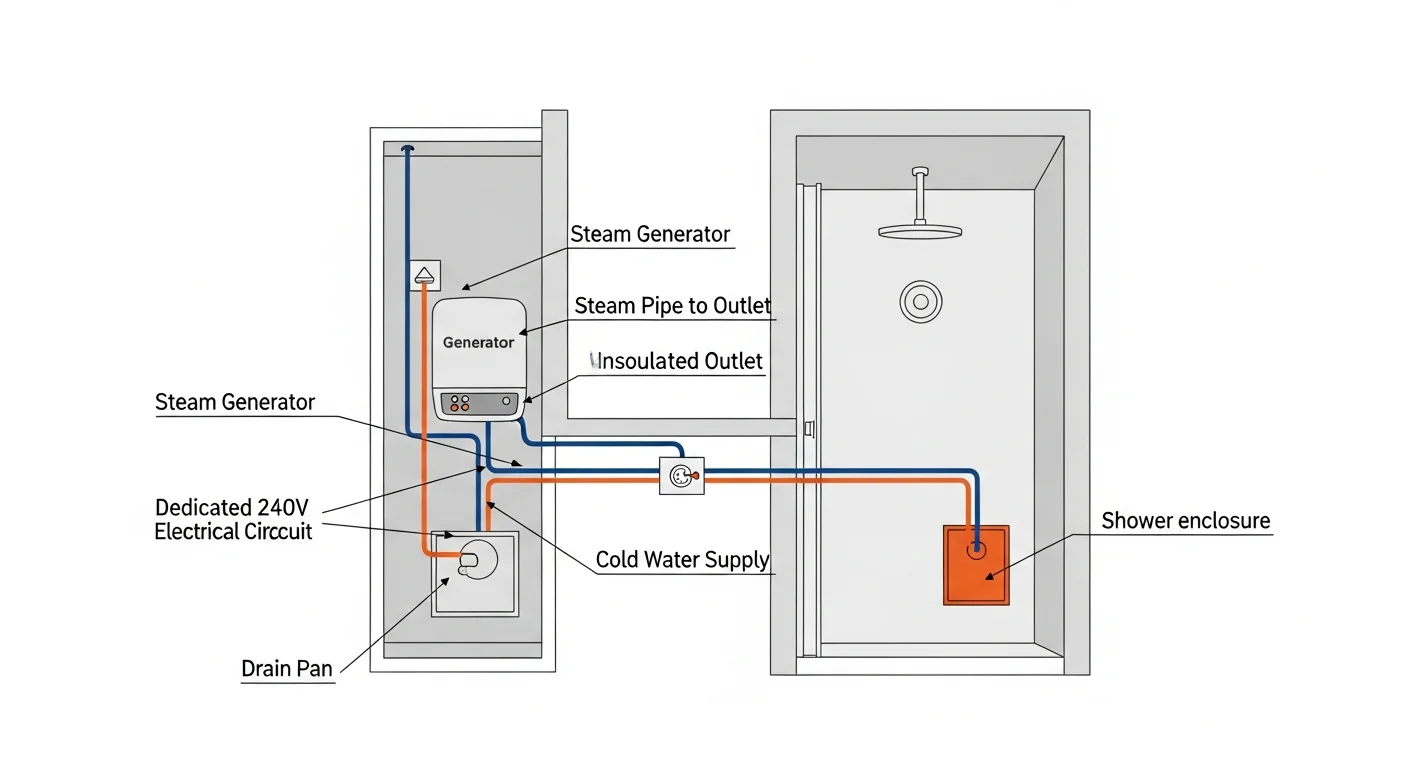
When we plan a steam shower install in Boise, the climate-physics conversation happens early. We size the generator based on the actual enclosure volume after accounting for ceiling reduction from the vapor membrane (typically 6–8 inches of ceiling drop), spec the membrane and grout to the dry-climate standard above manufacturer minimum, and coordinate the electrical and plumbing rough-ins before any tile work starts. The four failure cases above get checked during the design walkthrough — ceiling height with a tape measure, panel capacity from the existing label and load calc, floor-above-living analysis from the floor plan, and exterior-wall configuration from the layout.
Steam works in Boise homes when it's installed for the climate. We've installed it in homes throughout Eagle, Northwest Boise, and the foothills where the homeowner ended up using it more than they expected because the dry-climate efficiency makes shorter sessions feel meaningful. We've also walked away from steam scope when one of the four failure cases applied and the cost to remediate didn't justify the feature. Both are part of how we run shower remodeling in Boise.
How much does a steam shower add to a Boise bathroom remodel?
The all-in cost premium for adding steam to an otherwise-planned shower remodel runs $4,500–$9,500 in the Boise market, broken down approximately: steam generator and control ($1,800–$3,500), vapor-sealed ceiling and additional membrane work ($600–$1,200), dedicated 240V electrical circuit and outlet ($400–$900), exhaust fan upsizing ($150–$400), upgraded grout and sealing ($150–$400), and design and project-management overhead ($500–$1,200). The premium is on top of the base shower scope. For a typical Boise master bath remodel running $25k–$45k for the shower portion, adding steam moves the total to $30k–$55k. We're explicit about this cost during the design phase — steam is a real feature, but it's a real budget line too.
Is a steam shower worth the cost premium for resale in Boise?
For homes priced above $600,000, steam shower is a moderate positive resale feature — most luxury buyers expect or appreciate it, and absence of it doesn't disqualify but it doesn't help either. For homes in the $400k–$600k range, steam is a neutral feature at resale — it doesn't add measurable list-price premium but it doesn't hurt. For homes under $400k, steam is mildly negative at resale because some buyers see it as a maintenance question they don't want to take on. Our honest guidance: install steam if the household will use it, not as a resale ROI play. The function value to the user is what justifies the cost. The resale impact is essentially neutral in the Treasure Valley market across most price points.
Can I add a steam shower to an existing tile shower without redoing the whole thing?
Generally no. The vapor-sealing requirements above require continuous membrane assembly that's behind the tile, not on top of it, and the ceiling assembly needs to be installed before the ceiling tile or finish goes on. Retrofitting steam into an existing shower means tearing out the existing tile, installing the vapor membrane, and re-tiling. By the time the demo and rebuild happen, you've effectively done a shower remodel anyway. The exception is a shower originally built with steam-ready membrane and ceiling — rare in older Boise homes, but occasionally seen in 2010+ custom builds where the homeowner wanted the option and built the rough-in for it. If you have steam-ready rough-in already, adding just the generator and head runs $2,500–$4,500 standalone, which is more reasonable.
How long do residential steam generators typically last in Boise water?
Steam generators in Boise's water (about 6 grains per gallon on average, up to ~13 gpg in well-fed zones) typically run 8–12 years before requiring service or replacement. The wear modes are predictable: heating element scaling (causes longer ramp times and eventually failure), tank corrosion at the heating-element ports (typical in unsoftened water), and electronic control degradation (independent of water quality). Manufacturer warranties are typically 2–5 years on the generator and lifetime on certain components. If you've added a whole-house water softener (often the right call for any Boise kitchen or bath remodel — see our hard water guide), expect generator life to extend to 12–18 years because the scaling failure mode is the primary one. Mr. Steam offers a 'Steam at Home' service program in Idaho through its dealer network that handles annual descaling for owners who don't want to do it themselves.
Does Boise PDS require special permits for a steam shower install?
Yes — same permit types as any shower remodel, but with additional inspection scope. The plumbing permit covers the steam outlet rough-in and the cold water supply to the generator; the electrical permit covers the dedicated 240V circuit and any panel modifications; the building permit covers the structural and waterproofing scope. The added inspection scope is the vapor-membrane verification, which Boise PDS inspectors increasingly call out specifically on steam installs because they've seen the failure modes. Iron Crest handles all permitting and inspection scheduling as part of the standard project scope. Cost: typically $400–$900 in combined permit fees on top of the base bathroom remodel permit cost.
Can I use a portable steam unit instead of a built-in steam shower?
Portable units exist (most cost $300–$800) but they don't deliver the experience that a built-in installation does. They produce far less steam (typically 1–2 kW versus 7.5–15 kW for built-in), they require manual filling and emptying after each session, they don't seal the enclosure properly so the steam dissipates rapidly, and they don't reach the ambient temperature that makes the session feel like a proper steam experience. For a Boise homeowner curious about steam without committing to a built-in install, a portable unit is an okay way to see whether you'd actually use the feature — but it isn't a long-term substitute. Most owners who try portable units either commit to a built-in install within 2 years or decide steam isn't their thing. Both outcomes are useful.
Spec a steam shower built for Boise's dry climate
Steam works in Boise homes when it's installed for the climate — properly sized generator, dry-climate vapor sealing, validated panel capacity, and the right enclosure geometry. Schedule a consultation and we'll assess feasibility, walk the four failure cases, and quote what the install actually costs.
These pages go deeper on the topics linked from this article. Read them before your consultation and you'll come in with sharper questions and a clearer scope.
The following government agencies, industry organizations, and official resources provide additional information relevant to your remodeling project.