
Where to Put a Kitchen Remodel Budget in Boise: 7 Splurge-vs-Save Calls
You already have a number. This is how an experienced Boise project manager divides it — the four places to spend up, the three to save on, and why the answer shifts by neighborhood and by the age of the house.
Quick answer
As a working frame, cabinets tend to take the largest slice at roughly 30–35%, followed by countertops at 10–15%, appliances at 12–18%, plumbing/electrical/layout labor at 12–18%, fixtures like the faucet and sink at 4–7%, lighting at 3–6%, and finishes such as backsplash, paint, and flooring at 8–12%.
A kitchen remodel budget in Boise is really a stack of trade-offs you make before the first cabinet is ever ordered. Say you've landed on a number — a mid-range Boise kitchen tends to fall somewhere in the $45,000–$75,000 range (typical Treasure Valley range) — the hard part isn't the total. It's the forty small decisions that divide it. Spend up on the wrong things and you get a kitchen that photographs beautifully and falls apart at year six. Spend up on the right things and it ages quietly for twenty years.
Across projects in the North End, the Bench, Meridian, and Eagle, the splurge-versus-save calls I make are remarkably consistent. What follows treats your budget as a fixed pie — expressed as percentages of the whole — and shows where each slice earns its place. Four categories are worth spending up on. Three are safe to save on without regret. The order you fund them in is what separates a kitchen that holds up from one that just looked good on install day.
This page assumes you already have a number. If you're still working out what a Boise kitchen costs at each tier — entry, mid-range, or high-end — start with our Boise kitchen remodeling cost guide, which builds the budget from the ground up. Once you have that figure, this page shows how to divide it. For choices driven by resale rather than a long personal stay, pair it with our kitchen remodel for resale guide.

Spend up on the box, not just the door. The part of a cabinet you never see — the carcass (plywood versus particleboard), the drawer joinery, the full-extension undermount glides — is what decides whether the kitchen still functions in fifteen years.
This matters more in Boise than most homeowners expect. Our summer humidity drops below 15% and winters swing the other way, and that seasonal moisture cycling is hard on particleboard, which swells at any cut edge that meets water — the sink base especially. A 3/4-inch plywood box shrugs it off. The particleboard box under the sink in a 1950s Bench ranch is the one we pull out swollen and delaminated a decade later.
Who this applies to: anyone staying past five years, and anyone in a neighborhood where buyers open drawers — North End and Harris Ranch buyers do. Where to save inside this same category: the door style. A paint-grade MDF shaker door costs a fraction of a five-piece solid-wood door and holds paint better in our dry air. Put the money in the box; take it out of the door.
Long-term stays and any Boise resale tier where buyers inspect construction quality rather than just the look.
Plywood-box construction typically adds 10–20% to the cabinet line, and cabinets are already the largest single category at roughly 30–35% of the budget. It's the one place I'd protect first.
This is the surface your hands and eyes land on constantly, and it's worth spending up. Countertops run roughly 10–15% of a kitchen budget, and the jump from builder-grade laminate or entry granite to a quality quartz is one of the few upgrades you feel every single day.
In Boise's hard water — up to ~13 grains per gallon (avg ~6) on the municipal system — quartz has a specific advantage: it's non-porous, so it never needs the periodic sealing natural stone does, and it doesn't etch or spot the way marble will around the sink. Homeowners who choose marble for the look commonly end up with dull rings where hard water sat within a couple of years. (Cambria is engineered quartz made in Minnesota with regional distribution — a reference, not an endorsement; several quartz lines perform similarly.)
Who this applies to: nearly everyone. Where to save inside the category: skip the exotic-slab premium. A standard-movement quartz at roughly $55–$75 per square foot installed (typical Treasure Valley range) looks excellent; the designer slabs at double that are a want, not a need.
Every Boise kitchen — this is the highest daily-payoff splurge relative to its dollar cost.
Moving from entry granite to mid-tier quartz typically adds a few percent of total budget — a smaller dollar swing than cabinets, with a larger everyday return.
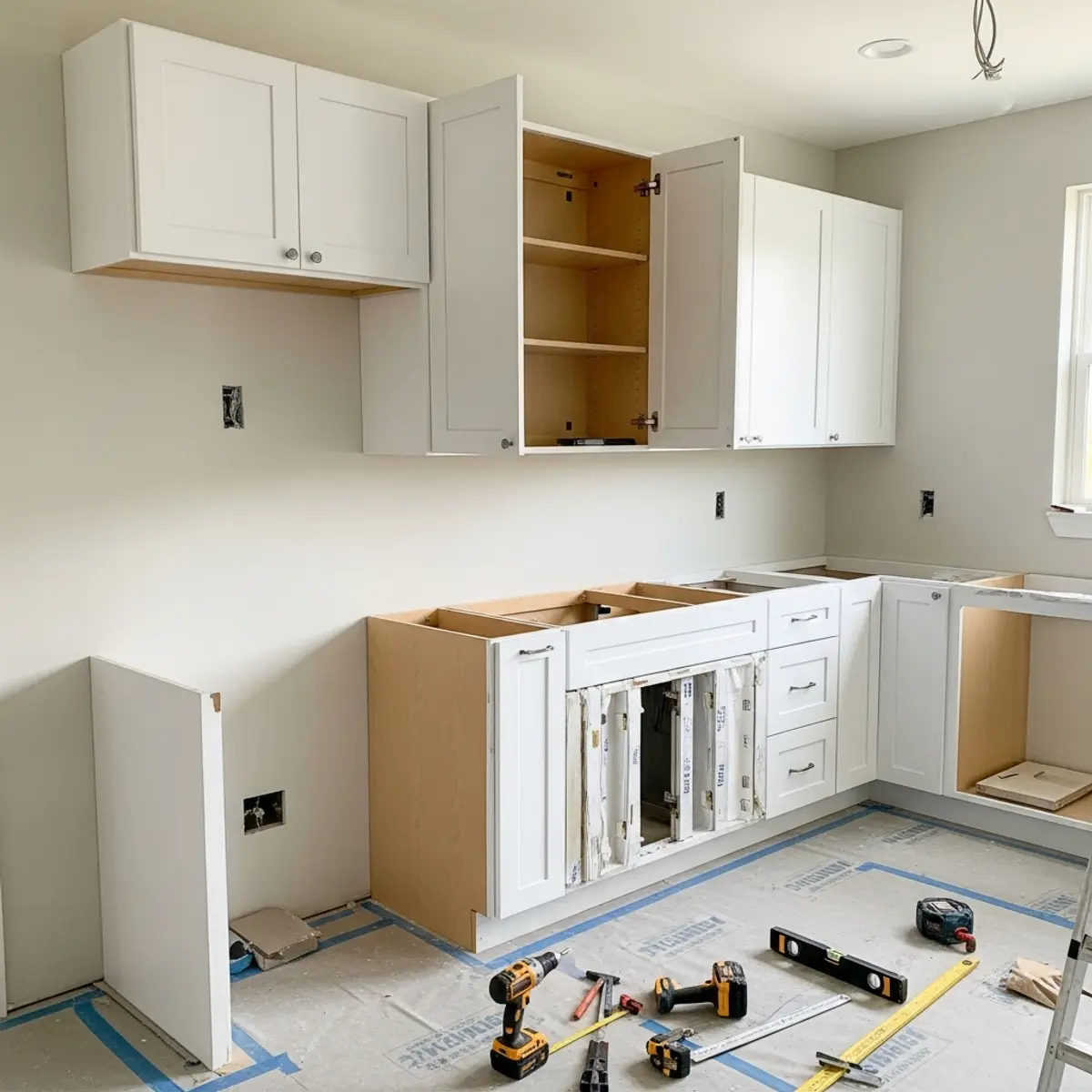
If the layout needs to change, pay to change it correctly the first time. Relocating a sink, adding a dedicated circuit, or moving a gas line is the least glamorous line on the budget and the one homeowners most want to cut — and it's the one that costs triple to fix later.
Older Boise housing stock makes this pointed. A pre-1980 North End bungalow or an older Bench build often hides an undersized 100-amp panel, ungrounded circuits, or galvanized supply lines that choke flow. Bringing a kitchen up to a modern circuit count — small-appliance, dishwasher, disposal, microwave — sometimes forces a panel conversation, and all of it is inspected by Boise City Planning & Development Services (PDS). Doing that work during the open-wall phase costs a fraction of retrofitting after drywall and tile are in.
Who this applies to: anyone changing the footprint, and most owners of pre-1980 homes even when the layout stays. What we do: we pull the panel and supply-line assessment forward into the design phase, so the mechanical scope is priced before you sign — not discovered on demo day.
Footprint changes and pre-1980 Boise homes where hidden panel or supply-line issues are likely.
Layout and mechanical work runs roughly 12–18% of the budget and is easy to resent because you can't see it — but it's the definition of spend-once.
Spend up on the faucet — it's a small category with an outsized failure rate here. Fixtures (faucet, sink, cabinet hardware) are only about 4–7% of the budget, which makes this the cheapest splurge on the list in absolute dollars.
Boise's up to ~13 gpg (avg ~6) water is unusually hard on faucets: scale clogs aerators, seizes cartridges, and blisters electroplated finishes years early. A faucet with a ceramic-disc cartridge and a PVD (physical vapor deposition) finish rather than electroplate holds up dramatically better in our water. This isn't about buying the most expensive faucet — it's about the right internals for the region.
Who this applies to: every Boise kitchen, but especially homes without a water softener. What we do: we match faucet internals to your measured water hardness during design, and it's part of how we plan every Boise kitchen remodeling project. Where to save inside the category: skip touchless electronics unless you have a softener — the sensor module is one more thing hard water attacks.
Every Boise kitchen; the payoff is largest in homes on unsoftened municipal water.
A durable mid-tier pull-down runs roughly $250–$500 installed (typical Treasure Valley range) versus about $120 for a big-box unit that fails at year three — the upgrade is a rounding error against the total.
Build your Boise kitchen budget in the right order
Bring us your number and we'll show you where it should go — boxes, counters, mechanicals, and faucet first, finishes and fixtures where they earn it. No pressure, no showroom upsell: an honest allocation matched to your home's age, your water, and how long you plan to stay.
This is the biggest save on the list. Appliances are 12–18% of the budget and the category where the marketing-to-durability gap is widest. A well-reviewed mid-tier suite performs within inches of a luxury suite costing two to three times more.
The Boise-specific angle is resale. Buyers in most Treasure Valley neighborhoods — Meridian and Nampa subdivisions especially — do not pay a premium for a pro-style range; they register "stainless, matching, working" and move on. The exception is a genuine high-end market like Eagle or Harris Ranch, where a luxury suite can be part of what the buyer already expects. Match the appliance tier to the neighborhood, not to the showroom.
Who this applies to: most owners outside the top resale tier. Where I'd still spend inside the category: the dishwasher, quietly, because a bad one you hear every night — and in our hard water, a model with a built-in softener cycle earns its keep.
Most Boise and Treasure Valley homes outside the Eagle/Harris Ranch luxury resale tier.
A mid-tier suite may need replacing a couple of years sooner than a luxury suite — but you can replace the whole mid-tier suite for the price difference and still come out ahead.
Save on anything that's fashion, and on custom you don't actually need. Two places bleed budget quietly: of-the-moment finishes (the bold backsplash, the colored faucet, the statement tile) and jumping to full-custom cabinetry when semi-custom would have fit.
Trends date fast, and in Boise's resale reality that matters — a very specific 2026 backsplash reads as "dated 2026" to a 2032 buyer, and you'll have paid a premium to install something you then discount. Keep the permanent, expensive surfaces (cabinets, counters) calm and neutral; put personality into the cheap, swappable layers — paint, hardware, a runner. On cabinetry, semi-custom lines now offer most of the sizes and organizers full-custom does; full-custom is justified by a genuinely odd layout — an old North End galley with out-of-square walls, say — not by default.
Who this applies to: anyone who might sell within ten years, and anyone whose layout is close to standard. Spend the custom premium only where the room truly demands it.
Homeowners likely to sell within a decade and kitchens whose footprint is close to standard cabinet sizing.
Full-custom typically adds 20–40% to the cabinet category over semi-custom — the single largest avoidable swing in a kitchen budget.

Save on the fixtures you hang; spend on where the wires go. Lighting is a small category — roughly 3–6% of the budget — and it splits cleanly. The electrical layout (recessed-can placement, under-cabinet wiring, switching) is spend-once infrastructure. The visible decorative fixtures are swappable at any time.
Boise's short winter days and low sun angle make the lighting layout genuinely important — a north-facing kitchen in the foothills, or an older Bench home with small windows, lives on artificial light half the year. That's an argument for spending on the wiring and layout, done while the walls are open and inspected under Boise PDS, not on a $600 designer pendant.
Who this applies to: everyone, but especially darker or north-facing kitchens. Where to spend inside the category: more and better-placed under-cabinet LED plus adequate recessed cans — the layer that actually makes the counter usable.
Every kitchen, and critically the north-facing and small-window homes common in the foothills and older Bench builds.
A $90 pendant and a $600 pendant throw nearly identical light; the difference is taste, and taste is the one thing you can upgrade later for the price of the fixture alone.
When we scope a Boise kitchen, the first working session isn't about door styles — it's about where your specific number should go. We start by pulling the invisible risks forward: panel capacity, supply-line condition, water hardness, and the age of the home, because those decide how much of the budget has to sit in the boxes and the mechanicals before anyone talks finishes. From there we build the allocation around how long you plan to stay and what your neighborhood's buyers actually reward, so the splurges land where they earn their place and the saves come off things you won't miss.
That sequencing is the whole point. A $60,000 kitchen (typical Treasure Valley range) assembled in the wrong order looks like a $40,000 kitchen in five years, and the reverse is just as true. We'd rather talk you out of a designer pendant and into a plywood sink base than the other way around. If you want that kind of line-by-line honesty applied to your own budget, it's how we run every kitchen remodel across the Treasure Valley.
How should I split a fixed kitchen budget across categories in Boise?
As a working frame, cabinets tend to take the largest slice at roughly 30–35%, followed by countertops at 10–15%, appliances at 12–18%, plumbing/electrical/layout labor at 12–18%, fixtures like the faucet and sink at 4–7%, lighting at 3–6%, and finishes such as backsplash, paint, and flooring at 8–12%. Hold roughly 10% back as contingency. Those are allocation guidelines, not fixed rules — an older North End home with panel and supply-line issues will shift more toward mechanicals, while a newer Meridian home with sound bones can put more toward finishes. The percentages matter more than any single dollar figure.
If I only have room for one splurge, where should it go?
The cabinet boxes. Everything else in the kitchen is either swappable later (fixtures, lighting, appliances) or a surface you can live with (a modest countertop). The carcass is structural, it's the hardest thing to change after the fact, and in Boise's dry-summer, wet-edge seasonal cycling a cheap particleboard box under the sink is the part we most often pull out swollen and delaminated. Protect the box first; you can upgrade almost everything else in stages.
Where do homeowners most often waste money on a Boise kitchen remodel?
Three places, in order. First, jumping to full-custom cabinetry when semi-custom would have fit — that alone can add 20–40% to the largest category for no functional gain. Second, a luxury appliance suite in a neighborhood where buyers won't pay for it. Third, expensive trend finishes on permanent surfaces that then read as dated within a few years. The common thread is spending up on things that are either invisible to a future buyer or easy to change cheaply later.
Should I really match my appliances to my neighborhood?
For resale, yes. In most Treasure Valley subdivisions — much of Meridian, Nampa, and Kuna — buyers read a matching stainless mid-tier suite as complete and don't pay extra for pro-style ranges. In a genuine high-end market like Eagle or Harris Ranch, a luxury suite can be closer to what buyers expect. If you're staying long-term and simply want the luxury range for yourself, that's a lifestyle choice and it's fine — just make it knowing you likely won't recover the premium at sale in most Boise-area neighborhoods.
Is full-custom cabinetry ever worth it in an older Boise home?
Sometimes, and older homes are exactly where the case is strongest. A 1920s or 1930s North End bungalow with out-of-square walls, unusual ceiling heights, or a tight galley footprint can genuinely need custom sizing that stock and semi-custom lines can't hit cleanly. That's a real justification. What isn't a justification is choosing full-custom by default in a home with a standard layout, where semi-custom now offers most of the same sizes, organizers, and finishes at a meaningfully lower cost.
How much contingency should I hold back, and why?
Plan on roughly 10% of the budget as contingency, and treat it as spoken-for rather than spare. In pre-1980 Boise homes especially, demo can expose an undersized panel, galvanized supply lines, or wiring that has to be brought up to current requirements and inspected by Boise PDS before new cabinets go in. Those discoveries are common enough that a budget without a cushion isn't really a finished budget — it's an optimistic one. If the contingency goes unused, it becomes an upgrade fund at the end; if it's needed, it keeps the project from stalling mid-stream.
Build your Boise kitchen budget in the right order
Bring us your number and we'll show you where it should go — boxes, counters, mechanicals, and faucet first, finishes and fixtures where they earn it. No pressure, no showroom upsell: an honest allocation matched to your home's age, your water, and how long you plan to stay.
These pages go deeper on the topics linked from this article. Read them before your consultation and you'll come in with sharper questions and a clearer scope.
The following government agencies, industry organizations, and official resources provide additional information relevant to your remodeling project.