
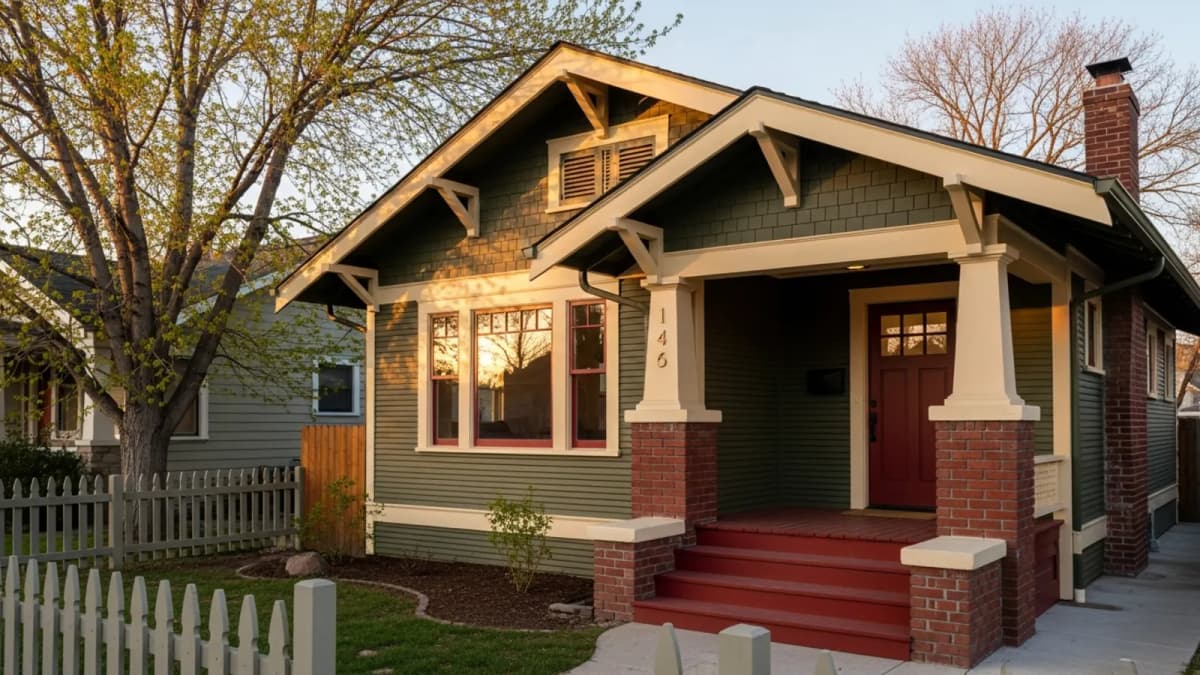
Exterior Painting Across the North End — Hyde Park, Harrison Boulevard, Camel's Back & Beyond
Restoration prep on pre-1928 wood lap siding across 13th Street and Hyde Park Craftsman bungalows, painted-trim refresh on Harrison Boulevard Tudors and Colonial Revivals, period-correct HPC-acceptable color palettes, EPA RRP lead-safe practices on every pre-1978 address — universal across the District.
Quick answer
Three reasons stack on every pre-1928 address. First, EPA RRP-required lead-safe practices add 15–25% to project cost on pre-1978 homes — virtually every North End property. Second, pre-1928 wood lap siding restoration prep is intensive: 30–60 hours of hand scraping on a typical 1,400 sq ft Hyde Park bungalow, individual board replacement with profile-matched milled cedar where rot is found, exposed rafter tail repair, porch column base repair, comprehensive caulking.
Exterior painting in the North End is fundamentally different work from exterior painting in any newer Boise neighborhood because of three specific North End realities: the original wood lap siding on pre-1928 homes is a different substrate than modern Hardie or LP SmartSide and requires a different prep protocol, the pre-1978 lead-paint reality is universal across the District which means EPA RRP lead-safe work practices apply on every single address, and the Historic Preservation Commission reviews body-color changes inside the District boundary for compatibility with the historic neighborhood character. The original wood lap siding on 1905–1925 Craftsman bungalows around Hyde Park, 13th Street, and Camel's Back is typically 7-inch reveal old-growth cedar or fir — high-quality old-growth softwood that, properly maintained, can last centuries. But after 80–120 years of Boise's high-UV high-altitude climate, freeze-thaw cycles, and sometimes decades of deferred maintenance, the prep work required to put down a paint film that lasts 8–12 years instead of 3–5 years is substantially more intensive than work on modern siding. Pre-1928 wood lap siding restoration prep is a labor category of its own: lead-safe scraping with poly-sheet ground containment, sanding to feather edges, identification and replacement of individual rotted boards while matching original profiles exactly (any board that needs replacement must be milled to the same reveal and bevel as the surrounding original siding — generic stock replacement reads as a patch from the curb), comprehensive caulking of every trim joint, oil-based or premium acrylic priming on bare wood, and only then two finish coats of premium exterior paint. The labor on a properly prepped Hyde Park Craftsman runs 2–3× what a modern-siding repaint of the same square footage would take. The 1925–1940 Tudor Revival, Colonial Revival, and Prairie homes along Harrison Boulevard, parts of Fort Boise, and the Camel's Back edge present a different prep profile — Tudor stucco bodies with painted decorative half-timbering need stucco patching and breathable paint specification, Colonial Revival lap siding bodies (slightly newer construction, generally better condition than the 1905–1925 stock) with formal painted trim need detailed trim prep on the more elaborate molding profiles. HPC reviews body-color changes inside the District for compatibility — significant changes from cream to navy on Harrison Boulevard, from current-taste gray to a period saturated red-brown on a Hyde Park bungalow, all warrant Certificate of Appropriateness submittal and add 4–8 weeks to project timeline. The lower-numbered streets (3rd–9th) include both contributing and non-contributing parcels — verification per property is essential. North of Hill Road infill is typically outside the District boundary entirely, which removes the HPC overlay on color choice but doesn't change the EPA RRP requirement on any pre-1978 address.
North End exterior painting strategy varies sharply by era because the siding type, trim profile complexity, original color conventions, and HPC contributing-resource status all differ across the District's housing waves. Era of the original house drives which prep protocol applies, what color palette is HPC-acceptable, and what the realistic paint-life expectation is.
1905–1925 original Craftsman bungalows (13th Street, Hyde Park, Camel's Back, Heron Streets)
Original 7-inch reveal wood lap siding (typically old-growth cedar or fir), painted trim, exposed rafter tails, tapered porch columns, and cedar shingle accents on the gable ends. Surface condition varies sharply by elevation — south- and west-facing surfaces have weathered substantially more than north and east on the older Hyde Park stock. Pre-1928 wood lap siding restoration prep is intensive: lead-safe scraping, sanding to feather edges, individual board replacement on rotted sections (matching original 7-inch reveal and bevel exactly — any new board must be milled to match), comprehensive caulking, oil-based or premium acrylic priming on bare wood. Original colors were typically deep saturated tones (forest green, deep red-brown, warm khaki, navy) with cream or warm-white trim and contrasting accent colors. Period-correct palette is HPC's preferred specification on contributing-resource homes. Cost: $14,000–$32,000 typical for whole-house with restoration prep. Timeline: 4–6 weeks.
1925–1940 Tudor Revival, Colonial Revival, Prairie (Harrison Boulevard, Fort Boise area)
Tudor: stucco panels with painted decorative half-timbering, often slate-look composite roofing, small-window patterns. Stucco bodies require breathable paint specification (mineral or breathable acrylic — standard latex traps moisture and causes stucco delamination over time). Half-timbering painted in dark contrasting color (deep brown, near-black, deep green). Colonial Revival: painted lap siding bodies (slightly newer construction than 1905–1925 stock, generally in better condition) with formal trim profiles — dentil molding at cornice, more refined casing around windows, sometimes brick veneer accents. Color palettes lean toward formal traditional — earthy greens, warm whites, deep reds, slate grays. HPC scrutiny on body-color changes is at its most demanding on Harrison Boulevard because these are the most architecturally significant homes in the District. Cost: $18,000–$42,000 typical for whole-house with stucco patching or formal trim prep.
1945–1965 post-war ranch and minimal traditional infill (lower-numbered streets 3rd–9th, parts of Fort Boise)
Painted lap siding (often original wood, sometimes aluminum from later 1960s–1970s updates) with simpler trim profiles, single-story massing, occasional brick veneer accents. Surface condition typically better than pre-1925 stock because slightly newer. Color schemes from the era featured pastels and earth tones; modern repaints typically choose more saturated current-taste palettes. HPC scrutiny varies — many of these homes are non-contributing resources within the District, which means color review is lighter or absent. Verification at consultation. Lower-numbered streets are increasingly being renovated as North End demand pushes outward from the 13th Street core. Cost: $9,500–$18,000 typical.
1985+ modern infill (north of Hill Road, isolated non-contributing parcels)
Modern lap siding (Hardie, LP SmartSide, occasionally vinyl) with no environmental complications and no pre-1928 prep requirements. Standard exterior painting practices apply with substantially faster turnaround than work on older homes. Often outside the Historic Preservation District boundary entirely on the homes north of Hill Road — no HPC color review. EPA RRP doesn't apply because post-1978 construction. Cost: $6,500–$14,000 typical.
Five recurring exterior-painting shapes account for nearly every North End project. Era of the original house, surface condition, scope (whole house vs. trim-only), and whether body-color is changing dramatically (which triggers HPC review inside the District) all drive which one fits.
1. The Pre-1928 Restoration Repaint (Hyde Park, 13th Street, Camel's Back Bungalows)
The defining North End paint job. A whole-house repaint on a Craftsman bungalow that hasn't been properly painted in 15–25+ years, with original 7-inch reveal cedar or fir lap siding that requires intensive restoration prep. Substantial scraping (often 30–60 hours of scraping labor on a typical 1,400 sq ft bungalow), individual board replacement on rotted sections with profile-matched milled cedar, exposed rafter tail repair where weather damage has set in, porch column base repair where water pooling has caused rot, comprehensive caulking, oil-based priming on bare wood. Lead-safe practices throughout — universal on pre-1978 homes. Result: a properly prepped exterior that should hold 8–12 years on premium paint. Period-correct color palette in HPC-acceptable saturated tones (forest green, deep red-brown, navy, warm khaki) with cream trim and contrasting accents.
Target homes: Pre-1928 Craftsman bungalows with significant deferred maintenance — peeling paint, exposed wood, soft spots on individual boards, weathered exposed rafter tails, porch column rot. Permit: no permit required for paint itself; rotted-wood replacement may require building permit if structural; HPC Certificate of Appropriateness for any body-color change inside the District.
2. The Tudor or Colonial Revival Whole-House Repaint (Harrison Boulevard)
Whole-house repaint on a 1925–1940 Tudor or Colonial Revival home. On Tudor: stucco patching where cracks have appeared, breathable paint specification (mineral or breathable acrylic — never standard latex on stucco), half-timbering repaint in dark contrasting color. On Colonial Revival: detailed trim prep on the formal molding profiles (dentil cornice, refined window casing), painted shutter refresh, sometimes brick veneer mortar work. Color palette in the formal traditional vocabulary — earthy greens, warm whites, deep reds, slate grays. HPC scrutiny is at its most demanding on Harrison Boulevard. EPA RRP-required throughout because pre-1978.
Target homes: 1925–1940 Tudor Revival, Colonial Revival, or Prairie homes on Harrison Boulevard, Fort Boise, or the Camel's Back edge. Permit: no permit for paint; HPC Certificate of Appropriateness for body-color change inside the District.
3. The Standard Whole-House Repaint (Same or Similar Color)
Comprehensive exterior repaint where color is staying the same or shifting only modestly within the existing palette. No HPC submittal required because no body-color change. Standard scope: power-wash, scrape and sand failing paint, prime bare wood and patches, caulk gaps and cracks, two finish coats of premium exterior paint on body, trim, and accents. EPA RRP-compliant for pre-1978 homes. Most cost-effective shape on Hyde Park bungalows where the existing palette is already period-appropriate and just needs refresh.
Target homes: Any North End home whose exterior is failing or whose color is dated but where dramatic color change isn't desired. Permit: no permit; no HPC submittal required for refresh of existing palette.
4. The Trim & Accents Refresh (Body Preserved)
Painting only trim, fascia, soffits, exposed rafter tails, porch columns, doors, shutters, and decorative elements while leaving the main body siding as-is. Common when body color is fine but trim needs refresh, or when budget doesn't allow whole-house. Highest visual impact per dollar — painted trim refresh can transform the curb appeal of a home that just had body work done. EPA RRP-compliant on pre-1978 trim disturbance.
Target homes: North End homes where body siding is in good shape but trim and accents need attention. Permit: none; no HPC submittal required for trim color refresh in established palette.
5. The Color-Change Whole-House Repaint (HPC Certificate of Appropriateness Required)
Whole-house repaint that involves changing one or more colors substantially — body color from cream to deep navy on a Hyde Park bungalow, from current-taste gray to period red-brown on a Camel's Back Craftsman, from sage green to charcoal on a Harrison Tudor. Inside the District boundary, this triggers HPC Certificate of Appropriateness review for compatibility with the historic neighborhood character. HPC reviews body color, trim color, and accent colors against the period-appropriate palette for the home's era. Iron Crest pre-meets with HPC staff before formal submittal to identify concerns and refine selections — this surfaces issues before they become formal redesign requests. Adds 4–8 weeks to project timeline.
Target homes: Inside-District homes wanting substantive aesthetic shift. Permit: no permit for paint; HPC Certificate of Appropriateness for body-color change.
The North End is made up of distinct sub-neighborhoods, each with its own remodeling personality.
13th Street & Hyde Park
The cultural and commercial heart of the North End — boutique shops and restaurants along 13th between Brumback and Eastman, with the densest concentration of original Craftsman bungalows on the surrounding blocks. Lots are tight (typically 50' frontage), alley access is common, and the neighborhood is heavily walked. Most homes here are 1905–1925 Craftsman.
Camel's Back & Heron Streets
The streets immediately around Camel's Back Park, climbing slightly into the lower foothills. Mostly Craftsman bungalows with some Tudor Revival mixed in. Lots get larger toward the park edge, and some homes back to the Foothills Reserve with significant trees. Project budgets here tend to be higher — these are some of the most coveted blocks in the city.
Harrison Boulevard corridor
The grand divided boulevard running south-to-north through the heart of the North End, lined with the neighborhood's largest historic homes. Tudor Revival, Colonial Revival, and a few notable Prairie-style houses sit on deep lots with mature plantings. Projects here lean toward sympathetic upgrade rather than reconfiguration — these homes already have generous floor plans.
Fort Boise & Capitol-area North End
The streets around Fort Boise Park and stretching toward the State Capitol grounds — a mix of original Craftsman bungalows, larger 1920s and 1930s homes, and a higher proportion of post-war infill. Lots vary widely. Project scopes span the full range depending on house age and homeowner intent.
North of Hill Road / new infill
The northern fringe of the historic North End, where construction continued through the 1950s and where modern infill has been most active. Newer (1945–present), larger, less constrained by historic-district considerations. Projects here look more like SE Boise or Harris Ranch in scope and material strategy.
Lower-numbered streets (3rd–9th)
The streets between the State Capitol grounds and Fort Boise — traditionally a more working-class section of the North End, with a mix of smaller Craftsman bungalows, post-war houses, and some converted multi-family. Increasingly being renovated as North End demand pushes outward from the 13th Street core. Excellent value if you can find an unrenovated home here.
Pricing reflects the four layers that drive North End exterior-painting cost: pre-1928 wood lap siding restoration prep is intensive and labor-heavy on the older Hyde Park and Camel's Back stock, EPA RRP lead-safe work practices add 15–25% above non-RRP work and apply on every pre-1978 address (which is virtually every North End property), HPC body-color review inside the District boundary adds 4–8 weeks to project timeline when scope includes color change, and the District's tight 50' lot pattern with limited curbside staging adds operational complexity for lift placement and right-of-way permits.
North End exterior painting ranges
Spot repaint (Specific elevation or feature, focused prep + paint): $3,500–$8,500 / 1–3 weeks end to end
Trim & accents only (All trim, fascia, soffits, doors, columns; body preserved): $5,500–$11,000 / 1–2 weeks end to end
Standard whole-house (same or similar color) (Comprehensive prep + 2 finish coats body and trim, no HPC submittal): $12,000–$22,000 / 2–4 weeks end to end
Color-change whole-house (HPC review) (Comprehensive scheme update with HPC Certificate of Appropriateness for body-color change): $16,000–$32,000 / 8–14 weeks (incl. HPC review) end to end
Pre-1928 restoration repaint (Long-deferred Craftsman bungalow with extensive scraping, board replacement, lead remediation, period-correct palette): $22,000–$42,000 / 4–6 weeks end to end
Pricing assumes EPA RRP lead-safe practices on every pre-1978 address (virtually every North End property), premium exterior paint (Benjamin Moore Aura Exterior, Sherwin Williams Duration, or Sherwin Williams Emerald), comprehensive surface prep including scraping/sanding/priming/caulking, two finish coats on body and trim, individual rotted board replacement with profile-matched milled cedar where required, careful protection of plantings and adjacent surfaces (particularly important on Camel's Back lots that back to the Foothills Reserve), right-of-way permits for lift or scaffolding placement on tight 50' District streets, and a 3-year workmanship warranty on properly prepped surfaces. Critical permit fact: the paint application itself requires no City of Boise permit. Body-color changes inside the District boundary trigger HPC Certificate of Appropriateness review for compatibility with the historic neighborhood character — adds 4–8 weeks to project timeline. Same-color refresh requires no HPC submittal. Stucco patching on Tudor bodies requires breathable paint specification — never standard latex which traps moisture and causes delamination over time. North of Hill Road infill is typically outside the District boundary entirely.
The North End Historic District boundary covers most — but not all — of the North End. The district is administered by the City of Boise Historic Preservation Commission, which reviews exterior modifications within the district boundary. Interior work, including comprehensive remodels, is exempt from Historic Preservation review. This is the single most important permitting fact to internalize: your interior work doesn't need historic review, regardless of how aggressive the scope.
Where Historic Preservation review enters the picture is when your project includes any exterior change. Examples we encounter regularly: enlarging a window, relocating an exterior door, adding an exterior-vented hood that requires a new wall penetration, building a small addition or bump-out, or replacing a side-yard window with a different style. Any of these requires a Certificate of Appropriateness from the Historic Preservation Commission, which can add several weeks to the permit timeline (confirm current timelines with PDS) and typically requires architectural drawings showing the proposed change in context.
For interior-only projects, the standard City of Boise permits apply: a building permit for structural work (wall removal, beam installation), an electrical permit for new circuits or panel work, a plumbing permit for fixture relocation or new water lines, and a mechanical permit for ducting or HVAC modifications. Permit fees for a typical mid-range project run several hundred to a few thousand dollars depending on scope. Processing times: electrical and plumbing permits are often same-day or next-day; building permits go through plan review, about two weeks for online plan review per Boise PDS and longer when structural drawings are involved.
One North End-specific permit consideration: parking and right-of-way. Placing a dumpster on the street or parking a construction trailer at the curb requires an ACHD temporary-use permit (fee varies), since North End residential streets are ACHD right-of-way. Some North End streets have additional restrictions related to the historic neighborhood designation. Iron Crest pulls all required temporary-use permits as part of project setup.
Exterior paint material and color strategy for North End homes balances longevity, weather performance in Boise's high-altitude high-UV climate with substantial freeze-thaw cycling, period-correct authenticity in HPC-acceptable palettes, and the specific substrate realities of pre-1928 wood lap siding versus 1925–1940 stucco-and-half-timber Tudor bodies versus modern lap siding on infill homes.
Paint product — premium-grade is non-negotiable
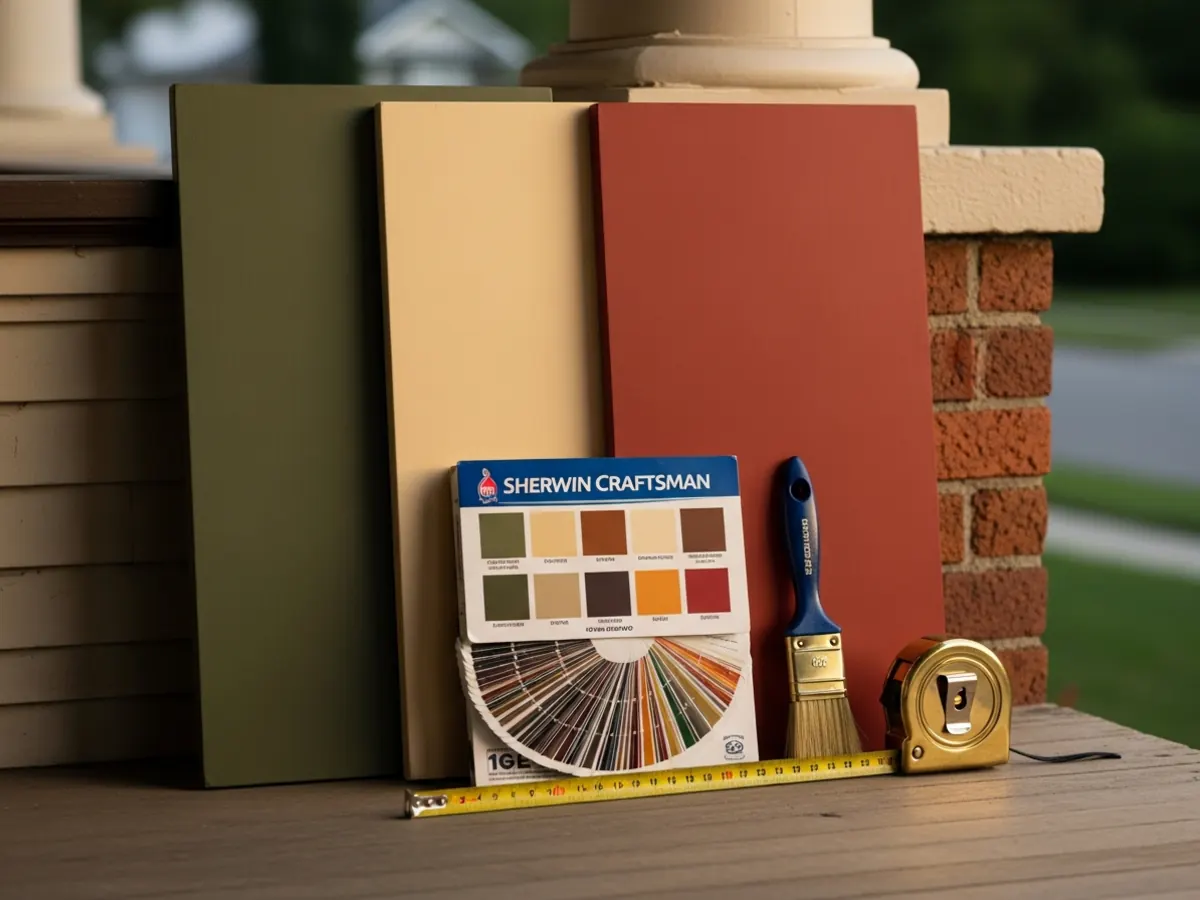
Premium exterior paint is non-negotiable on North End homes. Benjamin Moore Aura Exterior, Sherwin Williams Duration, or Sherwin Williams Emerald — all formulated for excellent UV resistance, mildew resistance, and color retention in Boise's 2,700' elevation, high-UV environment. Mid-grade exterior paints lose color quickly, chalk visibly, and require repainting in 5–6 years instead of 8–12. The premium-paint cost difference per house ($300–$600) is recovered many times over through extended life. On Tudor stucco bodies, breathable paint specification is required — Romabio mineral paint, Keim mineral paint, or breathable acrylic. Standard latex on stucco traps moisture, causes blistering and delamination, and produces a paint failure within a few years that's expensive to remediate.
HPC-acceptable color palette for Craftsman bungalows
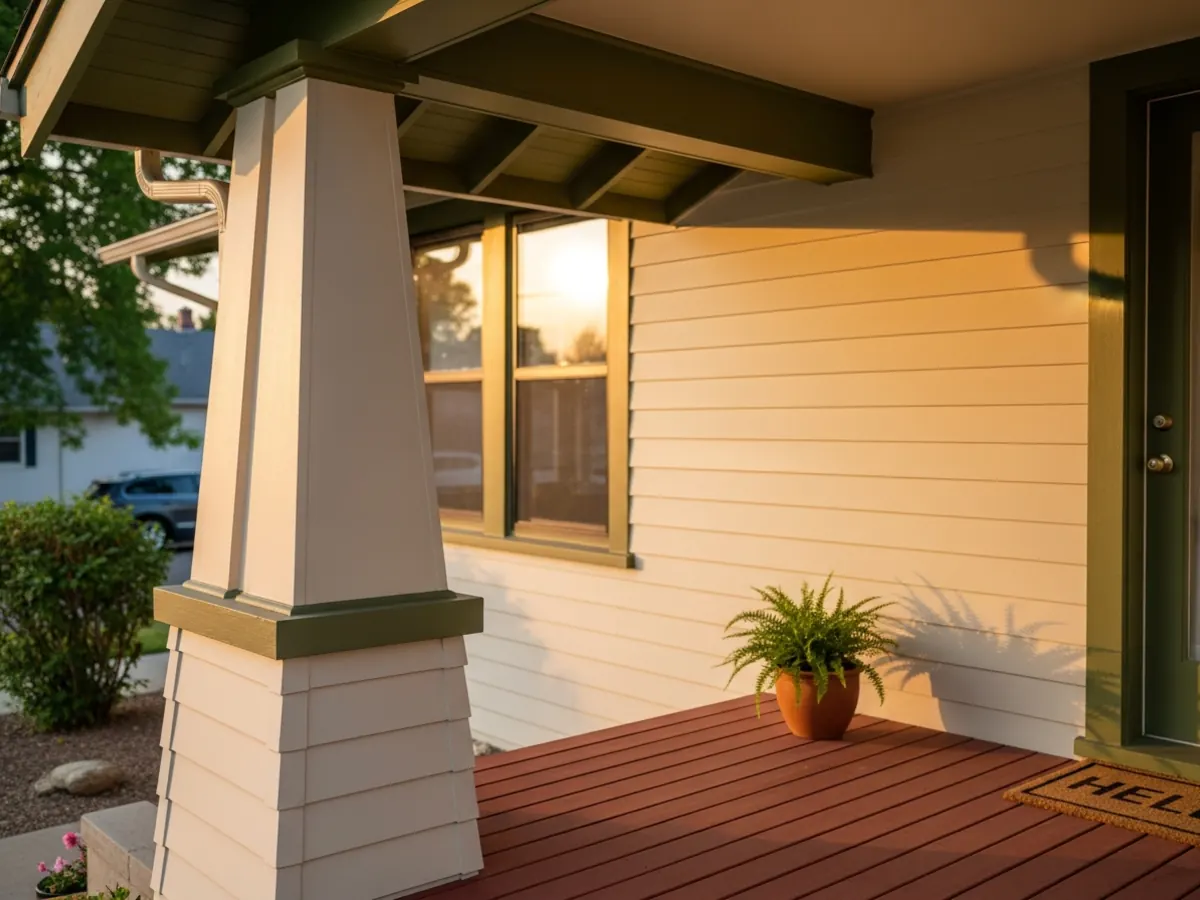
Period-correct Craftsman color schemes use deep saturated body colors with contrasting trim and accent colors — and this is the palette HPC reviews for compatibility on contributing-resource Hyde Park, 13th Street, and Camel's Back homes. Body options that are reliably HPC-acceptable: forest green (BM Black Forest Green, SW Rosemary), deep red-brown (BM Caponata, SW Cabin Red), warm khaki (BM Manchester Tan, SW Sand Beach), navy (BM Hale Navy, SW Naval). Trim: warm cream or off-white (BM Cottage White, SW Antique White) — never stark white which is anachronistic. Accents (doors, exposed rafter tails, gable shingles): brick red, deep green, ochre, or contrasting saturated color. Avoid: stark white body, gray-on-gray schemes, modern monochromatic. HPC actively pushes back against these on contributing-resource pre-1928 homes.
HPC-acceptable color palette for Tudor and Colonial Revival
Tudor (Harrison Boulevard, Fort Boise): cream or earth-tone stucco body with painted dark brown or near-black half-timbering, deep green or burgundy front door, dark trim. Mineral or breathable acrylic on stucco bodies — never standard latex. Colonial Revival: warm white or cream body with painted shutters in deep blue or deep green, white trim with refined dentil detail, contrasting door color (often deep red or black). Both eras tolerate richer, more formal palettes than Craftsman and HPC reviews these against the formal traditional vocabulary appropriate to the era. Iron Crest's HPC pre-application meeting includes presenting selected colors against compatibility precedent.
Surface prep — pre-1928 wood lap siding (Craftsman bungalow)
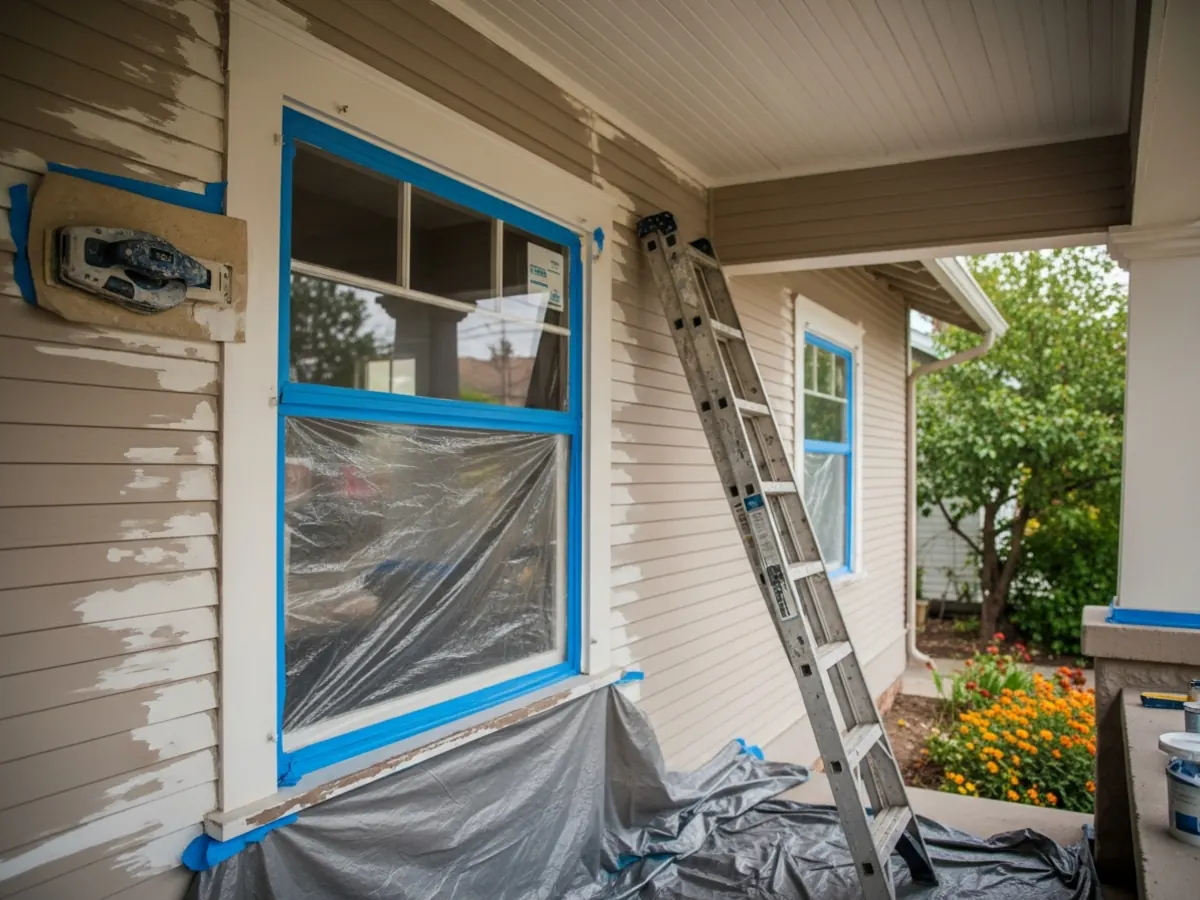
The defining North End prep protocol. Power wash with medium pressure (1,500–2,500 PSI) to remove loose dirt, mildew, and chalking — careful technique on original wood to avoid driving water into joints. Hand-scrape failing paint with lead-safe procedures. Sand to feather edges between scraped and intact paint with HEPA-collected power sanders. Identify and replace individual rotted boards — must be milled cedar matching original 7-inch reveal and bevel exactly. Original siding profiles on the older Hyde Park stock sometimes require custom milling because stock-profile cedar doesn't match. Prime bare wood with oil-based primer (best penetration on aged old-growth wood) or premium acrylic primer. Caulk gaps at trim-to-siding junctions, around windows, at corner boards, and at horizontal seams where appropriate (some original lap siding seams are designed to remain uncaulked for moisture management — knowing which is which is part of the craft). Quality of prep determines paint job life — this is the single highest-leverage step in the entire project.
Surface prep — Tudor stucco and Colonial Revival trim
Tudor stucco prep: identify hairline cracks (pattern recognition — settling cracks vs. structural cracks), patch with breathable stucco patch material matching original texture (some 1925–1940 Tudor stucco has a distinctive heavy-troweled texture that requires manual matching), prime with breathable mineral primer. Half-timbering prep: scrape failing paint with lead-safe procedures, sand smooth, fill any wood gaps, prime bare wood. Colonial Revival trim prep: more attention than body siding because of the formal molding profiles — dentil cornice work requires careful scraping to preserve detail, refined window casing requires hand-sanding rather than power-sanding to preserve crisp edges. Trim prep on Colonial Revival takes the most time per square foot of any North End exterior painting work but is the most visible final surface.
Lead-safe practices — universal on every North End address
EPA RRP rules require: containment with poly sheeting on the ground around the work area to capture paint chips, dampened sanding to minimize airborne dust, HEPA vacuuming of work area at end of each day, posted warning signs, proper waste disposal of contaminated debris, detailed cleanup verification. Adds 15–25% to total project cost compared to non-RRP work but is the legal and ethical requirement on every pre-1978 address — virtually every North End home. Iron Crest's RRP procedures are built into pricing rather than added as discovery. Particularly important on the tight 50' District lots where containment must extend to neighbor property lines and ground-level paint chip capture matters because pedestrians use the public sidewalks throughout the work.
Exterior painting prep on pre-1928 North End homes routinely surfaces issues that affect cost and timeline. Most relate to a century of weathering on original old-growth wood substrate, decades of accumulated caulk failure, and the universal pre-1978 lead-paint reality that's been slowly weathering off contact surfaces.
- •Rotted siding boards requiring profile-matched replacement Original 7-inch reveal cedar or fir lap siding 80–120 years old often has rot at boards near grade, around drainage points, at horizontal seams, and on south- and west-facing elevations of older Hyde Park and Camel's Back stock where decades of weathering have penetrated. Replacement boards must be milled cedar matching original reveal and bevel exactly — generic stock replacement reads as a patch from the curb. Per board: $200–$500. Larger areas of rot priced as carpentry scope.
- •Failed caulk at every joint Original caulk fails over decades, particularly at trim-to-siding junctions, window perimeters, corner boards, and porch-to-siding seams. Comprehensive re-caulking is part of restoration prep — substantial cases on long-deferred homes add $400–$1,500 above standard scope.
- •Soffit and fascia damage from gutter or weather failure Older soffit and fascia surfaces sometimes have water damage from failing gutters or weather exposure, particularly on Hyde Park and 13th Street homes where original gutters are still in service. Repair before painting: $400–$2,500 depending on extent.
- •Window glazing failure on original wood double-hungs Original 1905–1925 wood double-hung windows with deteriorated linseed-oil-based glazing putty around the panes need re-glazing before painting (otherwise the glazing failure quickly degrades the painted surface). Re-glazing per window: $80–$200 — or coordinate with concurrent window restoration scope at higher value.
- •Lead paint chipping and weathering — universal on every pre-1978 address Pre-1978 painted surfaces with severe weathering have loose paint chips on the ground around the home. EPA RRP-compliant cleanup and ground containment add labor and disposal cost. Built into pricing for pre-1978 homes — virtually every North End address.
- •Porch column base rot (Craftsman bungalows) Original Craftsman porch columns on Hyde Park, 13th Street, and Camel's Back bungalows sometimes have rot at the base from water pooling on the porch deck. Repair or replacement of column base: $400–$1,500 per column. Full column replacement on tapered Craftsman columns requires custom millwork.
- •Exposed rafter tail damage (signature Craftsman feature) Exposed rafter tails — the signature Craftsman architectural detail along the eave line — sometimes have weather damage or rot at the exposed end. Repair: $80–$300 per rafter tail. Replacement with profile-matched milled fir: $200–$500 per tail. HPC notification on rafter tail replacement because it's a contributing-resource architectural element.
- •Tudor stucco hairline cracks requiring breathable patch 1925–1940 Tudor stucco bodies on Harrison Boulevard occasionally develop hairline cracks at door and window jambs from settling. Patching with breathable stucco patch material matching original heavy-troweled texture: $300–$1,500.
- •Original cedar shingle gable accents requiring replacement Cedar shingle accents on Craftsman gable ends sometimes have weathered shingles requiring individual replacement. Per shingle: $25–$60 plus matching prep and finish.
- •Mildew or staining requiring chemical treatment before paint North-facing or shaded elevations sometimes have mildew or algae growth, particularly on Camel's Back and Heron Streets blocks where mature trees create extended shade. Treatment with mildewcide before priming: $200–$600.
- •HPC Certificate of Appropriateness color review modifications When body-color change is in scope inside the District boundary, HPC review of selected colors against compatibility precedent for the home's era. Iron Crest pre-meets with HPC staff to identify concerns before formal submittal — minimizes redesign risk on Harrison Boulevard or Hyde Park sites where scrutiny is highest. Modifications to selected colors typically don't add cost (Benjamin Moore and Sherwin Williams premium tiers are the same price across colors) but may add 1–2 weeks of design time.
Initial consultation and color planning (Week 1)
On-site walkthrough of the entire exterior — body, trim, soffits, accents, porch elements, exposed rafter tails, gable shingle accents on Craftsman bungalows, half-timbering on Tudor bodies. Existing-condition photographs per elevation. Color consultation with large painted samples (12-inch by 12-inch on actual surfaces) to view in real lighting at different times of day — particularly important on Hyde Park bungalows where saturated period colors look different in mid-morning vs. late-afternoon light. HPC contributing-resource status verification.
Estimate and HPC pre-application (Weeks 1–3)
Detailed line-item estimate per scope item. Color selection finalized in HPC-acceptable palette for the home's era. HPC pre-application meeting with staff for any body-color change inside the District boundary — surfaces concerns before formal submittal to minimize redesign risk.
HPC Certificate of Appropriateness review (Weeks 3–11)
Formal Certificate of Appropriateness application to HPC for any body-color change inside the District boundary. Color samples on actual home elevations. HPC review at monthly meetings — typically 4–8 weeks. Iron Crest sequences this concurrent with material orders to compress total timeline. Same-color refresh skips this step entirely.
Mobilization and protection (Day 1 of work)
Plant and shrub protection — particularly important on Camel's Back and Heron Streets lots that back to the Foothills Reserve where mature trees and native plantings are protected. Walkway and driveway protection. Containment poly sheeting on ground around work area for lead-safe practices on pre-1978 addresses (universal across the District). Lift or scaffolding setup with right-of-way permits where curbside placement is required on tight 50' District streets.
Power washing (Days 1–2)
Comprehensive power wash with medium pressure (1,500–2,500 PSI) to remove loose dirt, mildew, chalking, and any loose paint. Careful technique on pre-1928 original wood to avoid driving water into joints. Allow 24–48 hours for thorough drying before sanding.
Scraping, sanding, board replacement (Days 3–10 on restoration scope)
The longest single activity on pre-1928 restoration prep. Hand-scraping of failing paint with lead-safe procedures and ground containment. HEPA-collection power sanding to feather edges. Identification and individual board replacement on rotted sections with profile-matched milled cedar. Exposed rafter tail repair on Craftsman bungalows. Porch column base repair. Tudor stucco patching with breathable patch material on the Harrison Boulevard scope.
Priming and caulking (Days 10–14)
Prime all bare wood with oil-based primer (best penetration on aged old-growth wood) or premium acrylic primer. Breathable mineral primer on Tudor stucco. Caulk all joints, trim seams, gaps at corner boards. Repair any rot or damage discovered during prep that wasn't surfaced during initial walk.
First finish coat — body (Days 14–17)
First coat of body color across all siding. Consistent thickness, proper temperature conditions (50°F+ ambient, dry weather forecast for 24 hours after each coat). On Tudor stucco, breathable acrylic or mineral paint application — never standard latex.
Second finish coat — body (Days 17–20)
Second coat for full coverage and color depth. This is the final body surface.
Trim, accents, doors, walkthrough (Days 20–28)
Trim painting in coordinated color (multiple coats for smooth finish on the formal Colonial Revival cornice and casing details). Door painting (typically off-hardware for clean finish). Exposed rafter tail painting on Craftsman bungalows. Half-timbering repaint in dark contrasting color on Tudor bodies. Final touch-ups. EPA RRP final HEPA vacuuming and ground-containment cleanup. Walkthrough with you. Punch-list addressed within 1 week. 3-year workmanship warranty begins.
Exterior painting on pre-1928 North End homes is a different category from same-day power-wash-and-spray work that's common in suburban developments. The contractor needs deep familiarity with old-growth wood substrate prep protocol, hands-on experience with profile-matched cedar board replacement, EPA RRP lead-safe practices on every pre-1978 address, working knowledge of HPC's color-compatibility review process, and the period color sense to specify HPC-acceptable palettes that age well.
- City of Boise Historic Preservation Commission — Design review information, district maps, and Certificate of Appropriateness application.
- City of Boise Planning & Development Services — Building, electrical, plumbing, and mechanical permits. Online portal and in-person plan check.
- Idaho DEQ Air Quality (Asbestos) — Testing and abatement guidance for pre-1980 homes via the Idaho Department of Environmental Quality.
- EPA Lead Renovation, Repair and Painting (RRP) Program — Required certification and work practices for renovation in lead-paint homes.
- Preservation Idaho — Statewide nonprofit advocating for historic preservation. Resources and educational events.
Why does exterior painting cost more on a pre-1928 North End Craftsman bungalow?
Three reasons stack on every pre-1928 address. First, EPA RRP-required lead-safe practices add 15–25% to project cost on pre-1978 homes — virtually every North End property. Second, pre-1928 wood lap siding restoration prep is intensive: 30–60 hours of hand scraping on a typical 1,400 sq ft Hyde Park bungalow, individual board replacement with profile-matched milled cedar where rot is found, exposed rafter tail repair, porch column base repair, comprehensive caulking. The labor on a properly prepped Craftsman runs 2–3x what a modern-siding repaint of the same square footage would take. Third, premium paint is non-negotiable — Benjamin Moore Aura Exterior or Sherwin Williams Duration at $80–$110 per gallon vs. $35–$50 for mid-grade. Cutting corners on prep produces a paint job that fails embarrassingly soon — 3–5 years instead of the 8–12 years a properly prepped pre-1928 surface should hold.
Do I need Historic Preservation Commission approval to change my exterior color?
Inside the District boundary, body-color change triggers HPC Certificate of Appropriateness review for compatibility with the historic neighborhood character. HPC reviews body color, trim color, and accent colors against the period-appropriate palette for the home's era. Same-color refresh requires no HPC submittal. Significant changes (cream to deep navy on a Hyde Park bungalow, sage green to charcoal on a Harrison Tudor) trigger formal review and add 4–8 weeks to project timeline. Iron Crest pre-meets with HPC staff before formal submittal to identify concerns early — surfaces issues before they become formal redesign requests, particularly on Harrison Boulevard where scrutiny is at its most demanding. North of Hill Road infill is typically outside the District boundary entirely and requires no HPC review.
How long should an exterior paint job last on a North End Craftsman?
8–12 years on properly prepped surfaces with premium paint. Properly prepped means: comprehensive scraping of failing paint with lead-safe procedures, sanding to feather edges, individual board replacement on rotted sections with profile-matched milled cedar, oil-based or premium acrylic priming on bare wood, comprehensive caulking, and two coats of premium paint. Premium paint means Benjamin Moore Aura Exterior, Sherwin Williams Duration, or Sherwin Williams Emerald. Cheap or rushed paint jobs on pre-1928 Hyde Park or Camel's Back bungalows can fail within a few years (peeling, chalking, fading) and you end up paying twice. The premium investment pays back through extended life and the avoided cost of premature repaint.
What's an HPC-acceptable color scheme for a Craftsman bungalow in Hyde Park?
Period-correct Craftsman color schemes use deep saturated body colors with contrasting trim and accent colors. Reliably HPC-acceptable palettes: forest green body (BM Black Forest Green, SW Rosemary) with cream trim (BM Cottage White, SW Antique White) and brick-red accents on doors and exposed rafter tails. Deep red-brown body (BM Caponata, SW Cabin Red) with warm cream trim and dark green door. Navy body (BM Hale Navy, SW Naval) with warm cream trim and bright color door. Warm khaki body (BM Manchester Tan, SW Sand Beach) with white trim and ochre accents. Iron Crest provides color consultation with painted samples on your specific home so you can see options in your specific lighting and context.
What about Tudor stucco — can you paint over it?
Yes, but only with breathable paint specification — Romabio mineral paint, Keim mineral paint, or breathable acrylic. Standard latex on stucco traps moisture, causes blistering and delamination, and produces a paint failure within a few years that's expensive to remediate. Tudor bodies on Harrison Boulevard and Fort Boise require this specification on every repaint. Hairline cracks at door and window jambs from settling are patched with breathable stucco patch material matching the original heavy-troweled texture before priming. Half-timbering is repainted in dark contrasting color (deep brown, near-black, deep green) with EPA RRP-compliant prep on the pre-1978 wood substrate.
Can I have my exterior painted while I live in the home?
Yes, with planning. Exterior painting is inherently low-impact on indoor life — work happens outside, doors and windows are typically usable except briefly during direct adjacent painting. Some scheduling consideration around bedrooms (avoid painting outside bedroom windows during early morning) and home offices (avoid painting outside office windows during work hours where possible). On Hyde Park and 13th Street bungalows where the lot is tight, we coordinate with you on which elevation is being prepped each week. Plant protection on Camel's Back and Heron Streets lots that back to the Foothills Reserve gets specific attention because the mature trees and native plantings are protected.
What about painting in winter or shoulder seasons?
Boise's exterior painting season is roughly April through October — temperatures need to be 50°F+ during application and overnight, with no rain forecast 24 hours after each coat. Late October through March is generally too cold or unpredictable. Booking lead times stretch to 4–8 weeks during peak season (May through September) particularly on the 13th Street and Hyde Park blocks where demand is densest. Off-season (April or October) often has better scheduling availability and works fine for sites where weather windows are reliable.
What about wood rot or damage discovered during prep?
We assess obvious damage during the consultation walkthrough and include reasonable repair scope in the contract. Hidden rot discovered during scraping is addressed via change order priced at our standard hourly rate plus materials, with profile-matched cedar milled to original 7-inch reveal and bevel where individual board replacement is required. Substantial rot (multiple rotted boards, exposed rafter tail damage requiring full replacement, porch column base failure) sometimes warrants pausing the paint project to do dedicated carpentry work before continuing. We flag concerns immediately when discovered and discuss options before continuing — never silently bury damage under fresh paint.
Ready to start your North End exterior painting project?
Free in-home consultation, honest contingency-based budgeting, and the experience Boise homes require. Iron Crest Remodel — Idaho RCE #6681702, EPA RRP lead-safe work practices, $2M general liability, 3-year workmanship warranty.
Get Your Free Estimate