
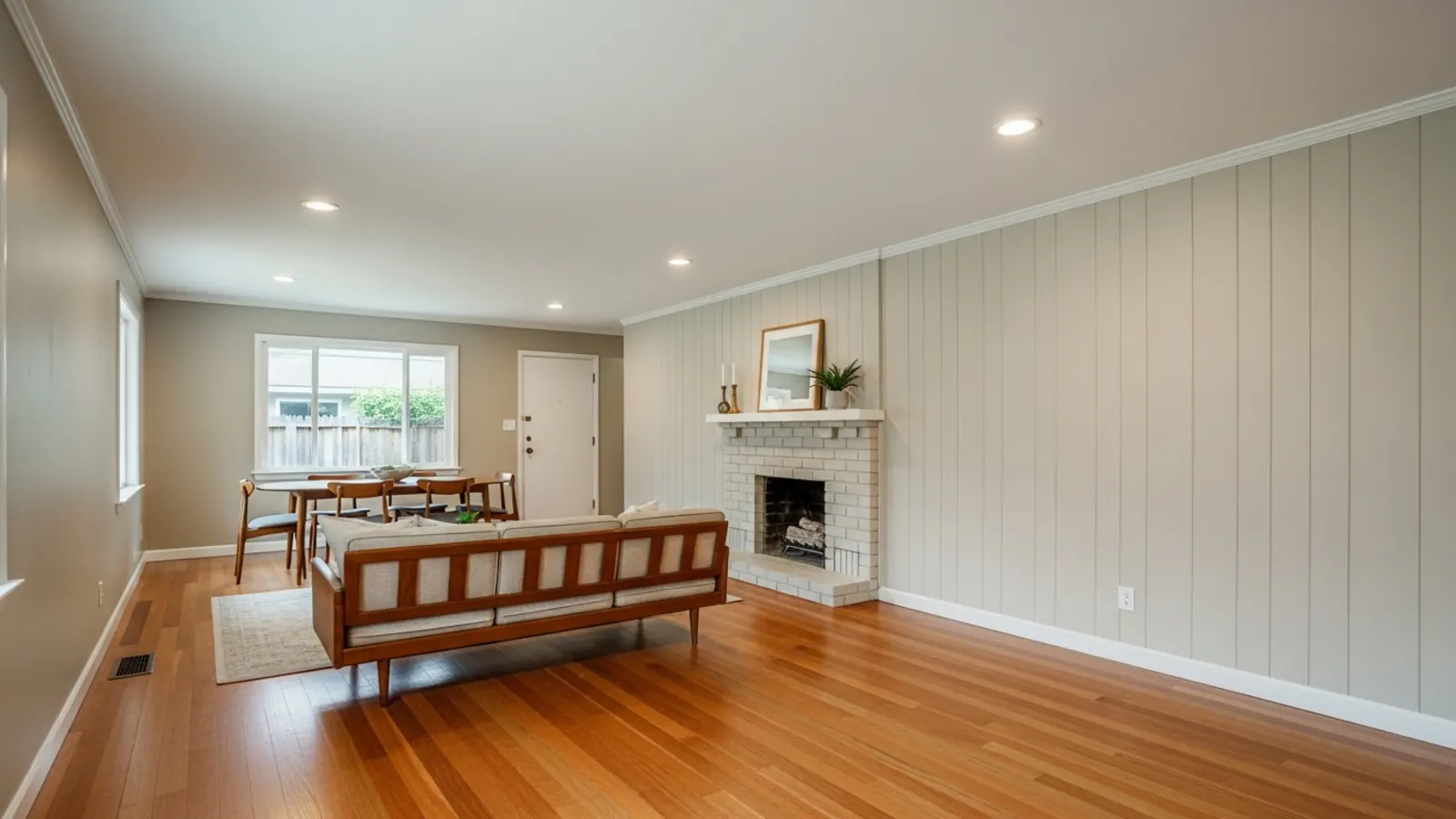
Interior Painting Across Vista, Curtis / Targee, Eastern Bench & the Lower Bench
Whole-house and room-by-room interior painting for 1940–1975 Bench ranches — escaping the era-signature pastel-and-paneled-wall palettes, repairing settlement cracks in pre-1955 lath-and-plaster walls, painting over the 1965-era wood paneling that defines many Bench feature walls. EPA RRP lead-safe universal on pre-1978 stock.
Quick answer
Three substantial differences. First, EPA RRP lead-safe practices add containment, labour and disposal cost on pre-1978 homes — and that's essentially every Bench address (the post-1985 infill is a small minority).
Interior painting on the Boise Bench has its own rhythm distinct from work in newer Boise neighborhoods, and it's shaped by three specific patterns. First, the wall systems split between pre-1955 lath-and-plaster (still in place on Roosevelt Market originals and parts of the Western Bench) and post-1955 drywall (Vista and Curtis / Targee ranches forward) — plaster work requires different repair protocols, settlement cracks at 60–80 years old are universal, and skim-coating for transitions is standard. Second, the era-signature original color palettes — soft pastels on 1948–1965 stock, avocado green and harvest gold earth tones on 1965–1975 Eastern Bench split-levels — read thoroughly dated by 2026 and are what owners are escaping with comprehensive whole-house repaints. Third, the original wood-look paneling on at least one feature wall of most 1965–1975 Bench homes (sometimes the entire family room) is the era-defining interior element — and painting over it (with proper sanding, oil-based or shellac-based stain-blocking primer to prevent tannin bleed-through, and two finish coats of warm white) is one of the highest-visual-impact-per-dollar scopes available on Bench interior work. EPA RRP applies universally on pre-1978 stock — essentially every Bench address. Without any Historic District overlay or HOA constraints on most Bench blocks, color choices are fully flexible: warm whites (Simply White, White Dove, Pure White), warm greys (Edgecomb Gray, Repose Gray, Agreeable Gray), and deep accents (Hale Navy, Black Iron, Iron Mountain) are what's currently moving the Bench comparable-sale market. Iron Crest's Bench interior work is anchored on EPA RRP lead-safe work practices universal, plaster-crack repair expertise on pre-1955 stock, the wood-paneling paint-over protocol with proper stain-blocking primer (the failed-paneling-fix call we get most often used latex-only primer), and the modern color-palette consultation that escapes era signatures without overcorrecting.
Interior painting strategy on the Bench varies by era because wall systems, original color palettes, and the presence of period-defining features (wood paneling) all change across the post-war housing waves.
1940–1955 early post-war minimal traditional (Roosevelt Market area, parts of Western Bench)
Lath-and-plaster walls universal — different repair protocols than drywall. Pre-1955 plaster at 70+ years old has settlement cracks at virtually every corner and along every long wall, requires skim-coating at transitions, and benefits from oil-based or shellac-based stain-blocking primer over patched areas before paint. Original simple painted trim from construction. Original color palettes leaned toward soft pastels (mint green, dusty rose, baby blue, primrose yellow) and warm whites typical of the era. Pre-1978 lead-paint universal — EPA RRP applies. Modern scope: repair plaster cracking, paint walls in current warm white or warm greige, repaint trim.
1955–1965 classic post-war ranch (Vista, Curtis / Targee, Eastern Bench)
Final-era plaster (1955–1958) transitioning to early drywall (1958 forward). Pre-1980 joint compound on early-drywall stock sometimes contains asbestos — pre-screen testing required when scope involves substantial drywall repair. Original trim painted from construction in soft warm whites or matching pastel-era body. Color palettes from this era featured pastels and earth tones — soft greens, salmon, dusty blue, almond. Modern repaints universally choose current warm white or deep charcoal palettes, sometimes with deep accent walls for visual depth.
1965–1975 expanded ranch and split-level (Eastern Bench / Overland, parts of Lower Bench)
Drywall walls universal. Original wood-look paneling on at least one feature wall of most homes — sometimes the entire family room or den is paneled. Color palettes featured the era-signature earth tones — avocado green, harvest gold, brown, burnt orange. Modern repaints completely escape the era palette, and the paneling can be either preserved with soft warm-white paint-over (preserving the original texture while updating aesthetic) or completely removed and walls re-skimmed for a smooth modern read.
1985+ infill and renovated Bench homes
Modern drywall construction. Standard interior painting practices apply. No EPA RRP overhead because post-1978. Faster turnaround than older Bench work — none of the plaster repair, paneling paint-over, or lead-safe protocol overhead.
Five recurring interior-painting shapes account for nearly every Bench project. Era of the home, presence of wood paneling, and whether owner is doing whole-house refresh or focused-room update drive which one fits.
1. The Whole-House Era-Escape Repaint
Comprehensive painting throughout the entire Bench home — every wall, every ceiling, every door, every section of trim. Sequenced by floor and room so owner can typically remain in residence. Includes ceiling repaint where original almond or pastel needs refresh, plaster settlement crack repair on pre-1955 stock, drywall repair on post-1955 stock, and (commonly) wood-paneling paint-over on 1965–1975 stock with original feature walls. Color palette is current 2026 transitional warm white or warm greige escaping the era signature. Most common Bench repaint scope.
Target homes: 1940–1975 Bench homes preparing for sale, recently purchased homes being refreshed before move-in, or comprehensive aesthetic update. Permit: none required.
2. The Wood-Paneling Paint-Over (1965–1975 Stock)
Specific scope for 1965–1975 Eastern Bench / Overland split-levels and Lower Bench ranches with original wood-look paneling on feature walls or entire rooms. Light sanding to scuff existing finish, oil-based or shellac-based stain-blocking primer (BIN or Cover Stain — universal mandate to prevent wood tannin bleed-through), two finish coats of warm white or matching wall color. Preserves original paneling texture while transforming aesthetic. Dramatically updates the room at a fraction of removal-and-re-drywall cost. The most common failed paneling-fix call we get used latex-only primer instead of oil-based or shellac.
Target homes: 1965–1975 Bench homes with intact original wood-look paneling. Permit: none required.
3. The Whole-Floor Repaint (Main Floor or Bedroom Level)
Comprehensive painting of all rooms on a single floor of a 1940–1975 Bench home. Includes all required drywall and plaster repair, trim work, door painting, and ceiling refresh where needed. Whole-floor projects benefit from cohesive color planning across rooms — typically a single warm-white wall color throughout with deep accent walls strategically placed at the entry and primary bedroom.
Target homes: Bench homes wanting comprehensive refresh of one floor without committing to full whole-house scope. Permit: none required.
4. The Trim & Door Refresh (Walls Preserved)
Repaint all interior trim, doors, and built-in cabinetry while leaving walls and ceilings as-is. Bench trim from 1948–1965 original construction is typically simple painted profile that's now showing decades of dingy or yellowed off-white that reads dated against current taste. Switching to a clean modern Pure White or Simply White on trim makes a substantial difference even with wall color staying the same.
Target homes: Bench homes where walls have been recently painted but trim is dated. Permit: none required.
5. The Single-Room Refresh
One Bench room — walls, ceiling, trim, and doors. Standard scope: protect floors and furniture, prep surfaces (including plaster crack repair on pre-1955 stock), prime if changing color dramatically over a pastel or earth-tone original, two finish coats of premium product. EPA RRP practices throughout on pre-1978 stock. Color consultation included with sample boards reviewed in actual room lighting.
Target homes: Any Bench home; common as part of broader room update or staging-prep scope. Permit: none required.
The Boise Bench is made up of distinct sub-neighborhoods, each with its own remodeling personality.
Vista
One of the most recognized sub-neighborhoods on the Boise Bench, centered around Vista Avenue between the Boise River and Overland Road. Post-war homes on uniform lots with mature street trees and good walkability to local commercial corridors. A heavy concentration of small ranch and minimal-traditional homes that respond well to galley-kitchen open-ups, primary-suite additions, and aesthetic modernization.
Central Bench (Curtis & Targee corridor)
The geographic core of the Bench, running along Curtis Road and Targee Street between I-84 and Overland. The City of Boise's Central Bench Neighborhood Plan records that the neighbourhood changed significantly during and after World War II, when agricultural land was subdivided into residential lots, and that new homes were built west of Orchard Street from the mid-1950s through the 1970s. Blueprint Boise designates the Central Bench primarily for compact-neighbourhood form — small lots, typically between 5,000 and 7,000 square feet, predominantly single-family, on an interconnected network of sidewalks and streets. Galley kitchen conversions are the dominant remodeling project type here.
Eastern Bench / Overland
The eastern edge of the Bench around Overland Road, with a mix of ranch and split-level homes. Lots tend to be slightly larger. Closer to mall-adjacent commercial corridors and major transit routes.
Western Bench / Roosevelt Market area
The western edge of the Bench near the Roosevelt Market and Capitol corridor. Some of the older Bench housing stock sits here, with steeper roof pitches and smaller footprints than the post-war ranches further east. Closer to downtown amenities and walkable.
Greenbelt-adjacent Bench
Bench properties along the elevated edges of the Boise River bluff with views down to the Greenbelt and the river. Frequently subject to view-preserving design considerations during exterior work — though without formal Historic District constraints.
Lower Bench (I-84 frontage)
The southern edge of the Bench close to I-84, on smaller lots and often with more traffic noise from the freeway. Common to combine kitchen, bathroom, and primary-suite remodels into a single comprehensive scope.
Most Boise interior painting projects run $1,800 to $14,000 — the band published on our Boise interior painting page. The ranges below run higher than that band because of the Bench's pre-1980 housing stock, where asbestos testing, lead-safe work practices and original-systems discovery are part of the base scope rather than an add-on. Pre-1978 Bench interior work costs more than the same scope in newer-construction Boise neighbourhoods — we do not publish a percentage for the gap — driven by EPA RRP lead-safe labor practices on every pre-1978 address, plaster repair on pre-1955 stock, and the wood-paneling paint-over protocol with proper stain-blocking primer that distinguishes durable work from latex-primer failures.
Boise Bench interior painting ranges
Single room refresh (Walls, ceiling, trim, doors — prep + 2 coats premium product): $2,800–$5,500 / 1–2 weeks end to end
Wood-paneling paint-over (incremental per paneled room) (Sanding, oil-based or shellac stain-blocking primer, two finish coats over 1965-era paneling): $3,500–$8,500 / 1–2 weeks end to end
Trim & door refresh (walls preserved) (All interior trim, doors, built-ins; walls stay as-is): $5,500–$10,000 / 1–3 weeks end to end
Whole-floor repaint (All rooms on one level — walls, ceilings, trim): $7,500–$14,000 / 2–3 weeks end to end
Whole-house era-escape repaint (Every room, every ceiling, trim, doors — current transitional palette): $12,000–$24,000 / 3–5 weeks end to end
Pricing assumes Iron Crest's standard Bench scope: EPA RRP lead-safe practices on every pre-1978 home (universal in the Bench housing stock), pre-1980 asbestos pre-screen on joint-compound disturbance for early-drywall era homes, plaster-crack repair on pre-1955 stock with skim-coating at transitions and stain-blocking primer over patched areas, full surface prep including patching and sanding, premium-grade Benjamin Moore Aura or Regal Select / Sherwin-Williams Emerald or Cashmere with two finish coats, careful protection of floors and furniture, and our 3-year workmanship warranty. The Bench isn't within any Boise Historic District and has no HOA on most blocks — full color flexibility, no Certificate of Appropriateness or ARC submittal overhead.
The City of Boise designates ten historic districts, and the Boise Bench is not one of them and does not sit inside one. There is no Historic Preservation Commission review for exterior modifications, so siding changes, window replacements, additions, and exterior colour changes don't trigger the Certificate of Appropriateness process that constrains North End and East End projects. That removes a review step from the pre-construction schedule on any Bench exterior scope; confirm current review timelines with Boise PDS for your specific project.
City of Boise standard permits still apply for any work involving electrical, plumbing, structural changes, or mechanical systems. A scope that includes new circuit additions, moving a gas line, or removing a load-bearing wall requires a building permit from City of Boise Planning and Development Services. Permit processing for Bench projects takes about two weeks for online plan review per Boise PDS, longer with structural drawings — without the historic-review overlay that North End projects carry. Building Division: (208) 608-7070. Planning & Zoning: (208) 608-7100.
Asbestos and lead paint remain serious considerations on the Bench, despite the absence of Historic District review. Pre-1980 Bench homes (which is most of the housing stock) commonly contain asbestos in floor tiles, joint compound, and sometimes pipe insulation. We test suspect pre-1980 materials and arrange AHERA-accredited abatement when asbestos is confirmed. Pre-1978 Bench homes contain lead paint. The EPA RRP rule requires lead-safe work practices for any renovation in lead-paint homes — including containment, specialized HEPA vacuuming, and proper disposal. Iron Crest follows EPA RRP lead-safe work practices and incorporates them into the standard scope on every pre-1980 Bench project.
Bench-specific permit consideration: setbacks. Blueprint Boise designates the Central Bench primarily for compact-neighbourhood form, with small lots typically between 5,000 and 7,000 square feet, so additions or detached structures must navigate side and rear setbacks carefully. Boise's residential zoning code sets no maximum lot coverage, so the binding constraint on a Bench addition is almost always the setback envelope rather than a coverage percentage. Zoning verification during initial design is critical to avoid late-stage redesigns.
Material strategy for Bench interior painting is about respecting the home's mid-century post-war architectural character through deliberate color choice, finish selection, and product quality — while escaping the era-signature palettes that read thoroughly dated by 2026.
Paint product — premium-grade only
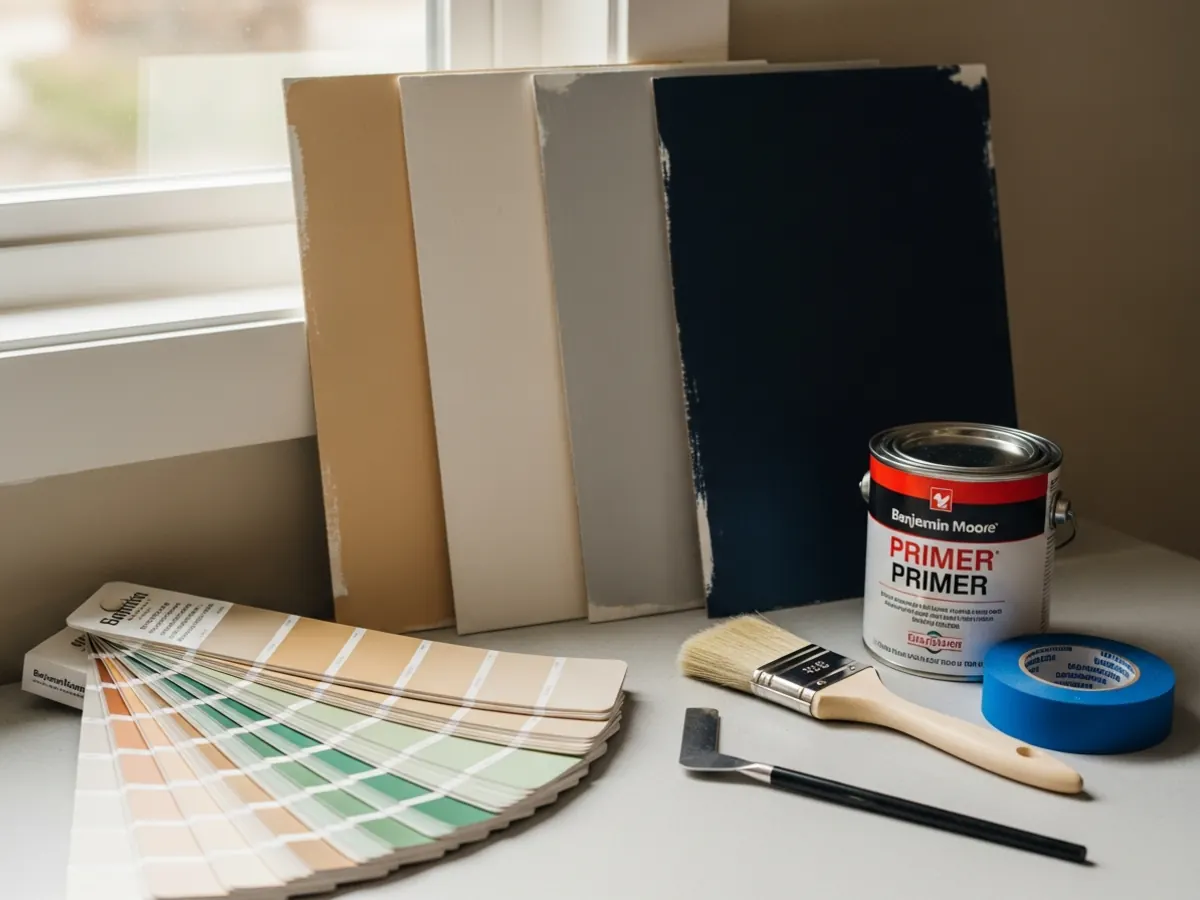
Premium-grade interior paint from Benjamin Moore (Aura, Regal Select) or Sherwin-Williams (Emerald, Cashmere). Mid-grade products (Benjamin Moore Ben, Sherwin-Williams ProMar) show brush marks more aggressively, age less well, and require more coats — false economy on a home of any meaningful value tier. Paint sheen: flat or matte for ceilings; matte or eggshell for living spaces and bedrooms; satin or semi-gloss for trim; semi-gloss or gloss for doors that take fingerprints.
Color palette for Bench mid-century ranches
Modern Bench palettes lean toward warm whites and warm greys with strategic deep accents. Walls: warm whites (Benjamin Moore Simply White, White Dove, Swiss Coffee; Sherwin-Williams Pure White, Alabaster), warm greys (Edgecomb Gray, Revere Pewter; Sherwin-Williams Repose Gray, Agreeable Gray), muted greens (Sea Salt, Sage Green). Accent walls or feature walls: Hale Navy, Black Iron, Iron Mountain, Forest Green, Studio Green. Trim: clean warm off-white. Avoid: stark cool whites that read clinical, recreated 1950s pastels (mint, dusty rose, baby blue), 1970s earth-tone revival (avocado, harvest gold, burnt orange) that recreates the era you're escaping.
Wood paneling treatment — paint-over with proper prep
When painting over original 1965–1975 wood paneling: light sand to scuff existing factory or aged finish, oil-based or shellac-based stain-blocking primer (Zinsser BIN or Cover Stain — non-negotiable because wood paneling tannins bleed through latex primer within 12 months), then two finish coats of premium acrylic. Soft warm white preserves the texture while transforming aesthetic. The most common failed paneling-fix call we get used latex-only primer — visible amber bleed-through within a year.
Trim and millwork — simple Bench profiles in warm off-white
Bench trim is typically simple painted profile from original 1948–1965 construction. Soft warm white (Simply White, White Dove, Pure White, Alabaster) is the safest choice across all rooms and broadly compatible with both warm-white and warm-grey wall palettes. Multiple thin coats with light sanding between rather than one heavy coat — produces smoother, more durable finish. Where original trim is salvageable and well-detailed, refinish and reuse with appropriate prep. Where new trim is required for damaged sections, stock matching profiles in fir or pine.
Drywall and plaster repair materials
Post-1955 drywall scope: USG Sheetrock joint compound applied in three thin coats with sanding between for small cracks; for larger cracks or holes, fiberglass mesh tape and skim-coat over patches. Pre-1955 plaster scope: paintable acrylic caulk or vinyl spackle for small cracks; joint compound or plaster patch for larger settlement cracks at corners and along long walls (universal on pre-1955 Roosevelt Market originals at 70+ years old). Stain-blocking primer (Zinsser BIN or Cover Stain) over water-damaged areas and over patched plaster before paint.
Lead-safe practices — universal on Bench pre-1978 work
EPA RRP rules require: containment with poly sheeting and 6-mil plastic over door and window openings to seal the work area, dampened sanding only (no dry power sanding without HEPA collection), HEPA vacuuming of all surfaces and debris, posted warning signs visible at entries, detailed cleanup verification with cloth tests. Adds time and labor cost compared to non-RRP work, but it's federal law on every pre-1978 home — and that's essentially every Bench address. Built into our standard Bench pricing.
Pre-1980 asbestos joint-compound consideration (early-drywall era)
Pre-1980 joint compound on early-drywall era Bench homes (1958–1980) sometimes contains asbestos. Pre-screen testing $300–$700 when scope involves substantial drywall repair. Licensed abatement when triggered: $1,500–$4,500.
Floor and furniture protection
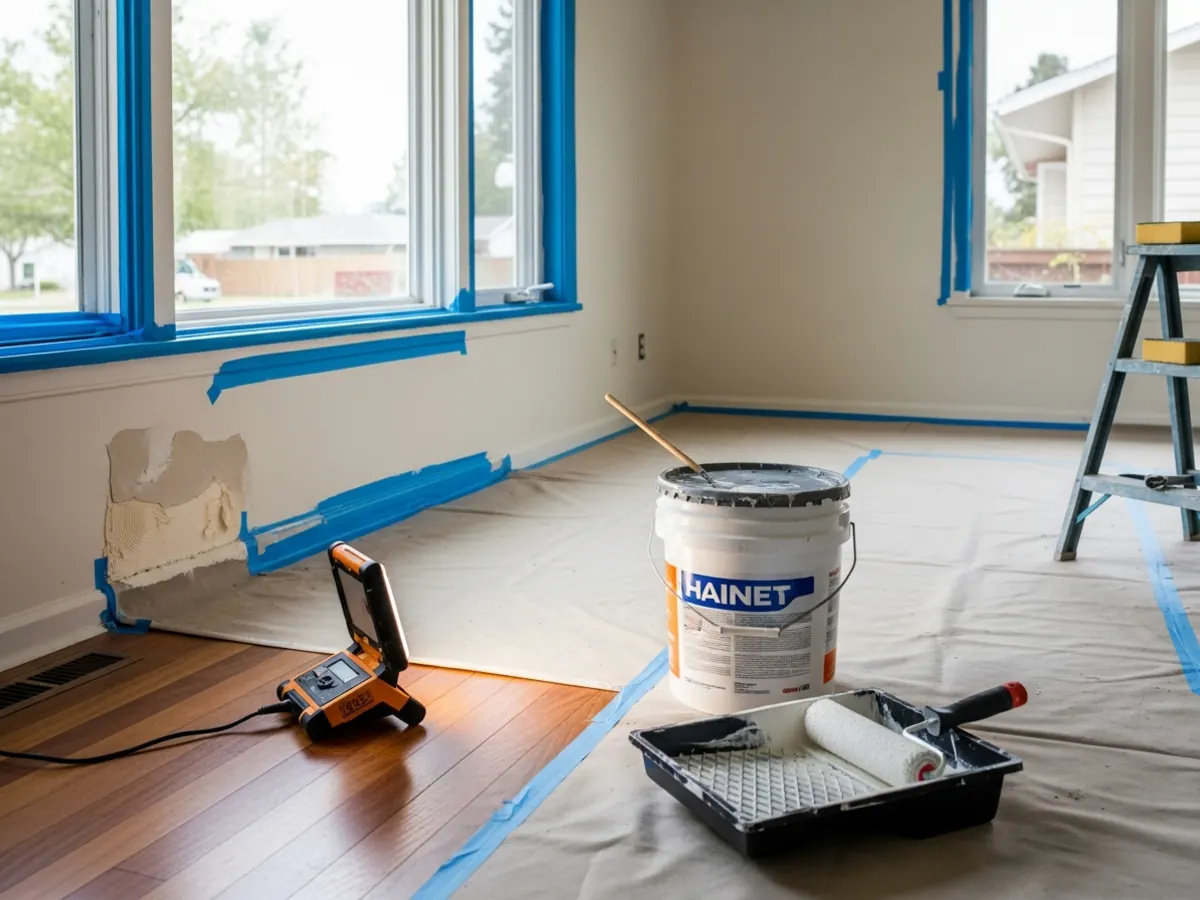
Original 2¼-inch red oak strip flooring on pre-1965 Bench homes requires careful protection — rosin paper or ram board under any work area with overlapped seams taped to prevent paint drip-through. Modern wide-plank engineered hardwood on post-2000 renovations protected with quality blue tape (FrogTape Multi-Surface or 3M ScotchBlue Premium) at baseboards. Furniture moved out of work zones or sealed within plastic.
Interior painting in older Bench homes occasionally surfaces issues that aren't apparent until prep work begins. Pre-screen at consultation walkthrough so the budget reflects them up front.
- •Plaster settlement cracks on pre-1955 stock (universal) Pre-1955 lath-and-plaster walls at 70+ years old have settlement cracks at virtually every inside corner and along every long wall. Patch with joint compound or plaster patch, skim-coat at transitions, stain-blocking primer over patched areas before paint. Cost: $300–$1,500 incremental above base scope depending on crack extent.
- •Drywall cracking on post-1955 stock from settlement Original drywall walls 50–65+ years old typically have settlement cracks at joints. Patch with fiberglass mesh tape and joint compound applied in three thin coats with sanding between. Standard scope on whole-house repaint pricing.
- •Lead paint chipping requiring careful encapsulation Pre-1978 Bench homes with deteriorating paint chips on walls or trim require careful encapsulation rather than removal under EPA RRP protocols. $400–$1,200 incremental on the scope where it's needed.
- •Wood-paneling tannin bleed-through risk Paint over original 1965-era wood paneling sometimes shows tannin bleed-through with latex-only primer — visible amber discoloration through the white topcoat within 6–12 months. Oil-based (Cover Stain) or shellac-based (Zinsser BIN) stain-blocking primer prevents this entirely. Built into our wood-paneling paint-over pricing.
- •Asbestos in pre-1980 joint compound (early-drywall era 1958–1980) Pre-screen testing $300–$700 when scope involves substantial drywall repair on early-drywall era Bench stock. Licensed abatement when triggered: $1,500–$4,500.
- •Wallpaper removal from prior renovation cycles Some 1948–1975 Bench homes have wallpaper in dining rooms, primary bathrooms, or powder rooms from prior renovation cycles. Removal: $1,000–$3,000 depending on adhesion and substrate condition.
- •Knockdown or stipple ceiling texture on 1960s–1970s stock Some 1960s–1970s Bench ceilings have knockdown or stipple texture standard for the era. Owner choice: keep, refresh, or remove. Removal to Level-5 smooth: $2.50–$4.00 per square foot. Smooth ceilings are the prevailing preference now.
- •Failed prior paint application from previous owner work Previous coats applied over inadequate prep can show peeling, blistering, or alligatoring. Removal of failed paint and proper prep before new coats: $400–$1,500 depending on extent.
- •Adequate ventilation for low-VOC paint cure Modern Bench homes with retrofitted air-sealing are tight enough that even low-VOC paint requires adequate ventilation during cure. Temporary HEPA-filtered exhaust setup during cure is built into standard scope.
Consultation and color planning (Week 1)
In-home walkthrough, scope confirmation, color discussion. Provide large painted color samples (12"×12" boards) to view in actual room lighting at different times of day. Assessment of plaster-crack or drywall-damage scope. Wood-paneling paint-over scope decision for 1965–1975 stock. Texture-removal scope assessment.
Estimate and scheduling (Week 1)
Detailed line-item estimate. Scheduling — typical lead time is 2–4 weeks for booked spring and summer work on Bench scope. Off-season (October–February) often has faster scheduling.
Surface prep (Day 1 of work)
Furniture protection. Floor protection — rosin paper or ram board on original 2¼-inch oak strip flooring (pre-1965 Bench homes); blue tape masking at baseboards. Fill nail holes. EPA RRP containment with poly sheeting on pre-1978 stock. Repair small drywall damage. Sand glossy or oil-based existing finishes.
Plaster / drywall repair (Days 1–3)
Plaster crack patching on pre-1955 stock — joint compound or plaster patch, skim-coating at transitions. Drywall crack patching on post-1955 stock — mesh tape, three thin coats joint compound, sanding between. Wood-paneling preparation on paint-over scope — light sanding to scuff existing finish.
Texture removal (Days 2–4 if in scope)
Knockdown or stipple ceiling texture wetted and scraped. Three coats joint compound to Level-5 smoothness. Sanding between coats. Stain-blocking primer.
Primer application (Days 3–4)
Stain-blocking primer over patched areas, plaster repairs, and water-damaged spots. Oil-based or shellac-based stain-blocking primer on wood-paneling paint-over scope (non-negotiable to prevent tannin bleed-through). Color-blocking primer where dramatic color change requires.
First finish coat (Days 4–5)
First coat of wall and ceiling color. 4–6 hours dry time (24 hours for premium products per manufacturer specification) before second coat.
Second finish coat (Days 5–6)
Second coat for full coverage and color depth. The depth difference between one and two coats of premium product is meaningful — single-coat application reads thin and shows roller marks against side light.
Trim and door painting (Days 6–8)
Trim and interior door painting in coordinated warm off-white. Multiple thin coats with light sanding between for smooth finish. Hardware removed and reinstalled.
Detail work, cleanup, walkthrough (Days 8–10)
Touch-ups identified during dry-time review. Caulk lines refreshed where original caulk failed. Hardware reinstalled. Masking removed. Floor protection removed. EPA RRP final HEPA vacuuming on pre-1978 stock. Final walkthrough with owner. 3-year Iron Crest workmanship warranty begins.
Interior painting on older Bench homes needs three things a generic painter often doesn't bring: EPA RRP lead-safe work practices (federally required on every pre-1978 home, and that's essentially every Bench address), plaster-repair expertise for pre-1955 stock (different protocol than drywall — settlement cracks at every corner, skim-coating at transitions), and the wood-paneling paint-over protocol with proper oil-based or shellac-based stain-blocking primer that's the difference between a 12-month bleed-through failure and a 12-year durable finish.
- City of Boise Planning & Development Services — Building, electrical, plumbing, and mechanical permits. Online portal and in-person plan check.
- Idaho DEQ Air Quality (Asbestos) — Testing and abatement guidance for pre-1980 homes via the Idaho Department of Environmental Quality.
- EPA Lead Renovation, Repair and Painting (RRP) Program — Required certification and work practices for renovation in pre-1978 lead-paint homes.
- Idaho Power — Rebates & Offers — Idaho Power's residential incentives: the Heating and Cooling Efficiency Program (heat pumps, central air conditioners, duct sealing, smart thermostats, heat pump water heaters, whole-house fans and similar equipment), the A/C Cool Credit, and the Shade Tree Project. Windows and insulation are not covered.
- Idaho DOPL — Contractor Search — Verify any contractor's RCE registration through the official Idaho DOPL license search.
How is interior painting on the Bench different from newer Boise neighborhoods?
Three substantial differences. First, EPA RRP lead-safe practices add containment, labour and disposal cost on pre-1978 homes — and that's essentially every Bench address (the post-1985 infill is a small minority). Second, pre-1955 lath-and-plaster walls at 70+ years old have settlement cracks at virtually every corner that require patching with different protocols than drywall. Third, the original wood-look paneling on 1965–1975 Eastern Bench / Overland stock needs proper oil-based or shellac-based stain-blocking primer to prevent tannin bleed-through — generic latex primer tends to fail quickly. The work costs more than same-scope newer-construction painting because of these factors.
Should I paint over my original 1968 wood paneling?
For most owners — yes. Original wood-look paneling on 1965–1975 Bench Eastern Bench / Overland split-levels and Lower Bench ranches is one of the most era-defining features and reads thoroughly dated against current taste. Painting over with proper prep (light sand, oil-based or shellac-based stain-blocking primer like Zinsser BIN or Cover Stain, two coats of soft warm white) preserves the original texture while transforming the room aesthetic. The transformation can be dramatic. Cost: $3,500–$8,500 incremental per paneled room. Critical detail: must use oil-based or shellac primer, not latex-only — latex primer fails with tannin bleed-through within 12 months.
What's the right color palette for a Bench mid-century ranch?
Modern Bench palettes lean toward warm whites and warm greys with strategic deep accents. Walls: warm whites (Simply White, White Dove, Pure White, Alabaster), warm greys (Edgecomb Gray, Repose Gray, Agreeable Gray). Trim: clean warm off-white. Accent walls or feature walls: Hale Navy, Black Iron, Iron Mountain, Forest Green. Avoid: stark cool whites that read clinical, recreated 1950s pastels (the era you're escaping), 1970s avocado/harvest-gold revival. We provide color consultation with painted sample boards on your specific home in actual room lighting.
How long does a whole-house Bench paint job take?
3–5 weeks. Smaller homes (1,200–1,500 sq ft Vista or Curtis / Targee ranch, 6–8 rooms) take 3 weeks. Larger homes (1,800–2,200 sq ft Eastern Bench split-level, 8–11 rooms) take 4–5 weeks. Add 3–7 days if knockdown ceiling texture removal is in scope and 2–4 days if wood-paneling paint-over is in scope. Owner can typically remain in residence by sequencing rooms.
Do I need EPA RRP-certified painters?
Yes, for pre-1978 homes — and that's essentially every Bench address. Federally required for any paint disturbance on pre-1978 housing. Iron Crest follows EPA RRP lead-safe work practices. Lead-safe practices (HEPA containment, wet-paste paint scraping, lead-safe disposal) are built into our standard Bench pricing.
What about wallpaper removal in my dining room?
Common scope on 1948–1975 Bench homes. Wallpaper removal cost: $1,000–$3,000 depending on adhesion and substrate condition. Some 1955-era wallpaper applied with high-tack adhesive damages the underlying plaster or drywall during removal and requires substantial patching afterward. We assess at consultation.
Can you do popcorn or knockdown ceiling removal?
Yes. Some 1960s–1970s Eastern Bench / Overland homes have knockdown or stipple ceiling texture standard for the era. Removal involves wetting and scraping, drywall repair where the scrape damages the underlying paper, three coats of joint compound to Level-5 smoothness, sanding between coats, primer, ceiling paint. Cost: $2.50–$4.00 per square foot. Smooth ceilings are the prevailing preference now.
Will repainting affect my home's resale value?
A whole-house repaint is one of the cheapest ways to change how a Bench house reads, and the pastel-era 1948–1965 and avocado-era 1965–1975 palettes both date a listing hard. We do not publish a cost-recovery percentage for it. The figures that circulate are national survey averages rather than Ada County appraisal data, and we have none of our own to cite. Your agent or appraiser can tell you what comparable sales on your street are actually doing; we can tell you what the work costs and what it fixes.
Ready to start your Boise Bench interior painting project?
Free in-home consultation, honest contingency-based budgeting, and the experience Boise homes require. Iron Crest Remodel — Idaho RCE #6681702, EPA RRP lead-safe work practices, $2M general liability, 3-year workmanship warranty.
Get Your Free Estimate