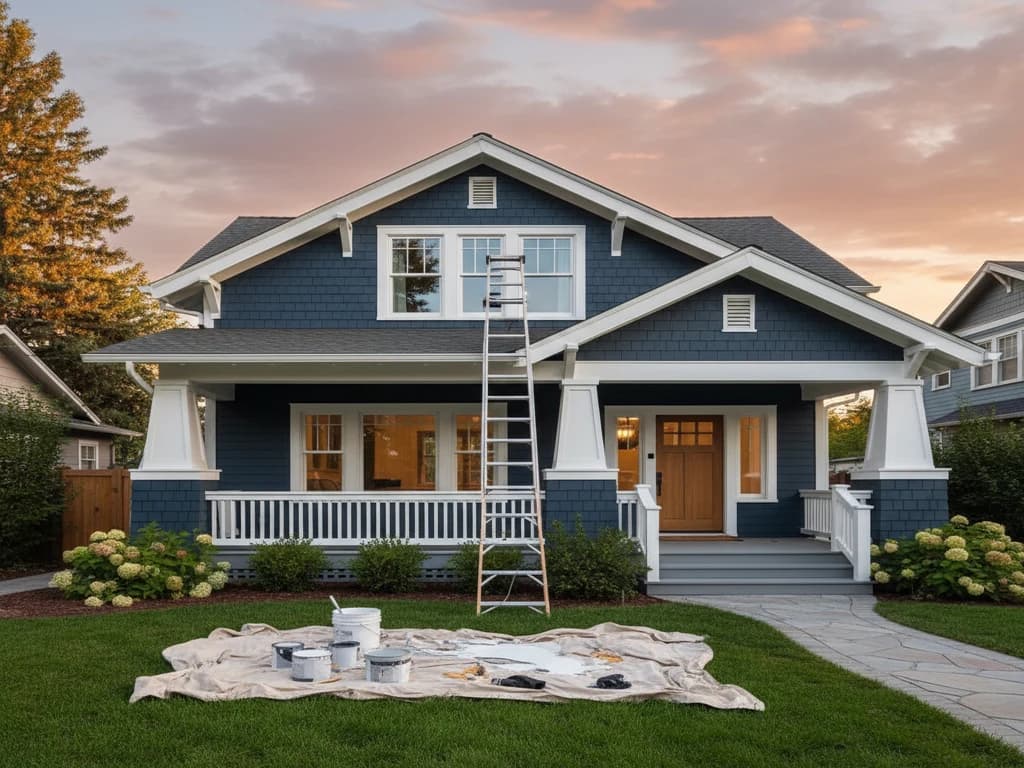
The Best Time to Paint Exteriors in Boise
Timing is everything with exterior painting in Boise, and getting it wrong can mean premature peeling, poor adhesion, and thousands of dollars in rework. The optimal painting window in the Treasure Valley runs from mid-May through mid-October, with June and September being the ideal months for most projects.
Why this specific window? Boise's climate creates a narrow band of conditions where exterior paint can cure properly. Here is what drives the calendar:
May (late month only): Daytime temperatures consistently hit the 65-80F range that premium paints require, but overnight lows can still dip into the 40s early in the month. We typically start exterior painting projects after May 15th in neighborhoods across the Bench, Southeast Boise, and the North End. The main risk in early May is morning dew that has not evaporated before painting begins -- surfaces need to be dry for at least 4 hours before paint application.
June: The sweet spot. Daytime highs of 75-90F, overnight lows in the 50s, low humidity, and very little rain. June provides the longest consistent painting days -- with sunlight until 9:30 PM, crews can work extended hours. The only caution is direct sun on south- and west-facing walls, which can heat surfaces above 90F and cause paint to dry too quickly, leading to brush marks and poor leveling.
July-August: Hotter temperatures (regularly 95-105F) shorten the usable painting window to early morning (6-11 AM) and late afternoon (5-8 PM). Midday work on sun-exposed surfaces is impractical because paint flashes off too fast. This is why exterior painting quotes in July and August are often higher -- the same job takes more calendar days because crews can only work in cooler portions of the day.
September: The second sweet spot. Temperatures moderate to 70-85F, the Boise National Weather Service records minimal precipitation, and the UV angle decreases enough that surfaces stay cooler longer during the day. September is a strong production month for exterior work in the valley for exactly these reasons.
October (early month): Still viable for painting, but the window is closing. Overnight temperatures begin dropping below 50F by mid-October, and morning dew becomes heavier. Projects that start in October need to be planned tightly -- there is no margin for weather delays.
The bottom line: if you are planning an exterior painting project as part of a larger remodel, schedule it for June or September whenever possible. If your remodel timeline puts exterior painting in July or August, expect it to run longer on the calendar, because the usable hours per day shrink.
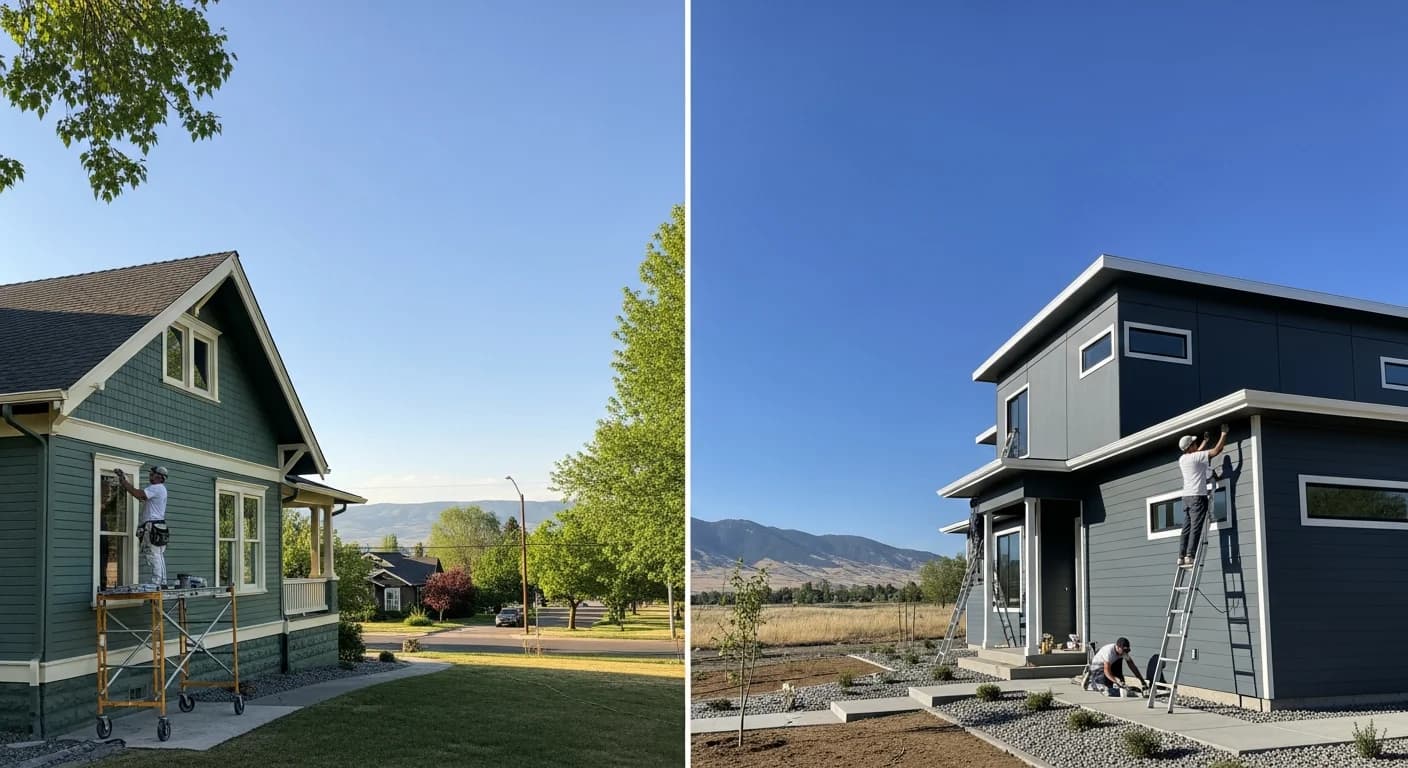
Temperature, Humidity, and Dew Point Requirements
Paint manufacturers specify environmental requirements for good reason -- violating them leads to adhesion failure, cracking, and dramatically shortened paint life. In Boise's semi-arid climate, the conditions are usually favorable, but there are specific traps to watch for.
Temperature Requirements
Most premium exterior paints require:
- Air temperature: 50-90F (some modern acrylic formulas work down to 35F, but adhesion and leveling are compromised below 50F)
- Surface temperature: 50-130F (measure with an infrared thermometer, not air temperature -- a dark-colored south- or west-facing wall in July sun runs far hotter than the air temperature, which is why the reading that matters is the one taken off the wall)
- Temperature trend: Rising or stable temperatures during application. Falling temperatures (painting late in the afternoon when temps are dropping) can cause moisture condensation on the paint film before it cures
Humidity and Dew Point
Boise's low summer humidity is generally an advantage for painting -- paint dries faster and mildew pressure is lower than in humid climates. However, there are two Boise-specific humidity concerns:
- Too-fast drying: When humidity drops below 15% during Boise's driest summer stretches, latex paint can skin over on the surface before the underlying layers cure. This traps solvents and leads to bubbling. The solution is to apply slightly thinner coats and avoid painting in direct sun during extreme low-humidity days.
- Irrigation overspray: Many Boise homes have lawn sprinkler systems that spray directly onto exterior walls. If irrigation runs the night before painting, surfaces may retain moisture that is invisible but prevents proper adhesion. Professional painters in Boise check for irrigation spray patterns and coordinate with homeowners to suspend watering on affected walls for 24-48 hours before painting.
Dew point must be at least 5 degrees below the air temperature to prevent condensation on painted surfaces. In Boise's dry summers this is seldom the binding constraint it is in the Pacific Northwest or Midwest, but check the forecast dew point rather than assuming it. The exception is early spring and late fall mornings when surfaces can be damp from overnight condensation until 9-10 AM.
The practical rule: in Boise's climate, you can paint most days from June through September between 7 AM and 7 PM on shaded surfaces, and 7-11 AM / 5-8 PM on sun-exposed surfaces during hot stretches. That is a generous window compared to most of the country.
Top Paint Brands for Boise Exteriors
Not all exterior paints perform equally in Boise's climate -- strong UV, a wide temperature range, low humidity, and alkaline soil that splashes onto lower surfaces. NOAA's Comparative Climatic Data for the Boise Air Terminal records 120 clear days and 90 partly cloudy days a year, an average of 48 days at or above 90F, and a period-of-record high of 111F; winter brings the other half of the problem, with an average of 87 freeze-thaw cycles a year (NOAA ASOS daily data at the Boise Air Terminal, 1996-2025, via the Iowa Environmental Mesonet; 30-year mean 87, range 56-108). These are the product lines we most often specify against those conditions.
Two notes on what follows. We do not print per-gallon prices, because neither manufacturer publishes a list price we could quote and retail pricing moves. And we do not publish a years-of-service comparison between premium and budget systems -- we have no test data of our own and the manufacturers do not publish one. What differs between tiers is the failure mode: on a sun-loaded elevation, a cheaper film tends to chalk and fade rather than wear down cleanly and gradually.
- Duration Exterior: Our most-specified topcoat for Boise homes. Sherwin-Williams describes it as "formulated with PermaLast® technology and infused with advanced acrylic co-polymers", rates it for application down to 35F, and backs it with a lifetime limited warranty -- read the warranty document itself, since it is the manufacturer's commitment, not ours. It is self-priming over sound, previously painted surfaces.
- SuperPaint Exterior: The value option in the same line-up, and a reasonable choice on budget-constrained projects and on lower-exposure elevations.
- Emerald Exterior: The top of the Sherwin-Williams exterior range, most often specified for the south- and west-facing walls that take the most sun in Boise.
- Aura Exterior: Benjamin Moore describes Aura Exterior's Color Lock® technology as embedding pigment within binding molecules to lock colour into the paint film, and pairs it with an acrylic resin the company credits with improved UV and fade resistance. Aura carries a limited lifetime warranty from Benjamin Moore. Colour retention is where those claims matter most, because fade shows first on darker and more saturated colours.
- Regal Select Exterior: Benjamin Moore's mid-tier exterior line, a step below Aura on colour-retention claims.
PPG (Pittsburgh Paints)
- PPG Timeless Exterior: A widely available alternative, sold through Home Depot, marketed as a paint-and-primer-in-one. Check the current product data sheet for substrate approvals before specifying it over fiber cement.
What about budget paints? We advise against big-box house brands for full exterior repaints in Boise, but we will not put a number on how much sooner they fail, because we do not have one. The honest version: prep and film thickness drive longevity more than brand does, and a premium topcoat is the cheaper half of the job to upgrade. If you want a dark body colour on a sun-loaded elevation, plan for a shorter repainting interval rather than expecting a product to cancel the physics.
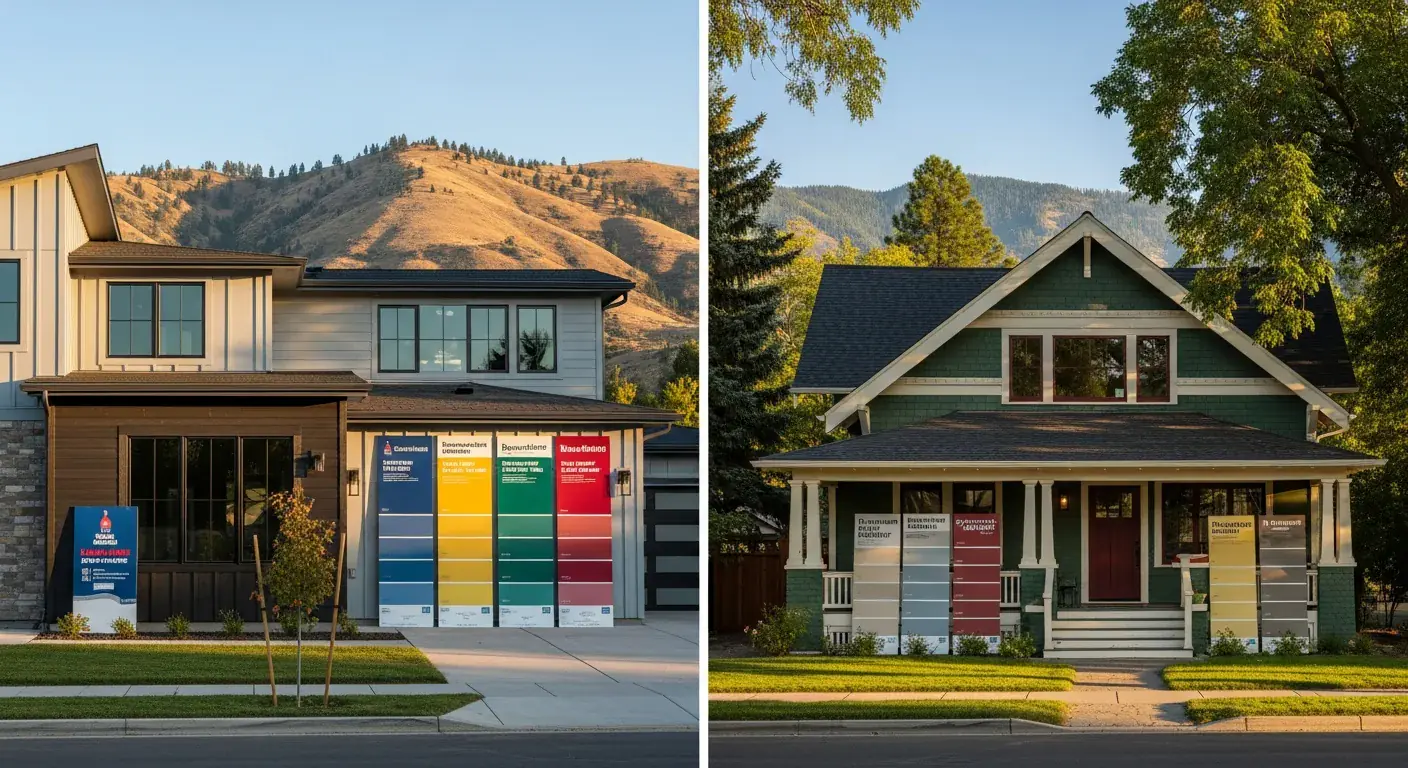
Trending Exterior Colors for Idaho Homes in 2026
Exterior color trends in Idaho are driven by two forces: national design trends and local landscape context. The most successful exterior color choices in Boise connect the home to its surroundings -- the sagebrush foothills, the basalt rock formations, the river corridor, and the warm earth tones of the high desert.
The Biggest Trend: Earthy Neutrals With Bold Accents
A widely used exterior palette in Boise right now pairs a warm neutral body color with a contrasting front door, shutters, or trim accent. These are colors we see specified often in the Treasure Valley -- design preference, not measured market share:
Body Colors:
- Accessible Beige (SW 7036) -- A warm, versatile neutral that works with almost any accent color and complements the natural stone and earth tones prevalent in Boise neighborhoods from the Bench to Eagle
- Oyster White (SW 7637) -- A soft, warm white that avoids the harshness of pure white in Boise's intense sunlight. Pure white reflects too aggressively at our elevation and appears stark; oyster white feels intentional and elegant
- Revere Pewter (BM HC-172) -- The most popular exterior gray in the Treasure Valley. A warm gray with green undertones that shifts beautifully between morning shade and afternoon sun
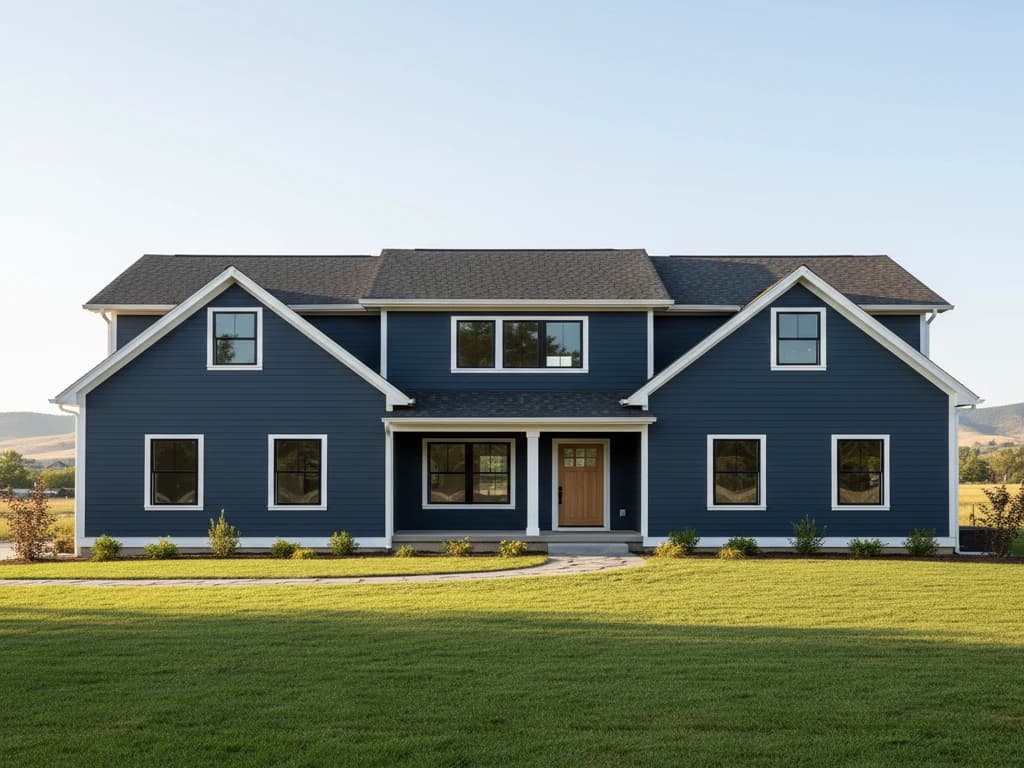
- Iron Ore (SW 7069) -- Dark charcoal (nearly black) exteriors are surging in popularity, especially in the North End, East End, and Boise Foothills where homes are surrounded by mature trees. The dark color recedes into the landscape and makes trim and landscaping pop
- Sage Green (various formulations) -- Reflecting Idaho's natural sagebrush landscape, muted sage greens are appearing on homes throughout Boise. Sherwin-Williams Clary Sage (SW 6178) is a frequently specified green body color
Accent and Front Door Colors:
- Tricorn Black (SW 6258) -- A go-to front door and shutter color. Works with nearly every body color
- Naval (SW 6244) -- A rich, deep navy that elevates any neutral body color
- Basil (SW 6194) -- A sophisticated dark green for front doors that nods to Idaho's evergreen forests
- Rojo Dust (SW 9013) -- A warm terracotta red for front doors on homes with earthy body colors
What is fading in Boise? All-gray exteriors (the "fifty shades of gray" trend from 2018-2022) are looking dated. Cool grays without warm undertones appear flat and lifeless in Boise's warm-toned sunlight. If your home is currently a cool gray, consider shifting to a warm gray or warm neutral in your next repaint. Bright, saturated colors (teal, bright yellow, fire-engine red) on the main body also look out of place in most Boise neighborhoods -- bold color is best reserved for front doors and accents.
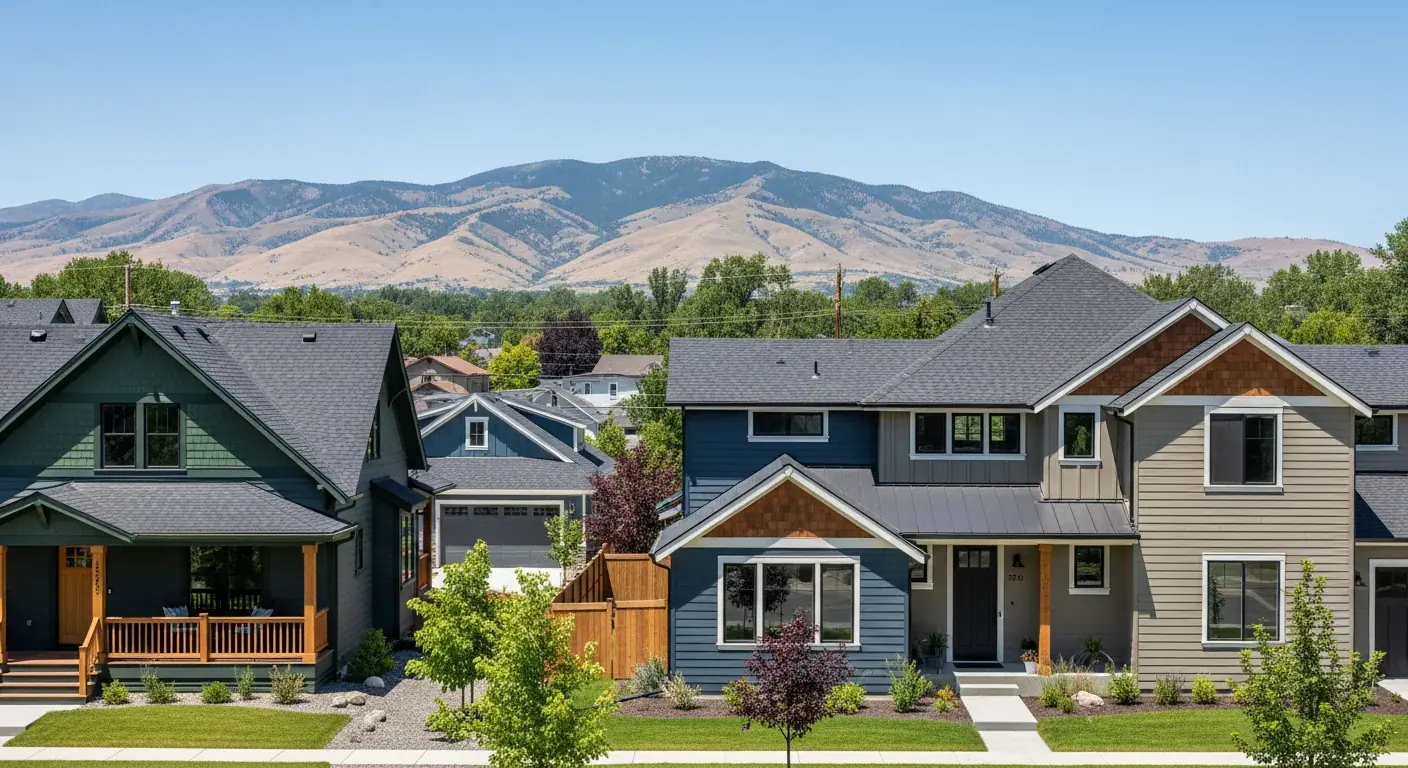
Surface Prep: Wood, Stucco, and Fiber Cement
Surface preparation, not the topcoat, is what decides how long an exterior paint job lasts. In Boise's climate, inadequate prep is the most common reason a repaint fails early -- and each siding material requires a different approach.
Wood Siding (Clapboard, Cedar Shingle, T1-11)
Wood siding is common in Boise's older neighborhoods -- the North End, Warm Springs, Hyde Park, and the Bench are filled with wood-sided homes ranging from 1900s craftsman bungalows to 1970s split-levels. Wood prep in Boise's climate requires:
- Scraping and sanding all loose, cracked, and peeling paint down to a sound surface. Boise's UV causes paint to become brittle faster than humid climates, so expect more extensive scraping than you might see in a coastal environment.
- Treating bare wood with a quality primer (Sherwin-Williams Extreme Bond or Benjamin Moore Fresh Start) before topcoating. Bare wood in Boise's dry air will absorb paint unevenly without primer, causing blotchy finish and reduced adhesion.
- Filling cracks, nail holes, and gaps with exterior-grade wood filler or caulk. Boise averages 87 freeze-thaw cycles a year (NOAA ASOS daily data at the Boise Air Terminal, 1996-2025, via the Iowa Environmental Mesonet; 30-year mean 87, range 56-108), and every one of them exploits an open gap -- moisture gets in, expands as ice, and pops paint off.
- Checking for dry rot, particularly at ground level, around windows, and on the south and west faces that take the most UV and moisture cycling. Rotten wood must be replaced before painting -- painting over rot is throwing money away.
Stucco
Stucco exteriors are common in Boise subdivisions built between 1990 and 2010, particularly in Southeast Boise, Eagle, and Meridian. Stucco prep includes:
- Pressure washing at 1,500-2,000 PSI to remove dirt, chalking paint residue, and alkaline deposits (efflorescence) that are common in Boise's alkaline soil environment
- Repairing all cracks with elastomeric caulk or stucco patch. Stucco cracks are entry points for moisture that freezes and causes spalling in Boise winters
- Using a masonry-specific system for stucco -- Sherwin-Williams Loxon Conditioner is a 100 percent acrylic sealer used to prepare masonry for topcoat, and where thermal cracking is present the crack-bridging is done by the topcoat: Loxon Masonry Topcoat, which Sherwin-Williams describes as having an elastic formula that helps bridge hairline cracking, or a ConFlex elastomeric, which the company says conceals hairline cracks and surface irregularities over Loxon primer. Standard flat house paint does not flex enough to bridge the cracks stucco develops as it expands and contracts across Boise's annual temperature range -- a median year at the Boise Airport runs from roughly 8F to 104F (daily records, 1995-2024, NOAA ASOS via the Iowa Environmental Mesonet)
Fiber Cement (James Hardie) and Engineered Wood (LP SmartSide)
These are two different materials and they are often confused. James Hardie is fiber cement -- cellulose fiber, portland cement, and sand. LP SmartSide is engineered wood -- wood strands and fibers bound with resins and treated with LP's SmartGuard zinc-borate process, which LP credits with resistance to termites and fungal decay. Both are common on Treasure Valley homes built after 2010, and both are painted, but they are not interchangeable. Boise sits in James Hardie's HZ5 climate zone, the cold-weather product line.
- Light cleaning with a garden hose and soft brush -- neither material needs high-pressure washing, and both can be damaged by excessive water pressure
- Priming bare and cut edges. Factory-primed product is supplied primed for topcoating, not as a finished surface; paint it within the window the manufacturer specifies in its current installation instructions, and prime every field cut
- Caulking all butt joints and trim intersections with high-quality paintable caulk (Sherwin-Williams 950A or DAP Dynaflex Ultra)
- Using a 100% acrylic latex topcoat approved for the substrate -- check the paint's product data sheet and the siding manufacturer's painting instructions, since coating requirements differ between fiber cement and engineered wood
One correction worth making explicitly, because it circulates locally: LP SmartSide is not a fire-rated or ignition-resistant product. LP's own technical bulletin TB-001 classifies SmartSide as Class C (Class III) under ASTM E84 and states it is not an ignition-resistant material under the International Wildland-Urban Interface Code. If you are building or re-siding in a Boise hillside or WUI area, Boise's Fire Prevention Code requires non-combustible siding and roof coverings, and LP SmartSide does not satisfy that. Western red cedar is Class B per the Western Red Cedar Lumber Association -- also not non-combustible.
The Complete Prep Work Process
Regardless of siding material, a professional exterior paint job in Boise follows a systematic prep process. Understanding these steps helps you evaluate contractor bids -- because the contractors who skip steps are the ones whose work fails early instead of lasting a full repaint cycle.
Step 1: Inspection and Repair ($200-$800)
Walk the entire perimeter and document: rotted wood, damaged siding, failed caulk joints, gaps around windows and doors, damaged flashing, and any areas where previous paint has failed. All structural repairs must happen before any painting begins. In Boise, the most common repair needs are rotted window sills on south-facing walls and cracked stucco at foundation transitions.
Step 2: Pressure Washing ($200-$400 for a typical Boise home)
All surfaces are washed to remove dirt, chalking paint, mildew, and cobwebs. In Boise, we pay special attention to north-facing walls where the minimal shade and irrigation overspray create conditions for mildew growth (even in our dry climate). Surfaces must dry completely -- typically 24-48 hours in Boise's summer heat -- before any paint application.
Step 3: Scraping and Sanding ($300-$1,500 depending on condition)
All loose, peeling, and flaking paint is scraped to a sound edge. Glossy surfaces are sanded to create a profile for paint adhesion. For homes built before 1978, lead paint testing is required before any disturbance -- EPA RRP rules apply, and lead-safe work practices add cost ($500-$2,000 for containment and disposal). Many North End and Bench homes in Boise have lead paint layers that require proper handling.
Step 4: Caulking and Sealing ($200-$600)
All gaps, joints, and penetrations are sealed with high-quality exterior caulk. This is one of the most important steps for Boise homes because our freeze-thaw cycling exploits any unsealed gap. Failed caulk around windows is a common path for water into the wall assembly during spring snowmelt and heavy rain events.
Step 5: Priming ($300-$800)
All bare surfaces, repaired areas, and stain-prone zones receive dedicated primer. Premium self-priming topcoats (Duration, Aura) can prime over existing sound paint, but bare wood, bare stucco, and problem areas always need dedicated primer for proper adhesion and stain blocking.
Step 6: Masking and Protection ($100-$300)
Windows, doors, light fixtures, and landscaping are masked with tape, plastic sheeting, and drop cloths. Boise's afternoon breezes (common from 2-6 PM, especially near the Boise River corridor) require extra attention to overspray protection on windy sides of the home.
The total prep cost for a typical 2,000 sq ft Boise home ranges from $1,300-$4,600 depending on condition. Homes with heavy peeling, lead paint, or extensive wood rot fall at the high end. Well-maintained homes with modern siding can be on the lower end. On most repaints prep is the larger share of the bid, not the paint -- and it should be. A beautiful topcoat over poor prep is a waste of money.
Exterior Painting Cost Per Square Foot in Boise
Exterior painting costs in Boise vary based on siding material, home size, number of stories, condition, and paint quality. Across all project types our Boise exterior painting range runs $2,800 to $18,000, with $6,500 the most common outcome -- a two-story, 2,200 sq ft home with horizontal lap siding in fair-to-good condition needing full prep, prime, and two topcoats. The breakdown below sits inside that range.
Per-Square-Foot Rates (paintable surface area, not floor area):
- Wood siding: $2.50-$4.50/sf (higher end for heavy prep, lead paint, or multi-story)
- Stucco: $2.00-$3.50/sf (lower prep cost but elastomeric paint is more expensive per gallon)
- Fiber cement: $2.00-$3.00/sf (easiest to prep, most predictable pricing)
- Brick (painting previously unpainted brick): $3.00-$5.00/sf (requires thorough cleaning and masonry primer)
- Trim and detail work only: $3.50-$6.00/sf (labor-intensive cutting-in and detail work)
Whole-Home Estimates for Common Boise Home Sizes:
- 1,200-1,500 sf ranch (Bench, Vista, Garden City): $3,500-$6,500
- 1,800-2,200 sf two-story (Southeast Boise, West Boise): $5,000-$9,000
- 2,500-3,000 sf two-story (Eagle, North Boise, Harris Ranch): $7,500-$13,000
- 3,500+ sf custom home (Foothills, Eagle, Hidden Springs): $12,000-$18,000
What drives cost higher?
- Multi-story homes -- Second and third stories require scaffolding or lift equipment ($500-$2,000 rental plus setup time). Many two-story homes in Southeast Boise and Eagle have 25+ foot gable walls that require specialized access.
- Extensive prep -- Homes with significant peeling, wood rot, or lead paint can double the prep cost portion of the bid.
- Premium paint -- Upgrading from a standard acrylic to Sherwin-Williams Emerald or Benjamin Moore Aura adds $500-$1,500 to a whole-home project in material costs alone.
- Multiple body colors and accents -- Each additional color adds cutting-in time and masking, so a three-color scheme costs more to execute than a two-color scheme.
- Summer timing -- July and August projects may carry a premium due to reduced daily work hours in extreme heat.
When evaluating bids, ask every contractor to specify: number of coats, specific paint brand and product line, prep scope (scraping, caulking, priming), and warranty. A low bid that specifies one coat of builder-grade paint with minimal prep is not comparable to a bid specifying two coats of Sherwin-Williams Duration with full prep and a 1-year workmanship warranty.
For a detailed exterior painting estimate, request a free quote from our team. We provide written proposals that itemize every step so you can compare apples to apples.
How Long Exterior Paint Lasts in Boise's UV Environment
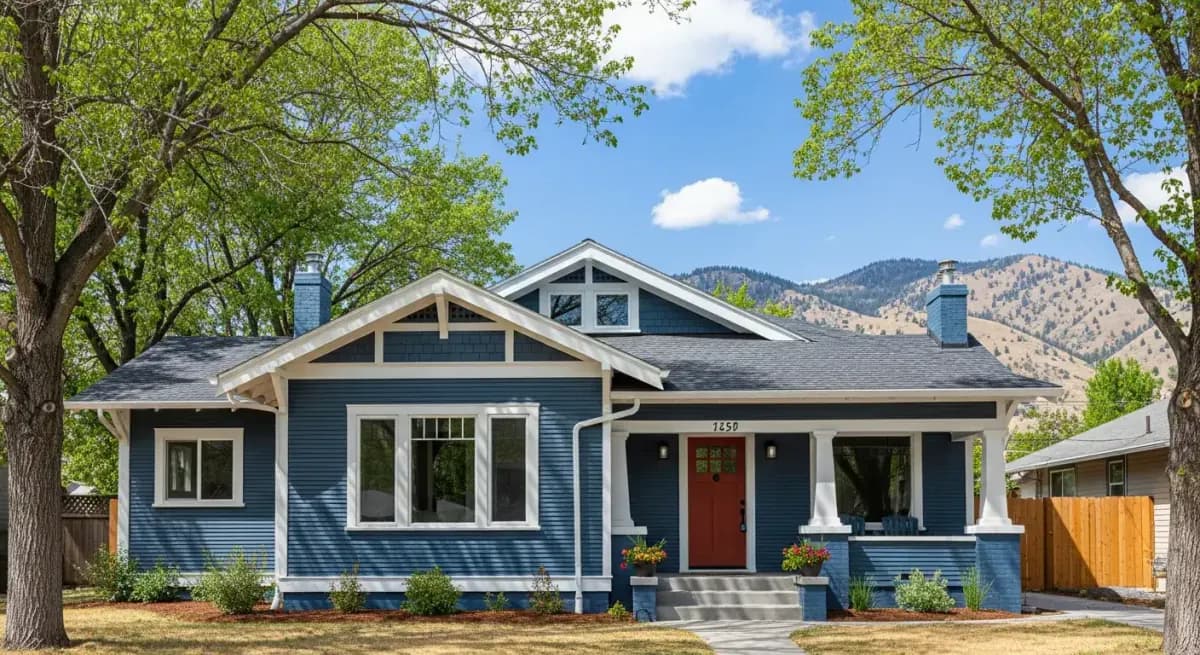
This is the question every Boise homeowner asks: how long will my new paint job last? We are going to answer it honestly, which means answering it without a table of numbers.
We do not publish a years-of-service figure for exterior paint in Boise. We have no test data of our own, the paint manufacturers do not publish service-life figures by exposure, and any contractor who hands you a precise "eight years on the south wall, twelve on the north" chart has made it up. What we can tell you is which variables drive the answer and in which direction.
Sun load is the dominant variable, and Boise has a lot of it. NOAA's Comparative Climatic Data for the Boise Air Terminal records 120 clear days and 90 partly cloudy days a year, plus an average of 48 days at or above 90F. South- and west-facing walls absorb the most of that, and surface temperature on a dark wall runs well above air temperature. UV also rises with elevation, and Boise sits near 2,700 feet -- but we are not going to attach a percentage to that, because we have not measured it.
What the ordering reliably looks like:
- West-facing walls fail first. Afternoon sun coincides with the hottest part of the day, so west elevations see both the highest UV dose and the highest surface temperatures.
- South is next, with the longest daily sun exposure through the year.
- East and north last longest. North elevations get the least direct sun; their limiting factor is usually moisture and mildew rather than UV.
- Premium topcoats outlast budget ones, but the difference shows up as a failure mode -- chalking and fade rather than clean gradual wear -- more predictably than as a specific number of extra years.
Color matters. Dark colors absorb more solar energy, which raises surface temperature and increases the thermal cycling stress on the film and the substrate beneath it. If you want a deep navy, charcoal, or near-black body color on a Boise south or west elevation, plan for a shorter repainting interval. There is no residential "heat-reflective" exterior paint line we can point you to -- Sherwin-Williams' solar-reflective coatings are industrial products for metal roof and wall panels, not house paint.
Material matters too. Fiber cement and engineered wood hold paint longer than solid wood siding because they move less with moisture. Stucco coated with a crack-bridging masonry topcoat handles thermal movement better than flat house paint over the same substrate. Older softwood siding needs the most frequent repainting, because the wood itself moves.
The practical planning takeaway: on a home with multiple exposures, the south and west walls will need attention before the north and east do. Repainting the sun-damaged elevations on their own schedule, rather than doing all four whenever one fails, is a legitimate cost-control strategy -- see the maintenance section below.
Maintenance Schedule to Extend Paint Life
The difference between a paint job that fails early and one that goes the distance in Boise's climate is not just paint quality -- it is maintenance. A simple annual routine catches the small failures (a split caulk joint, a chip down to bare wood) while they are still cheap to fix, instead of after water has been getting in behind the film for two winters.
Annual Maintenance (Every Spring, 30-60 minutes):
- Walk the perimeter and inspect all four sides for peeling, cracking, bubbling, or fading
- Check caulk joints around windows, doors, trim intersections, and penetrations. Re-caulk any cracked or separated joints before moisture enters -- Boise's spring rain and snowmelt season is when water intrusion causes the most damage
- Clean the exterior with a garden hose and soft brush or a light pressure wash (under 1,500 PSI). Remove dust, cobwebs, and pollen that trap moisture against paint surfaces
- Trim vegetation that contacts painted surfaces. Shrubs and tree branches that rub against siding trap moisture and accelerate paint breakdown. In Boise's irrigated landscapes, this is especially important along foundation plantings
Every 2-3 Years:
- Touch up any bare spots or chips before they expand. A $20 quart of matching paint and 30 minutes of work prevents a $500 repair later. Keep leftover paint from your original job stored in a temperature-controlled space (not an unheated Boise garage where it will freeze)
- Re-seal all exposed wood on decks, railings, and trim elements that may not have been painted (natural wood accents, pergola posts). Deck and patio surfaces need particular attention in Boise's UV
- Inspect south and west walls closely for chalking (run your hand across the surface -- if white powder transfers to your hand, the paint film is degrading). Chalking paint still protects the substrate but indicates the topcoat is wearing thin
Every 5-7 Years (Spot Maintenance):
- Consider spot-repainting the south and west walls when they are noticeably faded or chalked while the north and east walls are still in good condition. Matching color can be tricky -- bring a paint chip (shaded from UV) to your paint store for a color match
- Re-caulk all window and door perimeters completely. Even the best caulk in Boise's climate begins to shrink and crack after 5-7 years of UV and temperature cycling
- Address any wood rot that has developed. Small rot areas caught early can be stabilized with wood hardener and filler. Left untreated in Boise's freeze-thaw environment, a small rot spot can spread into a large one within a few seasons
This maintenance schedule is particularly important for homes in the North End, Warm Springs, and the Bench where wood siding is prevalent and homes are 40-100+ years old. The investment in annual maintenance -- a modest materials outlay and a few hours of time -- pays for itself by catching failures before they become structural repairs.
DIY vs Professional Exterior Painting in Boise
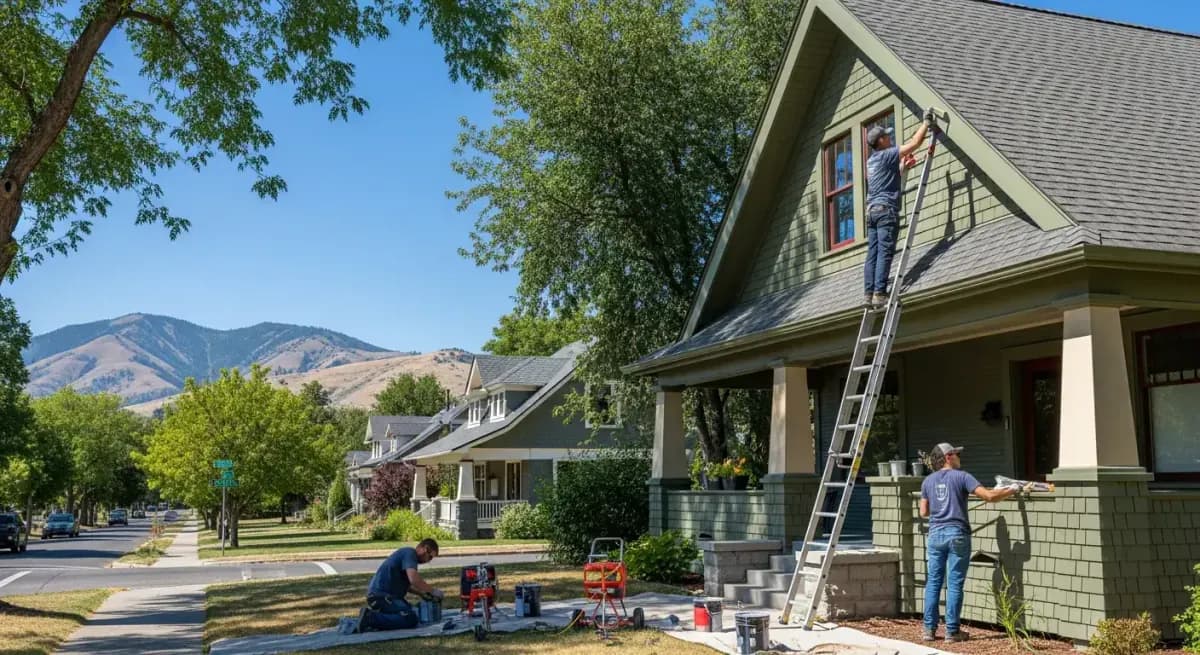
Exterior painting is one of the most commonly DIY'd home improvement projects, and for good reason -- the tools are relatively simple and the materials are available to anyone. But Boise's specific conditions create situations where professional painting delivers substantially better value. Here is an honest assessment of when to DIY and when to hire a pro.
DIY Makes Sense When:
- Your home is a single-story ranch (common in the Bench, Vista, and West Boise) where all surfaces are accessible from the ground or a standard 6-foot ladder
- The existing paint is in good condition -- no major peeling, no lead paint, no wood rot -- and you are doing a color refresh over sound paint
- You are painting a limited area like a front door, shutters, trim, or a single accent wall
- You have the time -- a DIY exterior paint job on a 1,500 sq ft ranch is a multi-weekend commitment, not a single Saturday
- The labor you are saving justifies the time and physical effort
Hire a Professional When:
- Your home is two or more stories -- ladder work above 12 feet carries serious safety risk, and scaffolding/lift rental and setup is a specialized skill. Many two-story homes in Eagle, Harris Ranch, and Southeast Boise have 25-30 foot gable walls that require professional equipment and fall-protection systems.
- The existing paint is heavily deteriorated and requires extensive scraping, priming, and repair work
- Your home was built before 1978 and may contain lead paint -- disturbing lead paint without EPA RRP certification and proper containment is both illegal and dangerous
- You have wood rot or structural damage that needs to be addressed as part of the project
- You want a workmanship warranty. Iron Crest backs its work with a 1-year workmanship warranty; a DIY repaint has none.
- Time is a factor -- a professional crew compresses an exterior repaint into a working week or two, where the same job spread across a homeowner's weekends runs most of a season
What DIY actually costs on a 1,800 sf Boise ranch. The materials bill is the easy part to underestimate: 10-15 gallons of premium exterior topcoat, 3-5 gallons of primer, brushes, rollers, tape, caulk, drop cloths, a pressure washer rental, and a ladder tall enough to work safely. We are not printing per-gallon prices here for the reason given above -- retail paint pricing moves and the manufacturers do not publish a list price -- so price the specific products at your local store before you commit to the DIY route.
Professional cost for the same home: $4,500-$7,500 with full prep, premium paint, and the 1-year workmanship warranty.
The gap narrows once you account for the value of your own time, the quality and speed difference, and the warranty. Price out the materials, put a realistic number on the weekends, and compare the total against a written bid -- not against the professional's price minus the paint.
What is the best time of year to paint a house exterior in Boise?
The best time to paint a house exterior in Boise is mid-May through mid-October, with June and September being the ideal months. June offers consistent 75-90F temperatures, low humidity, long daylight hours, and very little rain. September provides similar conditions with more moderate temperatures. July and August are viable but heat restricts painting to early morning and late afternoon hours, which stretches the project across more calendar days even though the scope has not changed.
How much does exterior painting cost in Boise in 2026?
Iron Crest's Boise exterior painting range runs $2,800 to $18,000 across all project types, with $6,500 the most common outcome. By home size: a typical 1,500 sf ranch costs $3,500-$6,500, a 2,000 sf two-story costs $5,000-$9,000, and a 3,000 sf home costs $7,500-$13,000. Per square foot of paintable surface, that works out to roughly $2.00-$4.50 depending on siding material and condition. These prices include full prep, premium paint (two coats), and labor. The main cost variables are home size, number of stories, existing paint condition, and paint quality selection.
What exterior paint brand is best for Boise's climate?
Sherwin-Williams Duration Exterior is the topcoat we most often specify for Boise homes. Sherwin-Williams describes it as formulated with PermaLast technology, rates it for application down to 35F, and backs it with a lifetime limited warranty. Benjamin Moore Aura Exterior is the alternative we reach for on deep or saturated colors, where Benjamin Moore's Color Lock technology targets exactly the fade problem Boise sun creates; Aura also carries a limited lifetime warranty. Read the warranty document itself in both cases, since it is the manufacturer's commitment, not ours. We advise against big-box house brands for a full exterior repaint, but we do not publish a years-of-service comparison between premium and budget systems, because we have no test data of our own and the manufacturers do not publish one.
How long does exterior paint last on a Boise home?
We do not publish a years-of-service figure, because we have no test data of our own and the paint manufacturers do not publish service life by exposure. What is reliable is the ordering: west-facing walls fail first (afternoon sun plus the highest surface temperatures), south next, and east and north last longest. Dark and saturated colors absorb more solar energy and need repainting sooner than light and medium tones on the same wall. Premium topcoats outlast budget ones, though the difference shows up as a failure mode (chalking and fade rather than clean gradual wear) more predictably than as a set number of extra years. Annual inspection, caulk repair and prompt touch-ups extend whatever interval your home would otherwise get.
What are the most popular exterior paint colors in Boise for 2026?
The most popular exterior colors in Boise for 2026 are warm earthy neutrals: Accessible Beige (SW 7036), Oyster White (SW 7637), and Revere Pewter (BM HC-172) for body colors, with Tricorn Black (SW 6258) and Naval (SW 6244) for accents and front doors. Dark charcoal/near-black exteriors (Iron Ore SW 7069) are trending in tree-lined neighborhoods like the North End. Sage green (Clary Sage SW 6178) reflects Idaho's natural landscape. Cool grays and all-white exteriors are declining in popularity.
Do I need to pressure wash before exterior painting in Boise?
Yes, pressure washing is essential before exterior painting in Boise. Even in our dry climate, exterior surfaces accumulate dust, pollen, cobwebs, chalking paint residue, and mineral deposits from irrigation overspray. Pressure washing at 1,500-2,000 PSI removes contaminants that prevent paint adhesion. The surface must dry completely (24-48 hours in summer conditions) before painting. Cost for pressure washing a typical Boise home is $200-$400. Note: fiber cement siding should be cleaned with lower pressure (under 1,500 PSI) to avoid surface damage.
Can you paint exterior in Boise during summer heat waves?
Yes, but with significant restrictions. During Boise's summer heat waves, painting is limited to early morning (6-11 AM) and late afternoon (5-8 PM) when surface temperatures are below 90F. Midday painting on sun-exposed surfaces causes paint to dry too quickly, resulting in poor adhesion, brush marks, and bubbling. Professional painters use infrared thermometers to verify surface temperatures before application. NOAA records an average of 48 days a year at or above 90F at the Boise Air Terminal, so expect heat-wave projects to occupy more calendar days than the same scope would in June or September, simply because there are fewer usable hours per day.
Should I repaint my whole Boise house or just the faded sides?
Spot-repainting the most damaged walls (typically south and west) is a legitimate cost-control strategy for Boise homes. Those walls receive the most UV and the highest surface temperatures, so they degrade before the north and east elevations do. If your south and west walls are visibly faded or chalking while the north and east walls still look good, repainting only the affected elevations costs less than a full repaint and defers the rest. The challenge is achieving an exact color match, so keep a sample chip stored away from UV for matching purposes.