Siding Installation Cost in Boise
A comprehensive material-by-material pricing guide for Boise and Treasure Valley homeowners planning a siding replacement in 2026. Real numbers, climate-driven recommendations, and transparent breakdowns.
Quick answer
Full siding replacement in Boise typically ranges from $8,000 to $35,000 or more depending on home size, material choice, and complexity. A 1,500-square-foot home with vinyl siding runs $8,000 to $15,000, while the same home in James Hardie fiber cement costs $15,000 to $25,000.
Siding material is the single largest variable in your project cost. Each option carries different installed pricing, lifespan, maintenance requirements, and suitability for Boise's demanding high-desert climate. Here is what each material costs per square foot installed in the Treasure Valley market, including labor, fasteners, flashing, and standard trim.
Vinyl Siding
$4 - $8 / sq ft
Installed | 20-30 year lifespan
- Lowest upfront cost of any siding material
- Zero painting or staining required
- Wide range of colors and profiles available
- Quick installation reduces labor cost
James Hardie Fiber Cement
Best for Boise Climate
$10 - $16 / sq ft
Installed | 30-50 year lifespan
- HZ5 formula engineered for freeze-thaw climates
- Non-combustible for hillside and WUI homes
- ColorPlus factory finish resists UV fading
- Resists rot, termites, and moisture damage
- 15-year limited warranty on ColorPlus finish
LP SmartSide
$8 - $13 / sq ft
Installed | 5/50 prorated limited warranty
- Engineered wood with SmartGuard resin treatment
- Natural wood grain texture and appearance
- Lighter weight than fiber cement (easier install)
- Popular for modern farmhouse builds in Eagle and Meridian
Natural Cedar
$10 - $18 / sq ft
Installed | 20-40 year lifespan
- Authentic wood grain with natural warmth
- Natural resistance to insects and rot
- Weathers to attractive silver-gray patina if left unstained
- Excellent insulating properties (R-0.87 per inch)
Board & Batten
$10 - $16 / sq ft
Installed | Varies by substrate material
- Vertical profile adds visual height and drama
- Available in fiber cement, engineered wood, or real wood
- Strong modern farmhouse and contemporary aesthetic
- Pairs well with horizontal lap siding as accent
Stone / Brick Veneer
$15 - $30 / sq ft
Installed | 50+ year lifespan
- Premium curb appeal and perceived home value
- Very low maintenance once installed
- Natural and manufactured options available
- Ideal for wainscot, columns, and entry accents
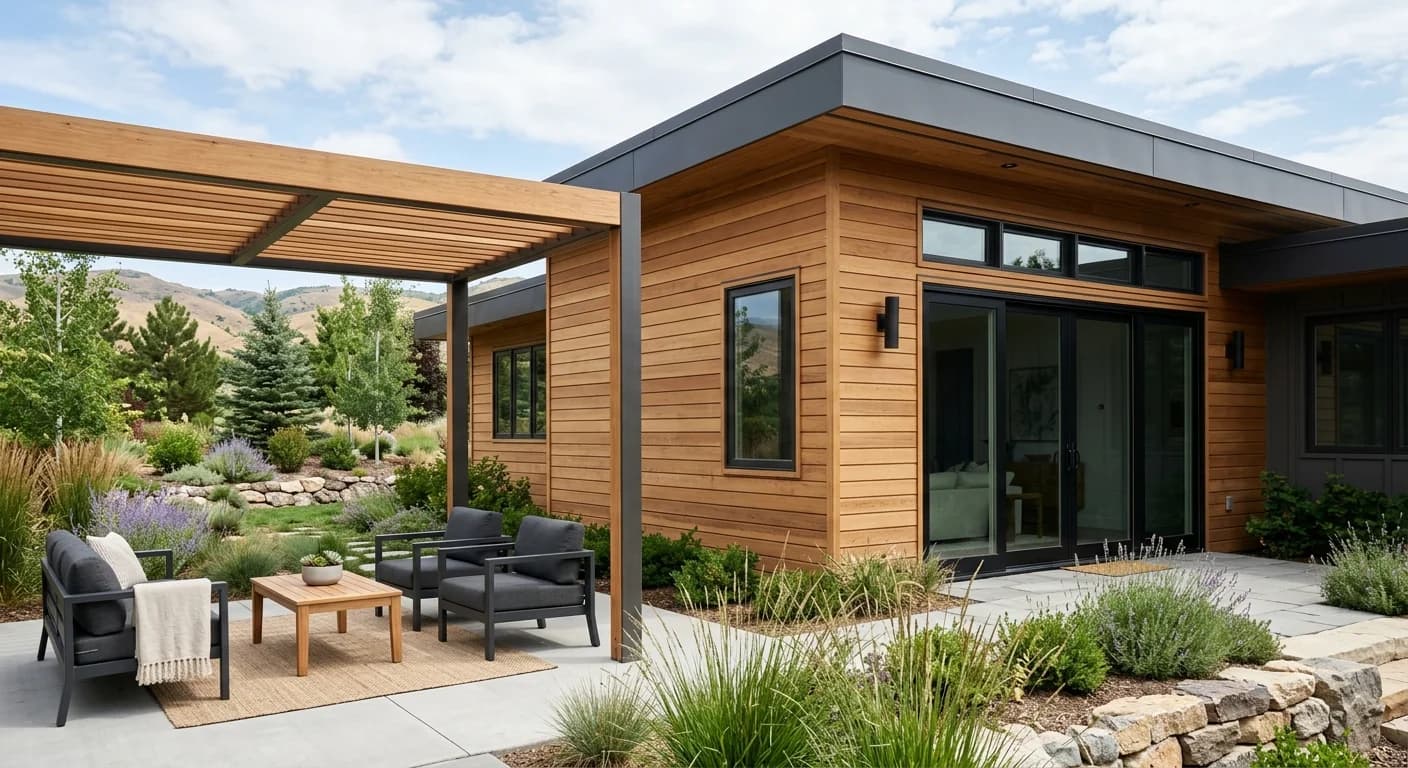
Total siding cost depends on your home's exterior square footage, not its interior living area. A 1,500 square foot home may have 1,200 to 1,800 square feet of sideable exterior depending on the number of stories, roof pitch, and window-to-wall ratio. Here are typical total project costs for Boise-area homes based on sideable exterior area.
| Home Size (Living Area) | Vinyl | LP SmartSide | James Hardie | Cedar |
|---|---|---|---|---|
| 1,200 sq ft | $5,500 - $10,000 | $8,500 - $14,500 | $10,000 - $17,000 | $12,000 - $22,000 |
| 1,500 sq ft | $7,000 - $13,000 | $10,500 - $18,000 | $12,500 - $21,000 | $15,000 - $27,000 |
| 2,000 sq ft | $9,500 - $17,000 | $14,000 - $24,000 | $17,000 - $28,000 | $20,000 - $36,000 |
| 2,500 sq ft | $12,000 - $21,000 | $17,500 - $30,000 | $21,000 - $35,000 | $25,000 - $45,000 |
| 3,000 sq ft | $14,500 - $25,000 | $21,000 - $36,000 | $25,000 - $42,000 | $30,000 - $54,000 |
| 3,500+ sq ft | $17,000 - $30,000+ | $24,500 - $42,000+ | $29,000 - $49,000+ | $35,000 - $63,000+ |
* Estimates include tear-off of existing siding, new housewrap, standard trim, and installation labor. Two-story homes and complex rooflines will fall toward the higher end of each range. Stone or brick veneer accents are additional.
Material and square footage are the primary cost drivers, but several project-specific variables can significantly impact your final investment. Understanding these factors helps you budget accurately and avoid surprises during your siding replacement.
Number of Stories & Scaffolding
Two-story homes require scaffolding, which adds $1,500 to $4,000 to the project depending on the perimeter and setup complexity. Three-story homes or homes built into Boise's foothills slopes may require specialized scaffolding systems that can reach $5,000 to $8,000. Single-story homes typically need only standard ladders, keeping access costs minimal. Scaffold rental is usually billed per week, so efficient project scheduling directly impacts this line item.
Sheathing Inspection & Repair
Once old siding is removed, the underlying sheathing (OSB or plywood) must be inspected for moisture damage, rot, or insect damage. Sheathing repairs in the Boise market run $3 to $6 per square foot for spot repairs or $5 to $10 per square foot for full panel replacement. Homes with vinyl siding that lacked proper housewrap installation frequently reveal moisture damage, especially on north-facing walls where drying is slowest. Budget a 10 to 15 percent contingency for potential sheathing work.
Old Siding Removal & Disposal
Tear-off costs vary by existing material. Vinyl siding removal is the least expensive at $0.50 to $1.00 per square foot since it is lightweight and fast to strip. Wood siding and fiber cement removal runs $1.00 to $2.50 per square foot due to weight and fastener density. Asbestos-containing siding, found in some pre-1980 Boise homes, requires licensed abatement contractors and can add $5,000 to $15,000 to the project. Disposal fees at Ada County landfills typically run $300 to $800 for a full-home tear-off.
Trim, Soffit & Fascia Work
Most siding replacement projects include updating exterior trim, corner boards, window and door casings, soffit, and fascia. Aluminum-wrapped trim runs $4 to $8 per linear foot. Cellular PVC trim (Azek, Royal) runs $6 to $12 per linear foot but offers superior longevity and zero rot potential. Replacing soffit and fascia adds $2,000 to $5,000 depending on home perimeter and current condition. Mismatched or deteriorating trim next to new siding is highly visible, so most homeowners include trim upgrades in their siding budget.
Window & Door Integration
Proper siding installation requires careful flashing and caulking around every window, door, and penetration. This is where most moisture failures occur. In Boise's climate, window integration should include self-adhering flexible flashing (such as DuPont FlexWrap), back-dam flashing at window heads, and proper J-channel or picture-frame trim. Depending on the number of openings, flashing and integration work adds $1,000 to $3,000 to the project. Homes with older windows may benefit from concurrent window replacement to optimize flashing details.
Insulation & Housewrap Upgrades
A siding replacement is the ideal time to upgrade your home's weather-resistant barrier (housewrap) and add continuous exterior insulation. New Tyvek or similar housewrap adds $0.50 to $1.00 per square foot. Rigid foam insulation board (1/2 to 1 inch) adds $1.50 to $3.00 per square foot but can reduce heating costs by 10 to 20 percent in Boise's cold winters. Insulated vinyl siding panels include built-in foam backing at a $1 to $2 per square foot premium over standard vinyl.
Common Add-On Costs Summary
| Add-On Item | Typical Cost | When Needed |
|---|---|---|
| Scaffolding (2-story) | $1,500 - $4,000 | All two-story homes |
| Sheathing repair (per panel) | $150 - $400 | Rot or moisture damage found |
| Full sheathing replacement | $3,000 - $8,000 | Widespread deterioration |
| Asbestos siding abatement | $5,000 - $15,000 | Pre-1980 homes with asbestos |
| Soffit & fascia replacement | $2,000 - $5,000 | Damaged or mismatched trim |
| Window flashing upgrade | $1,000 - $3,000 | All projects (recommended) |
| Housewrap replacement | $500 - $1,500 | Missing or damaged WRB |
| Rigid foam insulation | $2,000 - $5,000 | Energy efficiency upgrade |
| Gutter replacement | $1,500 - $3,500 | During siding is optimal timing |
| Painting (field-primed product) | $2,000 - $5,000 | Non-factory-finished siding |
Boise's high-desert climate presents a unique combination of challenges that directly impacts siding performance and longevity. Understanding these conditions is essential for choosing the right material and avoiding premature failure.
UV Exposure at 2,700 Feet
Boise sits at approximately 2,700 feet elevation in the high desert, receiving significantly more UV radiation than sea-level cities. This accelerated UV exposure fades paint and pigments faster, degrades vinyl polymers, and causes thermal expansion stress on south- and west-facing walls. Materials with factory-applied, UV-resistant finishes like James Hardie ColorPlus or pre-finished LP SmartSide dramatically outperform field-painted or standard vinyl options in this environment. Expect vinyl siding to show noticeable fading within 8 to 12 years on sun-exposed walls, while fiber cement ColorPlus finishes maintain color consistency for 15 years or more.
Freeze-Thaw Cycling
The Treasure Valley averages roughly 87 freeze-thaw cycles a year (Boise Airport, 1996–2025), primarily between October and April. Temperature swings of 30 to 40 degrees Fahrenheit within a single day are common during shoulder seasons. This relentless cycling is the leading cause of siding failure in Boise. Water that enters cracks, seams, or behind improperly flashed siding freezes, expands, and forces materials apart. James Hardie's HZ5 product line is engineered specifically for freeze-thaw climates, with moisture-resistant core technology that prevents water absorption. Cedar performs well if properly sealed, but maintenance lapses allow moisture intrusion that leads to splitting and cracking.
Wildfire Smoke & Fire Zones
Boise's proximity to national forests and BLM land means wildfire smoke is an annual occurrence, and homes in the foothills and North End border the wildland-urban interface. The City of Boise's Permit 428 states that roof coverings and siding installed in the hillside area or a Wildland Urban Interface area must be non-combustible. Fiber cement qualifies. Cedar does not — it is Class B under ASTM E84 per the Western Red Cedar Lumber Association — and neither does LP SmartSide, which LP states is Class C (III) under ASTM E84 and not an ignition-resistant material under IWUIC Section 503.2. Fire-retardant treatment does not make a wood product non-combustible. Vinyl melts and deforms under radiant heat exposure. If your home is in or near a hillside or Wildland Urban Interface area, confirm the cladding requirement with the Boise Fire Code official before selecting materials.
Thermal Cycling & Expansion
Boise summer temperatures regularly exceed 100 degrees Fahrenheit, while winter lows drop below zero. This 100-plus-degree annual temperature range creates significant thermal expansion and contraction stress on all siding materials. Vinyl expands and contracts the most, which is why proper installation with expansion gaps at every butt joint, J-channel, and corner post is critical. Fiber cement and engineered wood have much lower thermal expansion coefficients, making them more dimensionally stable across Boise's temperature extremes. Improperly fastened siding of any material can buckle, warp, or pull fasteners under repeated thermal cycling.
Material Performance Matrix for Boise Conditions
| Factor | Vinyl | Fiber Cement | LP SmartSide | Cedar |
|---|---|---|---|---|
| UV Resistance | Fair | Excellent | Very Good | Good (if stained) |
| Freeze-Thaw Durability | Good | Excellent (HZ5) | Very Good | Good (if sealed) |
| Fire Rating | Combustible (melts) | Non-combustible | Class C (III), combustible | Class B, combustible |
| Thermal Stability | Poor (high expansion) | Excellent | Very Good | Good |
| Maintenance Level | Very Low | Low | Low-Moderate | High |
| Impact Resistance | Poor (cracks in cold) | Good | Excellent | Good |
Siding is the largest single surface on the house, so replacing it changes how the home presents more than any other exterior project. What that is worth in dollars at resale is a question we decline to answer with a percentage.
Why We Publish No Recoup Figure
The cost-recovery percentages that circulate for siding come from national cost-versus-value surveys. There is no Boise-specific resale study behind them, and a national panel average does not transfer to one address, in one neighbourhood, in front of one buyer pool. We would rather publish nothing than publish a number we cannot trace to a Treasure Valley source.
If the resale case is what decides this project for you, the figure you want is a comparative market analysis from a local agent or an appraiser working current comparables on your street. That is a real number about your house. A national percentage is not.
We will happily give you the material and labour side of the equation in writing, by elevation and by scope, so the cost half of any return calculation is at least solid.
What Is True Without a Survey
Failing siding is a condition flag. Cupped, split, rotted or chalked cladding shows up in a home inspection report, and anything in an inspection report becomes a negotiation item. New siding removes that line before it is written.
Beyond resale, new siding ends a maintenance cycle. A cedar-sided home that needs re-staining on a regular cycle carries that expense indefinitely; fiber cement with a ColorPlus factory finish or LP SmartSide with ExpertFinish pushes the next refinish out by many years. We can price both paths side by side so the comparison is about your house rather than a category average.
Adding continuous exterior insulation during a re-side improves the wall assembly, and it is far cheaper to do while the cladding is off than as its own project. We do not publish a percentage for the energy saving, because the honest answer depends on what is in your walls now — which we can tell you once we open one up.
Common questions Boise homeowners ask about siding installation costs and material selection.
How much does it cost to re-side a house in Boise, Idaho?
Full siding replacement in Boise typically ranges from $8,000 to $35,000 or more depending on home size, material choice, and complexity. A 1,500-square-foot home with vinyl siding runs $8,000 to $15,000, while the same home in James Hardie fiber cement costs $15,000 to $25,000. Larger homes (2,500+ square feet) with premium materials and multi-story scaffolding requirements can exceed $40,000. These figures include tear-off of existing siding, installation, and standard trim work.
What is the best siding material for Boise's climate?
James Hardie fiber cement is widely considered the best overall siding material for Boise's climate. It handles the Treasure Valley's extreme UV exposure at 2,700 feet elevation, withstands Boise's roughly 87 freeze-thaw cycles a year without cracking, and is non-combustible, which matters in the hillside and Wildland Urban Interface areas where the City of Boise requires non-combustible siding. LP SmartSide engineered wood is a strong runner-up, offering excellent impact resistance and a more natural wood appearance at a slightly lower price point.
Does new siding increase home value in Boise?
We do not publish a cost-recovery percentage for siding in Boise. The figures that circulate come from national cost-versus-value surveys, and no Boise-specific resale study stands behind them; a national average does not transfer to one address in one neighbourhood. What is true without a survey is that failing, cupped or rotted siding reads as deferred maintenance to a buyer and as a condition flag to a home inspector, and it becomes a negotiation item. New siding removes that. For an actual number on your house, ask a local agent or an appraiser for a comparative market analysis on current Treasure Valley comparables.
How long does siding installation take in Boise?
A full siding replacement on a typical single-story Boise home (1,200 to 1,800 square feet) takes 5 to 10 business days. Two-story homes or homes with complex rooflines, dormers, and multiple gable ends may require 10 to 15 days. Weather can extend timelines during Boise's winter months, though most siding can be installed in temperatures above 40 degrees Fahrenheit. James Hardie fiber cement requires temperatures above 40 degrees for proper cutting and fastening.
Should I repair or replace my siding in Boise?
If damage affects less than 20 to 25 percent of your siding and the remaining material is in good condition, targeted repairs are usually more cost-effective at $500 to $3,000. However, if your siding is showing widespread fading, warping, cracking, or moisture damage — common with vinyl and wood siding after 15 to 25 years in Boise's harsh UV and freeze-thaw environment — full replacement is typically the better investment. Full replacement also allows you to upgrade housewrap, inspect sheathing, and improve energy efficiency.
Cost is just one piece of the puzzle. Explore our other siding and exterior remodeling guides to make fully informed decisions about your project.
Siding Installation Service
Our full siding installation service overview
Exterior Remodeling
All exterior remodeling services we offer
Window Installation
Pair new siding with window upgrades
Cost Guides Hub
Cost guides for all remodeling services
Get a Free Estimate
Request your personalized siding quote
Financing Options
Flexible payment plans for your project
Our Projects
See completed exterior remodeling projects
The following government agencies, industry organizations, and official resources provide additional information relevant to your remodeling project.
Get Your Siding Installation Estimate
Every home is different. Contact Iron Crest Remodel for a free, detailed siding estimate tailored to your Boise home, your material preferences, and your budget.