A 1997 North End Home With a 1990s Kitchen
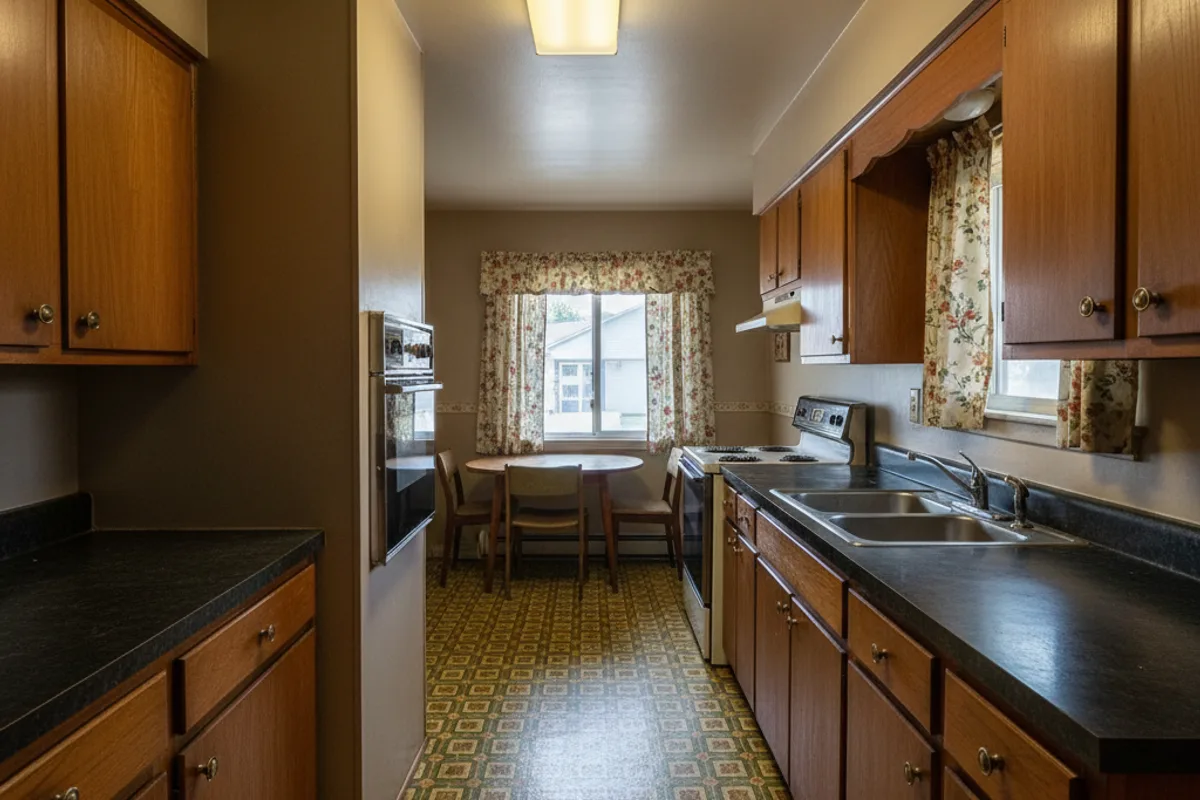
Boise's North End is best known for its early-1900s bungalows and Craftsman homes, but the neighborhood also has a quieter layer of later construction. This project's home is one of those: built in 1997, with the sound bones of a newer house and a kitchen that reflected exactly what builders were installing in the late 1990s — a closed-off L-shaped layout with a small island, oak cabinets, dated speckled countertops, and a load-bearing partial wall that boxed the kitchen off from the living room, with only a cased opening between them.
The house itself was sound. What had stopped working was a kitchen that suited one cook at a time and kept whoever was cooking cut off from everyone else in the house. The homeowners wanted the kitchen to be the center of daily life and of hosting, and the existing layout made that impossible.
This is the story of that project: what the kitchen was, what the family wanted, how we opened it up, and what a project like this realistically costs in Boise. The photos in this article are from the actual house — the same project documented on our North End kitchen case study page.
What Wasn't Working: The Before
Late-1990s production kitchens share a set of habits, and this one had most of them. Here is what we documented during the initial assessment:
Layout problems:
- A closed-off L-shaped configuration with a small island and no comfortable way for two people to work at the same time
- A load-bearing partial wall with only a cased opening to the living room — limited sightlines, little conversation with guests, no supervising homework from the stove
- Counter space broken into short runs, with no single stretch long enough for real prep work
- No island, and no room for one within the existing walls
Condition and storage issues:
- Original oak cabinets with upper boxes that stopped well short of the ceiling, wasting the most valuable vertical storage in the room
- Dated speckled countertops that made an already closed-in room feel busier
- Limited storage overall, with no room to grow into
- A ceiling-mounted fluorescent box light doing most of the work, with no task lighting at the counters
Mechanical concerns:
- Plumbing and electrical original to the 1997 build. Neither was unsafe, but a 1990s kitchen typically has fewer dedicated circuits than modern appliance loads and current code call for, and the plumbing would need to move for the new layout anyway
The kitchen footprint is about 185 square feet. That is not a small kitchen for a Boise home — the problem was never square footage. The problem was that the square footage was carved into a corridor and walled off from the rooms it should have been serving.
The Homeowners' Goals
Our first design meeting always starts with a goal-ranking exercise: separate the must-haves from the nice-to-haves before anyone draws a line. This family's list was short and clear.
Must-haves:
- Open the kitchen to the dining and living areas. The load-bearing wall had to go. Everything else on the list depended on it.
- An island with real seating. Not two stools squeezed at a peninsula — seating for four, so the island could double as the breakfast table and the place guests gather.
- More counter space and more storage. Enough prep surface for two people, and enough cabinet space to bring the overflow back into the kitchen.
- Separate zones for prep and cleanup. One person at the sink should not block the person chopping vegetables.
Strong preferences:
- A bright, classic look that would not date quickly
- Cabinetry that used the full ceiling height
- Durable surfaces that could handle daily cooking and hosting without fuss
Budget range: $45,000–$55,000. Removing a structural wall, installing custom cabinetry, and updating plumbing and electrical puts a project in the mid-range tier for Boise rather than the cosmetic tier — our Boise kitchen remodel cost guide explains why. Setting the range before design starts lets the design be built to fit it, instead of the other way around.
Design Decisions That Shaped the Project
The layout was redesigned from scratch around a single organizing idea: one large island at the center, with the working zones arranged around it. Here are the decisions that got us there and why we made them.
Decision 1: Remove the load-bearing wall and carry the load on an LVL beam.
This was the single most impactful change. The wall between the kitchen and the dining area was carrying load from above, so removing it meant transferring that load to a beam supported on posts that run down to the foundation. We had a structural engineer design a laminated veneer lumber (LVL) beam for the opening and stamp the calculations for the City of Boise permit. No load-bearing wall comes out of a home without that step.
Decision 2: Anchor the room with a 9-foot by 4-foot island.
Once the wall was gone, the kitchen and dining area read as one room, and a large island became possible. At 9 feet by 4 feet, the island seats four along one side while leaving a full working surface on the cook's side. It is the room's breakfast table, homework station, buffet line, and main prep counter — and it is what makes the open plan feel intentional instead of merely empty.
Decision 3: Dedicated prep and cleanup zones.
The sink and dishwasher sit together under the window on the perimeter run, forming the cleanup zone. The island and the counter beside the range form the prep zone. The two zones are separated by the island aisle, so two people can work without crossing paths.
Decision 4: Cabinetry to the ceiling.
The old uppers stopped short of the ceiling and wasted the top of every wall. The new cabinets are custom-built to run floor to ceiling, with a stacked upper row above the standard uppers. That decision alone is where most of the doubled storage came from — it added capacity without adding a single square foot to the room.
Decision 5: A bright, classic palette.
White painted shaker doors, marble-look quartz, white subway tile, and light wood floors. This is a look that photographs well, resells well in the North End, and still feels right in a decade. It also fits a home that is neither a period Craftsman nor a contemporary build — a 1997 house does best with a transitional kitchen rather than a themed one. If you want to see how this palette fits into what Boise homeowners are choosing right now, our 2026 kitchen trends article covers the broader picture.
Why Nothing Was Demolished Until the Cabinets Were on a Truck
One thing that surprises homeowners about how Iron Crest runs a kitchen project: we do not begin demolition until the cabinets and appliances are confirmed en route. On this project, that meant the family kept using their old kitchen through the entire design, engineering, permitting, and cabinet lead-time period — and lost it for only about two weeks.
What happens before the crew arrives:
- Design sign-off. Layout, cabinet drawings, countertop selection, tile, flooring, fixtures, and appliances are all finalized. Changing a decision on paper costs nothing; changing it after demolition costs time and money.
- Structural engineering. The engineer sizes the beam and its posts and provides stamped calculations.
- Permits. Inside Boise city limits, the City of Boise Planning & Development Services (PDS) issues the building permit for the structural work as well as the electrical and plumbing permits. A wall removal is not a cosmetic project; it is permitted and inspected.
- Cabinet and appliance orders. Custom cabinetry typically carries an 8–12 week lead time. That is the longest single wait in most kitchen projects, and it is the reason we will not start tearing out a kitchen early — a family sitting in a gutted kitchen waiting on cabinets is the most common way remodels turn miserable.
The practical result is a schedule that looks like this: roughly 3–4 months from first meeting to finished kitchen, with almost all of that time spent in a fully working old kitchen, followed by a short, intense on-site build. If you are planning your own project, our Boise kitchen remodel timeline guide walks through each phase.
Opening Up the Floor Plan: The Load-Bearing Wall
With everything ordered and the permit issued, the structural work is where the transformation becomes visible. Here is what removing a load-bearing wall actually involves, using this project as the example.
Temporary shoring. Before any of the wall comes out, temporary support walls go up on each side of it to carry the load from above. The existing wall is then removed down to the framing.
Setting the beam. The engineered LVL beam — a long-span member built from layers of veneer glued under pressure, far stiffer and straighter than sawn lumber of the same size — is lifted into the opening and bears on new posts at each end. Those posts carry the load down to the foundation, which is checked to confirm it can take the concentrated point loads. Whether the beam is tucked up into the ceiling framing or left as a dropped header depends on the framing above and the engineer's design.
Inspection before cover. The City of Boise inspects the framing, along with the electrical and plumbing rough-in, before anything is closed up with drywall. Passing on the first visit comes down to building exactly what the stamped drawings show.
Everything that lived in the wall. Walls are rarely empty. Wiring, plumbing, and sometimes ductwork have to be rerouted when a wall comes out, which is one reason this project's electrical and plumbing were reworked at the same time rather than patched around.
When the temporary shoring comes down, the change is immediate. A room that was boxed in becomes the center of the main floor, with sightlines from the range to the dining table to the living room. Our open-concept conversion guide goes deeper on how to tell whether a wall is load-bearing and what the engineering process looks like.
Material Selections and Why
Every material in this kitchen was chosen for a reason — durability, light, or budget, and usually all three. Here is what went in and why.
Cabinets: Custom maple shaker in a painted white finish
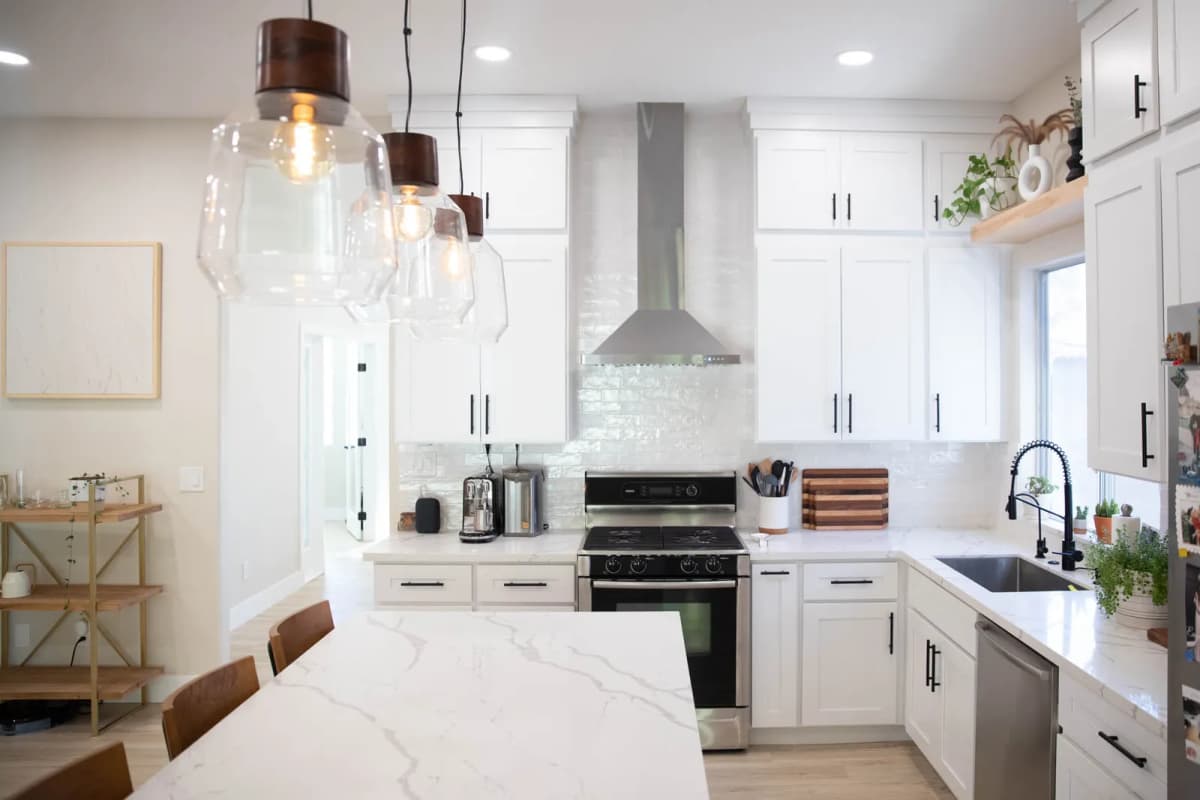
Maple takes paint exceptionally well because of its tight, even grain, which is why it is the standard choice for painted custom cabinetry. The doors are a classic shaker profile with matte black bar pulls. All 32 linear feet run floor to ceiling, with a stacked row of uppers above the main uppers, and every door and drawer has soft-close hinges and drawer glides. Custom boxes let us use every inch of the room instead of filling gaps with fillers and soffits.
Countertops: Calacatta-pattern quartz, 3 cm, with a waterfall edge on the island
Marble-look quartz gives the veining of Calacatta marble without the etching and staining that real marble suffers in a working kitchen. Quartz is non-porous and never needs sealing — a real advantage in Boise, where the water is moderately hard on average and hard to very hard in some zones. The waterfall edge carries the slab down the visible end of the island to the floor, which finishes the island like a piece of furniture and protects the end panel from kicks and chair scuffs.
Backsplash: White 3x6 subway tile
A glazed white subway tile behind the range and along the perimeter. It reflects light, wipes clean, and never fights the quartz for attention.
Flooring: Wire-brushed hickory engineered hardwood
Engineered hardwood is more dimensionally stable than solid plank in Boise's dry climate, and hickory is one of the hardest domestic species — a good match for a kitchen that gets daily use. The light, wire-brushed finish hides wear and keeps the room bright.
Range wall: Gas range with a stainless chimney hood, vented outside
A chimney-style hood mounted between the stacked uppers, ducted to the exterior. Exterior venting matters more in an open plan, because cooking smoke and grease no longer stay in a closed kitchen — they travel to the living room.
Fixtures and appliances
A Delta Trinsic pull-down faucet in matte black at the cleanup sink, a GE Profile appliance package (range, refrigerator, dishwasher, and microwave), Kichler glass pendants over the island, recessed lighting throughout, and under-cabinet LED task lighting on the perimeter runs. Our kitchen materials guide covers how we weigh these selections for Boise homes.
The Build: Two Weeks On Site
On-site construction for this project ran two weeks. That is possible only because everything that could be decided, engineered, permitted, ordered, and staged had been handled before the first cabinet came off the wall. Here is how the on-site phases unfolded.
Demolition. Existing cabinets, counters, and flooring came out, and the load-bearing wall was removed with temporary supports in place. Sealing the work area off from the rest of the house with plastic barriers keeps demolition dust contained.
Structural and rough-in. The LVL beam was set on its posts, new electrical circuits were run — including dedicated circuits for the new appliances — the plumbing was relocated for the new sink and dishwasher position, and the subfloor was prepped for the new flooring. The City of Boise inspects framing, electrical, and plumbing rough-in before anything is covered.
Cabinet and countertop install. With drywall closed and painted, the custom cabinets were set and leveled. The quartz was templated off the installed cabinets, fabricated, and installed, including the mitered waterfall panel on the island.
Tile, fixtures, and finish. Backsplash tile, the faucet and sink hookup, appliance connections, pendant and under-cabinet lighting, trim, and touch-up paint.
Final walkthrough. Punch list, cleaning, and a walkthrough with the homeowners and our project manager.
Most families stay in the home through a build this short. Two weeks without a kitchen is manageable with a microwave, a kettle, and a temporary setup in another room — our guide to living at home during a remodel covers how to set that up before demolition day rather than during it.
The Reveal: Before and After
The contrast is easiest to see in the numbers, but the numbers only tell part of it.
Before: A closed-off 1990s L-shaped kitchen with oak cabinets, a small oak island, dated speckled countertops, limited storage, a single fluorescent box light, and a load-bearing partial wall with only a cased opening to the living room. One cook at a time, working with their back to the rest of the house.
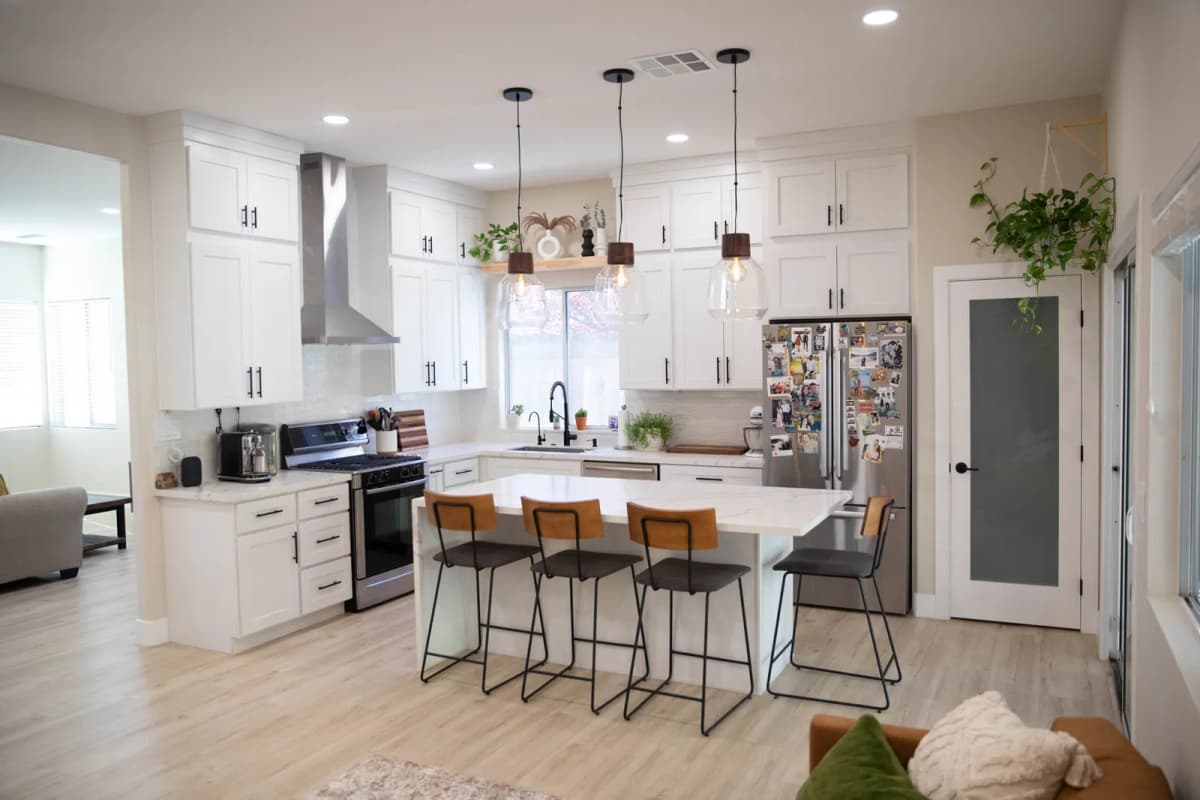
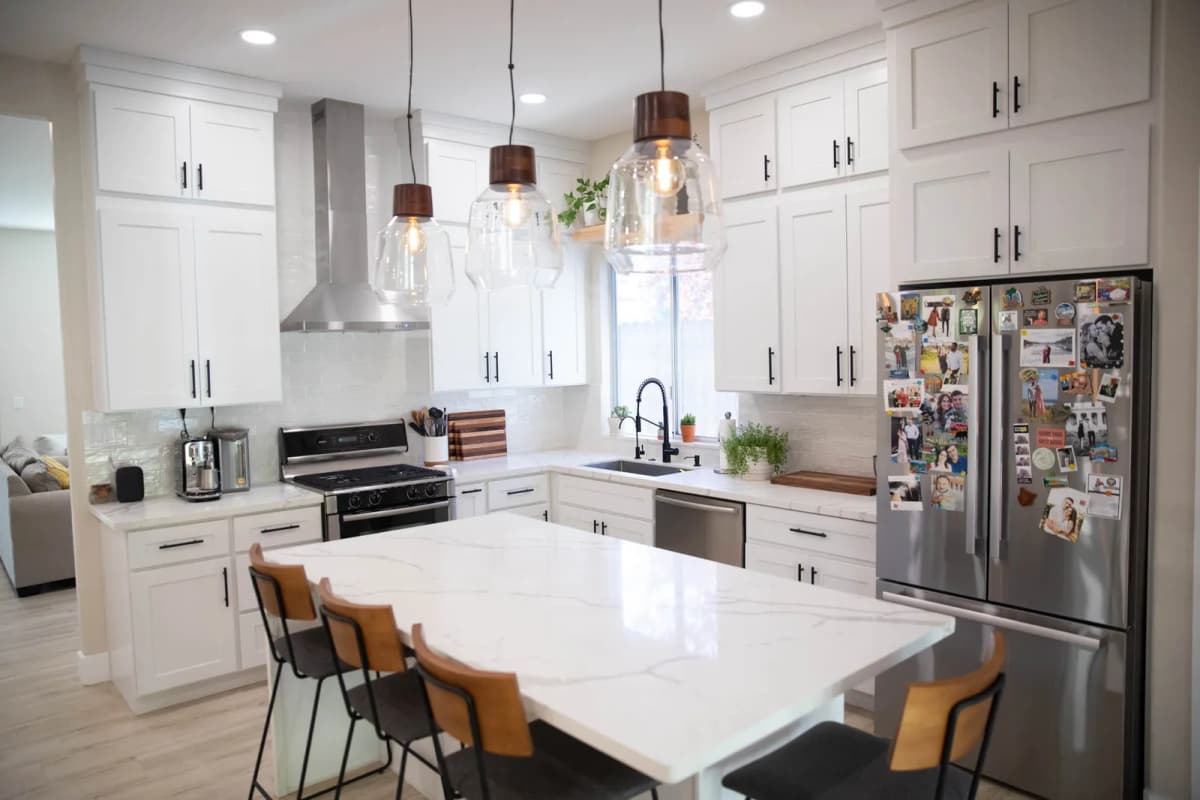
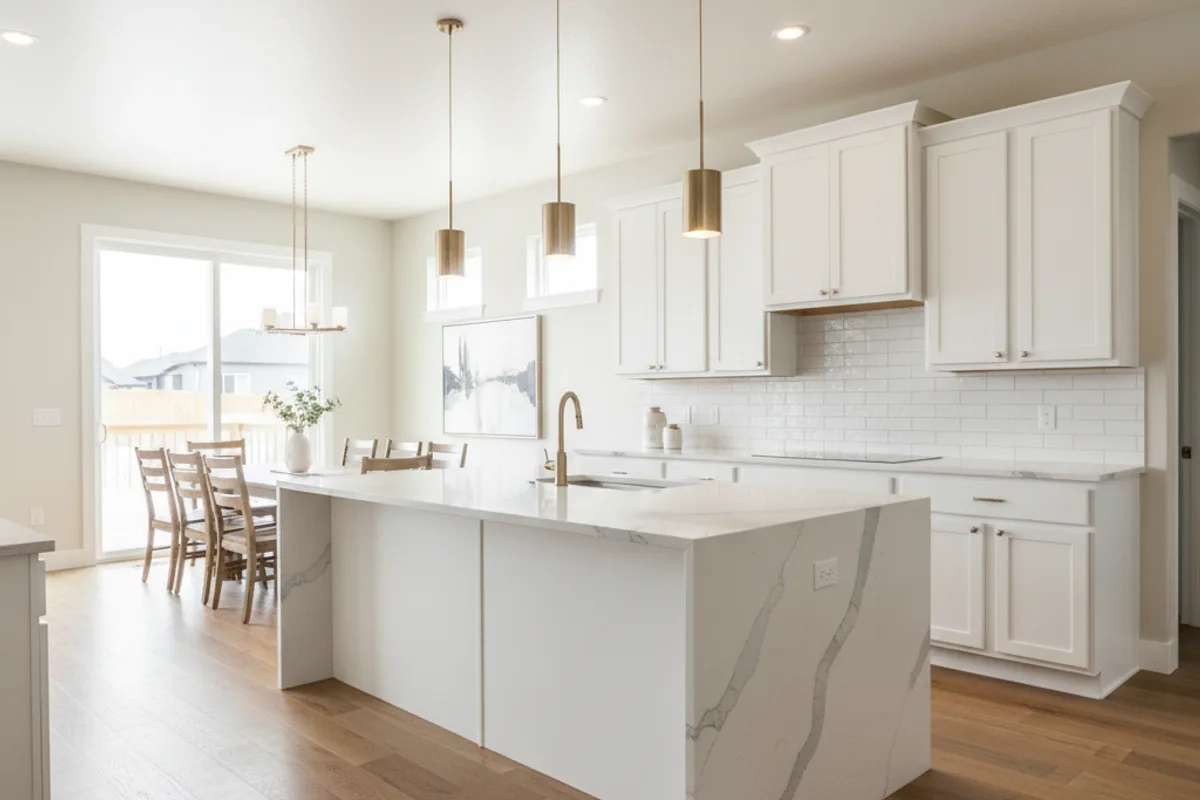
After: An open-plan kitchen connected to the dining and living areas, anchored by a 9-foot by 4-foot quartz island with seating for four. Custom maple shaker cabinets in painted white running 32 linear feet from floor to ceiling. A dedicated prep zone and a separate cleanup zone at the sink. New plumbing and electrical throughout, with dedicated circuits for every major appliance. The result: 40% more counter space and double the cabinet storage inside the same 185-square-foot footprint.
Walk in from the living room now and the kitchen is simply part of the main floor. An island like this becomes the breakfast table, the homework station while dinner is cooking, and the place guests end up during a party. The homeowners report that the kitchen has become the center of their daily life and their hosting — exactly the transformation they set out to get.
That is the real measure of a remodel. Not whether it photographs well (it does), but whether it changes how the family uses the house every day.
What It Cost and What to Take From It
This project was budgeted at $45,000–$55,000 for a 185-square-foot kitchen. For context, Boise kitchen remodels generally fall into three tiers:
- Cosmetic update ($22,000–$38,000): new counters, backsplash, paint, fixtures, and often cabinet painting or stock replacement, with the layout left alone
- Mid-range remodel ($45,000–$70,000): new cabinetry, quartz counters, updated plumbing and electrical, and layout changes — this project sits at the lower end of this tier
- High-end remodel ($85,000–$145,000): full custom cabinetry, premium stone, appliance packages at the top of the market, and significant structural work or additions
What put this project in the mid-range tier rather than the cosmetic tier was the combination of a structural wall removal with an engineered beam, 32 linear feet of custom floor-to-ceiling cabinetry, quartz with a waterfall edge, and a full plumbing and electrical update with dedicated circuits. What kept it from climbing higher was discipline in selections: a classic painted shaker rather than exotic veneers, quartz rather than natural quartzite, and a GE Profile appliance package rather than a luxury suite. Our Boise kitchen remodel cost guide breaks down where the money goes in each tier.
Lessons worth taking to your own project:
1. Engineer the structural work first. The beam design drives the permit, the framing, and the ceiling detail. Getting the stamped calculations done before anything else is ordered means no structural surprises during the build.
2. Do not let anyone demolish your kitchen before the cabinets are on a truck. The single biggest factor in how long you live without a kitchen is when demolition starts relative to cabinet delivery. Two weeks on site is achievable; it just requires patience up front.
3. In a 1990s home, plan a modest contingency. A house from 1997 will not hide knob-and-tube wiring or asbestos tile, but you should still carry about 10% for the things that only show up once walls are open — rerouted ducts, a subfloor that needs attention, a plumbing run that has to move farther than expected.
4. Go to the ceiling. If your uppers stop short of the ceiling, the space above them is the cheapest storage you will ever add. Custom or semi-custom boxes sized to the room can double usable cabinet space without touching the footprint.
5. Design zones, not just a layout. A separate prep zone and cleanup zone is what lets two people cook together. It is a planning decision, not a cost decision, and it is the difference between an open kitchen that works and one that only looks open.
If your North End, Bench, or Boise-area kitchen is a corridor walled off from the rest of the house, let's talk about what's possible. Every project starts with the same goal-ranking conversation this one did.
How much does a kitchen remodel cost in Boise's North End?
Boise kitchen remodels typically run $22,000–$38,000 for a cosmetic update, $45,000–$70,000 for a mid-range remodel with new cabinetry and layout changes, and $85,000–$145,000 for a high-end remodel with full custom cabinetry and major structural work. The North End project featured in this article was a mid-range remodel budgeted at $45,000–$55,000 for a 185-square-foot kitchen, including a load-bearing wall removal, custom floor-to-ceiling cabinets, quartz countertops, and a full plumbing and electrical update. Homes built before 1970 should carry a 15–20% contingency for discovery items; a 1990s home like this one usually needs about 10%.
Can you remove a load-bearing wall in a Boise home?
Yes. The wall's load is transferred to a beam (typically LVL or steel) supported by engineered posts that carry the weight down to the foundation. A licensed structural engineer must design the beam and connections — expect $2,000–$4,000 for engineering. The beam and installation typically cost $6,000–$12,000 depending on span length and what is inside the wall. Inside Boise city limits, the work requires a building permit from the City of Boise Planning & Development Services and a framing inspection before the opening is closed up.
Why does Iron Crest wait to start demolition until the cabinets are ordered?
Custom cabinetry typically has an 8–12 week lead time, and it is the longest single wait in most kitchen projects. If demolition starts before the cabinets are built, the family lives in a gutted kitchen for that entire wait. By finishing design, engineering, permitting, and ordering first, and only starting demolition once cabinets and appliances are confirmed en route, on-site construction can be compressed to about two weeks — as it was on this North End project.
How long does a full kitchen remodel take in Boise?
On-site construction typically takes 1–2 weeks, and often just 5–6 days, because Iron Crest does not begin demolition until cabinets and appliances are confirmed en route. Design, permitting, and cabinet lead time (8–12 weeks for custom cabinetry) happen before the crew arrives, so plan on roughly 3–4 months from first meeting to finished kitchen. This North End project ran two weeks on site.
What permits does a kitchen remodel with a wall removal need in Boise?
Inside Boise city limits, the City of Boise Planning & Development Services (PDS) issues the building permit for structural work such as a load-bearing wall removal, along with the electrical and plumbing permits for new circuits and relocated plumbing. The building permit application includes the structural engineer's stamped beam design. The city inspects framing, electrical, and plumbing rough-in before drywall, and performs a final inspection at completion.
What is the best countertop for a Boise kitchen remodel?
Quartz is the most popular and practical countertop for Boise kitchens. It is non-porous (no sealing required), resists hard-water spotting, and is available in patterns that convincingly mimic marble and natural stone. Quartz costs $55–$100/SF installed in Boise. Natural quartzite is the premium choice ($60–$120/SF) for homeowners who want genuine stone. Avoid marble in kitchens unless you accept the maintenance — it etches and stains far more easily than quartz.
Can I stay in my home during a kitchen remodel in Boise?
Yes, most Boise homeowners stay in their homes during kitchen remodels. The key is setting up a temporary kitchen in advance — typically in a basement, garage, or spare room — with a microwave, electric kettle, mini-fridge, and basic prep supplies. Plan for more takeout than usual, especially during the first few days when demolition dust is highest. A good contractor will seal off the work area with plastic barriers and run HEPA air filtration to minimize disruption. Because on-site construction usually runs only 1–2 weeks, the disruption is short.
What should my contingency budget be for a kitchen remodel in an older Boise home?
For homes built before 1970 in Boise (common in the North End, Bench, Vista, and Morris Hill), carry a 15–20% contingency budget above the estimated project cost. Common discovery items include outdated wiring (knob-and-tube in pre-1950 homes or aluminum branch wiring from 1965–1975, $4,000–$15,000 to rewire), asbestos materials ($2,000–$6,000 for abatement), inadequate insulation, subfloor damage, and plumbing past its service life. For homes built after 1990, a 10% contingency is usually sufficient.