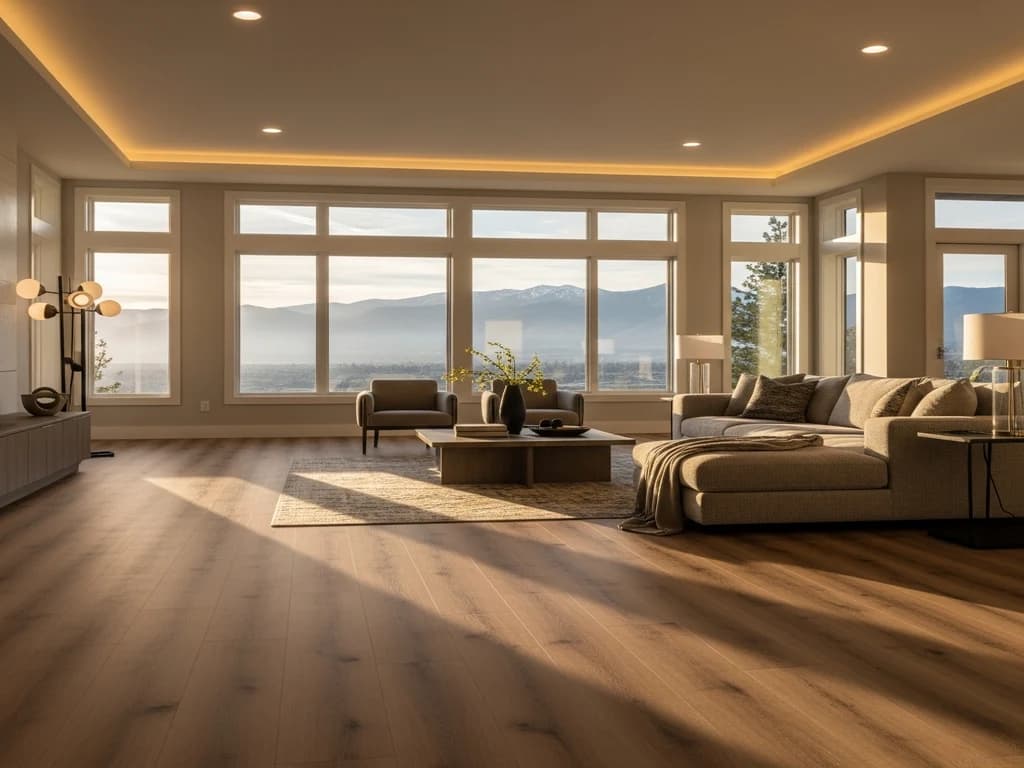
How Boise's Climate Affects Flooring Performance
Choosing flooring in Boise isn't the same as choosing flooring in Seattle, Phoenix, or Atlanta. The Treasure Valley's semi-arid high-desert climate creates a unique set of challenges and opportunities that directly impact which flooring materials thrive — and which ones fail prematurely.
Here's what makes Boise different:
Extremely low humidity: Boise's average indoor relative humidity drops to 15-25% during winter months when heating systems run constantly. This is dramatically drier than the 35-45% range most flooring manufacturers recommend. Low humidity causes natural wood to shrink, creating gaps between boards that are both unsightly and permanent if the wood has been dried past its elastic limit. It's the number-one reason solid hardwood floors develop problems in Boise homes.
Wide temperature swings: A typical January day in Boise can see temperatures range from 15 degrees at dawn to 42 degrees by afternoon. In summer, overnight lows of 58 can give way to 98-degree afternoons. These daily temperature fluctuations — especially in rooms with direct sun exposure — cause flooring materials to expand and contract repeatedly. Materials with poor dimensional stability buckle, gap, or telegraph joint lines through the surface.
Intense UV exposure: Boise averages 206 sunny days per year, and at our elevation (2,730 feet), UV radiation is roughly 8% stronger than at sea level. South-facing rooms in neighborhoods like Harris Ranch, the Highlands, and Southeast Boise with large windows take a beating. UV exposure fades and degrades some flooring materials — particularly lower-grade laminates and certain hardwood species — faster than the manufacturer's warranty suggests.
Seasonal moisture events: While Boise is dry overall, spring snowmelt and occasional heavy rainstorms create periodic moisture challenges. Homes in flood-adjacent areas near the Boise River (Garden City, Plantation Island, River Run) and homes with slab-on-grade foundations in the Bench and West Boise need flooring that handles occasional moisture intrusion without catastrophic failure.
These four factors — low humidity, temperature swings, UV intensity, and periodic moisture — form the framework for every flooring recommendation that follows. The best flooring for Boise homes isn't necessarily the "best" flooring nationally; it's the material that performs best under these specific conditions.

Luxury Vinyl Plank: Boise's Best-Selling Floor
Luxury Vinyl Plank (LVP) isn't just popular in Boise — it's dominant. At IronCrest, LVP accounts for roughly 55% of all flooring we install across the Treasure Valley, and for good reason. It addresses every single climate challenge listed above while delivering aesthetics that rival natural wood at a fraction of the cost.
Why LVP thrives in Boise:
- Dimensional stability: LVP is engineered from PVC core layers that are unaffected by humidity changes. While solid hardwood expands and contracts 3-5% across the grain with humidity shifts, rigid-core LVP moves less than 0.5%. In Boise's 15-25% winter humidity, this difference is enormous.
- 100% waterproof: The vinyl composition means LVP handles water exposure without damage — critical for kitchens, bathrooms, laundry rooms, and basements. If your Boise slab foundation has minor moisture transmission, LVP handles it without the mold risk of hardwood or the delamination risk of standard laminate.
- UV resistance: Quality LVP includes a UV-stabilized wear layer that resists fading. This matters in Boise's sunny south-facing rooms where lesser flooring materials fade noticeably within 2-3 years.
- Comfort underfoot: Rigid-core LVP with attached pad provides a warmer, softer feel than tile or hardwood — welcome in Boise's cold winters when stepping out of bed at 6 AM in January.
What to look for in LVP for Boise homes:
- Wear layer: Minimum 20 mil for residential, 28 mil for high-traffic homes with kids and dogs. Boise's active families — hiking boots, mountain bike shoes, and wet dog paws coming through the door year-round — demand durable wear layers.
- Core type: SPC (Stone Polymer Composite) core over WPC (Wood Polymer Composite). SPC is denser, more rigid, and handles temperature fluctuations better — important for Boise's wide daily temperature swings.
- Attached pad: Integrated IXPE or cork underlayment eliminates the need for separate underlayment and improves acoustics in open floor plans.
Top LVP brands installed in Boise:
- COREtec Plus: Premium SPC with patented cork-backed construction. $4.50-$7.00/SF material. The gold standard for Boise installations.
- Shaw Floorte Pro: Excellent commercial-grade durability at a mid-range price. $3.50-$5.50/SF. Strong warranty.
- MSI Everlife: Best value option with good performance. $2.50-$4.50/SF. Available at local Boise flooring distributors.
- Mohawk RevWood: Technically a laminate-LVP hybrid with excellent realistic wood visuals. $3.00-$5.00/SF.
LVP cost installed in Boise: $5.00-$12.00 per square foot including professional installation, removal of existing flooring, and base trim. A 1,500 SF home costs $7,500-$18,000 for full LVP installation. Explore our complete flooring installation cost guide for detailed pricing.
Solid Hardwood Flooring in Boise's Dry Climate
Solid hardwood is gorgeous, timeless, and — in Boise — demanding. That's not to say you shouldn't install it. Hardwood floors are the premium choice for homes in the North End, Warm Springs, Harrison Boulevard, and East End where period-appropriate aesthetics matter and home values justify the investment. But you need to go in with realistic expectations about maintenance in a semi-arid climate.
The humidity challenge: Solid hardwood flooring is milled from a single piece of timber, which means it responds directly to ambient moisture levels. The National Wood Flooring Association (NWFA) recommends maintaining indoor humidity between 35-55% for hardwood floor stability. Boise homes routinely drop to 15-25% in winter without active humidification. At these levels, hardwood boards shrink, creating visible gaps between planks that accumulate dust and debris.
Making hardwood work in Boise:
- Whole-home humidification is essential. An Aprilaire or Honeywell whole-home humidifier integrated into your HVAC system ($500-$1,500 installed) maintains 35-40% humidity year-round, protecting your hardwood investment. Portable humidifiers aren't sufficient for whole-home coverage.
- Species selection matters. Harder species with tighter grain resist gap formation better. White oak (Janka 1,360) is the best all-around choice for Boise — it's hard, stable, takes stain beautifully, and is available in both traditional and rift-sawn cuts. Hickory (Janka 1,820) is the most durable domestic species and hides the character marks that pets and active families inevitably create. Avoid softer species like pine, fir, or American cherry in high-traffic areas.
- Wider planks require more caution. Boards wider than 5 inches show more dramatic gapping in low humidity. If you want the wide-plank look (7"+), seriously consider engineered hardwood instead of solid.
- Finish choice: Matte and satin finishes are overtaking high-gloss in Boise's market. They show less scratching, hide minor imperfections, and are consistent with the Treasure Valley's relaxed, natural aesthetic. UV-cured factory finishes are more durable than site-applied polyurethane for Boise's intense sunlight.
Solid hardwood cost installed in Boise: $8.00-$16.00/SF for standard species, $14.00-$25.00/SF for premium wide-plank white oak or hickory with custom stain. A 1,200 SF hardwood installation typically runs $10,000-$20,000 for mid-grade and $18,000-$30,000 for premium.

Engineered Hardwood: The Smart Alternative
Engineered hardwood delivers the look and feel of real wood — because the top layer is real wood — while solving the dimensional stability problems that make solid hardwood temperamental in Boise's climate. For most Treasure Valley homeowners, engineered hardwood is the smarter choice.
How engineered hardwood works: Instead of a single solid piece of wood, engineered hardwood consists of a real hardwood veneer (2-6mm thick) bonded to multiple layers of plywood or HDF core material arranged in cross-grain orientation. This cross-grain construction resists expansion and contraction in all directions, making it 3-4 times more dimensionally stable than solid hardwood of the same species.
Why it's ideal for Boise:
- Humidity tolerance: Engineered hardwood handles Boise's 15-25% winter humidity without the severe gapping you see in solid hardwood. While a whole-home humidifier is still recommended, the consequences of fluctuation are far less visible.
- Installation versatility: Engineered can be installed over concrete slabs (common in Boise ranch homes and newer construction), over radiant heating systems, and in below-grade spaces like finished basements — all places where solid hardwood cannot safely go.
- Wide plank capability: Want 7-inch or 9-inch wide planks? Engineered hardwood handles wide formats without the cupping and bowing risks of solid wood in Boise's dry climate.
- Refinishing: Quality engineered hardwood with a 4mm+ wear layer can be sanded and refinished 1-2 times over its lifespan. This isn't as many refinishes as 3/4-inch solid wood (3-4 times), but it's enough for decades of performance.
Top engineered hardwood for Boise:
- Garrison Collection (European White Oak): Locally available through Boise flooring distributors. 6mm veneer, wide plank, wire-brushed textures. $7.00-$11.00/SF.
- Hallmark Floors (True Collection): Made in USA. Exceptional dimensional stability. $8.00-$14.00/SF.
- Shaw Repel (Engineered line): Water-resistant enhanced construction, good for kitchens and entries. $5.00-$9.00/SF.
Engineered hardwood cost installed in Boise: $7.00-$18.00/SF depending on species, plank width, and finish quality. A typical 1,500 SF main-level installation runs $10,500-$27,000. That's comparable to or slightly less than equivalent solid hardwood — but with dramatically better long-term performance in Boise's climate. For material selection guidance, see our flooring materials guide.
Tile Flooring for Boise Kitchens and Bathrooms
Tile remains the gold standard for Boise bathrooms, and it's making a strong comeback in kitchens thanks to large-format porcelain that mimics natural stone and wood with stunning realism. In a climate as dry and temperature-variable as Boise's, tile offers unmatched durability and zero moisture concerns.
Porcelain tile: The workhorse of Boise tile installations. Porcelain is denser and less porous than ceramic, with water absorption rates below 0.5%. This makes it virtually impervious to Boise's occasional freeze-thaw cycles in entryways and three-season porches. Large-format porcelain tiles (24x24, 24x48, and even 48x48) create expansive, grout-minimized surfaces that make rooms feel larger. Wood-look porcelain planks (6x36, 8x48) deliver the aesthetic of hardwood with the indestructibility of tile.
Ceramic tile: More affordable than porcelain but with higher porosity. Best limited to interior applications in Boise — not exterior or unheated spaces where temperature drops below freezing. Ceramic remains an excellent choice for bathroom walls, backsplashes, and low-traffic floor areas where budget is a priority.
Natural stone tile: Travertine, slate, and marble are installed in higher-end Boise homes, particularly in master bathrooms and entryways. Natural stone requires sealing (annually in Boise's hard-water environment) and is more susceptible to staining and etching than porcelain. The aesthetic is unmatched, though — a travertine bathroom floor in a Warm Springs or East End home feels appropriate and luxurious in a way no manufactured material can replicate.
Tile considerations specific to Boise:
- Radiant floor heating: Tile is the ideal pairing for in-floor radiant heating, which is increasingly popular in Boise bathroom and kitchen remodels. Tile's thermal conductivity means the heat reaches your feet efficiently. Electric radiant mats under tile add $6-$12/SF to the installation but transform cold Boise winter mornings.
- Boise's hard water: Our 12-17 grain-per-gallon water leaves mineral deposits on tile surfaces, especially in showers. Choose tiles with minimal texture in shower installations — heavily textured tiles trap mineral deposits in their crevices. For shower tile specifically, glass and glazed porcelain clean most easily.
- Grout maintenance: Epoxy grout (SpectraLOCK, Kerapoxy) costs more upfront but is virtually maintenance-free and doesn't stain or absorb hard-water deposits. Standard cement grout requires sealing every 1-2 years in Boise's water conditions.
Tile cost installed in Boise: Ceramic: $6.00-$12.00/SF. Porcelain: $8.00-$18.00/SF. Natural stone: $12.00-$30.00/SF. Large-format installation adds a $1-$3/SF premium for the specialized tools and adhesives required. For design inspiration, visit our flooring design ideas gallery.

Carpet: Where It Still Makes Sense in Boise Homes
Carpet has lost market share in Boise's remodeling market — particularly on main floors — but it remains the best choice for specific applications. The key is knowing where carpet excels rather than treating it as a whole-home default.
Where carpet still wins in Boise:
- Bedrooms: Warmth, sound dampening, and comfort underfoot make carpet the preferred bedroom flooring in most of the Boise homes we remodel. Stepping onto warm carpet on a 12-degree January morning beats even heated tile. Bedrooms also don't face the moisture and traffic challenges that disqualify carpet elsewhere.
- Basement rec rooms: Carpet over quality pad provides insulation and comfort on concrete slab — common in Boise's below-grade finished basements. Choose synthetic fibers (nylon or polyester) that resist mold if minor moisture intrusion occurs.
- Stairs: Carpet on stairs provides safety traction and noise reduction that hard surfaces can't match, especially in two-story Boise homes where stairways are open to living areas.
- Home offices: Sound absorption and comfort for standing desks make carpet a practical choice for the work-from-home offices that Boise's tech-sector growth has made ubiquitous.
Best carpet types for Boise:
- Nylon (Solution-dyed): The premium choice. Solution-dyed nylon resists fading from Boise's intense sunlight better than any other fiber. Brands: Shaw Anso, Mohawk SmartStrand. $3.50-$7.00/SF.
- PET Polyester: Naturally stain-resistant, soft, and available from recycled content. Less resilient than nylon (matting in high-traffic areas) but excellent value. $2.00-$4.50/SF.
- Wool: Premium natural fiber with excellent feel, durability, and natural soil resistance. Performs well in Boise's dry climate. $8.00-$15.00/SF. Best for formal living rooms and primary bedrooms in higher-end homes.
Carpet's enemies in Boise: Boise households tend to be hard on carpet. Trail dirt from hiking the Foothills Ridge to Rivers trail, sand from Boise River beaches, pet hair from Idaho's dog-loving culture, and the general outdoor-active lifestyle mean carpet in entryways, living rooms, and kitchens faces an uphill battle. This is why most Boise homeowners are choosing hard-surface flooring on the main level and reserving carpet for bedrooms and upstairs.
Carpet cost installed in Boise: $3.00-$10.00/SF including quality pad and professional installation. A typical 600 SF bedroom-level carpet installation runs $2,000-$6,000.
Cork and Bamboo: Sustainable Alternatives
For Boise homeowners who prioritize sustainability, cork and bamboo offer genuinely eco-friendly flooring options that perform well in our climate — with some important caveats.
Cork flooring:
Cork is harvested from the bark of the cork oak tree without cutting the tree down, making it one of the most renewable flooring materials available. The bark regrows every 9-12 years, and a single tree can be harvested over 200 years. Beyond sustainability, cork offers properties that are uniquely valuable in Boise homes:
- Thermal insulation: Cork's cellular structure contains millions of air pockets that provide natural insulation — R-value of approximately 1.125 per inch. This helps keep feet warm on cold Boise mornings without radiant heating.
- Acoustic dampening: Cork absorbs sound, making it ideal for multi-story Boise homes where footfall noise between floors is a concern.
- Cushioned comfort: The springy surface reduces fatigue for standing activities — cooking, crafting, home office work — and is gentle on joints.
- Antimicrobial properties: Cork's natural waxy substance (suberin) resists mold, mildew, and allergens — a benefit in Boise's allergy season (April-June pollen peaks).
Cork's concern in Boise: UV fading. Direct sunlight fades cork faster than most flooring materials. Use UV-filtering window treatments in south-facing rooms, or choose pre-finished cork with UV-resistant coatings. Cork also requires resealing every 3-5 years in Boise's dry climate to prevent the surface from drying out.
Cork cost installed in Boise: $5.00-$10.00/SF for click-lock floating cork tiles. $7.00-$14.00/SF for glue-down cork with premium finish.
Bamboo flooring:
Bamboo reaches harvest maturity in 5-7 years versus 40-80 years for hardwood trees, making it one of the most rapidly renewable flooring resources. Strand-woven bamboo — where bamboo fibers are compressed under extreme heat and pressure — creates a flooring material that is harder than white oak (Janka rating of 3,000-5,000+ versus oak's 1,360).
- Hardness: Strand-woven bamboo is one of the hardest flooring materials available, resisting dents and scratches better than any domestic hardwood. Ideal for Boise homes with large dogs, active children, and high foot traffic.
- Moisture stability: Strand-woven bamboo handles Boise's humidity fluctuations better than solid hardwood, though not as well as engineered hardwood or LVP.
- Aesthetic range: Available in natural (blonde), carbonized (amber/caramel), and stained finishes. Tiger-strand patterns with natural color variation are popular in Boise's modern-rustic aesthetic.
Bamboo's concern in Boise: quality variation. Budget bamboo from unverified sources can contain high formaldehyde levels and delaminate in dry conditions. Purchase only from manufacturers who certify CARB Phase 2 (California Air Resources Board) compliance or better.
Bamboo cost installed in Boise: $5.00-$10.00/SF for strand-woven, $3.00-$6.00/SF for horizontal/vertical construction. Strand-woven is strongly recommended for Boise's conditions.

Flooring Cost Comparison for Boise Homeowners
Here's a side-by-side cost comparison of every flooring type discussed, using current Boise-area installed pricing. These figures include material, professional installation, removal of existing flooring, and base trim reinstallation.
| Flooring Type | Cost/SF Installed | 1,500 SF Estimate | Lifespan | Best For |
|---|---|---|---|---|
| LVP (Mid-grade) | $5.00-$8.00 | $7,500-$12,000 | 15-25 years | Whole home, families, pets |
| LVP (Premium) | $8.00-$12.00 | $12,000-$18,000 | 20-30 years | Whole home, high-end look |
| Engineered Hardwood | $7.00-$18.00 | $10,500-$27,000 | 25-50 years | Main floors, living areas |
| Solid Hardwood | $8.00-$25.00 | $12,000-$37,500 | 50-100 years | Historic homes, premium |
| Porcelain Tile | $8.00-$18.00 | $12,000-$27,000 | 50+ years | Bathrooms, kitchens, entries |
| Ceramic Tile | $6.00-$12.00 | $9,000-$18,000 | 40+ years | Bathrooms, budget tile |
| Carpet (Mid-grade) | $3.00-$7.00 | $4,500-$10,500 | 8-15 years | Bedrooms, basements |
| Carpet (Premium) | $7.00-$15.00 | $10,500-$22,500 | 15-25 years | Primary suites, formal rooms |
| Cork | $5.00-$14.00 | $7,500-$21,000 | 20-40 years | Offices, kitchens, eco-focus |
| Strand Bamboo | $5.00-$10.00 | $7,500-$15,000 | 25-50 years | High-traffic, eco-focus |
Cost-per-year analysis: When you divide the installed cost by the expected lifespan, the most economical Boise flooring choices shift. Premium LVP at $12/SF lasting 25 years costs $0.48/year/SF. Solid hardwood at $16/SF lasting 75 years costs $0.21/year/SF. Porcelain tile at $14/SF lasting 50+ years costs $0.28/year/SF. Short-lived carpet at $5/SF lasting 10 years costs $0.50/year/SF — making "cheap" carpet one of the most expensive long-term choices.
These numbers tell a clear story: invest in durable materials that match Boise's climate, and you'll spend less over the life of your home. The upfront cost difference between budget and premium options is almost always recovered through longevity and reduced replacement cycles.
Choosing Flooring by Room and Lifestyle
Instead of choosing one flooring type for your entire Boise home, the smartest approach is matching the flooring to each room's demands. Here's our recommended room-by-room strategy based on how Boise families actually live.
Main living areas (living room, family room, dining room):
This is where you spend the most visible time and where guests form their first impression. Best choices: engineered hardwood (premium look, Boise-climate friendly), premium LVP (maximum durability, pet-proof). If budget allows one premium flooring investment, put it here. Continuous flooring from entry through living areas creates a sense of spaciousness that's particularly effective in the open floor plans common in Meridian, Eagle, and Star subdivisions.
Kitchen:
Moisture resistance, drop resistance, and comfort for standing are the priorities. Best choices: LVP (waterproof, comfortable, easy to clean), porcelain tile (indestructible, works with radiant heat), cork (cushioned, antimicrobial). Avoid solid hardwood in kitchens — dishwasher leaks and sink splashes cause irreversible damage.
Bathrooms:
Waterproof and slip-resistant are non-negotiable. Best choices: porcelain tile (the standard for good reason), LVP (budget-friendly alternative). Natural stone for luxury primary baths. Never install hardwood or laminate in bathrooms — period. Our bathroom remodeling team coordinates flooring selection with overall bath design.
Bedrooms:
Comfort, warmth, and quiet are the priorities. Best choices: carpet (warmest, quietest, most comfortable), engineered hardwood with area rugs (versatile, upscale), cork (warm, quiet, hypoallergenic). Children's bedrooms benefit from stain-resistant carpet or LVP depending on age and activity level.
Basement:
Moisture management dominates the decision. Best choices: LVP (waterproof, installs over concrete), carpet tiles (replaceable sections if moisture event occurs), porcelain tile with radiant heat. Never install solid hardwood or standard laminate on below-grade concrete in Boise.
Entryway and mudroom:
This is where Boise's outdoor lifestyle meets your interior. Trail mud, snow, gravel, and wet boots need flooring that doesn't flinch. Best choices: porcelain tile (toughest option), slate (natural grip, hides dirt), LVP (durable, easy to clean). This is the one room where we actively discourage carpet, hardwood, and cork.
Home office:
Rolling desk chairs destroy most flooring over time. Best choices: LVP (handles chair castors well), commercial-grade carpet tile (replaceable), cork (cushioned for standing desks). If you have hardwood and a rolling chair, use a quality chair mat — it's worth the $50 to protect a $15,000 floor.
Installation Considerations for Boise Homes
Even the best flooring material can fail prematurely if it's installed improperly. Here are the installation factors that matter most in Boise's unique environment.
Acclimation: All flooring materials need to acclimate to your home's temperature and humidity before installation. In Boise, where indoor humidity can be 20% when flooring arrives from a 50% warehouse, acclimation is critical. LVP needs 48 hours minimum. Hardwood and engineered hardwood need 5-7 days. Bamboo needs 5-10 days. Skipping or shortening acclimation is the number-one cause of post-installation flooring problems in Boise. Any installer who proposes to install hardwood the day it's delivered doesn't understand our climate.
Subfloor preparation: Boise homes present three common subfloor scenarios:
- Concrete slab: Common in ranch homes across the Bench, West Boise, and newer construction. Must be moisture-tested before installation. A calcium chloride test or relative humidity test identifies slabs that are too wet for direct flooring installation. Moisture barriers are essential for hardwood and recommended for LVP.
- Plywood subfloor: Standard in two-story and crawlspace homes. Must be flat within 3/16" over 10 feet for LVP and hardwood. Older Boise homes (pre-1980) often have 1/2" plywood that needs reinforcement to 3/4" minimum before hardwood installation.
- Existing flooring: LVP can often install over existing vinyl, tile, or hardwood if the surface is flat and sound. This saves demolition costs ($1-$3/SF) but requires careful evaluation of the existing floor's condition.
Transitions between rooms: Thoughtful transitions between different flooring materials separate professional installations from DIY attempts. In open-concept Boise homes where kitchen tile meets living room hardwood, flush T-moldings or reducer strips must be precision-cut and properly secured. Color-matching transition strips are available from most premium flooring manufacturers.
Underlayment selection: The right underlayment is as important as the flooring itself. For Boise installations: use moisture-barrier underlayment over concrete slabs, acoustic underlayment in multi-story homes, and thermal underlayment in spaces over unheated crawlspaces. Premium LVP with attached pad doesn't need additional underlayment — adding it actually voids some warranties.
Seasonal installation timing: The ideal time to install flooring in Boise is spring (April-May) and fall (September-October) when indoor humidity and temperature are closest to year-round averages. Installing hardwood in January when humidity is 15% means the wood is at its smallest — it will expand in spring and potentially buckle. Installing in August when doors are open and humidity spikes means the wood is at its largest — it will shrink and gap in winter. Spring and fall split the difference.
Ready to choose the right flooring for your Boise home? Schedule a free in-home consultation where we'll assess your subfloor conditions, discuss your lifestyle needs, and provide material recommendations with transparent installed pricing. Our flooring installation team handles every step from material selection through final trim installation.

What is the best flooring for Boise's dry climate?
Luxury Vinyl Plank (LVP) with SPC core is the best overall flooring for Boise's dry climate. It's dimensionally stable in low humidity (15-25% in winter), 100% waterproof, UV-resistant, and comfortable underfoot. Engineered hardwood is the best premium alternative, offering real wood aesthetics with 3-4 times more dimensional stability than solid hardwood. Both materials handle Boise's wide temperature swings and dry air without gapping, buckling, or warping.
How much does flooring installation cost in Boise?
Flooring installation costs in Boise range from $3-$7/SF for carpet, $5-$12/SF for LVP, $7-$18/SF for engineered hardwood, $8-$25/SF for solid hardwood, and $6-$18/SF for tile. These are fully installed prices including material, labor, old flooring removal, and base trim. A 1,500 SF main-level flooring project typically costs $7,500-$18,000 for LVP, $10,500-$27,000 for engineered hardwood, or $12,000-$27,000 for porcelain tile.
Can you install solid hardwood flooring in Boise homes?
Yes, but it requires a whole-home humidification system ($500-$1,500) to maintain 35-40% indoor humidity year-round. Without active humidification, Boise's 15-25% winter humidity causes solid hardwood to shrink and develop visible gaps between boards. Choose dimensionally stable species like white oak or hickory, avoid planks wider than 5 inches, and select factory-applied UV-resistant finishes to combat Boise's intense sunlight.
Is LVP waterproof enough for Boise bathrooms?
Yes, quality SPC-core LVP is 100% waterproof and an excellent choice for Boise bathrooms. The vinyl and stone polymer construction will not absorb water, swell, or grow mold even with direct water exposure. However, water can seep through seams if the floor is submerged (flood scenario), so ensure proper seam locking during installation. For shower floors, tile remains the standard — LVP is for bathroom floor areas, not wet shower enclosures.
What flooring is best for Boise homes with dogs?
For Boise homes with dogs, we recommend: SPC-core LVP with a 28-mil wear layer (scratch-resistant, waterproof, easy to clean), strand-woven bamboo (hardest flooring option, resists claw marks), or textured porcelain tile (indestructible). Avoid solid hardwood softer than white oak, high-gloss finishes that show every scratch, and carpet in common areas. Wire-brushed or hand-scraped textures in any material help camouflage pet-related wear.
How long should flooring acclimate before installation in Boise?
In Boise's dry climate, acclimation periods are critical and should not be shortened. LVP needs 48 hours minimum in the installation room. Solid and engineered hardwood need 5-7 days. Bamboo needs 5-10 days. The flooring must reach equilibrium with your home's temperature and humidity before installation. An installer who offers same-day delivery and installation for hardwood doesn't understand Boise's climate conditions.
Is cork flooring a good choice for Boise?
Cork flooring works well in Boise for specific rooms — home offices, kitchens, and bedrooms — where its thermal insulation, acoustic dampening, and cushioned comfort shine. Cork's natural antimicrobial properties help during Boise's allergy season. However, cork fades in direct sunlight (a concern in Boise's 206 sunny days/year) and requires resealing every 3-5 years in our dry climate. Use UV-filtering window treatments in south-facing rooms with cork flooring.
What is the most durable flooring for Boise's active families?
For Boise families with kids, dogs, and an outdoor-active lifestyle, the most durable options are: porcelain tile (virtually indestructible, best for entries and kitchens), SPC-core LVP with 28-mil wear layer (best whole-home option, handles everything from muddy boots to spilled juice), and strand-woven bamboo (Janka 3,000+, harder than any hardwood). Choose textured or matte finishes that hide daily wear, and invest in quality doormats to manage the trail dirt that's inevitable in Boise homes.